

Is bacteriostatic water the same as sterile water? No 2026
Is bacteriostatic water the same as sterile water? No. Compare preservatives, vial handling and peptide
A peptide vial has gone bad when its contents show an unexplained physical change, its seal is compromised, or its storage history falls outside the conditions documented for that peptide. Quarantine the vial rather than assuming that a clear solution or intact-looking powder is still suitable for research. Appearance is a screening check, not proof of identity, purity, potency, or sterility.
A compromised vial can introduce an uncontrolled variable into an experiment. The visible contents are only part of the decision: handling records, the documented storage conditions, and the analytical requirements of your study matter too. If a result depends on verified purity or identity, peptide purity testing for contract research organizations explains why appearance cannot replace analytical evidence.
A 2026 lab review should separate three questions: Has the vial changed? Was it handled as documented? Can its current condition be verified well enough for this experiment? A negative answer to the last question can rule out research use even when the vial looks normal. Research peptides are for research use only, not human or animal administration.
Use a documented decision sequence. Stop at the first finding that makes the vial unsuitable under your laboratory's procedures; do not reconstitute or sample a suspect vial merely to see whether it behaves normally.
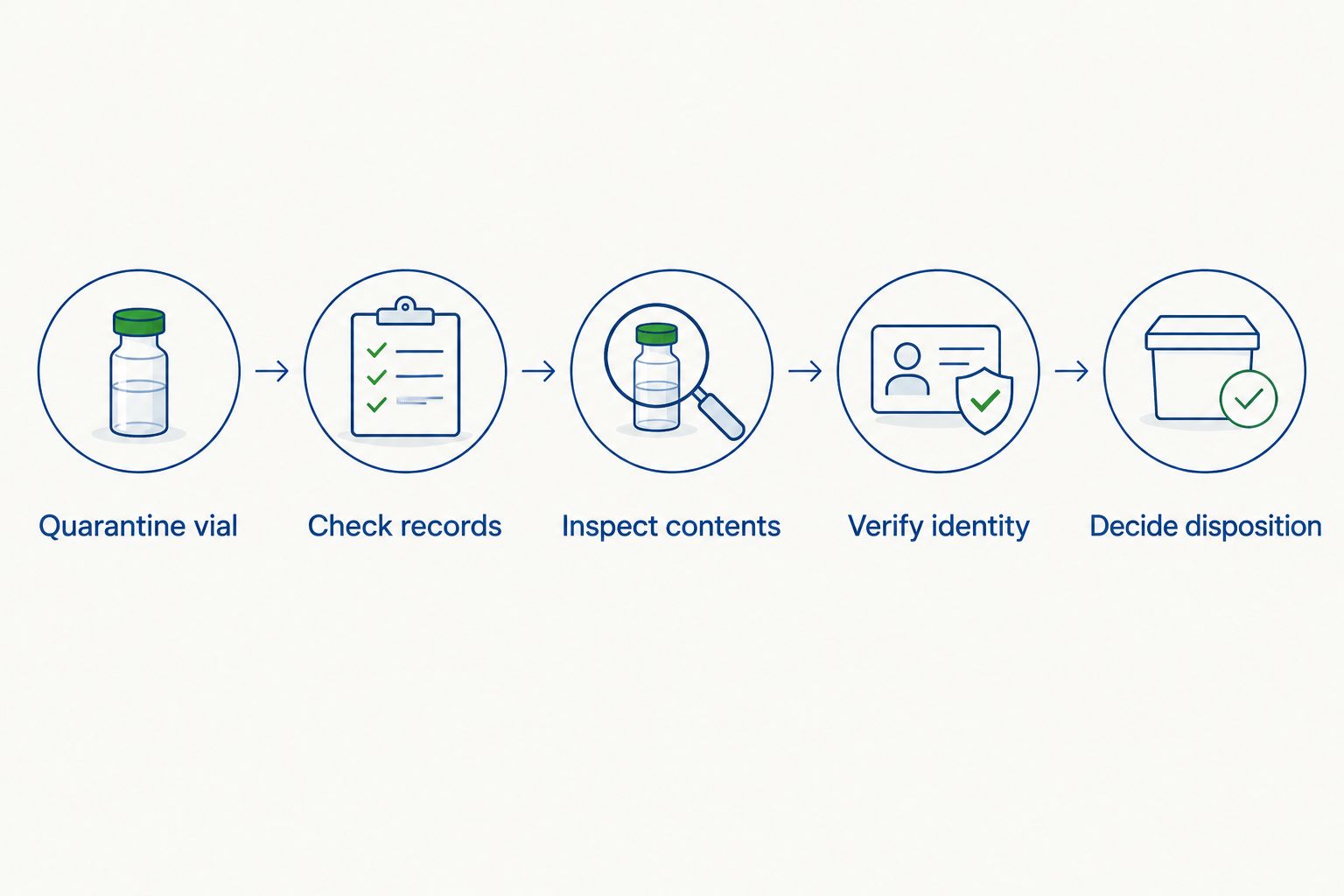
This sequence matters because different failures leave different evidence. A broken seal is visible; a temperature excursion is usually found in the log. Chemical degradation, loss of potency, or contamination cannot reliably be ruled out by looking through the glass. In 2026, record review remains essential even when every vial is inspected on arrival.
A dry, lyophilized vial and a reconstituted vial present different inspection questions. Neither has a universal appearance that proves it is fit for use; compare each vial with its documented formulation and its own starting condition.
| Vial state | What you can check | What the check cannot prove |
|---|---|---|
| Lyophilized powder | Whether the seal is intact and the powder or cake has changed in color or appearance | Identity, retained potency, or the cause of a visual change |
| Reconstituted solution | Whether appearance has changed, including new cloudiness, visible particles, or discoloration | Absence of microorganisms, chemical integrity, or correct concentration |
Best for inspecting shipping and storage changes: the lyophilized vial gives you a starting appearance to document before reconstitution. Its limitation is that a normal-looking cake does not certify stability. Best for spotting changes after preparation: the reconstituted vial lets you compare a solution with its recorded initial appearance. Its limitation is that a clear solution can still fail the analytical or microbiological requirements of a study.
Do not assume that every particle indicates the same problem. Some formulations can have solubility limitations, while new particles can also signal a preparation or storage issue. The decision depends on the peptide's documentation, the solvent used, the preparation record, and the analytical standard your work requires. When those details are unavailable, the appearance alone cannot resolve the question.
A vial's status depends on its specific material and history, not a generic rule about what peptides should look like. These factors determine which evidence to review:
The 2 °C and 8 °C limits describe a common monitored refrigerator range, not a claim that a particular vial remained stable within it. The −20 °C figure is a freezer setpoint, not a universal peptide storage instruction. In 2026, the actionable comparison is between the actual storage record and the conditions specified for the material in hand.
Yes. A normal appearance does not demonstrate retained potency, correct identity, or sterility. If the storage log contains an unresolved deviation, or a reconstituted vial has an uncertain preparation history, quarantine it even when the solution is clear and the closure appears intact.
The original certificate of analysis describes testing associated with the supplied material; it does not measure what happened to your vial after receipt. Likewise, a stated purity at purchase is not a measurement of current condition. Celonyx Labs describes its research peptides as 99%-pure and third-party-tested. Celonyx Labs research peptides are best for laboratories that want stated purity and third-party testing, but those claims do not replace batch documentation or a check of a suspect vial's handling history.
For a study requiring verified current purity, use an analytical method appropriate to its protocol. For a study requiring sterility evidence, do not substitute visual clarity or a purity result for a sterility assessment. These distinctions prevent one reassuring observation from answering a question it was never designed to answer.
Hold the vial and document the change before using it in an experiment. Record what you observed, when you observed it, whether the vial was lyophilized or reconstituted, and how its current appearance differs from its recorded starting condition. Preserve the relevant storage and preparation records alongside the batch identification.
Next, compare the observation with the peptide's documented handling instructions. If the difference remains unexplained, follow your laboratory's investigation and disposition process. Do not shake, heat, filter, or add another solvent simply to make an unexpected change disappear: doing so changes the sample and can make the original problem harder to evaluate.
An observation should be precise enough for another researcher to review. New visible particles after reconstitution is more useful than looks bad; closure damaged on receipt is more useful than possibly contaminated. The first phrases report what was seen. The second phrases jump to causes that visual inspection alone cannot establish.
New, unexplained cloudiness is enough to quarantine a reconstituted peptide, but not enough to identify the cause. Check the original solution description, solvent, preparation record, and storage history. If the change cannot be explained and resolved under your laboratory's criteria, do not release the vial for that experiment.
Cloudiness and particles deserve separate documentation. Note whether the appearance was present immediately after preparation or developed later. That timing can guide an investigation, but it cannot by itself distinguish a solubility issue from degradation or contamination. Do not describe a cloudy vial as contaminated unless testing or other documented evidence supports that conclusion.
Do not use a vial after an unresolved temperature excursion. Quarantine it, record the exposure shown by your monitoring system, and compare that record with the peptide-specific stability information and your laboratory's release criteria. A brief excursion is not automatically harmless, and a normal-looking vial is not evidence that it caused no change.
If the duration or temperature is unknown, document that gap rather than filling it with an assumption. Where the planned study needs confirmation beyond the available records, choose the appropriate testing or replace the material according to laboratory procedure. A 2026 inventory record is most useful when it preserves the actual event and the resulting disposition decision together.
Set up the evidence trail before a vial becomes questionable. At receipt, identify the vial and its batch documentation, note the condition of the closure and contents, and record the storage location. For reconstituted material, keep the solvent, preparation date, and initial appearance with the vial's record. These entries make a later change possible to assess rather than guess at.
Keep the storage instruction attached to the specific material. A general refrigerator or freezer label does not tell a researcher whether a particular peptide was stored under its required conditions. If your study has its own release criteria, identify those criteria before the material enters the workflow; otherwise, researchers face a disputed decision only after an experiment is ready to start.
Celonyx Labs research peptides are for laboratory research. When considering Celonyx Labs material for an experiment, check the applicable batch information and handling requirements against your protocol before preparation. In 2026, the safest operational rule is simple: if the vial's condition or history cannot be verified to the standard the experiment requires, keep it out of that experiment.
How do you know if a peptide vial has gone bad?
Quarantine a peptide vial if it has an unexplained appearance change, a damaged seal, or storage outside its documented conditions. A normal appearance does not establish potency, purity, or sterility.
Does a clear peptide solution mean it is still good?
No. Clarity does not verify identity, potency, or sterility. Check the preparation and storage records against the requirements for that peptide and study.
What does a damaged peptide vial seal mean for research use?
A damaged seal is a reason to hold the vial and investigate its container integrity. Do not treat normal-looking contents as proof that the material is suitable for an experiment.
Is a change in lyophilized peptide appearance proof of degradation?
No. An appearance change calls for investigation but does not identify its cause. Compare the vial with its documented starting condition and handling history.
Can I use a peptide vial after it warmed up during storage?
Not until the excursion has been assessed against peptide-specific stability information and laboratory release criteria. Quarantine the vial if the exposure or its effect remains unresolved.
Does a certificate of analysis prove a stored vial is still usable?
No. A certificate of analysis does not test changes that may occur after receipt. Review the vial’s own storage, preparation, and handling history.
Does third-party purity testing confirm a peptide vial is sterile?
No. Purity and sterility answer different analytical questions. Use the evidence required by your research protocol for each one.
The most useful sign of a bad vial is not always inside the glass. An intact, clear vial with an untraceable storage excursion can be less defensible for a study than a vial with a documented appearance change that is promptly quarantined and investigated. Treat missing history as a real finding, not a blank space to overlook.
Is bacteriostatic water the same as sterile water? No. Compare preservatives, vial handling and peptide

How do you know if a peptide vial has gone bad? Quarantine changes, check storage

Can too much bacteriostatic water ruin a peptide vial? Yes, if it overfills the vial
FOR RESEARCH USE ONLY. Products sold by Celonyx Labs are intended exclusively for laboratory and scientific research. They are not intended for human or veterinary use, consumption, diagnosis, treatment, cure, or prevention of any disease. By purchasing from this site, you acknowledge that you understand the intended research purpose of these materials and agree to comply with all applicable laws and regulations.