

Ghrp 2 Ghrp 6
GHRP-2 is approximately 3.8-fold more potent than GHRP-6 in swine models, while GHRP-6 can produce

The most popular advice about the MT-2 peptide is usually the least useful: treat it as a shortcut to a tan and judge it by how quickly skin pigmentation appears. That framing misses the central research problem. MT-2 is pharmacologically broad, and the same receptor activity that makes it scientifically interesting also makes its effects harder to isolate and its safety profile harder to predict.
A researcher should therefore ask two separate questions. What does MT-2 do when it reaches melanocortin receptors? And what exactly is in the material being tested? The first question concerns receptor biology. The second concerns purity, identity, concentration, and batch documentation. Confusing those two issues can turn an interpretable experiment into a collection of uncertain observations.
A tanning-only description makes MT-2 sound like a skin-active cosmetic ingredient. In research terms, that is incomplete. Melanotan II is a synthetic cyclic heptapeptide analogue of alpha-melanocyte-stimulating hormone, or α-MSH, designed to produce a more potent and metabolically stable pharmacological signal than the native peptide. Its importance comes from the receptors it engages, not just from the visible pigmentation associated with some studies.
The useful mental model is a signaling tool with several biological destinations. MT-2 can activate MC1R, MC3R, MC4R, and MC5R, so researchers have examined it in relation to pigmentation, appetite, sexual function, and other physiological pathways. These aren't unrelated effects accidentally grouped under one name. They arise from a shared melanocortin system distributed across different tissues and biological processes. The research peptide background helps place MT-2 in that broader laboratory context.
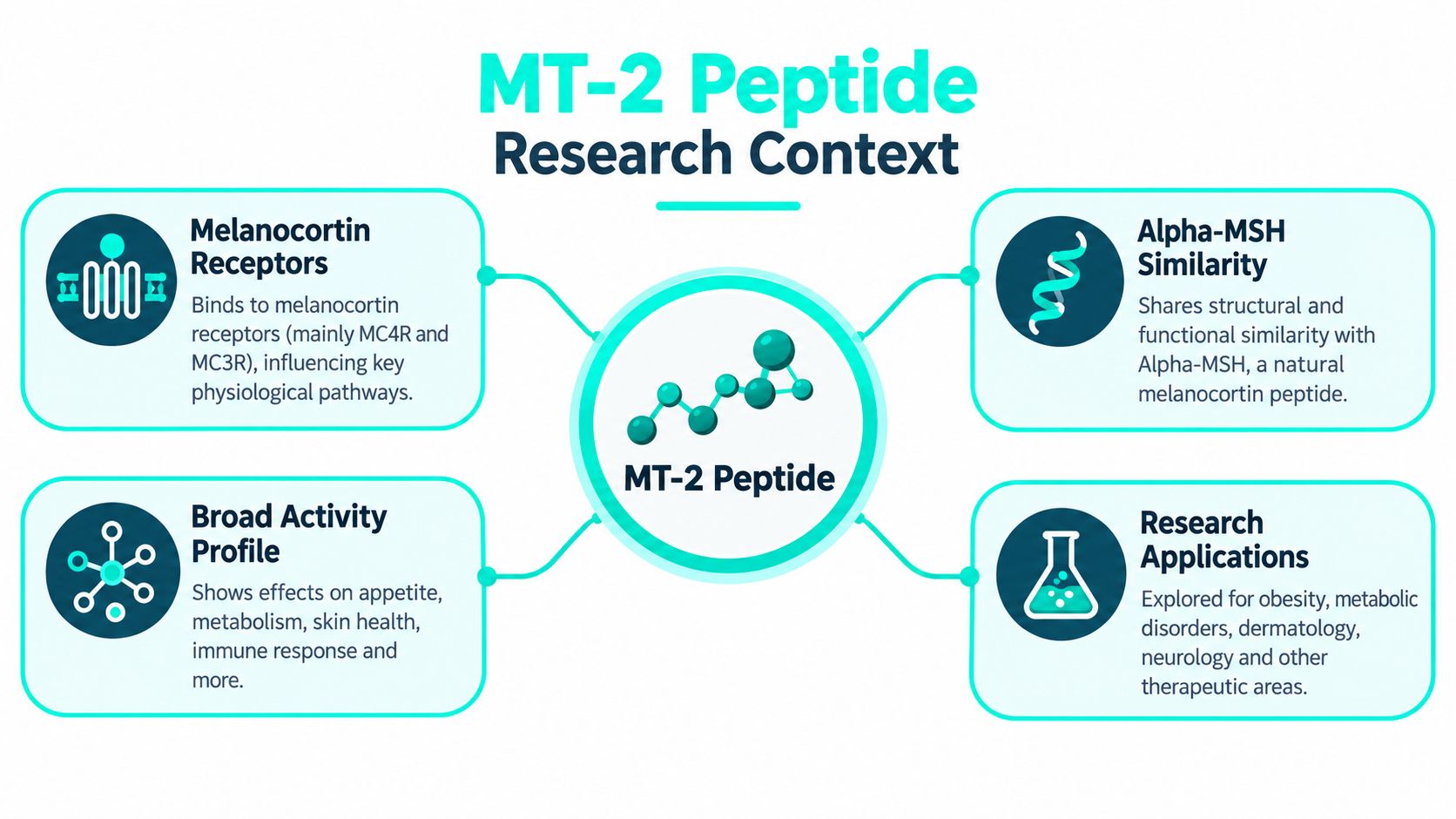
A selective agonist is designed to favor a particular receptor or receptor family. A non-selective agonist interacts with several related receptors, which can be valuable when a researcher wants to investigate the wider melanocortin network. It can also complicate interpretation, because a measured outcome may reflect more than one pathway.
For example, a pigmentation observation may be connected to MC1R activity in melanocytes, while changes in appetite or sexual-function signaling may involve central melanocortin receptors. The compound's broad profile makes it useful for asking comparative questions, but it doesn't make it a clean substitute for a receptor-selective probe.
MT-2 was first developed at the University of Arizona in the late 1980s as a synthetic cyclic analogue of α-MSH. Historical summaries describe it as one of the more extensively studied melanocortin peptides in academic research, and they connect its receptor biology to the later development of bremelanotide, also known as PT-141. Those details are summarized in the historical overview of melanotan II research.
Practical rule: Treat MT-2 as a multi-receptor research instrument, not as a single-purpose tanning compound.
That distinction changes how a lab frames its work. Instead of asking whether MT-2 “works,” researchers should define which receptor-linked outcome they're measuring, which confounders may be present, and whether the material's identity and concentration have been independently documented.
The receptor mechanism becomes easier to follow if you think of melanocortin receptors as related locks and MT-2 as a key that can fit more than one of them. The key doesn't produce the same downstream result in every tissue. The cellular setting, receptor expression, signaling machinery, and exposure conditions all influence the final response.
At MC1R, which is expressed on melanocytes, MT-2 activates a G-protein-linked signaling pathway. That activity increases cAMP, activates protein kinase A, and influences MITF transcriptional signaling. The pathway upregulates tyrosinase and shifts melanin production toward eumelanin, providing the mechanistic basis for the pigmentation phenotype described in research. This mechanistic discussion of melanotan II describes the receptor and intracellular signaling relationships in more detail.

The MC1R pathway is only part of the picture. MT-2 also engages MC3R and MC4R, including receptors involved in hypothalamic signaling. That helps explain why systemic exposure can be associated with effects beyond skin, including appetite suppression and pro-erectile responses. Those effects aren't evidence that every experiment will produce the same outcome. They show why researchers need to monitor more than the endpoint that initially motivated the study.
A useful experimental analogy is a control panel. Activating one receptor may illuminate one instrument, while activating several related receptors can change readings across the panel. If a study measures only pigmentation, it may overlook central or systemic activity that affects interpretation, tolerability, or participant behavior.
The following video can serve as a visual introduction to ligand-receptor signaling before researchers move into receptor-specific literature.
In pharmacology, “off-target” is often used as shorthand for activity outside the intended receptor or tissue. With MT-2, that language needs care because the broader receptor activity is part of the molecule's defining profile. MC4R-linked effects aren't random contamination of an otherwise skin-specific compound. They are a predictable consequence of using a non-selective melanocortin agonist.
That breadth creates scientific value when the research question concerns melanocortin biology as a system. It creates safety uncertainty when people assume a visible skin response is the only meaningful pharmacological outcome. Researchers should therefore separate intended activity, secondary receptor activity, and unmeasured outcomes rather than treating them as one general effect.
The history of MT-2 shows why early observations can be scientifically important without being sufficient for modern safety conclusions. The compound emerged from efforts to create a synthetic α-MSH analogue with a stronger and more stable biological profile. That design made it useful for studying melanocortin signaling, but it also meant that researchers were working with a molecule capable of producing effects outside the original pigmentation question.
The first human tanning study was published in 1996 and enrolled three healthy male volunteers in a single-blind, placebo-controlled pilot trial, as reported in the original PubMed record. Participants received subcutaneous injections beginning at 0.01 mg/kg daily on weekdays for two consecutive weeks, and investigators reported increased pigmentation in the face, upper body, and buttocks after five low-dose injections.
Those findings established that the compound could produce a visible biological response in humans. They didn't establish that MT-2 was suitable for routine cosmetic use, nor did they resolve the safety questions created by broader receptor engagement. The same study reported tolerability signals at low doses, including Grade II somnolence and fatigue at 0.03 mg/kg in one of two subjects, along with mild nausea at most dose levels.
Early pilot work is valuable because it identifies whether a biological effect is plausible and whether investigators can detect acute responses. Its limitations are equally important. A very small sample cannot characterize uncommon adverse events, long-term outcomes, product variability, or differences across populations.
The study also predates the current online supply environment, where products sold under the same name may not share standardized manufacturing or documentation. A historical result generated with characterized study material can't automatically validate an unverified product purchased through a modern informal supply chain.
| Historical finding | Appropriate interpretation |
|---|---|
| Visible pigmentation occurred | MT-2 has biologically active melanocortin effects |
| Nausea, fatigue, and somnolence were reported | Tolerability signals can occur even in early low-dose work |
| The human sample was very small | The study doesn't provide a reliable long-term risk estimate |
| The compound affected more than one receptor | Pigmentation should not be treated as the only research endpoint |
The later interest in appetite and sexual-function pathways followed logically from receptor breadth. Researchers weren't changing subjects at random. They were tracing the consequences of a molecule that interacts with several melanocortin receptors and asking which effects might be useful, which might be limiting, and which could be separated through new compound design.
The most important correction to casual MT-2 discussions is that a visible effect isn't a safety validation. Medical and regulator-facing coverage identifies MT-II as unapproved for human use, with no completed Phase III safety or efficacy trials. That means the evidence base doesn't support the kind of risk estimate people often expect when they ask whether the compound is “safe.”
Reported serious adverse events include melanoma concern, rhabdomyolysis, renal infarction, and posterior reversible encephalopathy syndrome, as summarized by WebMD's medical overview of melanotan. These reports don't establish that every event was caused by MT-2, and they don't provide a precise probability for an individual. They do establish why responsible discussions must go beyond the cosmetic endpoint.
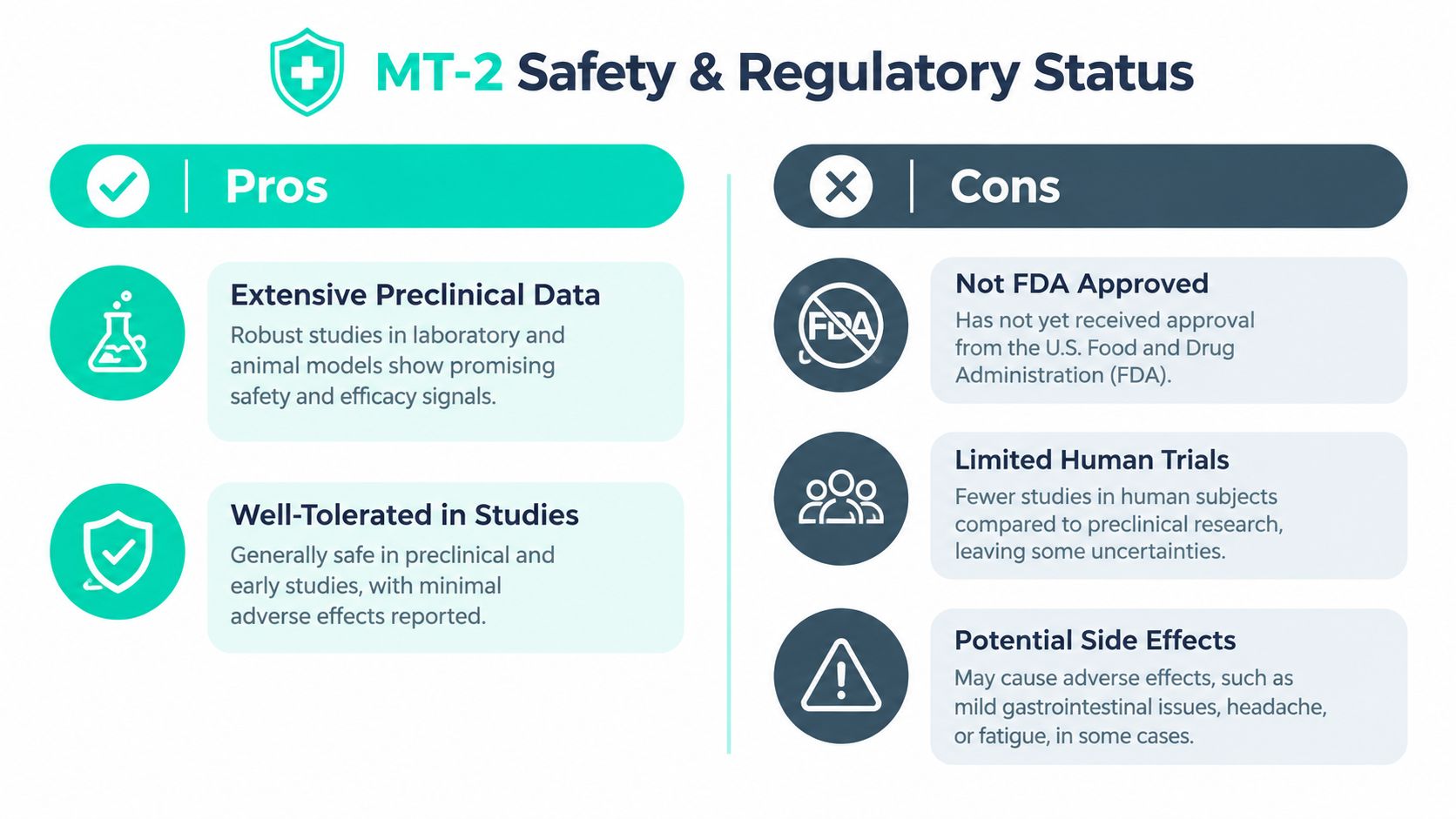
These are related but distinct problems.
That last category deserves separate attention. A product can have a plausible mechanism and still produce unreliable results if its identity or concentration isn't adequately documented. Conversely, a laboratory result that looks unusual may reflect material quality rather than an unexpected feature of melanocortin biology.
A responsible conclusion is not “the risk is zero” or “the risk is proven for everyone.” The evidence supports caution, medical oversight, and clear separation between documented reports and unresolved questions.
Researchers and consumers also shouldn't assume that “research use only” language transforms an unapproved product into a clinically validated one. Anyone who has used an unapproved product and develops concerning symptoms should seek medical advice rather than trying to interpret the event from online anecdotes. Questions about purchasing, possession, and applicable rules also require jurisdiction-specific review, including the information provided in this guide to the legality of buying research peptides in the United States.
Mechanism is only half of the reproducibility problem. A well-described receptor profile won't rescue an experiment if the material has inconsistent concentration, unidentified impurities, degradation, or incomplete identity documentation. Current regulator-facing coverage warns that products sold as Melanotan II can be inconsistently dosed and that unapproved tanning products may vary in manufacturing quality, as explained by the Therapeutic Goods Administration's warning about tanning products containing melanotan.
That creates a practical dilemma. Two labs may believe they're testing the same MT-2 peptide while using material with different lot characteristics. Their divergent observations could then be misread as biological disagreement, when the underlying difference is analytical or manufacturing quality.
A useful quality review begins with the specific lot. Researchers should look for documentation that connects the material in hand to the testing record, rather than relying on a general statement that applies to an entire catalog.
Check for:
Third-party testing adds an external check, but it isn't a magic word. The value depends on the laboratory's methods, the scope of the report, the date of analysis, and whether the certificate applies to the exact lot received.
Document the supplier, lot, certificate, receipt date, storage conditions, preparation steps, and any deviations from the planned protocol. Use the same documentation standard for every comparison compound. If results shift between lots, retain enough information to investigate whether the change tracks with material quality rather than receptor biology.
A researcher should also avoid treating marketing terms as experimental controls. “High purity” is a claim to verify, not a substitute for a certificate of analysis. The more sensitive the assay, the more important that distinction becomes.
MT-2 belongs to a research lineage rather than standing alone. Its early development demonstrated that modifying α-MSH could produce a synthetic analogue with a stronger and more durable pharmacological profile. Its broad melanocortin activity then created a productive tension: the same receptor reach that opened several research directions also made it difficult to separate desired effects from unwanted ones.
Bremelanotide, also known as PT-141, illustrates how researchers can build on those observations while pursuing a different development path. Historical accounts connect the compound's development to observations from MT-2 research and describe bremelanotide as an approved follow-on compound derived from that melanocortin work. The important lesson isn't that one compound replaced the other. It's that researchers used the original findings to identify a potentially useful physiological pathway and then explored a more targeted therapeutic direction.

The comparison can be stated as follows:
| Research characteristic | MT-2 | Follow-on development |
|---|---|---|
| Starting point | Synthetic α-MSH analogue | Compounds informed by melanocortin observations |
| Receptor profile | Non-selective activity across several melanocortin receptors | Greater emphasis on a defined therapeutic objective |
| Scientific value | Useful for investigating connected receptor pathways | Useful for testing whether a selected pathway can support treatment |
| Main interpretive challenge | Multiple physiological effects may overlap | Selectivity and clinical development become central questions |
This progression is common in pharmacology. An early compound can be valuable precisely because it reveals what a receptor family is capable of doing. It may still be unsuitable as a therapeutic product if its activity is too broad, its tolerability is uncertain, or its manufacturing and clinical evidence don't meet regulatory standards.
MT-2 remains relevant because it helps researchers understand the relationship between ligand structure, receptor engagement, and physiological outcome. Newer compounds don't erase the historical value of the original tool. They show how researchers refine a broad biological signal into a more specific development hypothesis.
MT-2 is best approached as a multi-receptor research tool with a recognizable pigmentation phenotype, not as a validated cosmetic solution. Its activity at MC1R helps explain melanin-related effects, while activity at other melanocortin receptors explains why researchers have investigated appetite, sexual function, and additional physiological pathways.
For laboratory planning, keep the central questions concrete:
The most useful shift is from asking whether MT-2 “works” to asking what it activates, in which model, at what verified concentration, and with which documented material. That framework protects scientific interpretation from both hype and reflexive dismissal. It also explains why lot-specific purity documentation can matter as much as receptor pharmacology when researchers compare results.
Celonyx Labs supplies research peptides to laboratories and investigators, with product information that includes stated purity and independent third-party testing. Review the available documentation and research-use information at Celonyx Labs before deciding whether its materials fit your laboratory's procurement and reproducibility requirements.
GHRP-2 is approximately 3.8-fold more potent than GHRP-6 in swine models, while GHRP-6 can produce

How long does peptide reconstitution take? Use a peptide-specific SOP, not a fixed timer. Learn

Can research peptides be stored in a home refrigerator? Not alongside food. Learn dedicated-storage checks,
FOR RESEARCH USE ONLY. Products sold by Celonyx Labs are intended exclusively for laboratory and scientific research. They are not intended for human or veterinary use, consumption, diagnosis, treatment, cure, or prevention of any disease. By purchasing from this site, you acknowledge that you understand the intended research purpose of these materials and agree to comply with all applicable laws and regulations.