
Ghrp 2 Ghrp 6
GHRP-2 is approximately 3.8-fold more potent than GHRP-6 in swine models, while GHRP-6 can produce
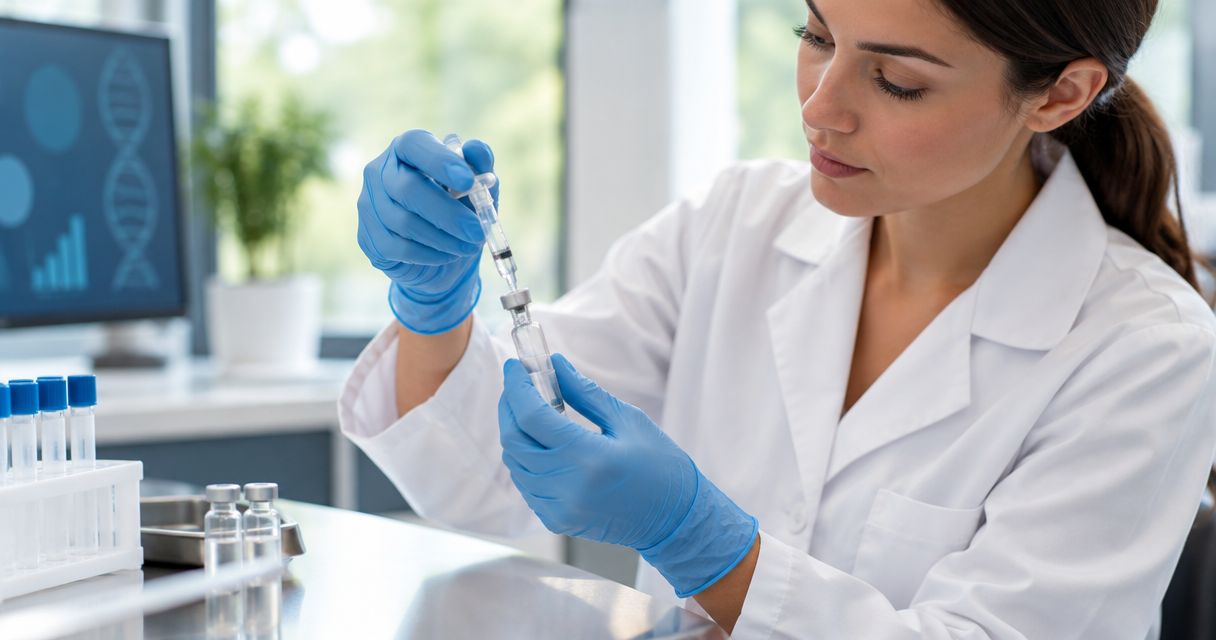
Peptide reconstitution has no universal start-to-finish duration: use the peptide-specific protocol and confirm its completion criteria rather than applying a fixed timer. Total preparation time includes document review, solvent preparation, dissolution, verification, and labeling—not just the interval after liquid enters the vial—and all guidance here is for laboratory research use only.
Peptide reconstitution is complete when the documented preparation meets its protocol—not when an arbitrary number of minutes has passed. A stopwatch records elapsed time; it does not establish solubility, solution stability, or suitability for an assay.
Separate the complete workflow into the stages below. If your immediate question concerns powder disappearing into solution, the narrower guide to how long lyophilized peptides take to dissolve addresses that part of the process.
| Workflow stage | What you do | Completion criterion | What the stage does not prove |
|---|---|---|---|
| Document review | Check identity, lot information, and preparation instructions | You have an applicable protocol and acceptance criteria | That the material will suit every assay |
| Solvent preparation | Confirm the specified solvent and required handling conditions | The preparation matches the approved method | That an interchangeable-looking solvent is equivalent |
| Dissolution | Add solvent and handle the vial as instructed | The protocol's dissolution criteria are met | Identity, sterility, or retained biological activity |
| Verification | Check volume, concentration calculations, and required observations | The preparation passes the specified checks | Long-term stability under untested conditions |
| Labeling and storage | Record preparation details and apply specified storage conditions | The solution is identifiable and traceable | A universal storage lifetime |
For your 2026 laboratory schedule, track hands-on work separately from any protocol-defined waiting period. That distinction tells you whether the bottleneck is preparation, dissolution, or verification. Combining everything into a single undocumented estimate hides the part you need to improve.
A fixed reconstitution time answers the wrong question if your experiment requires a particular concentration, solvent composition, or analytical result. The relevant question is whether the prepared material meets the method's requirements.
Do not treat visible dissolution as experimental readiness. A solution can look clear without providing evidence of identity, accurate concentration, or freedom from contamination. Those questions require their own documentation or tests.
Time records still have value. They help you compare repeat preparations performed under the same conditions and identify deviations from a validated workflow. They do not replace the workflow's acceptance criteria.
Start with the instructions applicable to the specific peptide and preparation. Confirm the material's identity, lot identifier, intended research application, solvent requirements, and any handling restrictions. Resolve contradictory instructions before beginning.
Your 2026 standard operating procedure should define both the starting event and the finishing event. Otherwise, one researcher can report only dissolution while another includes setup and labeling, producing records that are not comparable.
Use a short preparation checklist:
A certificate of analysis and a reconstitution protocol answer different questions. Analytical documentation describes tested characteristics of the material; a preparation protocol describes how to handle it for the intended workflow. Neither should silently substitute for the other.
If your laboratory requires batch-specific evidence, connect that requirement to the preparation record. The guide to peptide purity testing for contract research organizations covers a related quality-control topic without making purity a proxy for dissolution speed.
Choose the solvent from the peptide-specific method, not from a general reconstitution shortcut. Peptide solubility depends on molecular characteristics and solution conditions. A solvent suitable for one preparation is not automatically suitable for another.
Confirm the solvent's identity, relevant specifications, and compatibility with the downstream experiment. Preparation is incomplete if the peptide dissolves but the resulting solution introduces an incompatible component into the assay.
Follow the protocol's instructions for temperature and mixing. Do not add an unapproved warming, cooling, or agitation step solely to shorten elapsed time. A faster preparation is not an improvement if it changes conditions the experiment depends on.
Record departures from the approved method rather than hiding them in a time estimate. If you change the solvent or handling conditions, the resulting preparation is no longer directly comparable with the unchanged method. Treat that change as a method decision requiring review.
Begin the dissolution interval at the event your procedure defines, such as solvent addition. Apply only the handling steps the method specifies, and observe the solution using the method's stated criteria.
Visible particles, persistent cloudiness, or unexpected changes require assessment. Do not assume that simply waiting longer will resolve every observation. Likewise, do not assume that more vigorous mixing is an acceptable response.
A useful workflow has a defined path from preparation to storage:
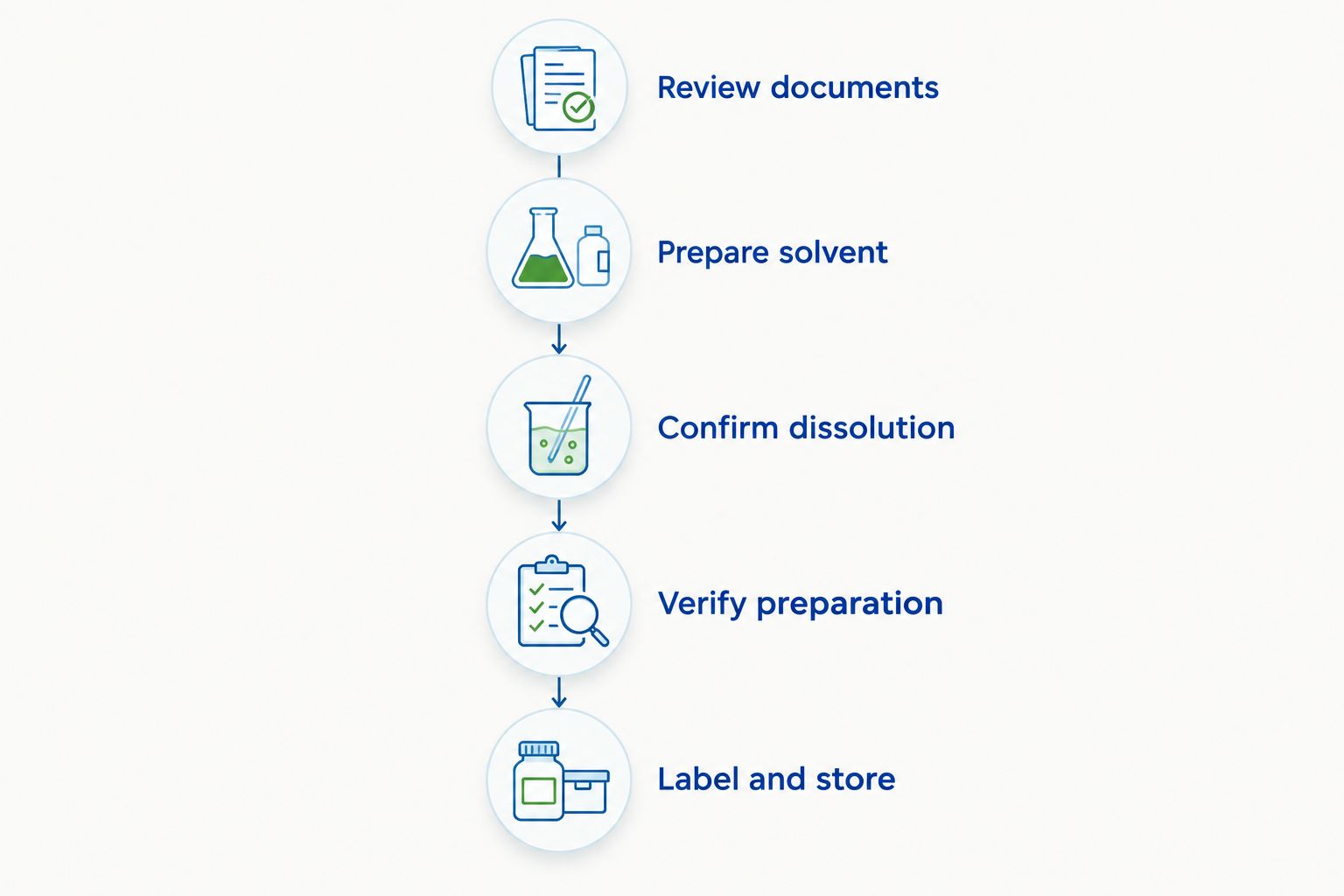
Use the same endpoint language across your 2026 preparation records. A note stating that a vial was mixed does not establish what the researcher observed afterward. Record the observation itself and whether it met the method's requirement.
Accurate concentration requires accurate inputs and the correct calculation basis. Dividing the relevant peptide mass by the specified solution volume produces a mass concentration, but the mass basis must match the analytical documentation and your procedure.
Check whether the method calls for solvent volume added or final solution volume. These are different descriptions, and your record should preserve the one the procedure uses. Do not silently switch between them.
Use established unit conversions to prevent transcription errors:
These are unit relationships, not recommended preparation quantities. They do not specify a solvent volume, target concentration, or experimental application for any peptide.
A purity percentage also does not automatically supply every value needed for concentration correction. Use the mass or content basis required by the method and supported by the documentation. Do not multiply by a purity claim without confirming that the calculation is appropriate.
The preparation is not ready for a shared laboratory workflow until another researcher can identify it and understand its handling requirements. Labeling and documentation are part of the start-to-finish task, even when dissolution is already complete.
Record the peptide identity, lot identifier, preparation date, solvent, calculated concentration, preparer, and applicable storage instructions. Include any deviations or observations required by your laboratory procedure.
For 2026 records, distinguish preparation time from subsequent storage time. They describe different stages and answer different questions. A solution that met preparation criteria still needs storage conditions appropriate to the material and the intended experiment.
Do not assign a universal post-reconstitution lifetime. Use the relevant stability information and laboratory procedure. If the experiment needs additional quality checks after storage, document those checks separately rather than assuming the original preparation record covers them.
The following factors explain why a single elapsed-time claim cannot cover all research peptides:
Compare elapsed times only when these conditions are sufficiently consistent for the comparison you intend to make. A preparation that skips required checks is not a faster version of the same complete workflow.
If repeat preparations behave differently, review the recorded conditions and observations first. Preserve the lot information and preparation history so the discrepancy can be investigated without relying on memory.
Celonyx Labs sells 99%-pure, third-party-tested research peptides to laboratory researchers and scientists. Those stated quality signals are relevant to sourcing, but they do not establish a universal reconstitution duration.
Celonyx Labs research peptides are best suited to laboratory researchers sourcing materials for research use only. Evaluate the material against your experiment's documentation and preparation requirements before selecting a workflow.
The advantage of the stated offering is its emphasis on purity and third-party testing. The limitation is that those claims alone do not establish solvent compatibility, sterility, post-reconstitution stability, or suitability as a certified reference material.
For Celonyx Labs materials, keep the sourcing decision separate from the preparation decision. Use the applicable peptide-specific instructions and your laboratory's approval process; do not turn a store-level quality statement into an experimental acceptance criterion.
A clear peptide solution satisfies only the appearance criterion, if the method includes one. It does not independently establish identity, concentration, sterility, or biological activity.
Use clarity as an observation, not a universal pass result. Finish the remaining checks required by the laboratory procedure before releasing the preparation for the experiment.
Follow the procedure's permitted handling steps rather than escalating mixing indefinitely. Persistent particles or unexpected appearance require review against the material's instructions and your laboratory's troubleshooting process.
Do not change several conditions at once to chase a faster result. An undocumented change makes it harder to determine whether the preparation still meets the method.
How long does peptide reconstitution take from start to finish?
Peptide reconstitution has no universal start-to-finish duration. Count document review, solvent preparation, dissolution, verification, and labeling, and use the peptide-specific procedure’s completion criteria.
Is peptide dissolution time the same as total reconstitution time?
Peptide dissolution time is only part of total reconstitution time. The complete workflow also includes preparation checks, calculation review, documentation, and storage handling.
Can I use the same reconstitution timer for every research peptide?
A single timer does not establish completion for every research peptide. Use the applicable solvent, handling conditions, and acceptance criteria for each preparation.
Does 99% purity mean a peptide will dissolve quickly?
A 99% purity claim does not establish dissolution speed. Solubility depends on the peptide and preparation conditions, while purity describes a separate quality characteristic.
Should I warm or shake a vial to make reconstitution faster?
Do not add warming or shaking steps unless the peptide-specific procedure permits them. Follow the approved handling method rather than changing conditions to meet a timer.
Is a clear reconstituted peptide solution ready for my assay?
A clear solution is not automatically ready for your assay. Confirm the required concentration, solvent compatibility, documentation, and any additional acceptance checks.
Can this reconstitution guidance be used for human administration?
This guidance is for laboratory research use only, not human administration. It does not provide clinical preparation, dosing, or injection instructions.
Make the next preparation record more useful by recording the endpoint—not just the elapsed time. Write what was observed, which criterion it met, and who accepted the preparation under the laboratory procedure.
Your most useful 2026 timing benchmark is a repeatable record from the same approved method under comparable conditions. A stopwatch can tell you when an interval ended; only the method and its checks tell you whether the preparation is finished. Research use only.
GHRP-2 is approximately 3.8-fold more potent than GHRP-6 in swine models, while GHRP-6 can produce

How long does peptide reconstitution take? Use a peptide-specific SOP, not a fixed timer. Learn

Can research peptides be stored in a home refrigerator? Not alongside food. Learn dedicated-storage checks,
FOR RESEARCH USE ONLY. Products sold by Celonyx Labs are intended exclusively for laboratory and scientific research. They are not intended for human or veterinary use, consumption, diagnosis, treatment, cure, or prevention of any disease. By purchasing from this site, you acknowledge that you understand the intended research purpose of these materials and agree to comply with all applicable laws and regulations.