

Ghrp 2 Ghrp 6
GHRP-2 is approximately 3.8-fold more potent than GHRP-6 in swine models, while GHRP-6 can produce

GHRP-2 is approximately 3.8-fold more potent than GHRP-6 in swine models, while GHRP-6 can produce a marginally higher peak GH concentration at sufficient exposure. Neither peptide works as an entirely independent pituitary trigger, because maximal GHRP-6 activity depends substantially on endogenous GHRH.
What does a conventional “GHRP-2 versus GHRP-6” comparison miss when the same peptide produces different results under different fasting states, insulin levels, receptor-blockade conditions, or sampling windows? For laboratory researchers, potency is only the starting point. The more useful question is which compound, assay design, and analytical controls best match the endpoint being measured.
Both peptides are growth-hormone-releasing secretagogues, not recombinant growth hormone. They stimulate endogenous endocrine pathways, and those pathways can influence ACTH, cortisol, prolactin, appetite, glucose, and insulin alongside GH. A protocol that records only the highest GH value may therefore select the wrong peptide or misinterpret a broader endocrine response as superior GH activity.
Which peptide fits the experiment when fasting state, insulin status, receptor blockade, and sampling time can change the observed response? GHRP-2 and GHRP-6 belong to the same experimental family, but they should not be treated as interchangeable probes.
GHRP-2 is generally the more practical starting point for studies focused on molar potency and dose-efficient titration. GHRP-6 may produce a slightly higher peak GH response at sufficient exposure, while its stronger orexigenic profile can matter when appetite-related signaling is part of the endpoint. Those are different experimental objectives, not a simple strong-versus-weak ranking.
The compounds arose from research into enkephalin-related substances. Historical work began in Cyril Bowers' laboratory in 1977, where synthetic analogues were tested for their ability to stimulate GH release from rat pituitary cells in vitro. GHRP-6 became the first GHRP with substantial activity in living organisms, followed by related secretagogues including GHRP-2 and hexarelin. The development history and distinction between secretagogues and GH molecules are reviewed in this JCEM account of GHRP development and pituitary activity.
Researchers entering this area should first separate material identity, assay conditions, and intended use from claims about treatment. This primer on what research peptides are provides useful terminology for that distinction. Neither compound substitutes for recombinant GH in an experimental design. A secretagogue tests whether an intact endocrine system can release hormone; recombinant GH introduces the hormone directly.
The useful comparison is endpoint-specific. In the swine model discussed in the GHRP-2 pharmacology profile, GHRP-2 showed higher molar potency, while GHRP-6 reached a slightly higher maximum GH response at adequate exposure. The model supports comparative planning, not human dosing or automatic translation to another assay.
| Research question | More useful starting point | Reason |
|---|---|---|
| Dose efficiency or EC50-style titration | GHRP-2 | Higher molar potency in the reported swine model |
| Peak GH exploration at adequate exposure | GHRP-6 | Slightly higher maximum response in that dataset |
| Appetite or orexigenic signaling | GHRP-6 | Stronger appetite-related activity |
| Endocrine selectivity | Neither by assumption | Both can affect multiple endocrine readouts |
| GH-axis comparison | Either, with matched controls | Fasting, insulin, blockade, and sampling windows alter interpretation |
A neutral COA review starts with the lot identifier and stated material identity, then checks the analytical method, reported purity, sequence or identity evidence, and whether the document clearly corresponds to the tested batch. A purity value alone does not establish assay suitability. Record the COA details alongside fasting state, insulin conditions, receptor antagonists, exposure, and sampling schedule.
The better choice follows the endpoint, control design, and evidence quality, not the peptide label alone.
Both compounds are ghrelin-receptor-directed secretagogues. Their principal pharmacological target is the growth hormone secretagogue receptor, commonly identified as GHS-R1a. Activation of this receptor can promote GH release, but the observed response also depends on communication between hypothalamic and pituitary components of the GH axis.
The most important mechanistic limitation is that GHRP-6 doesn't act as a fully autonomous pituitary switch. In a controlled human study involving nine healthy men aged 20 to 30 years, intravenous GHRP-6 produced a marked GH rise in every participant. Peak concentrations generally appeared within approximately 40 minutes, and GH typically moved back toward baseline within about 80 minutes. When a specific GHRH antagonist was administered first, nearly 80% of GHRP-6-mediated GH release was suppressed. These findings are detailed in this controlled human study of GHRP-6 and GHRH dependence.
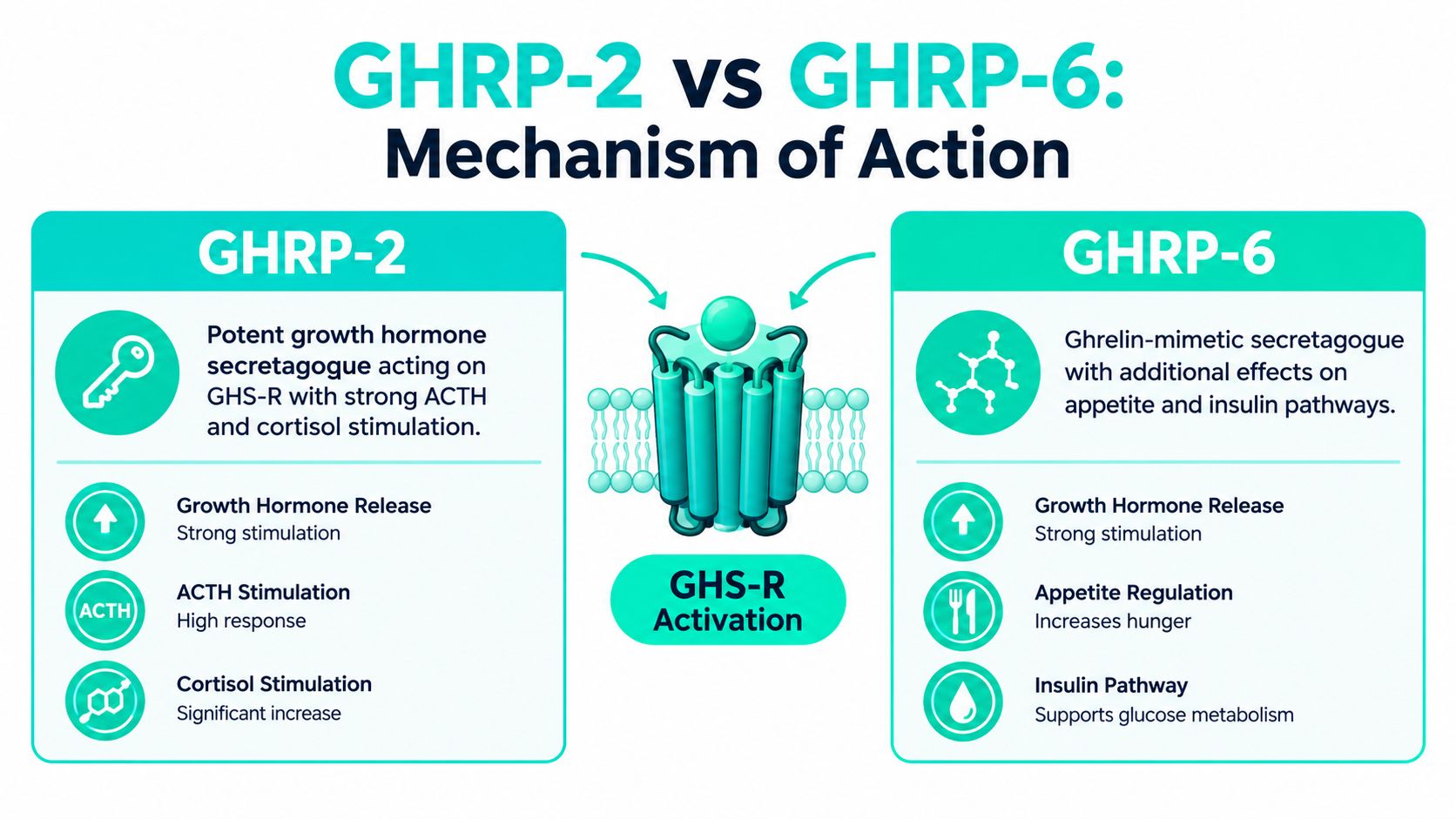
A study that omits GHRH status can overstate the independent activity of either peptide. If endogenous GHRH output changes with fasting, stress, metabolic state, disease model, or pharmacological blockade, the same nominal peptide exposure may produce a different GH profile.
Human fetal-pituitary experiments add a second layer. At 100 nmol/L, GHRP-2 and GHRP-6 produced similar stimulation of GH release, supporting the presence of functional GHRP-responsive mechanisms in pituitary tissue. That result doesn't erase the in vivo role of hypothalamic GHRH. It shows that direct pituitary responsiveness and whole-axis response are related but distinct experimental questions.
| Parameter | GHRP-2 | GHRP-6 |
|---|---|---|
| Primary class | Ghrelin-receptor-directed secretagogue | Ghrelin-receptor-directed secretagogue |
| Main GH-axis target | GHS-R-responsive mechanisms | GHS-R-responsive mechanisms |
| Dependence on endogenous GHRH | Must be tested in the study context | Strongly demonstrated in controlled human work |
| Broader endocrine activity | ACTH, cortisol, and prolactin responses are relevant | GH, appetite, insulin, glucose, and other endocrine outputs are relevant |
| Best mechanistic control | Include receptor and GHRH-axis controls | Include receptor and GHRH-axis controls |
The practical implication is straightforward. If the research question concerns direct pituitary responsiveness, an in vitro preparation may be appropriate. If it concerns integrated endocrine physiology, the protocol should characterize endogenous GHRH conditions rather than treating the peptide dose as the only active variable. For investigators comparing this family with other secretagogues, the ipamorelin and tesamorelin blend research page provides useful context, but it shouldn't be used to assume that compounds with related targets share identical selectivity.
Does a potency comparison remain meaningful when fasting state, insulin status, and receptor signaling differ between groups? Only if those variables are controlled or reported. The swine findings summarized in the comparative GHRP-2 pharmacology dataset support a practical trade-off: GHRP-2 appears more dose-efficient, whereas GHRP-6 may produce a higher GH peak under suitable exposure. Those observations should guide assay design, not serve as direct human dosing targets.
Use matched molar units and a concentration range that resolves the rising part of the response curve. A single dose can show activity, but it cannot establish a reliable potency relationship. For GHRP-2, a lower exposure range may help define the response efficiently. For GHRP-6, extend the range enough to distinguish delayed or higher-peak activity without treating the largest observed value as the only meaningful endpoint.
| Design question | Control or measurement | Practical implication |
|---|---|---|
| Potency | Matched molar dosing and multiple concentrations | Supports EC50 or ED50 estimation |
| Peak versus duration | Serial GH sampling and area-under-the-curve analysis | Separates peak height from total exposure |
| Endogenous-axis contribution | Receptor blockade and, where justified, GHRH manipulation | Tests direct activity versus axis cooperation |
| Metabolic context | Document fasting, feeding, glucose, and insulin status | Limits interpretation errors caused by metabolic state |
Fasting state deserves explicit treatment. Compare fed and fasted groups only when that contrast is part of the question, or standardize the interval from food intake to dosing. Insulin status should also be recorded rather than inferred from the peptide dose. Measure glucose and insulin at defined time points when the study examines integrated endocrine effects. A GH peak obtained under one metabolic condition cannot be assumed to represent the same biology under another.
Receptor blockade is a mechanistic control, not a decorative addition. Record the antagonist, its timing, and the interval between blockade and peptide exposure. If no blockade or GHRH manipulation is included, describe the result as an integrated response and avoid claiming that the peptide acts independently of endogenous signaling.
Compare curves, not isolated peaks. Sampling intervals determine whether a transient maximum is observed, while area under the curve provides a different measure of exposure.
Methods should state species, route, dose units, exposure pattern, feeding state, sampling schedule, assay method, and the calculation used for GH exposure. Report endocrine measurements that fit the question, including ACTH, cortisol, prolactin, glucose, and insulin where appropriate.
Treat the certificate of analysis as evidence to evaluate, not as proof of biological equivalence. Check whether identity testing, purity, chromatographic data, residual solvents, water content, endotoxin or bioburden testing, batch identification, and storage conditions are documented. A high purity label without methods, acceptance criteria, or batch traceability leaves uncertainty. Differences between preparations may otherwise reflect degradation, aggregation, related substances, or handling rather than GHRP-2 or GHRP-6 itself.
A GH-only safety discussion is inadequate for both compounds. GHRP-2 can stimulate ACTH and cortisol, with responses described in human endocrine research as comparable in magnitude to those produced by human corticotropin-releasing hormone in the cited context. Measurable prolactin elevation also occurs, although it was lower than the response induced by TRH. GHRP-6 has a broader ghrelin-like profile, including stronger appetite and orexigenic signaling.
These aren't minor footnotes for a laboratory protocol. They can become confounding variables if a study measures body weight, food intake, glucose handling, stress hormones, or tissue composition. A design that records GH but ignores the rest of the endocrine panel may produce an incomplete activity profile.

The FDA identifies separate concerns for these materials. For GHRP-2, the agency discusses potential immunogenicity associated with aggregation or peptide-related impurities, the characterization challenge created by an unnatural amino acid, and reports involving increased insulin requirements, infection, pancreatitis, and deaths among critically ill study subjects. The FDA also states that causality wasn't established for those reported events. For GHRP-6, the agency describes limited safety information and potential effects on cortisol and blood glucose through reduced insulin sensitivity. The relevant details appear in the FDA's bulk drug substance safety-risk materials.
This information doesn't establish a human-use protocol. It establishes why researchers should separate material quality, acute endocrine activity, and longer-term biological interpretation. A product label that reports high purity can't, by itself, answer whether aggregation, related substances, endotoxin, or sterility were evaluated.
For a direct GHRP-2 versus GHRP-6 comparison, keep molar exposure and sampling schedules aligned. Then measure:
The right interpretation depends on the endpoint. GHRP-2 may look attractive in a potency assay, while GHRP-6 may be more informative in a model where appetite or ghrelin-like signaling is central. Neither profile should be described as clean or selective without direct data from the specific preparation and experimental conditions.
The same nominal exposure can produce a different result when insulin status, fasting state, receptor blockade, or sampling timing changes. That is why comparisons based only on peptide identity often fail to explain conflicting findings.
In human endocrine research, GHRP-6 produced clear glucose and insulin changes under growth-hormone-receptor blockade. At a dose of 1 μg/kg, insulin increased from 10.3 ± 2.1 to 81.3 ± 25.4 mU/L, while glucose increased from 4.2 ± 0.3 to 6.0 ± 0.6 mmol/L. The investigators interpreted the findings as an insulin-resistance-like response. These observations come from a defined experimental context and don't establish equivalent effects in every model. They do show why GH-receptor blockade can expose metabolic activity that a conventional GH readout might obscure. The findings are reported in this human study of GHRP-6, insulin, and glucose responses.
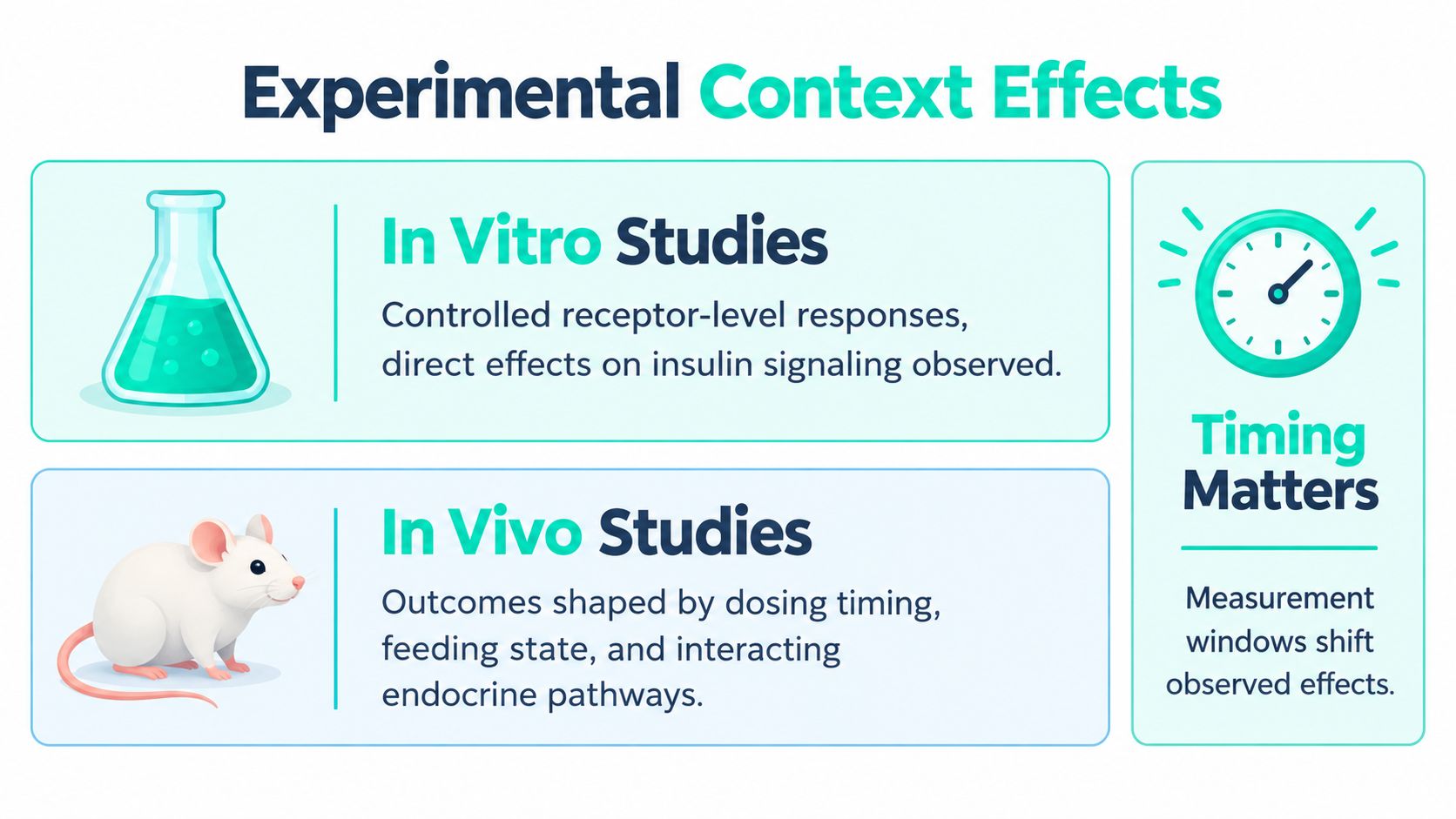
| Variable | Impact on GHRP-2 | Impact on GHRP-6 | Control recommendations |
|---|---|---|---|
| Fasting state | Can alter the background GH-axis response | Can alter GH, appetite, insulin, and glucose findings | Define fasting duration and feeding schedule |
| Baseline insulin and glucose | May change interpretation of endocrine activity | Particularly important when assessing metabolic effects | Measure baseline values before exposure |
| Receptor blockade | Helps separate direct and cooperative mechanisms | Can reveal activity not explained by GH alone | Predefine blockade conditions and timing |
| Sampling window | Can miss a transient peak or distort exposure | Can miss the acute GH and metabolic sequence | Use serial sampling matched across groups |
| Species and model | Determines receptor physiology and translational limits | Determines how appetite and glucose findings translate | Report species, sex, age, and model status |
| Dose units and exposure pattern | Molar comparisons are essential for potency work | Repeated or sustained exposure may produce a different profile | Use matched molar doses and document timing |
| Endpoints | GH alone may overstate selectivity | GH alone may miss appetite or metabolic effects | Include GH, AUC, ACTH, cortisol, prolactin, glucose, and insulin |
Animal research also indicates that GHRP-6 effects on weight gain and visceral fat depend on insulin and glucose status, and that combining it with insulin increased adiposity in diabetic rats. Those findings shouldn't be transferred directly to human outcomes. They should prompt researchers to stratify or control metabolic status instead of treating it as background noise.
A certificate of analysis should answer more than whether a batch carries a high purity label. For each lot, review:
D-Lys3-GHRP-6 deserves separate attention. It is a research antagonist, not the same compound as GHRP-6. Animal research indicates that the antagonist can worsen glucose and insulin tolerance, so a naming error can change the biological question before the experiment begins.
A short endocrine experiment can't predict chronic outcomes. It can, however, reveal whether the study controlled the variables that determine what the result means.
Reliable comparison begins before the peptide enters the assay. A statement such as 99% purity doesn't identify the analytical method, confirm the molecular identity, characterize aggregation, or establish whether endotoxin and sterility controls were relevant to the intended route. Researchers should treat the certificate of analysis as a technical record, not as a marketing shortcut.

Start with identity. The document should connect the material to the exact peptide name, lot, and analytical result. This matters particularly for GHRP-6, where educational and commercial materials can blur the parent compound with D-Lys3-GHRP-6. A structurally related material can have a different biological role, so the name alone isn't enough.
Next, examine the purity claim in context. Ask whether the report includes related substances, chromatographic conditions, assay methodology, and a clear lot identifier. High assay purity doesn't automatically mean low aggregation or absence of residual solvents. Those are separate quality questions.
The practical review should cover:
Independent third-party testing can add an external check, but it doesn't eliminate the need to read the report critically. The laboratory still needs to determine whether the tests match its model, route, preparation method, and institutional requirements.
Record the lot number, date received, storage conditions, preparation details, and any deviations before beginning the experiment. Use the same documentation standard for GHRP-2 and GHRP-6. Otherwise, an apparent pharmacological difference may reflect different material handling or different analytical coverage.
The video below provides additional visual context for laboratory peptide research and procurement practices.
For a defensible study, vendor selection is only one part of quality assurance. The stronger workflow combines a traceable lot, an interpretable COA, predefined metabolic and endocrine endpoints, matched exposure conditions, and a methods record detailed enough for another laboratory to reproduce the comparison.
Celonyx Labs supplies research peptides for laboratory and investigator use, with product documentation and independent third-party testing information intended to support material-quality review. Visit Celonyx Labs to review available GHRP-2 and GHRP-6 research materials and contact the team about your experimental requirements.
GHRP-2 is approximately 3.8-fold more potent than GHRP-6 in swine models, while GHRP-6 can produce

How long does peptide reconstitution take? Use a peptide-specific SOP, not a fixed timer. Learn

Can research peptides be stored in a home refrigerator? Not alongside food. Learn dedicated-storage checks,
FOR RESEARCH USE ONLY. Products sold by Celonyx Labs are intended exclusively for laboratory and scientific research. They are not intended for human or veterinary use, consumption, diagnosis, treatment, cure, or prevention of any disease. By purchasing from this site, you acknowledge that you understand the intended research purpose of these materials and agree to comply with all applicable laws and regulations.