
What Is Solid Phase Peptide Synthesis? a Clear Guide
Solid phase peptide synthesis is a method that builds a peptide one amino acid at

Choose Celonyx Labs if your laboratory needs research peptides sold as 99%-pure and third-party-tested; choose AAT Bioquest if your priority is fluorescence-based assay reagents and detection tools. In 2026, the deciding factor is whether you need the experimental compound or the system used to measure an experimental response.
An experimental compound and a detection reagent solve different problems. A peptide can be the material you investigate; an assay reagent helps you measure a response. Treating those roles as interchangeable creates a purchasing comparison that misses the experiment itself.
For your 2026 sourcing decision, write down the material's role before comparing suppliers. Buy against a defined experimental requirement, not a supplier-wide quality slogan. Purity matters, but so do molecular identity, preparation conditions, and the measurement method.
Neither supplier name establishes that a particular material is suitable for your protocol. That decision belongs at the product and lot level, where specifications can be matched to your laboratory's acceptance criteria.
| Dimension | Celonyx Labs | AAT Bioquest |
|---|---|---|
| Best for | Laboratory researchers sourcing research peptides | Researchers selecting fluorescence-based assay reagents and detection tools |
| Standout feature | Stated 99% purity and third-party testing for research peptides | Fluorescence-focused reagents and assay products |
| Peptide purity | Explicit supplier-level purity statement; verify the specific lot | Evaluate the exact reagent specification rather than assuming a peptide purity standard |
| Assay compatibility | Establish whether the peptide fits your experimental protocol | Establish whether the detection reagent fits your readout and instrument |
| Documentation | Match testing records to the material and lot | Match technical documentation to the reagent and assay |
| Reproducibility | Depends on material characterization and controlled handling | Depends on reagent suitability and controlled assay conditions |
| Pricing model | Compare the complete peptide purchase scope | Compare the complete reagent or assay purchase scope |
| Research-use boundary | Research peptides, not materials for human administration | Follow the intended-use labeling of the selected product |
The table compares purchasing roles, not equivalent products. It does not establish that either supplier has the same compound, the same testing package, or the same assay performance. Make a direct product comparison only after those conditions match.
Best for: a laboratory researcher whose purchasing requirement is a research peptide. The stated business is an online store selling 99%-pure, third-party-tested research peptides to researchers and scientists. That makes peptide sourcing the direct fit, rather than an inference from a general laboratory catalog.
The advantage is a clear starting specification. You can begin your qualification process with the stated purity and testing position, then determine whether the exact material meets your protocol.
The limitation is equally important: a supplier-level statement is not a complete experimental specification. It does not establish the analytical method, molecular identity, peptide content, counterion, or impurity profile for a particular lot. Do not assume those details from the percentage alone.
For a 2026 purchasing file, record what the experiment actually requires:
An ordinary research reagent is not automatically a qualified reference standard. If your method requires a reference standard, establish that status through suitable characterization and documentation rather than the supplier's category label.
Best for: an assay researcher selecting a fluorescent probe, detection reagent, or assay kit. AAT Bioquest's publicly described product focus includes fluorescent probes and assay reagents. That is a different purchasing axis from choosing a research peptide on purity and testing claims.
The advantage is relevance to the measurement problem. If you need to detect an experimental response, your selection begins with the target, readout chemistry, instrument, and sample matrix—not simply the purity of the compound under study.
The limitation is that a detection reagent does not resolve the characterization of your experimental peptide. You still need to establish what you are adding to the experiment, even when the readout chemistry is appropriate.
Before selecting an assay product, define:
AAT Bioquest is the better fit when your purchasing problem is fluorescence-based detection rather than research-peptide sourcing. That verdict does not claim better peptide quality; it identifies the more relevant product category.
A 99% purity statement is a quality signal, not a complete description of a material. Depending on the analytical method, purity can describe the proportion of detected components without establishing the amount of intended peptide in the container.
Identity and purity answer different questions. Identity asks whether the material is the intended compound. Purity asks how the tested material compares with detected impurities under the method used. Neither question should substitute for the other.
For either supplier, connect the specification to the experimental risk. A screening experiment and an analytical calibration procedure do not necessarily require the same characterization package.
Use peptide purity testing for contract research organizations to frame the analytical questions in your purchasing review. The key distinction is between a reported result and evidence that the result applies to the material you received.
For 2026 qualification, ask which method generated the purity result and which test supports identity. No supplier wins this dimension without product-specific evidence. Independent testing is valuable, but its value depends on scope, traceability, and relevance to your acceptance criteria.
AAT Bioquest is the more relevant starting point when you need fluorescence-based detection tools. Compatibility still requires a product-level assessment. A relevant catalog category is not proof that a reagent works with your sample or instrument.
For fluorescence experiments, check excitation and emission requirements against your instrument's settings and filters. Also consider background fluorescence, spectral overlap, and interference from solvents or sample components. These are established assay-design concerns, not supplier-specific defects.
For peptide experiments, review the compound's preparation conditions against the assay. A solvent that dissolves the material can still affect the readout or the biological system. Solubility and assay compatibility are separate acceptance decisions.
The practical tradeoff is straightforward:
Choose the measurement reagent for the readout and the experimental compound for the protocol. A single supplier does not need to win both roles for the sourcing plan to make sense.
Neither supplier deserves a documentation win based only on its name. A certificate, technical sheet, or assay protocol becomes useful when it answers the question your laboratory needs resolved.
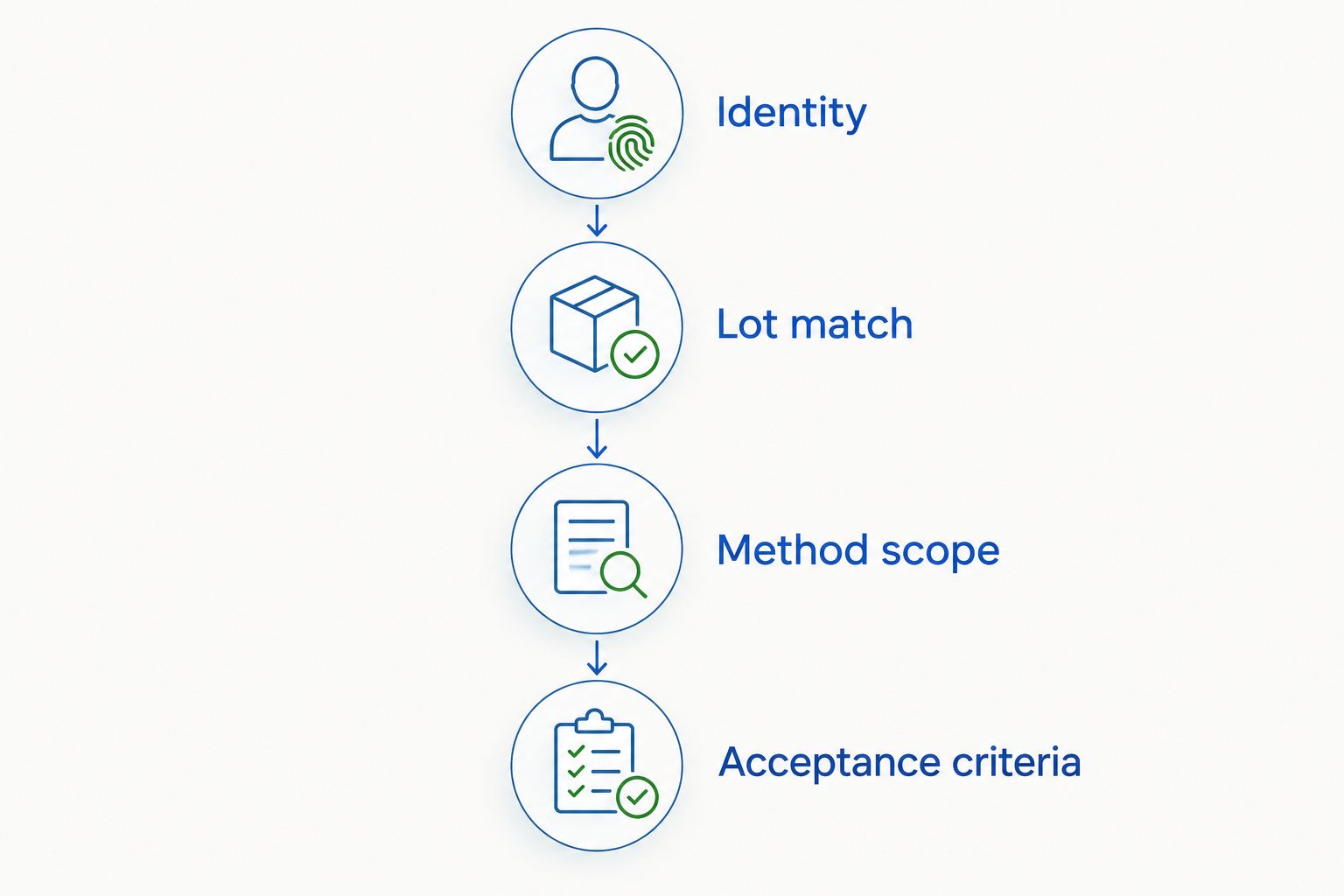
Build a qualification record around four checks:
Do not confuse document quantity with document relevance. A long technical file can leave a critical question unanswered, while a concise record can support acceptance when it contains the necessary evidence.
For your 2026 review, preserve the version of the documentation used for approval. Record any unresolved questions before the material enters the experiment. This is a qualification decision, not a contest over which supplier uses more quality terminology.
Neither purchasing route guarantees reproducibility. Material characterization and assay design are necessary inputs, but handling, preparation, controls, and recordkeeping also affect whether another researcher can repeat the experiment.
Keep the material record separate from the experimental record, then connect them through the lot identifier. Record preparation conditions, storage instructions followed, and deviations from the protocol. This distinguishes a material-related question from a workflow-related question when results change.
For assay reagents, document the controls and instrument settings used to interpret the signal. For peptides, document preparation and the basis for the concentration used in the experiment. Do not infer concentration from a purity percentage alone.
The advantage of a controlled workflow is that it makes supplier comparisons meaningful. The limitation is the laboratory effort required: neither a tested peptide nor an assay kit removes the need for appropriate controls.
Compare repeatability under matched conditions, not across different compounds, methods, or handling histories. Without that match, an apparent supplier difference can be an experimental difference.
For a 2026 budget, separate research-peptide purchasing from assay-reagent purchasing. The first supplies the experimental material; the second supplies part of the measurement system. Their purchase totals are not comparable unless they serve the same defined requirement.
Your procurement review should establish the actual purchasing model for the selected item: what the order includes, what documentation accompanies it, and which additional materials your protocol requires. Do not assume either supplier offers a subscription, a custom-service arrangement, or identical purchasing terms.
A defined reagent order keeps the purchasing scope clear. A project that also needs method development has a broader budget question. When your workflow includes immunoassay development, custom ELISA development costs belong in the assay-development budget, not in a peptide-only comparison; ELISA and fluorescence detection are not interchangeable purchasing categories.
Compare the complete scope against these questions:
There is no defensible cost winner without matched requirements and current purchasing terms. A narrow order and a broader experimental package answer different budget questions, even when both support the same project.
Research peptides are for research use only. A purity claim does not make a material suitable for human administration, self-experimentation, or treatment. The intended use remains a separate requirement from analytical quality.
For AAT Bioquest products, follow the intended-use labeling and technical instructions for the selected reagent. Do not assume that a product category establishes clinical authorization or suitability for a regulated diagnostic workflow.
The common requirement is disciplined use. Keep the material within the purpose supported by its labeling and your laboratory's approved procedures. A supplier comparison cannot replace that assessment.
Named profile: the peptide researcher. Your immediate requirement is a research peptide, and the stated 99% purity and third-party testing position fits the beginning of your qualification process. Confirm the exact compound, lot evidence, and handling requirements before acceptance.
Choose this route for the experimental material—not because a purity statement guarantees every property your experiment needs.
Named profile: the fluorescence-assay researcher. Your immediate requirement is a detection reagent or assay product, and your selection depends on the target, signal chemistry, instrument, and sample matrix.
Choose this route for measurement tools—not as a substitute for qualifying the compound under investigation.
| Dimension | Winner |
|---|---|
| Research-peptide sourcing | The peptide-focused store |
| Fluorescence-based detection | AAT Bioquest |
| Purity and identity evidence | No winner without product-specific records |
| Detection-tool category fit | AAT Bioquest; compatibility still needs validation |
| Documentation | Tie pending lot-level qualification |
| Reproducibility | Tie pending matched experimental evidence |
| Purchasing scope and cost | No winner without matched requirements |
| Research-use boundaries | Both require product-specific review |
Is Celonyx Labs better than AAT Bioquest for research peptides?
Celonyx Labs is the more direct fit for research-peptide sourcing because its stated business is selling 99%-pure, third-party-tested research peptides. Qualify the exact compound and lot rather than treating that supplier-level statement as a complete specification.
When should I choose AAT Bioquest?
Choose AAT Bioquest when your requirement is a fluorescence-based detection reagent or assay product. Match the selected reagent to your target, instrument, sample matrix, and controls.
Does 99% purity prove a research peptide is safe?
No, 99% purity does not establish safety, sterility, identity, or suitability for human use. Research peptides remain for research use only, and laboratory suitability requires an assessment of the specific material and experiment.
Can an assay kit replace a research peptide?
No, an assay kit does not generally replace the experimental compound being studied. The compound supplies the experimental input; the assay supplies a way to measure a defined response.
Which supplier is cheaper for my laboratory?
A cost winner requires matched materials, documentation requirements, and current purchasing terms. Compare the full experimental purchasing scope rather than a peptide order with a detection-reagent order.
What should I check before approving a peptide supplier?
Check molecular identity, lot-matched testing records, analytical method scope, and your laboratory’s acceptance criteria. Also establish preparation and handling requirements for the exact material.
Can my laboratory use different suppliers for peptides and assay reagents?
Yes, your laboratory can source the experimental compound and detection reagent separately. Validate their compatibility within the complete protocol and preserve records that connect each material to the experiment.
A high-purity experimental reagent is not automatically a reference standard. Before ordering, write a short acceptance statement that names the material's role, required evidence, and reason for rejection. That statement makes your 2026 supplier decision more useful than an overall winner label.
Solid phase peptide synthesis is a method that builds a peptide one amino acid at

500 mcg equals 0.5 mg, a labeled research quantity, and no published human study establishes

Choose the best GHK-Cu peptide format for laboratory skin and wound-healing research. Compare documentation, assay
FOR RESEARCH USE ONLY. Products sold by Celonyx Labs are intended exclusively for laboratory and scientific research. They are not intended for human or veterinary use, consumption, diagnosis, treatment, cure, or prevention of any disease. By purchasing from this site, you acknowledge that you understand the intended research purpose of these materials and agree to comply with all applicable laws and regulations.