
What Is Solid Phase Peptide Synthesis? a Clear Guide
Solid phase peptide synthesis is a method that builds a peptide one amino acid at
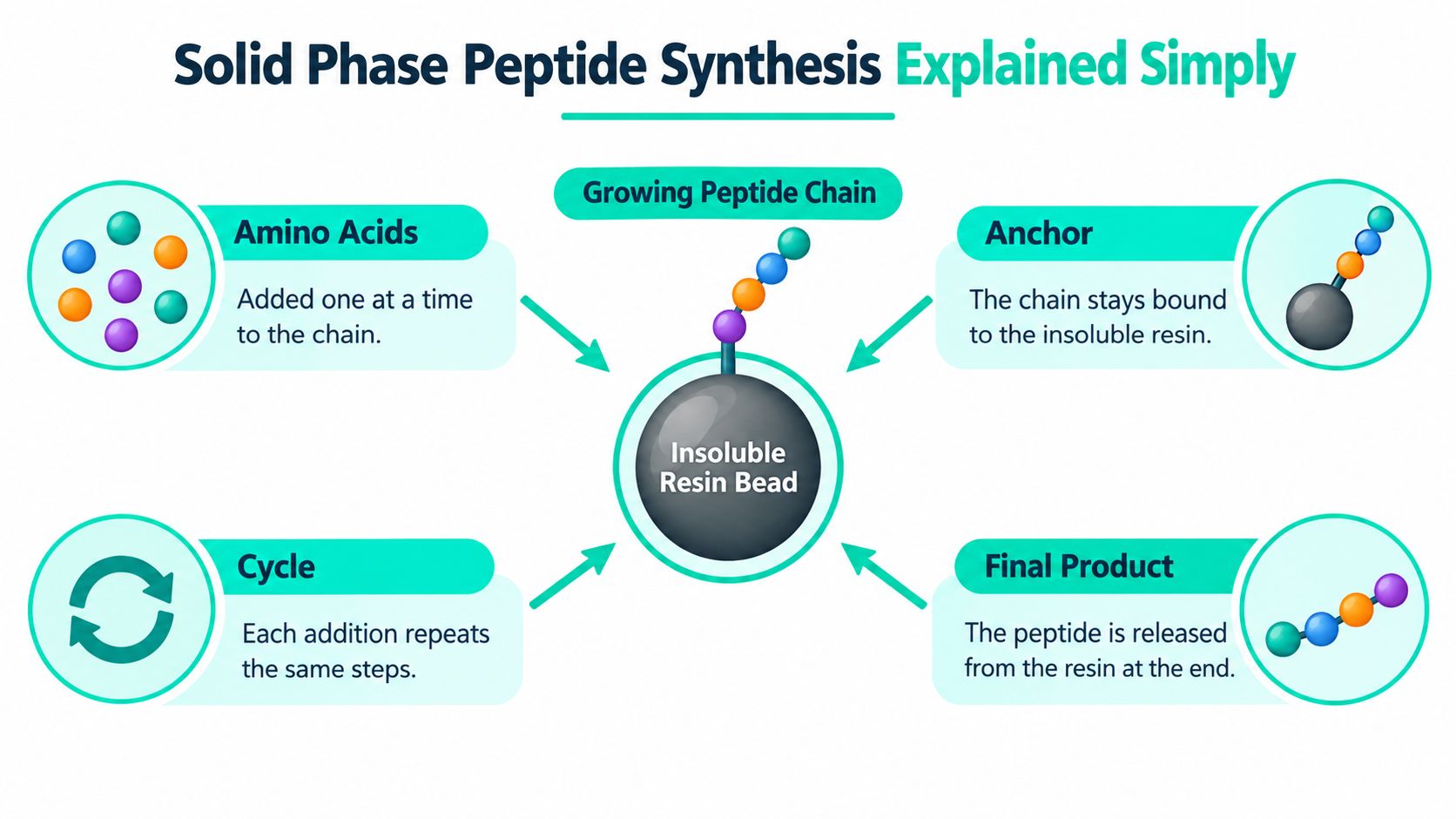
Solid phase peptide synthesis is a method that builds a peptide one amino acid at a time while the growing chain stays anchored to an insoluble resin bead, with excess reagents removed by washing after each step. If the process is that simple, why can two vials with the same sequence name behave differently in an assay? The answer sits in the details of the cycle, because every addition can complete, stall, or create a close impurity.
Think of a jeweller threading beads onto a string clipped into a holder. The jeweller adds one bead to the free end, rinses away loose beads, then adds the next one without losing the string. That's the clearest picture of What Is Solid Phase Peptide Synthesis in practice, with amino acids as the beads and the clipped string as the growing chain.
The diagram below shows that anchored relationship before the chemistry gets detailed.
Bruce Merrifield introduced the method in 1963 and received the 1984 Nobel Prize in Chemistry for it. His key move was attaching the first amino acid to an insoluble resin, so the chain stayed put while liquids around it changed.
The resin is usually made of small polymer beads, commonly polystyrene around 75 to 150 µm across. These beads swell in solvents such as DMF, opening space so reagents can reach the attached chain. Beginners often picture a hard pebble, but a swollen bead behaves more like a tiny gel with reaction sites inside it.
The chain grows from the C-terminus toward the N-terminus. That means the first amino acid loaded onto the resin becomes the C-terminal residue of the finished peptide. Each new amino acid joins the free N-terminal end.
A 10-residue peptide needs one initial attachment plus nine coupling cycles. You're not mixing all ten amino acids at once and hoping they line up. You're building one defined order, residue by residue.
Solid describes the support holding the chain. It doesn't describe the purity, identity, or quality of the peptide released at the end.
That last point prevents a common misunderstanding. Washing is easy because the resin can be filtered and rinsed. Making every bond correctly is a separate challenge.
Fmoc and Boc are two locking systems on the same door. Both temporarily protect the chain end so an amino acid reacts at the intended place, but they use different keys to release it. That difference controls which other protecting groups can survive the full synthesis.
Fmoc protection is removed with a weak base. Side-chain groups that are sensitive to acid can therefore stay in place through repeated basic deprotection cycles. Boc protection is removed with acid, so its side-chain groups must tolerate repeated acid exposure and come off only under much stronger final conditions.
| Feature | Fmoc strategy | Boc strategy |
|---|---|---|
| Temporary Nα protection | Fmoc, removed by base | Boc, removed by acid |
| Deprotection reagent | 20% piperidine in DMF | 25-50% TFA in DCM |
| Side-chain protection | tBu, Trt and Pbf groups, acid-labile | Benzyl-based groups, needing strong acid |
| Final cleavage | TFA cocktail with scavengers, 1-3 h | HF or TFMSA, specialist apparatus |
| Typical strength | Mild conditions, broad compatibility, easy automation | Often better for aggregation-prone or hydrophobic sequences |
| Typical drawback | Aggregation can still occur, and some residues need careful handling under basic conditions | Hazardous acid handling and more equipment |
Most routine labs and automated synthesizers use Fmoc chemistry because the cycle conditions are milder and easier to handle. It also fits many modified building blocks, including phosphorylated, glycosylated, and labelled residues. For a standard research peptide, that flexibility usually outweighs the benefits of Boc.
Boc still has a real use. After acid deprotection, the protonated chain can disrupt interactions between neighboring chains, which helps some long or hydrophobic sequences that aggregate badly during Fmoc synthesis. The tradeoff is serious, because final Boc cleavage may require HF or TFMSA and specialist safety equipment.
Don't choose Boc just because it sounds more powerful. Choose it when the sequence problem matches what Boc does well and your lab can manage the hazards.
Default to Fmoc, and consider Boc only when a sequence repeatedly fails through aggregation under Fmoc conditions and the lab has the required safety setup.
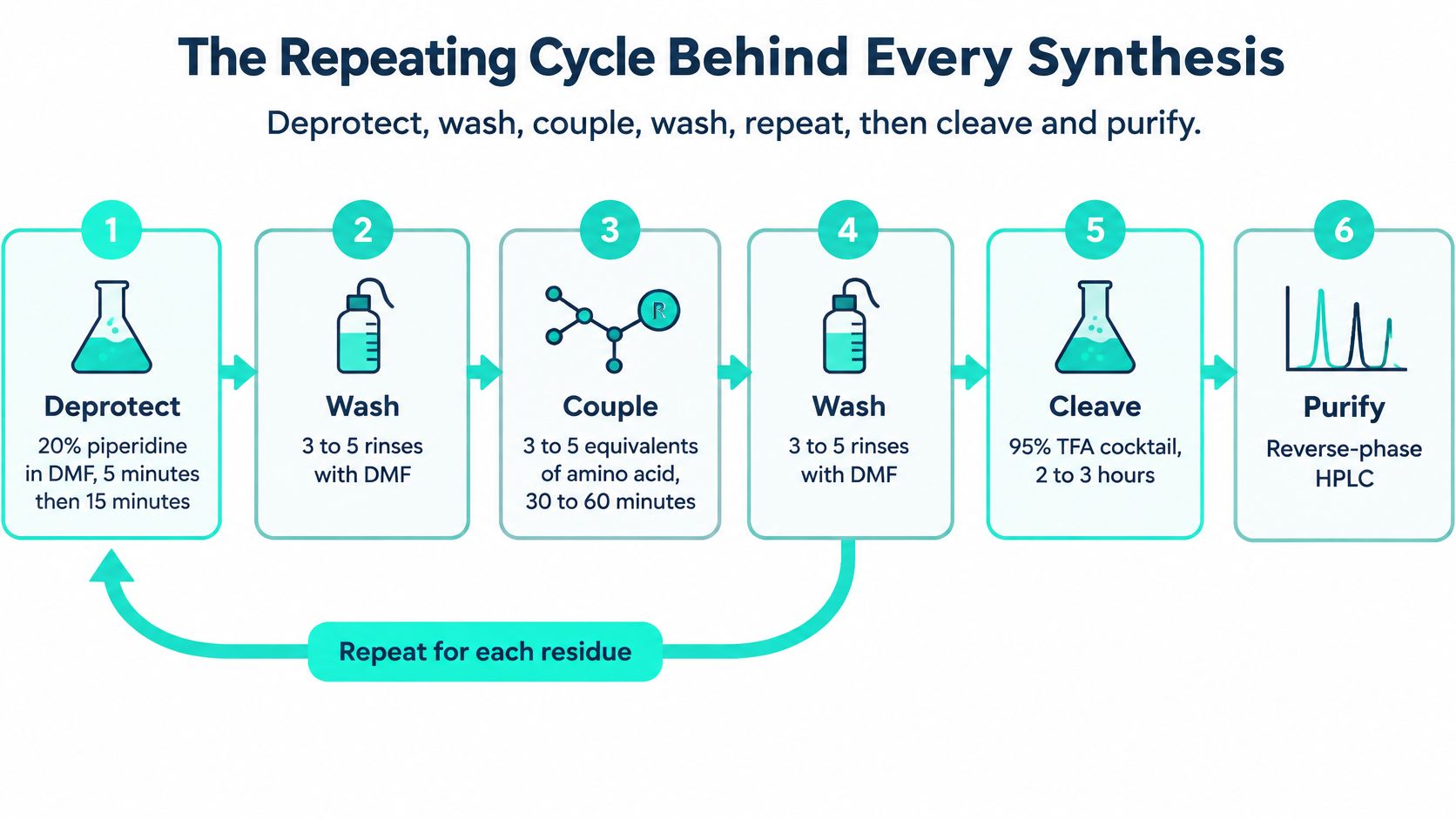
Solid-phase peptide synthesis works through a repeated wash-and-couple loop. Each cycle exposes the chain's reactive end, attaches one amino acid, then washes away leftover reagents. The resin holds the growing chain in place, much like a workbench keeps a project steady while each piece is added.
The diagram shows the core cycle. Resin preparation happens once before the loop; cleavage, purification, and analysis follow after the chain is complete.
| Stage | Purpose | Typical reagent and time |
|---|---|---|
| One-time setup | Attach the C-terminal Fmoc-amino acid to functionalized resin | Fmoc-amino acid and resin, 1-2 h |
| 1. Deprotect | Remove the temporary Fmoc group from the chain end | 20% piperidine in DMF, 2 × 5-10 min |
| 2. Wash | Remove piperidine and by-products | DMF rinses, several resin volumes |
| 3. Couple | Attach the next protected amino acid to the free amine | 3-5 equivalents with HBTU, HATU or DIC/Oxyma, 30-60 min |
| 4. Wash | Remove unreacted amino acid and coupling reagents | DMF then DCM, several resin volumes |
| 5. Deprotect again | Expose the new chain end for the next addition | Repeat the deprotection conditions above |
| 6. Wash and repeat | Clear remaining reagents, then run the cycle again for each residue | Repeat the wash and coupling steps above |
| Post-synthesis | Release the peptide and remove side-chain protecting groups | 90-95% TFA plus scavengers, 1-3 h |
| Post-synthesis | Precipitate and purify the crude peptide | Precipitation, then preparative HPLC |
| Post-synthesis | Check mass and purity | LC-MS for mass, analytical HPLC for purity |
The six steps describe the repeated loop: deprotect, wash, couple, wash, deprotect, then wash before the next round. The initial attachment is setup, not part of that loop. Cleavage and purification happen only after the sequence is assembled.
Coupling uses excess amino acid to help drive attachment toward completion. Any unreacted material can then be washed away. Solvent choices also matter when preparing stock solutions and handling the product; see this guide to acetic acid use with peptides.
The video shows the sequence in motion, which can make the repeated steps easier to follow than a static table.
The simple loop can hide missed couplings. If each coupling succeeds 99% of the time, a 30-residue product contains about 74% full-length material before purification, based on 0.99 raised to the 30th power. At 95% success per coupling, about 21% remains full length. Estimate a sequence's expected full-length fraction by raising the per-step success rate to the number of couplings.
Cleavage releases a crude mixture, not a ready-to-use peptide. Purification and checks of identity and purity are still needed to assess what the synthesis produced.
SPPS is most useful when you need an exact short sequence, a modification at one chosen position, or many related sequences made in parallel. The table gives the pattern first, then three lab examples show why those fits matter.
| Application | Typical length | Why SPPS fits |
|---|---|---|
| Epitope and antigen peptides for antibody work | 8-25 residues | Exact sequence and a label placed at a chosen residue |
| Kinase substrates and inhibitor peptides | 5-20 residues | Phosphorylated or non-natural residues at defined positions |
| Receptor ligand and hormone analogs | Short to medium sequences | Full control over sequence and stereochemistry |
| Peptide libraries for screening | Short sequences in parallel | Parallel synthesis on separate resin spots or beads |
| Cyclic and stapled peptides | 8-20 residues | Head-to-tail or side-chain cyclization on the resin |
| Fluorescent or biotin-labelled probes | 8-25 residues | Label added at the chosen residue during synthesis |
The laboratory image below reflects the hands-on preparation and handling that still surrounds automated synthesis and downstream testing.
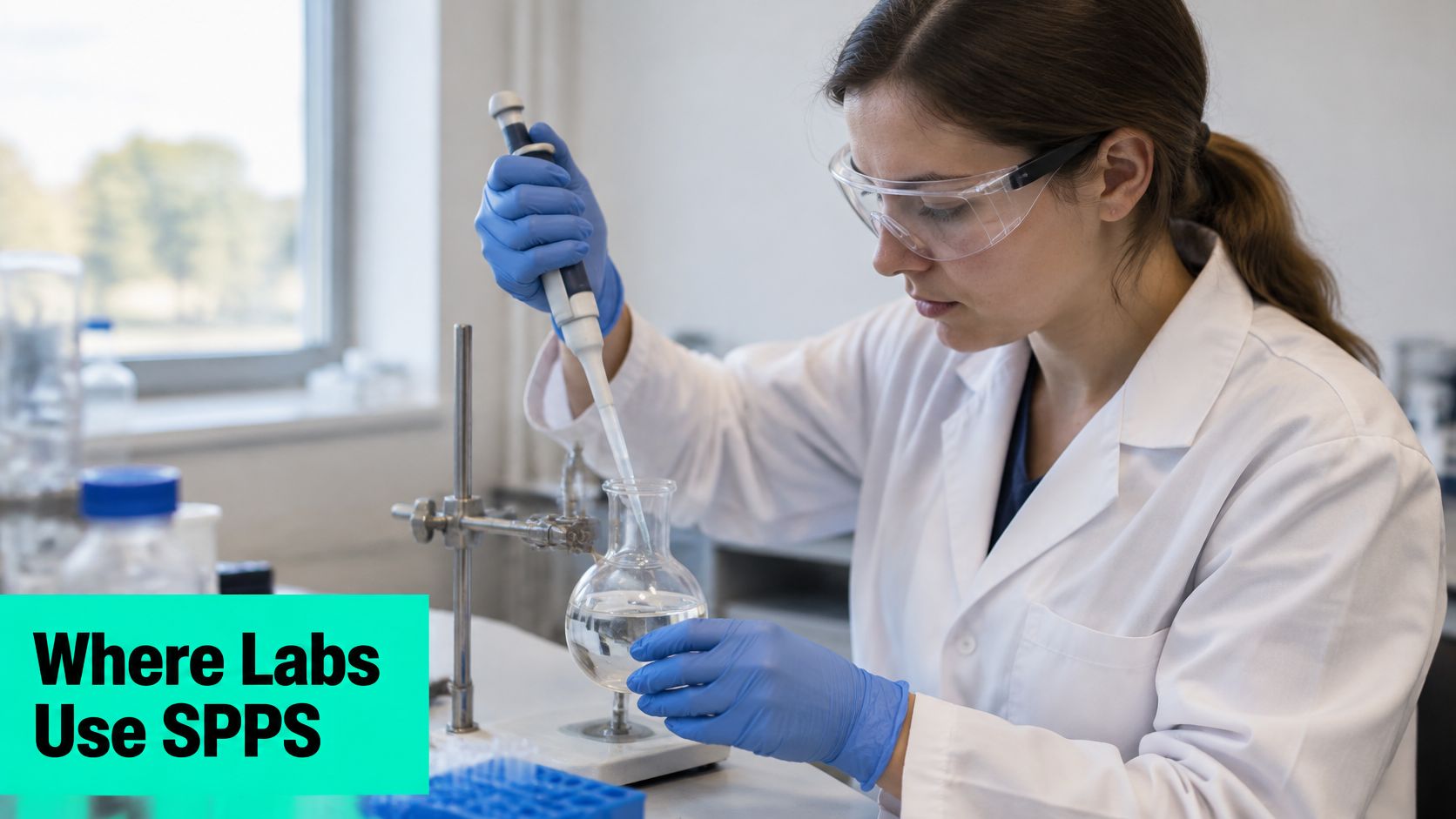
An immunology lab might order a 15-residue epitope with biotin at the C-terminus so it can coat an assay plate in a consistent orientation. The label isn't decoration. Its position determines how the peptide is captured and presented.
A kinase group might place a phosphorylated serine at one defined position to test substrate specificity. Moving that phosphate by even one residue creates a different experimental question. SPPS lets the team specify that position directly.
A screening team can make a library of 500 short peptides on separate resin spots and test them for binding. Pharmaceutical teams also use SPPS for many short therapeutic peptides and for fragments that are later joined through ligation or combined with recombinant routes.
Most research work sits at milligram to gram scale, where SPPS is especially practical. Manufacturing scale changes cost, solvent use, and purification decisions.
If a sequence is under about 30 to 40 residues and needs chemical modifications, SPPS is usually the first option to consider.
SPPS works well for many routine peptides, but it doesn't make every sequence equally easy. The resin simplifies separation after each cycle, yet chains inside and around the beads can experience uneven microenvironments where reagents diffuse poorly. The synthesis discussion at Fluorochem's overview of advances in peptide synthesis is useful background for why difficult sequences need more than the basic cycle.
Those failures can hide inside a supposedly finished product as deletion sequences, truncated products, epimerized residues, or incorrectly modified side chains. A crude HPLC trace with many closely spaced peaks often points to repeated coupling trouble rather than one isolated mistake. Reviewing peptide separation techniques helps you judge whether those peaks can realistically be resolved during purification.
Don't troubleshoot by changing everything at once. Change one variable, then check whether crude purity and mass data improve.
Solid phase means higher purity. It doesn't. The resin makes washing easier, but it can also hold chains in uneven environments where reagents don't diffuse uniformly. Final purity depends on sequence behavior, coupling efficiency, cleavage, and purification, so you judge it from analytical data rather than the synthesis label.
Greener SPPS is solved by swapping one reagent. A replacement for DMF, piperidine, or a coupling reagent must still preserve resin swelling, coupling rate, conversion, stereochemical integrity, impurity control, operator safety, waste treatment, and regulatory acceptability. If a greener solvent slows coupling and creates more failed batches, the total process may get worse.
That broader accounting matters in the sustainability discussion covered by ACS Sustainable Chemistry and Engineering research on greener peptide synthesis. Solvent selection and in-situ Fmoc removal can reduce washing, while preparative reversed-phase HPLC can remain highly resource intensive. Aqueous or micellar approaches may reduce organic solvent use, but they still carry substantial technical challenges.
One recipe fits every sequence. It doesn't. Coupling time, activator choice, reagent excess, resin loading, and monitoring need adjustment when a sequence aggregates or contains hindered residues. A protocol that works for a soluble 12-mer may fail badly on a hydrophobic sequence of similar length.
Judge sustainability with process mass intensity, solvent volume per gram, isolated yield, aqueous waste, and purification cycles per verified gram, not with a green chemistry label alone.
The greenest process may be the one that produces a verified product with the fewest repeats, least solvent, and lowest purification burden. Failed synthesis is waste, even if one reagent in it sounds environmentally friendly.
Before any cell or animal work, confirm the peptide is the sequence you ordered. A supplier page may state a purity figure or third-party testing, and Celonyx Labs is one supplier that presents research peptides through an online catalog, but your decision should rest on the lot-specific certificate of analysis. Match that certificate to the vial in your hand.
The checklist image summarizes the release decision, while the numbered items below add fields that are easy to overlook.
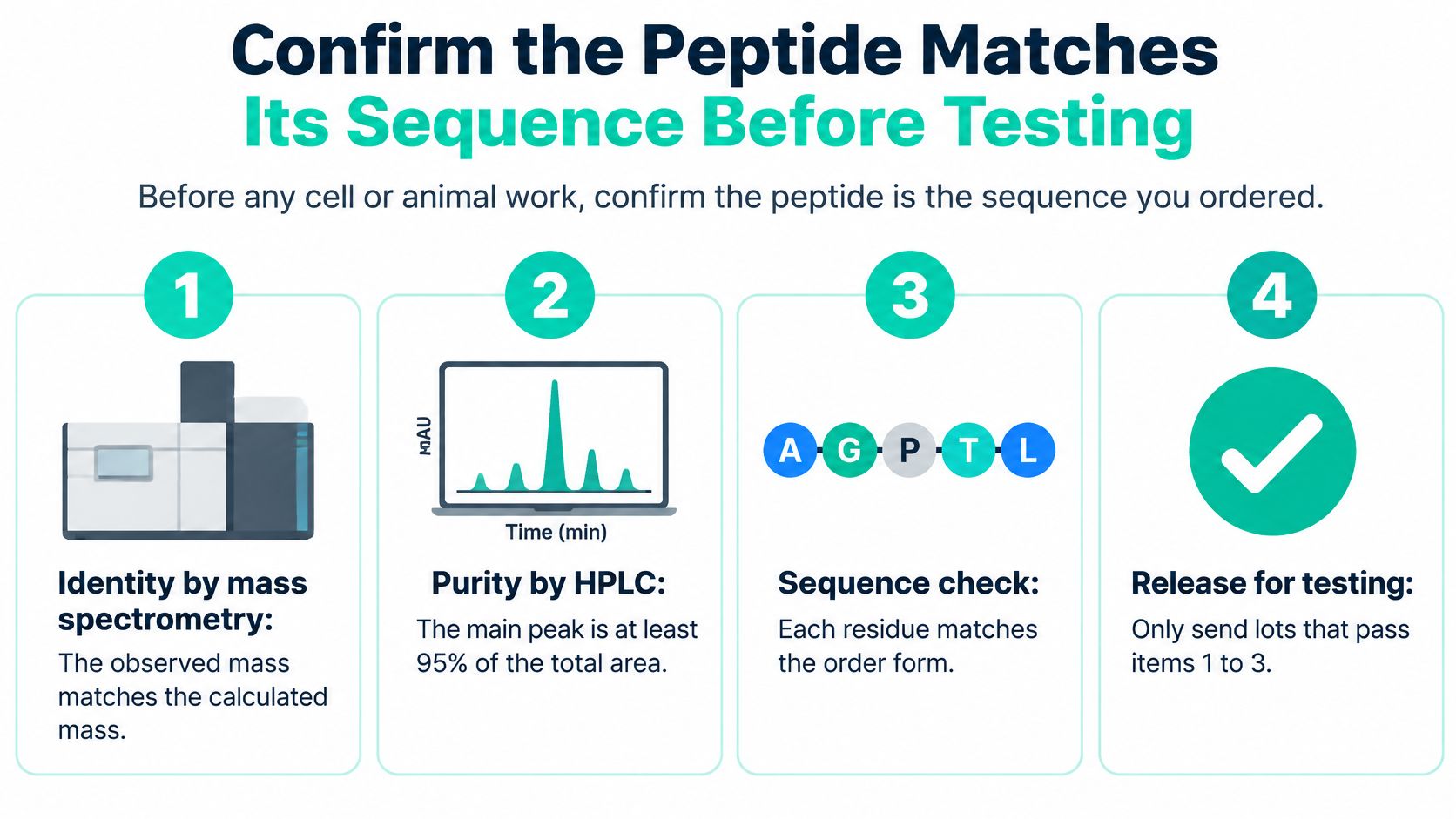
Identity and purity answer different questions. A high chromatographic percentage doesn't by itself prove the correct sequence, stereochemistry, oxidation state, or cyclic form. Use the guidance on HPLC-MS analysis to separate those checks instead of treating one clean peak as complete proof.
Request the lot-specific certificate today and run your own identity check before the first experiment. That small pause can save an entire study built on the wrong material.
If you're sourcing research peptides for laboratory work, review the available sequences, product information, and lot documentation before you order. Visit Celonyx Labs to browse the catalog and contact the team with questions about availability, ordering, or the documentation you need for your next experiment.
Solid phase peptide synthesis is a method that builds a peptide one amino acid at
500 mcg equals 0.5 mg, a labeled research quantity, and no published human study establishes
Choose the best GHK-Cu peptide format for laboratory skin and wound-healing research. Compare documentation, assay
FOR RESEARCH USE ONLY. Products sold by Celonyx Labs are intended exclusively for laboratory and scientific research. They are not intended for human or veterinary use, consumption, diagnosis, treatment, cure, or prevention of any disease. By purchasing from this site, you acknowledge that you understand the intended research purpose of these materials and agree to comply with all applicable laws and regulations.