
Research peptide subcutaneous injection: Not safe in 2026
Is subcutaneous injection safe for research peptides? No—purity does not establish human safety. Learn what

No. 99% purity does not establish that a peptide is safe or suitable for your research: it describes a result from a particular analytical method, not a complete assessment of identity, contamination, stability, or experimental compatibility.
A 99% purity result is one quality measurement, not a safety certificate. Before accepting a peptide, determine what the percentage measures, whether the tested sample represents your batch, and whether the evidence addresses your intended experiment.
For a laboratory reviewing materials in 2026, the distinction is practical: a result suitable for checking synthesis-related impurities does not automatically answer questions about microbial contamination or biological activity. Start with the peptide purity testing guide for contract research organizations when organizing your analytical review.
The following tests address different questions. None replaces the others.
| Evidence | Best for | What it supports | What it does not establish alone |
|---|---|---|---|
| HPLC purity result | Reviewing resolved chromatographic impurities | Relative peak areas under the reported method | Complete identity, sterility, or peptide content by mass |
| Mass spectrometry result | Checking molecular mass | Whether an observed mass is consistent with the intended peptide | Complete sequence confirmation or absence of every contaminant |
| Peptide content measurement | Preparing quantitative experiments | Amount of peptide under the stated measurement basis | Sterility or biological activity |
| Sterility test | Assessing microbial contamination | Results under the specified test conditions | Absence of endotoxins or chemical impurities |
| Endotoxin test | Assessing endotoxin contamination | Endotoxin result within the method's scope | Sterility or absence of every inflammatory contaminant |
| Stability evidence | Evaluating storage and handling | Behavior under the conditions studied | Suitability under untested conditions |
A certificate of analysis, or COA, should connect these results to an identifiable batch. A certificate heading alone is not enough; the methods, sample identity, and interpretation determine what the document supports.
A research material can meet a chromatographic purity specification and still introduce an uncontrolled variable into an experiment. Chemical impurities, incorrect concentration, microbial contamination, and degradation are different problems with different checks.
Celonyx Labs is a research-peptide supplier for laboratory researchers and scientists, not a source of human-use medicines. Its stated 99% purity and third-party testing are relevant quality signals, but those signals do not replace your laboratory's acceptance criteria.
In 2026, keep two decisions separate: whether the supplier's analytical evidence is credible, and whether the particular batch meets your protocol. The first supports purchasing review. The second supports experimental use.
When a report specifies HPLC area purity, 99% generally means that the assigned main peak accounts for that proportion of the integrated peak area under the reported method. The result depends on separation, detection, and integration conditions. Read the calculation basis before interpreting the number.
The remaining 1% of integrated area is not automatically 1% of the vial's total mass. Detector responses differ between substances, and some components are not measured by the selected method. Water, counterions, and residual solvents require appropriate measurement rather than inference from a chromatogram.
This is why chromatographic purity and peptide content are not interchangeable. A vial's stated material mass does not, by itself, tell you the mass of peptide available for a quantitative assay.
Ask these questions when reading a purity report:
Do not interpret a clean-looking chromatogram as evidence for every quality attribute. It is evidence within the scope of its method.
A purity result describes the sample's measured composition under a method. Identity testing addresses whether the material matches the intended compound. You need both questions answered when a mistaken identity would invalidate the experiment.
Mass spectrometry provides molecular-mass evidence. That is useful, but an expected mass alone does not establish every structural detail: some different structures share the same mass. Sequence-sensitive or other characterization methods become relevant when the research question requires that distinction.
Review the reported findings rather than accepting an instrument name as the conclusion. A document that lists mass spectrometry should also explain what was observed and how that observation supports the assigned identity.
Use identity evidence to confirm the material, and purity evidence to assess the measured impurity profile. Neither result should be asked to prove something outside its analytical scope.
99% purity does not establish sterility, and sterility does not establish absence of endotoxins. Chromatography, microbial testing, and endotoxin testing measure different attributes.
USP General Chapter <71> addresses sterility tests; USP General Chapter <85> addresses bacterial endotoxins testing. These are distinct analytical frameworks, not interchangeable labels. Mention of either chapter on a document still requires review of the actual method, sample, result, and intended application.
For biological experiments, identify which contaminants would interfere with the endpoint before selecting acceptance requirements. Endotoxin contamination is particularly relevant when interpreting inflammatory responses. A chromatographic purity percentage does not answer that question.
A preservative-containing solvent also does not retroactively demonstrate that the original peptide material was sterile or endotoxin-controlled. Evaluate the material and the preparation process separately.
Use a documented acceptance sequence before releasing material for an experiment. These steps organize the decision; they do not replace your institution's procedures or the compound-specific documentation.
The release decision should follow the evidence in that order. Starting an experiment and reviewing the certificate afterward reverses the control process.
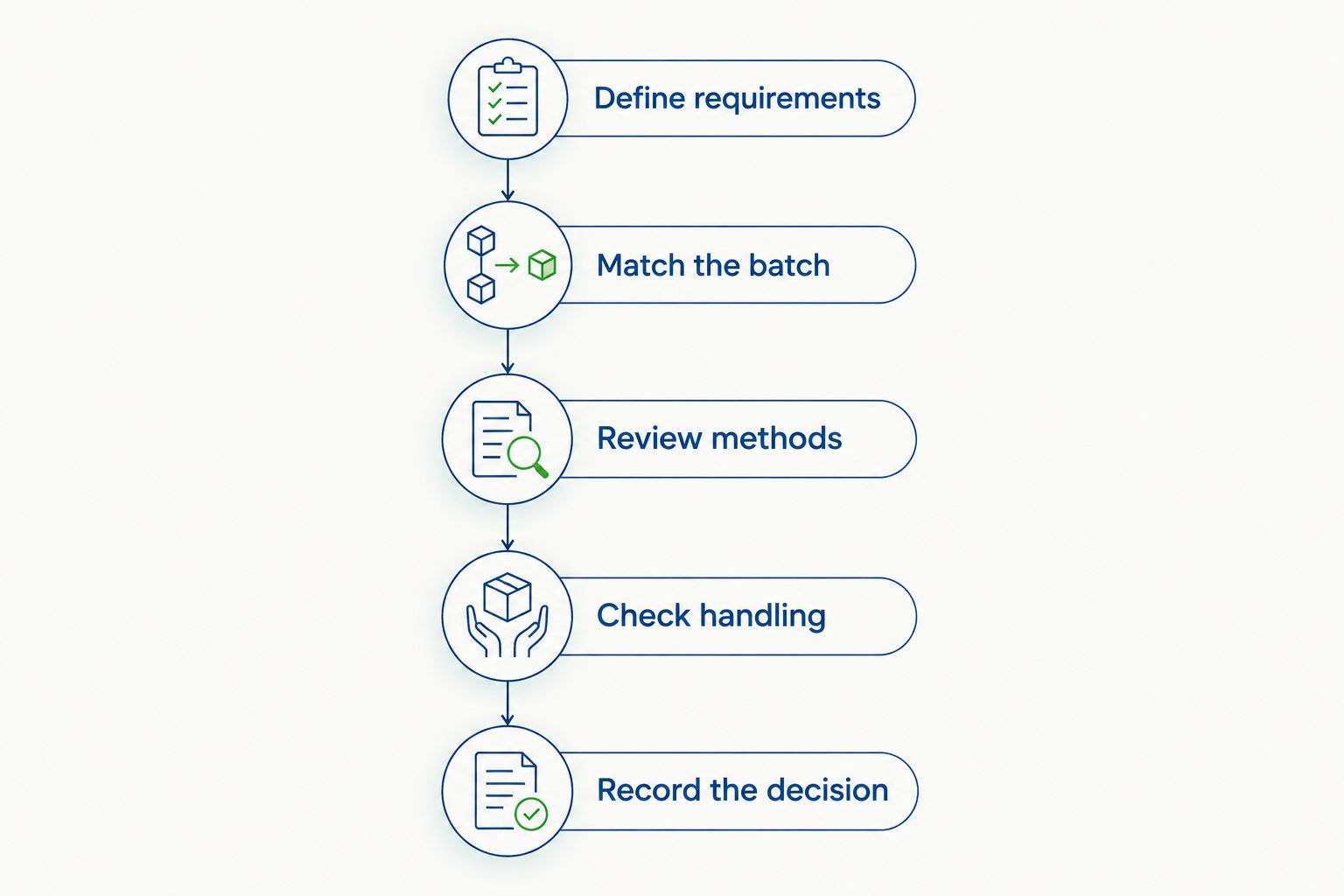
Keep the acceptance record alongside the experimental record. The guide to connecting peptide purity data to your electronic lab notebook addresses that documentation task without replacing the underlying analytical review.
The same reported purity percentage can support different decisions because experiments impose different requirements. During a 2026 material review, evaluate these factors rather than assuming that a higher percentage resolves every concern:
There is no universal acceptance rule that turns a research peptide into a suitable reagent for every experiment. Define suitability against the protocol, not against the largest number on the product description.
Third-party testing identifies an external testing relationship. Its value depends on the tested sample, the method, and the reported result—not just the phrase on a listing.
Celonyx Labs describes its research peptides as 99%-pure and third-party-tested. Use those statements as a starting point for document review, then evaluate the batch-specific evidence needed for your experiment.
A useful review distinguishes the laboratory that performed the work from the supplier that provided the sample. It also checks whether the sample identifier can be connected to the received material. These details determine how confidently the result applies to your vial.
The benefit of third-party testing is an external analytical result. The limitation is its scope: a purity test remains a purity test even when an independent laboratory performs it. It does not become a sterility, stability, or human-safety assessment.
A peptide reported as 99% pure can still be unsuitable for a particular experiment. An unresolved identity question, an unsuitable concentration basis, or contamination outside the purity method's scope can undermine interpretation.
Separate the failure modes when investigating unexpected results. Repeat analysis of the same quality attribute does not answer a different question; another purity measurement, for example, does not resolve an endotoxin concern.
99% purity does not establish human safety. Research-use-only labeling identifies a laboratory-use context; it is not approval for administration to people or evidence of clinical safety.
Keep laboratory acceptance separate from medical decisions. A research certificate does not substitute for the evidence, manufacturing controls, and authorization required for a human-use medicine.
For a 2026 document review, use established analytical references to understand what the methods demonstrate. ICH Q2(R2), Validation of Analytical Procedures, addresses analytical procedure validation; ICH Q14, Analytical Procedure Development, addresses procedure development.
USP General Chapters <71> and <85> address sterility and bacterial endotoxins testing, respectively. These references help you distinguish method scope from supplier language. They do not establish that a particular supplier or batch complies with them.
Check a claimed standard against the report's actual procedure and result. Naming a standard is not the same as demonstrating conformance.
Does 99 percent purity mean a peptide is safe for research?
No. A 99% purity result does not establish identity, sterility, endotoxin control, stability, or suitability for your experiment; review those requirements separately.
What does 99% HPLC purity mean on a peptide certificate?
A 99% HPLC area-purity result generally describes the assigned main peak’s share of integrated peak area under the reported method. It does not automatically mean that 99% of the vial’s total mass is peptide.
Is a 99%-pure peptide sterile?
A 99%-pure peptide is not demonstrated to be sterile by its purity result alone. Sterility requires evidence from an appropriate microbial assessment, separate from chemical purity testing.
Does third-party testing prove a research peptide is safe?
Third-party testing does not establish complete safety by itself. Review the tested sample, method, batch connection, and result to determine what the evidence supports.
What should I check before using Celonyx Labs research peptides?
Check that the batch documentation supports your experiment’s identity, purity, content, contamination, and handling requirements. Celonyx Labs research peptides are for research use only, not human administration.
Is peptide purity the same as peptide content?
Peptide purity and peptide content are different measurements. Chromatographic area purity describes a method-specific peak-area relationship, while peptide content addresses the amount of peptide under a stated measurement basis.
Can a peptide meet its purity specification but fail my laboratory’s requirements?
Yes. A peptide can meet a purity specification while lacking acceptable evidence for another required attribute, such as identity, endotoxin control, or stability under your handling conditions.
The most useful question is not whether the purity number is high enough, but whether the evidence answers your experiment's risks. For your 2026 acceptance checklist, add a field beside each required quality attribute that identifies the supporting test or document.
If the only entry is a purity percentage, the checklist is treating different questions as one. Separate them before releasing the batch. That simple documentation change makes the acceptance decision easier to inspect and harder to misunderstand.
Is subcutaneous injection safe for research peptides? No—purity does not establish human safety. Learn what

Does 99 percent purity mean a peptide is safe for research? No. Learn what purity

Can research peptides be shipped internationally? Yes, subject to import and export rules. Learn the
FOR RESEARCH USE ONLY. Products sold by Celonyx Labs are intended exclusively for laboratory and scientific research. They are not intended for human or veterinary use, consumption, diagnosis, treatment, cure, or prevention of any disease. By purchasing from this site, you acknowledge that you understand the intended research purpose of these materials and agree to comply with all applicable laws and regulations.