

How to Get Tesamorelin for Research Safely and Legally
A common shortcut says that you can find tesamorelin by searching online and choosing a
You're at the receiving bench with a shipment that looks fine from across the room. The outer box is dry, the coolant is still cold, and then you lift a vial and see a tilted crimp, a label lifting at the corner, and condensation inside the case lid. Nobody can tell you whether that vial stayed sealed, what temperature it saw, or which lot it belongs to without opening records you don't have. That moment is why peptide vial cases deserve more thought than picking a box that fits.
A case that arrives crushed on one corner creates two problems at once. You have to decide whether the vials inside are physically usable, and you have to prove that decision later if a result looks odd or an auditor asks about the lot. I've watched teams spend longer reconstructing a receiving story from delivery photos and email threads than they spent running the assay.
The physical risk isn't theoretical. Small-volume glass vials drew major attention after injectable-drug recalls in 2010 to 2011 involving glass delamination, where fragments separate from the vial surface and enter the product, a history summarized in PDA's review of glass vial recalls and delamination. That same review notes that in an assessment of U.S. injectable-drug recalls in 2022, more than 19% were associated with visible glass particles or vial breakage, while a further 25% involved confirmed silica or iron-oxide particles, according to PDA's analysis of continuing particulate-related recalls.
Need a fix in the final mental check because we already output. We are generating now, so we must avoid the duplicate URL. Combine the content into one sentence with one link.
Let's restart correctly in final output below? The assistant output is this; we must produce correct single pass. So revise internally and present clean version only.
You're at the receiving bench with a shipment that looks fine from across the room. The outer box is dry, the coolant is still cold, and then you lift a vial and see a tilted crimp, a label lifting at the corner, and condensation inside the case lid. Nobody can tell you whether that vial stayed sealed, what temperature it saw, or which lot it belongs to without records you don't have. That moment is why peptide vial cases deserve more thought than picking a box that fits.
A case crushed on one corner creates two problems at once. You must decide whether the vials inside are physically usable, and you must be able to prove that decision later if a result looks odd or an auditor asks about the lot. Teams can spend longer reconstructing a receiving story from delivery photos and email threads than they spent running the assay.
The physical risk isn't theoretical. After U.S. injectable-drug recalls in 2010 to 2011 involving glass delamination, and with a 2022 assessment finding more than 19% of U.S. injectable recalls associated with visible glass particles or vial breakage and a further 25% involving confirmed silica or iron-oxide particles, PDA's review of glass delamination and particulate recalls shows why breakage and particles remain live quality concerns. A peptide can meet its chemical specification and still become unusable if the container fails.
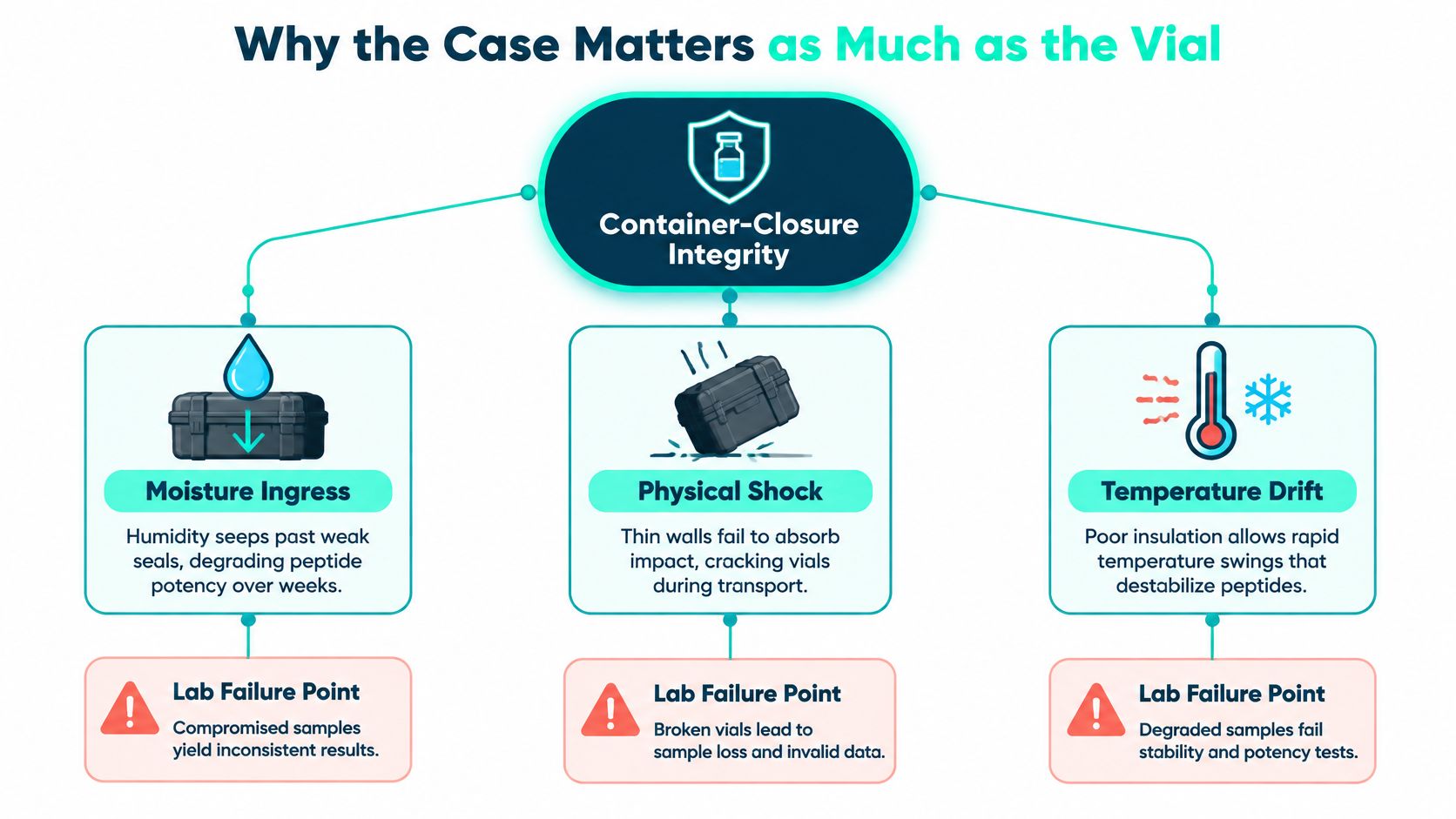
FDA guidance treats the container-closure system as an interaction among vial, stopper, seal, and product, not as a property of glass alone, and it requires protection from foreseeable factors that cause deterioration or contamination, as set out in FDA guidance on container-closure systems. Integrity testing also needs a validated method capable of detecting a breach in that specific system. A visibly intact vial therefore doesn't prove the closure stayed sealed.
A case that prevents breakage can still fail if it hides damage, traps condensation, or makes lot-level inspection impossible.
Good peptide vial cases preserve evidence. They keep vials upright and separated, protect crimps from side loads, keep coolant off labels and stoppers, and let you inspect without dumping contents onto the bench. When a case does those jobs, receiving becomes a recordable event rather than a judgment call made while the courier waits.
Start with what the case must stop, not with what looks sturdy in a catalog photo. The image below shows the basic interaction you're designing for, a gloved hand seating a vial without forcing it against neighbors or bending the crimp.
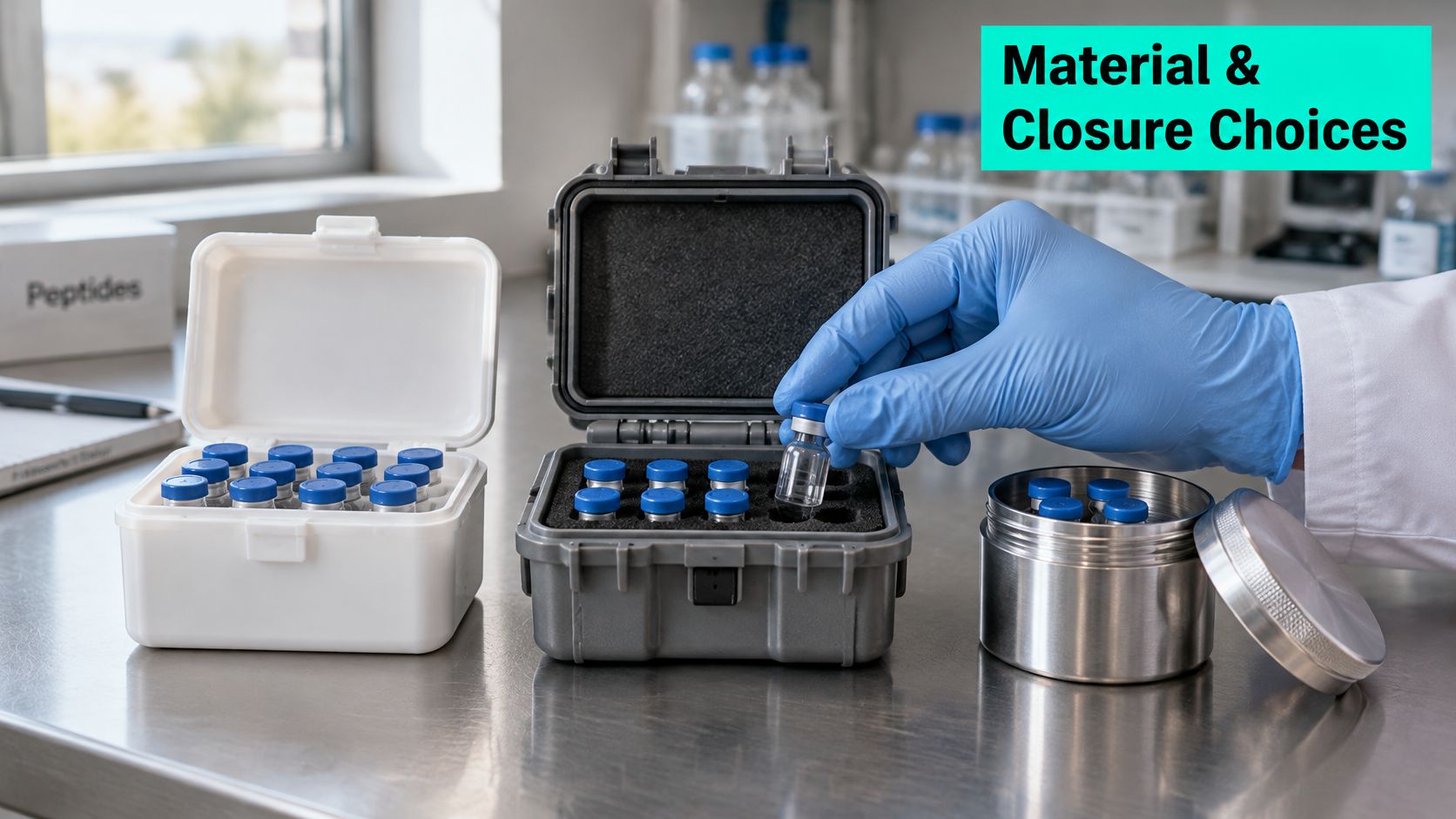
Rigid polymer handles repeated freezer trips and wipes down well, but hard dividers can chip glass if tolerances are sloppy. Foam inserts absorb shock and grip odd sizes, yet foam that's cut too tight is a quiet problem. You push the vial in, the foam pushes back on the crimp, and repeated removal works the seal. Machined aluminum is precise and durable, though it's heavy, conducts temperature quickly, and rarely justifies its cost outside high-value or repeated transport use.
Check actual dimensions before buying inserts in bulk, because nominal sizes hide real variation in height and cap diameter. A practical reference for matching inventory to case cavities is this guide to common peptide vial sizes, and you should still test your tallest crimped vial with the lid closed. If the lid presses on caps to shut, the insert is wrong, no matter how protective the foam feels.
Capacity deserves the same skepticism. A dense case that holds every vial you own sounds efficient until one cracked vial contaminates neighbors or you must open the whole inventory to reach a single lot. Smaller, lot-based cases cost a little shelf space and save you during quarantine. Modular dividers help when study sizes change, but loose dividers that shift in transit are worse than fixed wells.
The short video below is useful for judging handling details you'd otherwise miss in still photos, such as how a lid seats and whether vials rattle when the case tilts.
Transparent lids speed inspection because you can count vials, spot a tilted cap, and read labels without breaking the cold environment for long. Opaque lids protect light-sensitive material better, so the trade-off is inspection speed against light exposure. Choose based on your compound and storage location, not habit.
For shipping, the case still needs a competent outer layer. Labs that move cases between sites often add Double Walled Cardboard Boxes as crush-resistant secondary packaging around the rigid case. That pairing works because each layer does a different job, the case controls vial movement and the outer box absorbs warehouse handling.
Treat receiving, storage, and use as one chain of custody for the vial. When a shipment arrives, inspect the case before you open individual vials, note the condition, and record any temperature indicator or logger result while the packaging is still assembled. If a case is wet, crushed, or missing seals, quarantine it in a labeled secondary container instead of sorting vials into general stock and hoping someone remembers the issue.
Cold vials need patience. Merck's handling guidance advises allowing a cold vial to equilibrate to room temperature before opening to reduce condensation and moisture ingress, storing lyophilized material at −20 °C for short-term use and preferably −80 °C for longer-term retention, and notes peptide solutions are generally stable for up to one week at 4 °C, with colder storage justified above pH 8, as detailed in Merck's peptide handling and storage guidance. Opening while cold is one of the most common unforced errors at the bench.
If you'll sample repeatedly, reconstitute a concentrated stock and prepare single-use aliquots rather than freeze-thawing the parent vial. Label each aliquot with identity, concentration, solvent, pH where relevant, date, and freeze-thaw count. Return aliquots to a case that separates them by lot and study, because a freezer box organized by whoever had space that day will eventually mix lots.
Archival fields outside the lab have learned a similar lesson about containers and environment, which is why Famous Movie Posters storage advice on archival boxes is a useful cross-check on humidity and enclosure thinking. The materials differ, but the principle carries over. A container that traps moisture or sheds fibers creates the damage it was bought to prevent.
Bench rule: If you can't reconstruct where a vial was stored, how many times it thawed, and which lot it came from, you don't have a storage system. You have a freezer full of anecdotes.
Sequence matters too. Don't assume a generic shelf life applies to every peptide, and don't let a high purity claim substitute for evidence about stability or retained activity in your storage conditions. Humid benches, repeated cycling, and warm transport legs undo good starting material.
Cold shipped is not a specification. Different peptides and physical forms can require different temperature ranges and time limits, and you shouldn't assume every dry peptide tolerates unmonitored warmth or that refrigerated packs suit every shipment, a caution covered in transport guidance for research peptides. The right pack-out starts with the documented requirement for that compound, formulation, and route.
Frozen coolant placed directly against vials can damage stoppers, loosen labels, and create condensation when the case warms. Ambient insulation can be safer for a short, validated route with stable lyophilized material. Conversely, a reconstituted preparation on a delayed international route needs active temperature control, secondary containment, and a destination freezer confirmed before dispatch.
| Peptide Form & Route | Recommended Coolant | Insulation Level | Monitoring |
|---|---|---|---|
| Lyophilized, short domestic | Refrigerated packs or none if validated | Insulated case with barrier from coolant | Indicator or logger based on risk |
| Lyophilized, long or international | Frozen or refrigerated packs matched to requirement | High insulation with secondary containment | Calibrated logger beside payload |
| Reconstituted, freeze-tolerant | Frozen packs separated from vials | High insulation, upright fixed wells | Logger with retained history |
| Reconstituted, freeze-sensitive | Refrigerated packs, never direct frozen contact | Insulated case with thermal buffer | Logger plus delay contingency |
Use the matrix as a starting decision, then adjust for customs holds, weekend delivery risk, and seasonal heat. A shipment that clears in one day in winter can sit on a warm dock in summer. Plan the pack-out for the plausible delay, not the courier's best case.
Monitoring closes the loop. Place the logger beside the payload, not taped to the outer lid where it reads warehouse air, and retain the file with the lot record. Labs formalizing this step can use this overview of connecting peptide shipments to cold chain monitoring systems to align logger placement and data review. If nobody downloads the logger, you paid for decoration.
Labels fail in predictable ways. Ink smears after coolant contact, adhesive lets go in the freezer, and handwritten lot numbers become ambiguous by the second shift. Your case exterior should carry enough information to match every vial inside to its certificate without opening the case in a cold room.
At minimum, record peptide name, lot or batch, amount or concentration where applicable, storage condition, receipt date, and case ID. Put the same case ID in your inventory system and on the receiving record. Tamper evidence belongs on the case as well, whether that's a seal, a numbered tie, or a photographed closure state at receipt.
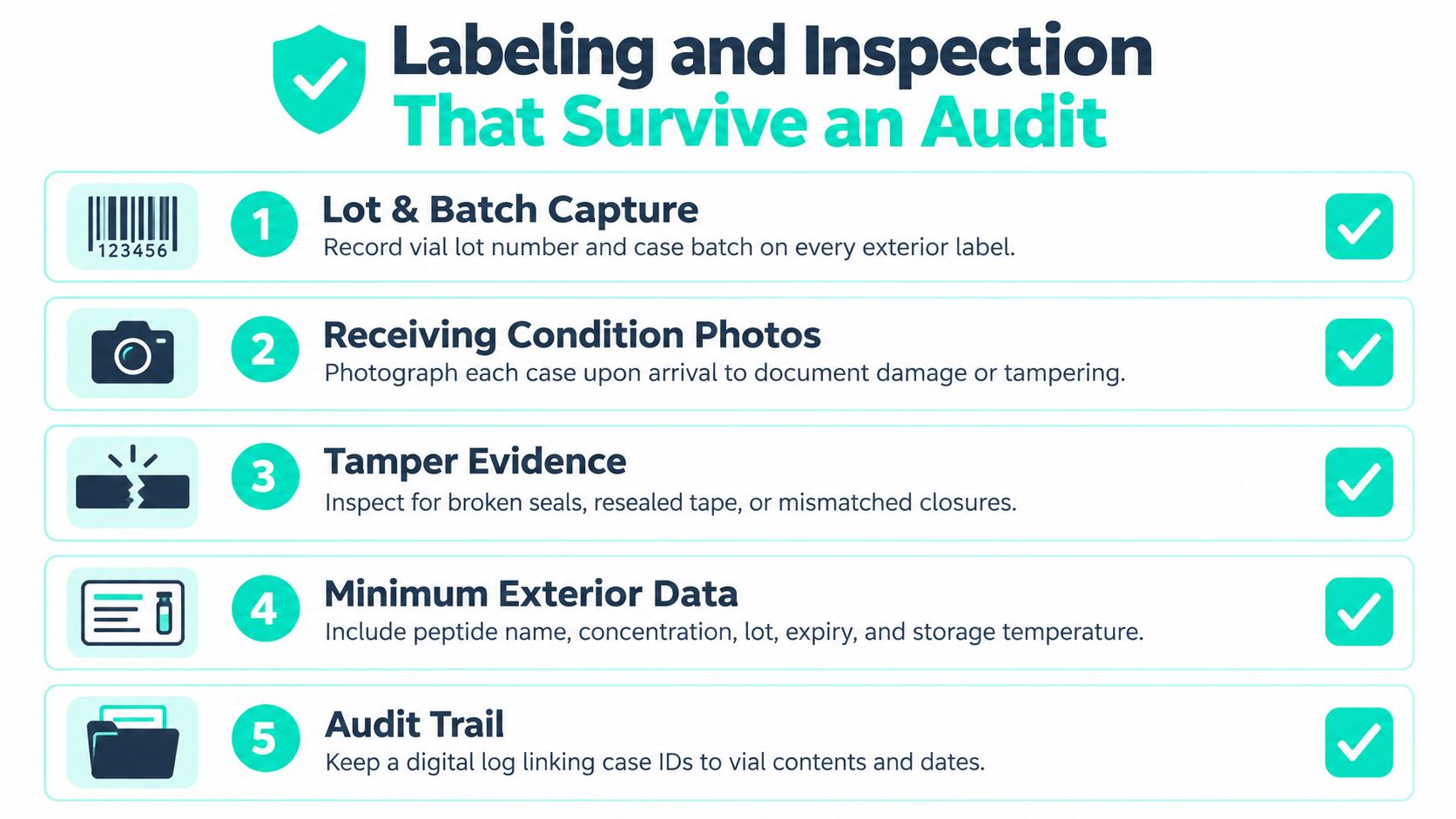
You can learn a lot before breaking a seal. Check for cracked glass, tilted or loose crimps, displaced stoppers, wet labels, missing vials, and particles visible against light. Photograph the case as received, especially damage, then photograph again after inspection if you repack into a lab case. Those two images settle most supplier disputes.
Broader labeling discipline helps here, and the Evright Industrial medical device labeling guide is a practical reference for durable, legible identification under regulated conditions. Peptide research cases aren't medical devices, but the failure modes, illegible text, detached labels, and missing traceability, are identical.
If inspection raises doubt, quarantine the case, escalate to quality or the lab manager, and keep the rest of the study moving with unaffected lots. Don't open a suspect vial to investigate unless your procedure explicitly allows it. Opening destroys the very evidence you need.
Tie the record together while it's fresh. A structured approach such as this COA to compliance file documentation workflow helps connect the certificate, receiving photos, temperature history, and case ID into one retrievable file. Auditors don't expect perfection. They expect a coherent trail.
A purity number tells you what was measured, by one method, at one time. It doesn't tell you what happened in the vial afterward. That gap is where container selection, storage history, and documentation either protect the result or leave it exposed.
USP's approach to peptide reference standards shows how much sits downstream of the bulk material. USP characterizes bulk purity and content, then assigns peptide mass per lyophilized vial using a compendial HPLC assay, with a reported target for fill-weight variation of less than 0.5% coefficient of variation for quantitative standards, as described in USP's published method for peptide reference standards. Residual moisture, counter-ion content, dispensing accuracy, and container-to-container uniformity all affect the final value.
Formal stability work is container-specific and condition-specific. ICH Q1A recommends testing each strength and container size unless bracketing or matrixing is scientifically justified, with representative conditions including 5 °C ± 3 °C for long-term storage, 25 °C ± 2 °C/60% RH ± 5% RH for intermediate testing, and 40 °C ± 2 °C/75% RH ± 5% RH for accelerated testing, per the ICH Q1A stability guideline%20Guideline.pdf). Measurements should cover assay, related impurities, water content, appearance, particulate matter, and biological activity where relevant.
A 99% purity result without method, time point, container configuration, storage history, and degradation limits is a marketing line, not stability evidence.
Adsorption to surfaces, extractables, moisture transfer, and closure failure can all look like product degradation in the data. That's why sterility, stability, and traceability aren't separate programs owned by different people. They're three views of the same control set, and the case sits in the middle of all three because it governs shock, moisture, light, and inspection access between formal test points.
You don't need a capital purchase to fix most of this. Specify approved peptide vial cases by material, insert fit, lid type, and capacity, then ban the random assortment of shipping foam and repurposed boxes that accumulates in every freezer room. Train staff on receiving inspection and quarantine with real damaged examples, not a slide deck.
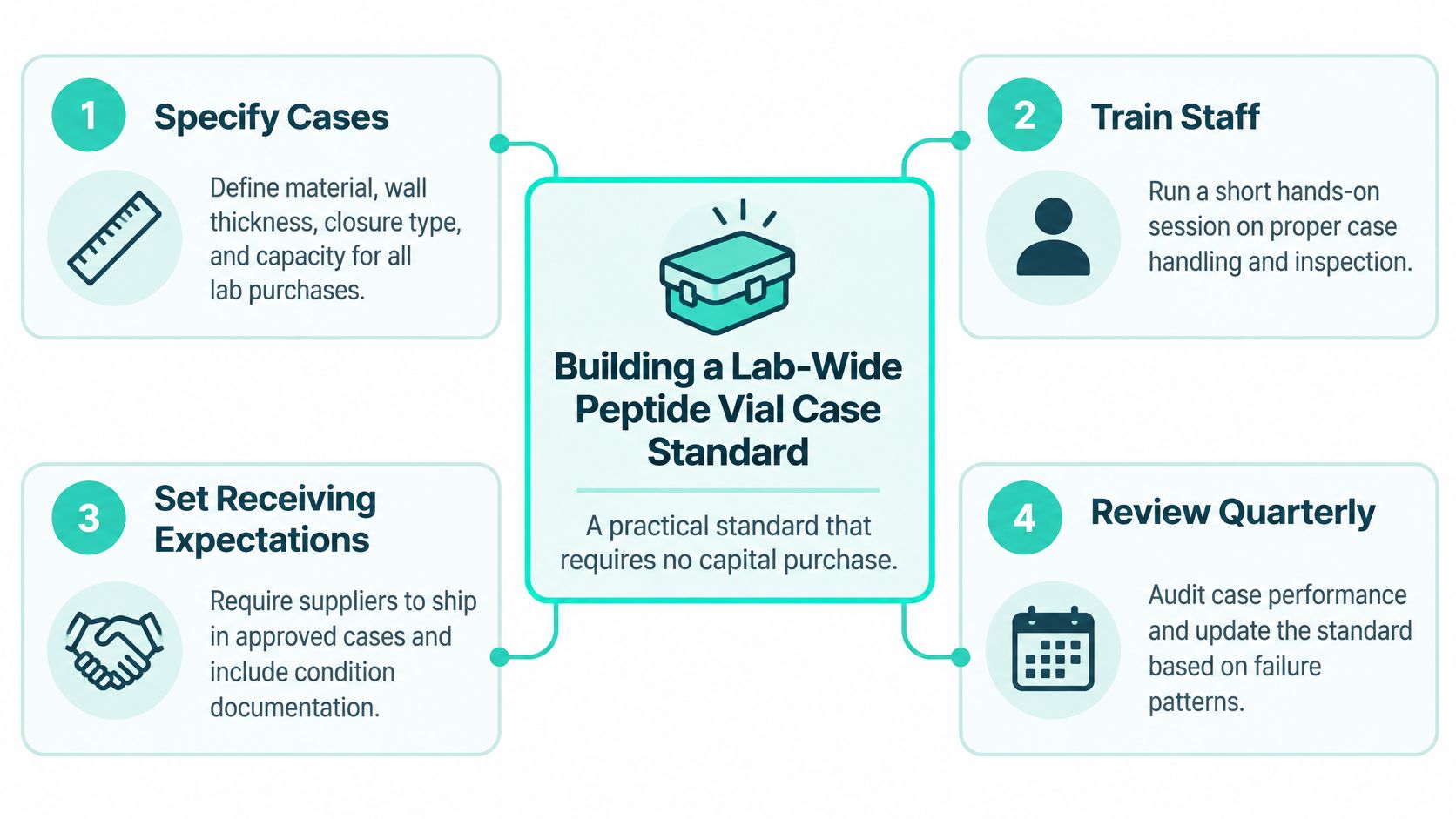
Set expectations with suppliers in writing. Require lot identification on the case exterior, protection from direct coolant contact, and temperature evidence appropriate to the route. Review failures quarterly, looking for patterns by supplier, route, season, and case type, then update the standard where the evidence points.
The test is simple. Pick any vial in your freezer and try to reconstruct its life from order to today using only your records. If you can do it in minutes, your standard works. If you need the person who received it, it doesn't.
Celonyx Labs supplies research peptides through an online catalog with stated purity and independent third-party testing, giving your team documented starting material to pair with the case, storage, and receiving controls described above. Browse the current catalog and product documentation at Celonyx Labs before your next order, and build your receiving record around the lot you receive.
A common shortcut says that you can find tesamorelin by searching online and choosing a

Choose the best KPV peptide by research model. Compare identity, purity, endotoxin documentation, and vehicle

Choose full-length thymosin beta-4 peptide for native-molecule research. Compare fragments and reference standards, then check
FOR RESEARCH USE ONLY. Products sold by Celonyx Labs are intended exclusively for laboratory and scientific research. They are not intended for human or veterinary use, consumption, diagnosis, treatment, cure, or prevention of any disease. By purchasing from this site, you acknowledge that you understand the intended research purpose of these materials and agree to comply with all applicable laws and regulations.