
How to Get Tesamorelin for Research Safely and Legally
A common shortcut says that you can find tesamorelin by searching online and choosing a
A common shortcut says that you can find tesamorelin by searching online and choosing a listing with a familiar product name. That advice skips the question that matters most: what is the material for, and which regulatory pathway applies? A prescription medicine, a laboratory research material, and an online listing may use the same compound name without sharing the same approval status, evidence, documentation, or permitted purpose.
For laboratory buyers, “how to get tesamorelin” should begin with intended use and institutional review, not a checkout page. For anyone considering treatment, the route is different: a qualified clinician evaluates the patient, and an authorized pharmacy dispenses a prescription when appropriate. The two pathways aren't interchangeable.
A biotech buyer sees a listing labeled “tesamorelin” with a 99% purity badge and assumes the name establishes what's in the vial. It doesn't. A product name alone doesn't prove regulatory status, identity, purity, sterility, or suitability for a particular use.

A listing communicates what a vendor claims, not what an independent review has verified. Purity percentages, compound names, and catalog categories are representations. They gain meaning only when matched against documentation, testing evidence, and the institution's own requirements.
The regulated pathway shows why that match matters. In the United States, EGRIFTA SV and EGRIFTA WR are FDA-approved prescription products indicated to reduce excess abdominal fat in HIV-infected adults with lipodystrophy. FDA labeling also states that tesamorelin isn't indicated for weight-loss management because its effect on overall body weight is considered weight-neutral. The FDA's prescribing information for EGRIFTA describes the approved products and their specific uses.
Material sold for laboratory research sits outside that approval. A vendor's research-use listing doesn't become an approved medicine because it names the same compound, and a research label doesn't establish clinical suitability.
Start with purpose: Is this a patient-treatment request or a laboratory research request? The answer determines which review pathway applies and which records must exist.
The deeper test is whether the material, its stated purpose, the vendor's claims, and the institution's records all belong to the same pathway. Procurement, quality, biosafety, and legal reviewers may each need documentation showing what was requested, what the vendor represented, and what material arrived. When the records can't answer those questions, the lab can pause, ask for clarification, or decline.
Readers weighing a separate treatment-access question may find this guide to GLP-1 costs for uninsured useful for understanding how eligibility and payment shape access discussions. It doesn't change tesamorelin's labeled use or replace a clinician's evaluation.
Online searches can place distinct material types side by side. Sort them by pathway before comparing suppliers.
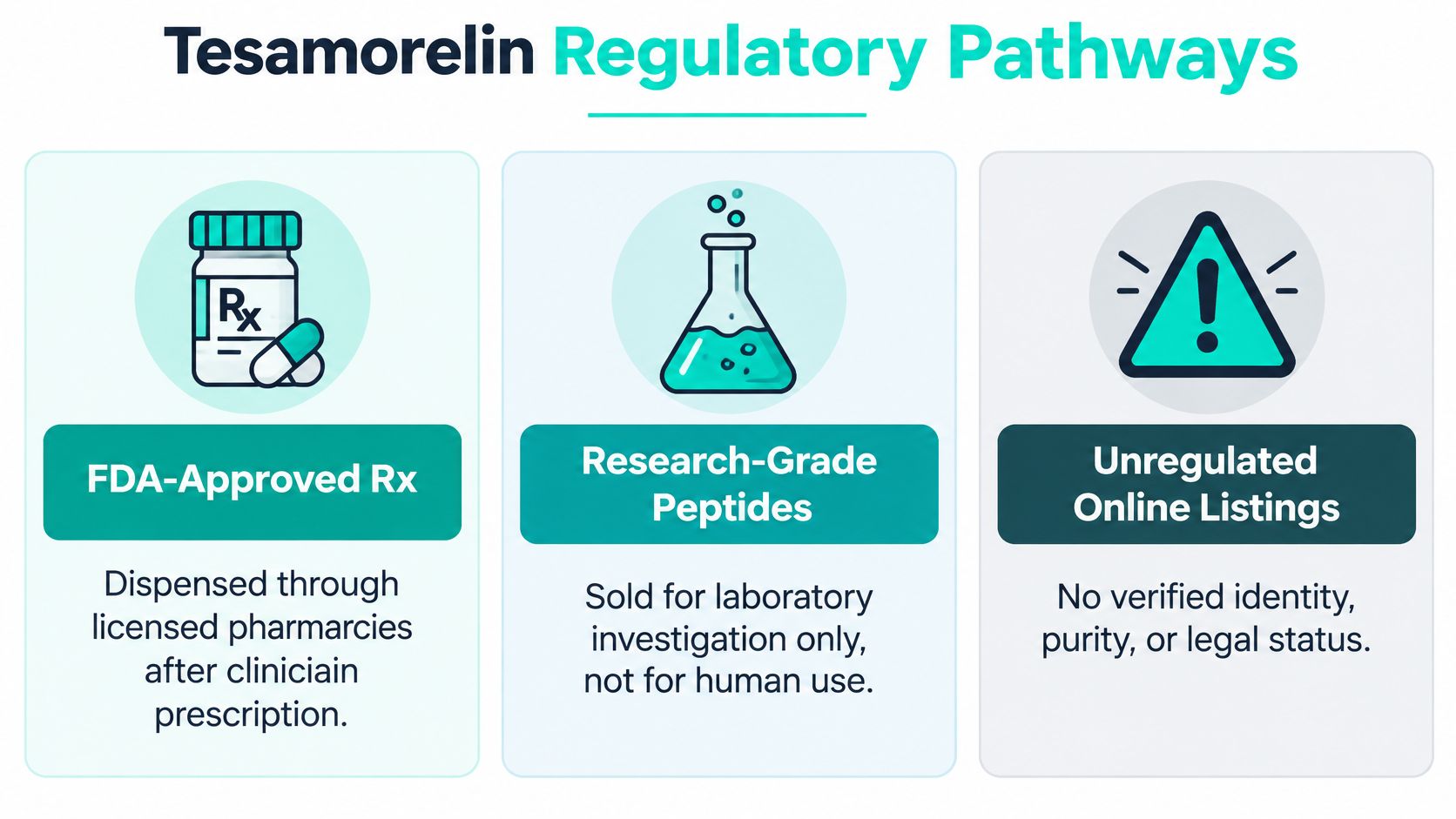
Clinician-prescribed product. EGRIFTA SV and EGRIFTA WR are FDA-approved prescription products for the labeled patient population. Access runs through evaluation by a licensed healthcare professional, a prescription when appropriate, and dispensing through an authorized pharmacy. The clinician weighs the patient's condition, medical history, contraindications, and relevant risks. The prescribing information cited above also carries product-specific directions, including a defined once-daily subcutaneous regimen for EGRIFTA SV, and warns that the two products aren't interchangeable. Those details belong to the approved prescription pathway, not to a laboratory sourcing decision.
Research-use material. This category is intended for laboratory investigation, not human treatment. Its listing, paperwork, and claims don't establish FDA approval or clinical equivalence to a prescription product. A research buyer assesses the material against institutional requirements and the project's authorized scope.
Unverified online listings. A seller's product page is not, by itself, proof of identity, manufacturing controls, sterility, or legal status. Marketing language can't replace records tied to the particular material being evaluated or received.
A pharmacy counter makes the difference concrete: a prescription product arrives with a defined formulation and labeled instructions, with a licensed clinician and pharmacy inside the process, while a research vial is not that product merely because its label uses the same compound name.
The name on the vial is the weakest evidence in the file.
The right comparison isn't "Which listing looks most familiar?" It's "Which pathway matches the intended use, and what records support that decision?"
The pathway test applies to four things at once: the material itself, its stated purpose, the vendor's claims, and the institution's own records. A shared compound name across a product page, an invoice, and a lab notebook doesn't prove those items belong to the same pathway. Procurement files show their alignment, or their gaps.
Laboratories that need more background on the U.S. regulatory distinction can consult this overview of whether research peptides can be purchased in the United States. The institution still determines what its own rules and review processes require.
The embedded video offers another overview of the subject:
Tesamorelin's clinical evidence has a defined population and purpose. It centers on adults with HIV-associated lipodystrophy and excess visceral abdominal fat, not general fitness, bodybuilding, anti-aging, or routine weight reduction. Applying findings beyond the studied population would go beyond what those results establish.
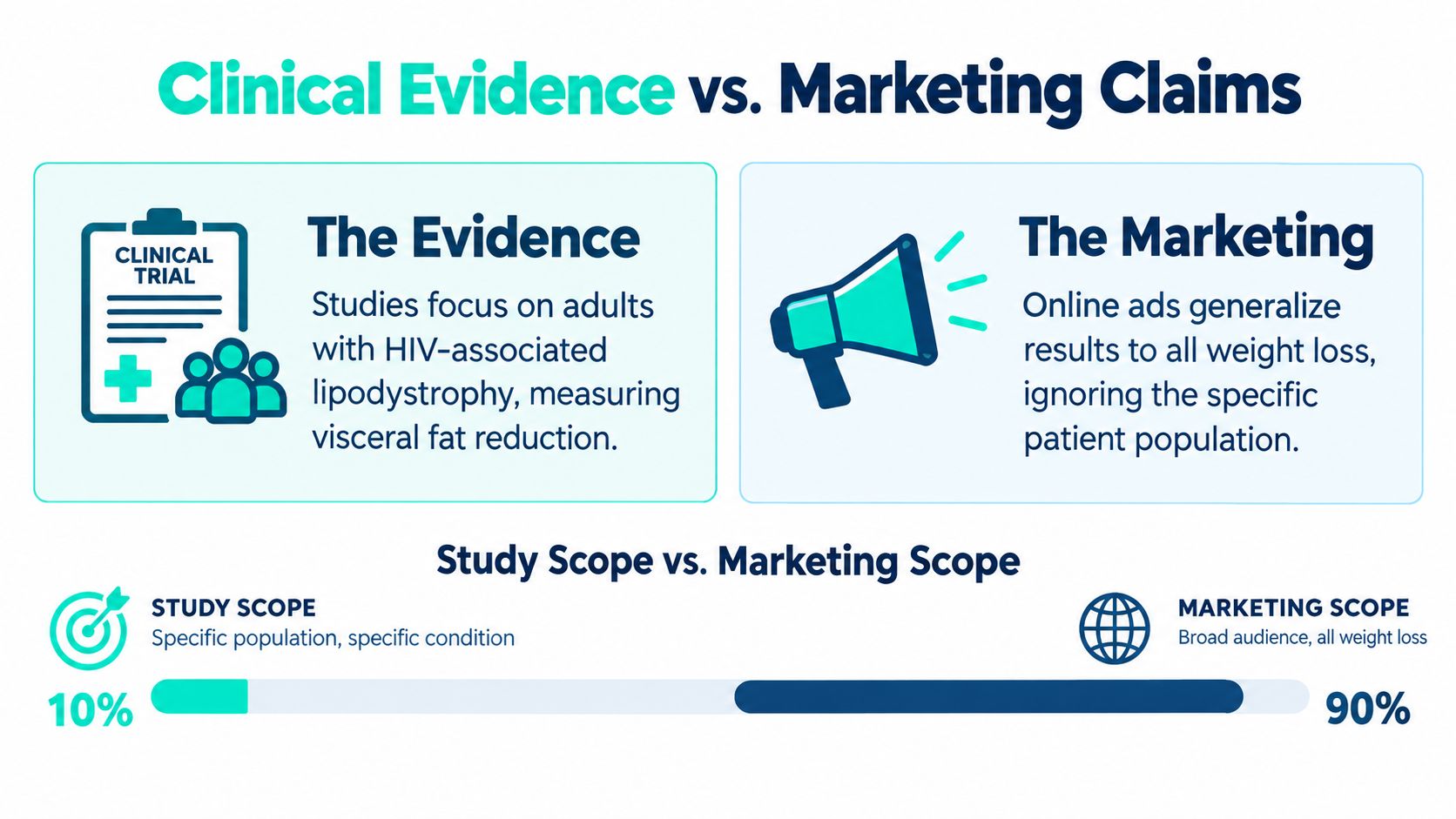
The measurements matter, too. A Canadian clinical review reported statistically significant reductions in visceral adipose tissue at week 26 compared with placebo: the least-squares mean differences were −19.6% in one trial, with a 95% confidence interval of −23.7% to −15.3%, and −11.7% in another, with a 95% confidence interval of −16.2% to −7.1%. The clinical review indexed by the National Center for Biotechnology Information summarizes these findings. Those results concern visceral fat in the studied population, not a general promise of weight loss.
A separate analysis of two Phase III trials described about a 15% selective reduction in visceral adipose-tissue area over 26 weeks, without changing subcutaneous fat or body-mass index, in the same review. In a later study, 67% of participants receiving tesamorelin reached the FDA-defined threshold of at least an 8% visceral-fat reduction, compared with 13% of those receiving placebo, with P=0.002. These figures help clarify what was measured. They don't establish that the treatment is appropriate for people seeking a different outcome or who don't share the studied condition.
A result in a specific clinical population is evidence about that population. It isn't a general endorsement for other goals.
Candidacy depends on more than a target on the scale. Diagnosis, abdominal-fat distribution, medical history, glucose-related risk, and clinical monitoring all matter. The FDA label states that tesamorelin isn't indicated for weight-loss management. For a separate educational comparison of the compounds discussed online, see this Weight Method peptide comparison guide. A comparison article can help clarify terminology, but it can't determine a person's eligibility or replace medical advice.
A research request becomes easier to review when the file explains why the material is being considered and what evidence supports the purchase. The goal isn't to create a clinical protocol. It's to give institutional reviewers a record they can assess against their responsibilities.
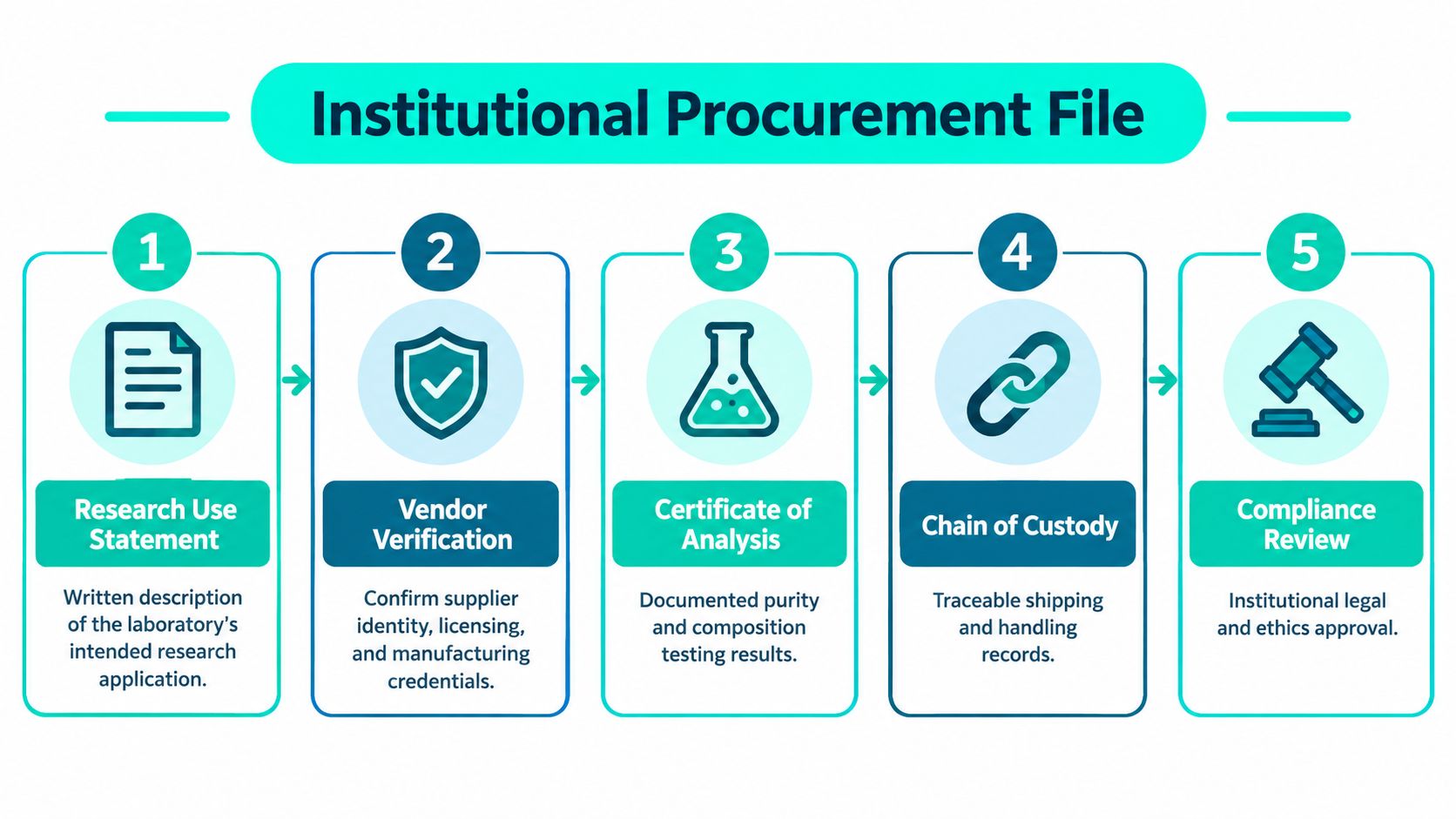
Begin with a written research-use statement. It should identify the proposed research context clearly enough for the institution to decide which policies apply. Avoid relying on a product title or a general statement from a seller to define the project's purpose.
Next, confirm the institution's authorization. Procurement may need approval or review from internal teams responsible for purchasing, quality, biosafety, legal matters, or research ethics. Which reviewers are required depends on the institution and the work; a vendor cannot grant institutional approval.
The supplier's records should then be examined for what they document. Ask whether the available paperwork identifies the material and lot, explains the analytical testing represented, and provides purchasing, shipping, and return-policy details relevant to the institution. Keep general website statements separate from documents tied to the particular lot under review.
A broad purity claim and a lot-specific document answer different questions. The claim describes what a vendor says about its products; material-specific records can help reviewers evaluate whether the evidence corresponds to the item being considered. The institution decides whether that evidence meets its own quality expectations.
A useful file can include:
These documents serve different readers. Procurement may need clear purchasing terms, quality reviewers may focus on material evidence, and legal or biosafety staff may need to establish whether the request fits institutional rules. A guide to procurement documents and their role in vendor review can help teams organize those records, but the institution determines what it requires.
A claim and a record answer different questions. A purity statement tells a reviewer what the vendor says about a product. An analytical record, when one is available, gives the reviewer something to check: the method used, the lot tested, and whether the document can be connected to a specific item. Operational details such as shipping terms and customer support address purchasing questions. None of these signals, alone or together, turns a research-use listing into a prescription medicine.
A delivery estimate describes the expected shipment, not the contents of the parcel, and a purity headline does not by itself establish identity, method, lot, or correspondence with the material received.
The gap between a claim and the evidence behind it is where review work happens.
Reviewers can compare claims and evidence without treating the vendor's website as a substitute for the receiving record:
| Review question | What to look for |
|---|---|
| What does the vendor claim? | Clearly stated product attributes, including any purity figure |
| Is testing described? | Documentation about the testing and the material it covers |
| Can the material be traced? | Lot or batch information linking records to the item under review |
| Does the listing match the intended context? | Research-use labeling and claims consistent with the laboratory's stated purpose |
| Are purchasing terms published? | Shipping, refund, return, privacy, and terms policies a buyer can read before ordering |
Celonyx Labs states that its peptide products are 99% pure and supported by independent third-party testing, and it publishes shipping, refund and return, privacy, and terms policies along with phone and email support. These are vendor-provided claims and operational details for a buyer to weigh. They do not establish FDA approval or clinical suitability.
For a closer look at what external testing does and does not establish, see this overview of third-party-tested peptides. The practical question for reviewers is whether a document is clear enough to evaluate, retain, and connect to the material that arrives.
An academic lab receives an email offering a peptide for research. The message includes a product description, but the purchasing team can't determine whether the available records identify the material or connect it to a lot. The lab doesn't add the item to its approved purchasing workflow on the strength of the email. It pauses and requests clarification.
A biotech team sees a prescription product discussed in an online forum and asks its procurement staff to locate an equivalent research listing. The staff recognizes that a treatment request and a research-material request belong to different processes. It routes the inquiry away from research procurement and toward appropriate clinical evaluation, rather than treating an online listing as a substitute for a clinician and pharmacy.
A procurement officer reviews a supplier's stated purity and finds documentation that needs assessment against the institution's requirements. The officer doesn't infer that the material is suitable from the headline alone. The file goes to the institution's quality reviewers, who decide whether the evidence is sufficient or whether the request should be held.
Different evidence gaps call for different decisions. A lab may ask for more records, redirect a clinical inquiry, or escalate a quality question.
These examples show why procurement decisions shouldn't hinge on the shared name of a compound. Intended use, institutional authorization, and the records available for review determine what the next step should be. Readers following regulatory developments for other research compounds may also find this retatrutide approval timeline UK helpful as a separate example of how product interest and approval status are distinct questions.
Before an institutional purchasing decision, make sure the file answers the questions that determine the applicable pathway:
The boundary is simple, even when the paperwork isn't: prescription access is a clinician-and-pharmacy pathway; research procurement is limited by the project's purpose, institutional policy, and the vendor's documented claims.
For laboratory teams evaluating research peptide vendors, Celonyx Labs offers an online research peptide catalog, publishes product and purchasing policies, and describes its purity and third-party testing claims. Review those details alongside your institution's documentation requirements before deciding whether a supplier fits your procurement process.
A common shortcut says that you can find tesamorelin by searching online and choosing a

Choose the best KPV peptide by research model. Compare identity, purity, endotoxin documentation, and vehicle

Choose full-length thymosin beta-4 peptide for native-molecule research. Compare fragments and reference standards, then check
FOR RESEARCH USE ONLY. Products sold by Celonyx Labs are intended exclusively for laboratory and scientific research. They are not intended for human or veterinary use, consumption, diagnosis, treatment, cure, or prevention of any disease. By purchasing from this site, you acknowledge that you understand the intended research purpose of these materials and agree to comply with all applicable laws and regulations.