

How to Mix Melanotan 2: A Complete Reconstitution Guide
Most advice on how to mix Melanotan 2 stops at “add water and swirl.” That
You're on a supplier page, ready to order, and the dropdown gives you 2 mg, 5 mg, 10 mg, maybe 15 mg. Most new researchers pause there longer than they expect. The peptide itself is chosen. The assay plan is drafted. But the vial size decision suddenly feels like a small purchasing detail that could still derail the work.
That hesitation is justified. Order too little and you interrupt your workflow with another procurement cycle. Order too much and you may spend less per milligram up front, then throw away usable material after reconstitution because your lab didn't consume it fast enough. That second mistake is more common, and it's rarely discussed clearly.
I've seen new buyers assume the largest option is the “smart” one because bulk usually looks efficient on paper. In peptide work, that logic often breaks down once sterility, reconstitution, and actual bench usage enter the picture. A vial choice isn't just a purchasing choice. It affects concentration planning, handling, waste, and whether the peptide is still fit for use when you need the last portion.
If you need a quick primer on the category itself, research peptides are typically sold for laboratory workflows where storage format, purity documentation, and reconstitution method all matter as much as the catalog listing.
A new researcher usually asks the wrong first question. They ask, “Which vial size is cheapest?” The better question is, “Which vial size will my lab use without waste?”
That difference matters because peptide vial sizes sit at the intersection of purchasing and bench practice. The product page may show a mass option, but your real decision includes how you'll reconstitute it, how often you'll use it, and whether the remaining solution will still be within your lab's acceptable handling window when the next experiment comes around.
Three mistakes drive most bad orders:
Practical rule: Choose peptide vial sizes based on planned consumption and target concentration, not catalog psychology.
In supply conversations, I tell new researchers to think backward from the experiment. Start with the amount you need in solution, how many runs you expect, and how quickly the lab will use the material after reconstitution. Once you do that, the “best” vial size usually becomes obvious, and it often isn't the largest one available.
A peptide order usually arrives as a small crimped vial with a dry film or cake at the bottom. For a new researcher, that can look underwhelming. In practice, that dry state is what gives the lab control.
Lyophilized peptides are supplied dry because dry material generally tolerates shipping and storage better than pre-made solution. Of greater relevance for bench work, you decide when to add solvent and what concentration to make. That flexibility helps only if the ordered amount matches how quickly the lab will use the peptide after reconstitution.
That is the trade-off many buyers miss.
A larger vial option can reduce cost per milligram on paper. If the peptide is only used occasionally, the extra material may spend more time in solution than your lab is comfortable with, or it may be aliquoted poorly and discarded. The cheaper unit price disappears fast when part of the vial becomes unusable after reconstitution. For regularly run assays, the larger vial may still be the right call. For intermittent work, smaller fills often produce less waste and fewer concentration errors.
The vial itself is just a container system. It protects the lyophilized powder, supports puncture access through the stopper, and gives you enough headspace to add solvent and mix carefully. It does not tell you the peptide mass by appearance, and it does not tell you the final concentration. Those decisions come from the label, the certificate or lot paperwork, and your reconstitution plan.
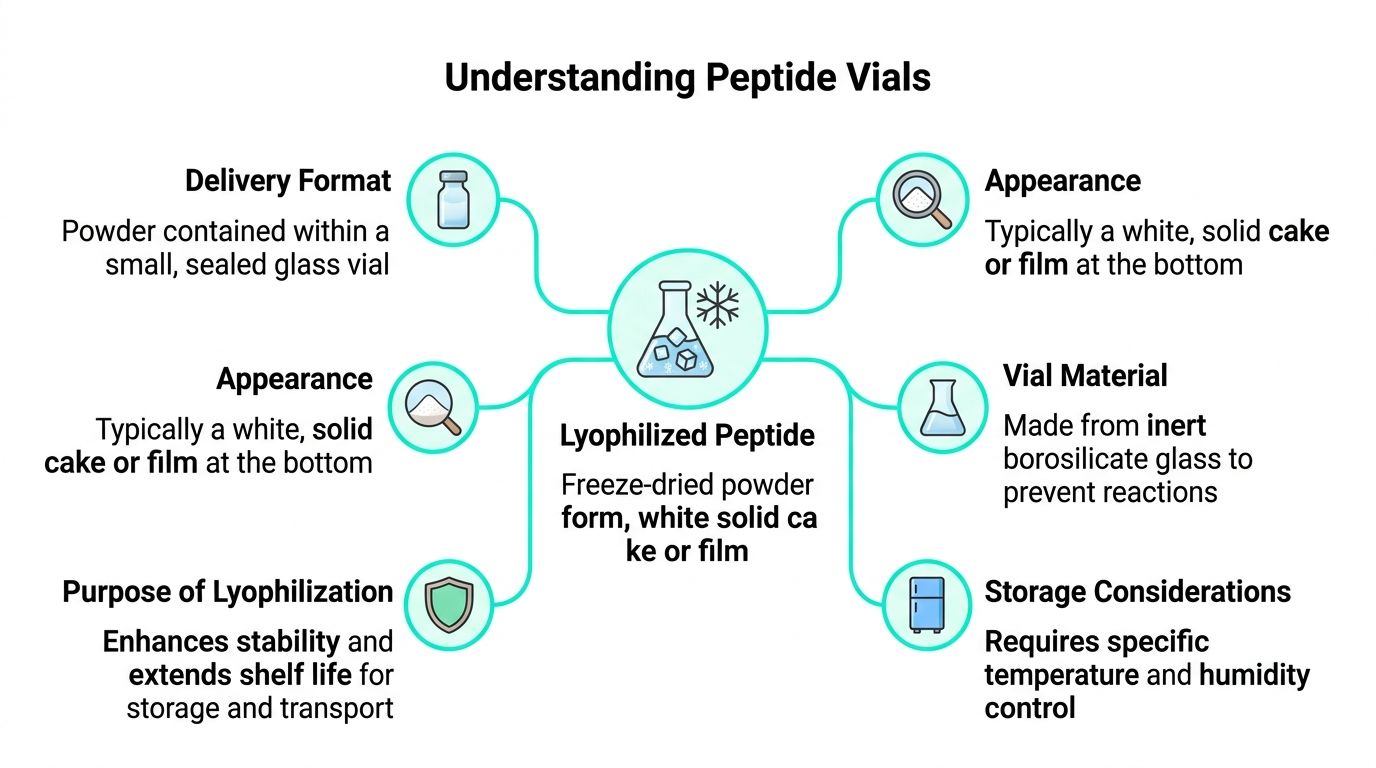
Researchers new to peptide handling often try to judge quantity by eye. That is a mistake. A thin, compact film can contain more peptide than a taller, airy cake because the final appearance depends on the formulation and freeze-drying process, not just the labeled mass.
I tell new buyers to ignore fill height entirely. Read the mass on the label. Then check whether that mass fits the amount of solution you plan to prepare per run, how many runs you expect, and how long the reconstituted material can realistically stay in use under your lab's handling rules.
Physical vial size also causes confusion. A small glass vial may hold a meaningful peptide mass, while a larger-looking vial may provide more headspace for safer reconstitution and mixing. Do not assume the container volume and peptide amount scale together. They often do not.
The practical takeaway is simple. Treat lyophilized peptide as stable inventory, and treat reconstituted peptide as a time-sensitive working material. That mindset leads to better vial selection, less wasted peptide, and fewer avoidable ordering errors.
A new researcher sees a 10 mg listing, assumes it is the “bigger vial” option, and orders it to save on unit price. Then the peptide arrives in a container that looks much like the 5 mg version, and a key question appears at the bench. How much volume will be needed to dissolve it to a usable concentration, and will the lab use that material before the working solution should be discarded?
That is the point of decoding mass and volume correctly.
A “5 mg vial” refers to 5 mg of lyophilized peptide. It does not describe how much liquid the vial can hold after reconstitution, and it does not tell you the final concentration. Concentration only exists after you choose a diluent and a reconstitution volume.
Labs often mix up three separate numbers:
Treat them separately during ordering, because each one affects a different part of the workflow. Mass drives how much material you have. Vial capacity determines whether you can add solvent, mix, and withdraw cleanly. Reconstitution volume determines whether the final concentration is practical for your assay.
Typical research presentations include 1 mg, 2 mg, 5 mg, 10 mg, and 15 mg, with larger fills sometimes offered for higher-volume programs. Those mass options are commercial packaging choices, not a promise that each size will suit your handling plan.
The bench problem is rarely “Can I buy more peptide?” The bench problem is “Can I reconstitute this amount to a concentration my lab can use without creating waste?”
That is why a larger mass can be the wrong purchase even if the price per milligram looks better.
Use the table below as a screening tool before you place the order. It is not a substitute for the product sheet or your peptide-specific solubility data, but it helps catch bad fits early.
| Peptide Mass | Recommended Vial Size (Volume) | Typical Reconstitution Volume | Common Use Case |
|---|---|---|---|
| 1 to 5 mg | 2 mL vial | 0.2 to 2 mL | Small pilot runs, low-volume assay work |
| 5 to 20 mg | 5 mL vial | 1 to 5 mL | Standard research use with repeated access |
| 20 to 50 mg | 10 mL vial | 2 to 10 mL | Higher-throughput workflows or larger batch prep |
| 50 to 100+ mg | 20 mL vial | 5 to 20 mL | Large-scale use where solvent demand is higher |
These bands are practical starting points. They reflect ordinary handling limits, headspace needs, and the fact that highly concentrated peptide solutions are often harder to dissolve and harder to recover consistently from the vial.
A few ordering rules help prevent common mistakes:
I usually tell new buyers to work backward from usage. Start with how much peptide the lab consumes in a normal week or month. Then set the reconstitution plan. Then choose the vial mass that supports that plan with the least waste, not the one that looks cheapest on the quote.
If the peptide amount, solvent volume, and lab usage rate do not fit together on paper, they will not fit at the bench.
Mass and volume are connected by workflow. Get that relationship right before ordering, and reconstitution becomes straightforward instead of expensive guesswork.
A new researcher sees two quotes for the same peptide. The larger vial has the lower per-milligram price, so it looks like the obvious buy. Then the lab reconstitutes it, uses a fraction for the first run, and throws part of the remainder away later because the material is no longer suitable for the study plan. That is one of the most common purchasing mistakes I see.
The key decision is not price per milligram alone. It is price per usable milligram under your lab's actual usage rate.
Large vials often win on the quote sheet because bulk presentations reduce unit cost. In practice, they only save money if the team can reconstitute, aliquot, and consume the material within the period the lab considers acceptable for that peptide and method. If use is slow or irregular, the cheaper vial can become the more expensive one after discard.
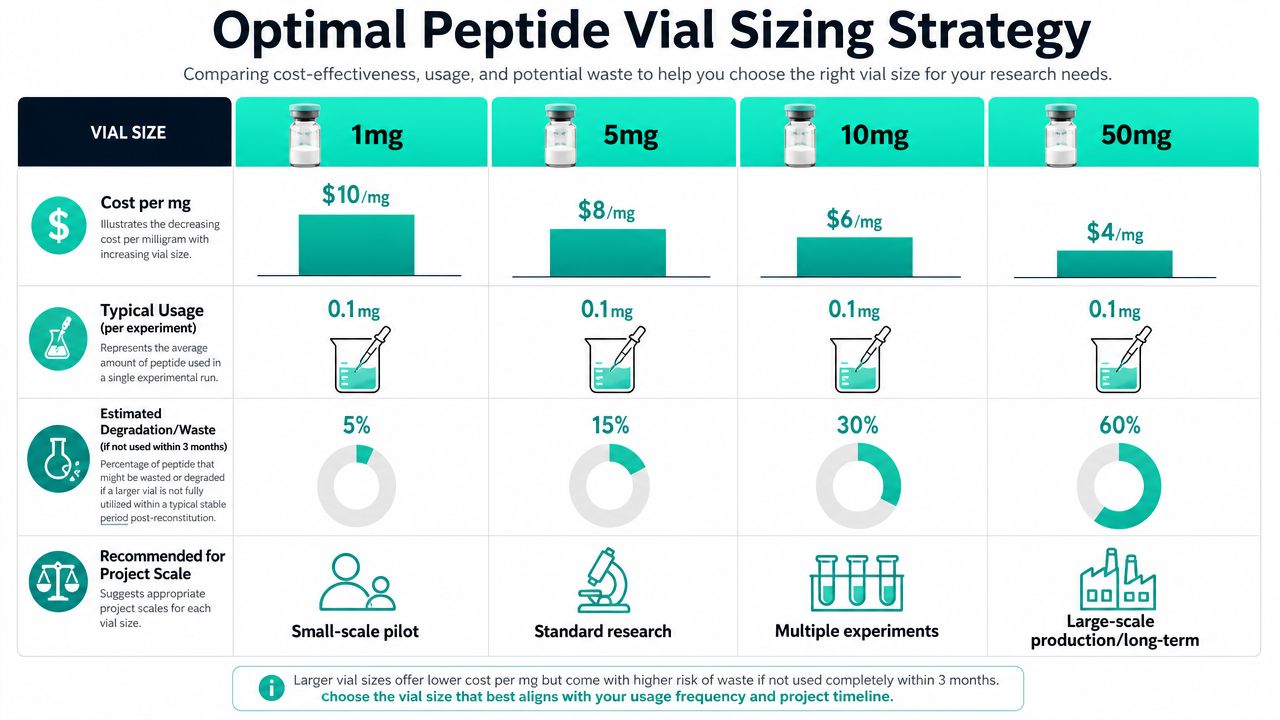
The trade-off many buyers miss is simple. Bigger vials lower the purchase price per milligram. Smaller vials often lower waste after reconstitution.
That matters most in three situations. Early-stage projects with changing protocols. Shared labs where no one owns the full vial inventory. Low-frequency studies that only consume small amounts per run. In all three cases, oversized vials tend to create leftovers that looked economical at ordering time and inefficient at the bench.
One industry analysis of peptide vial size trade-offs makes the same point: slow-use facilities often lose material because reconstituted stock expires before the vial is fully consumed, while smaller lyophilized presentations can reduce that waste in routine workflows, as discussed in this analysis of peptide vial size trade-offs.
Use these four checks before placing the order:
Start with monthly consumption, not total project size
A project may need 50 mg over six months. That does not mean a 50 mg vial is the right format. What matters is how much the lab can use during each realistic reconstitution cycle.
Check whether the peptide will be used on a fixed schedule or sporadically
Frequent, planned runs support larger vials. Interrupted schedules favor smaller vials because fewer milligrams are exposed at one time.
Decide how the lab will handle stock after reconstitution
If the team will prepare aliquots immediately and store them under validated conditions, a larger vial may still make sense. If repeated withdrawals from one vial are more likely, the waste risk rises.
Calculate expected discard before comparing quotes
A vial that is 20 percent cheaper per milligram is a poor buy if 30 percent of the reconstituted material is likely to be discarded.
I tell new buyers to make the decision with one plain question: how much of this vial will become usable data, not just purchased inventory?
A few rules help keep that answer honest:
The best vial size is the one your lab can fully use within its real handling window, with minimal leftover material and minimal concentration drift.
That is the strategic decision. Buy for the rate of use, the reconstitution plan, and the likelihood of discard. Labs that do that usually spend less over the life of the project, even when the chosen vial looks less attractive on a per-milligram basis.
A common ordering mistake shows up at the bench. A lab buys the larger vial because the price per milligram looks better, then reconstitutes the full amount into a concentration that works on paper and sits with leftover solution that cannot be used before stability becomes the actual limit. Good math prevents that, but only if the calculation matches your actual use rate.
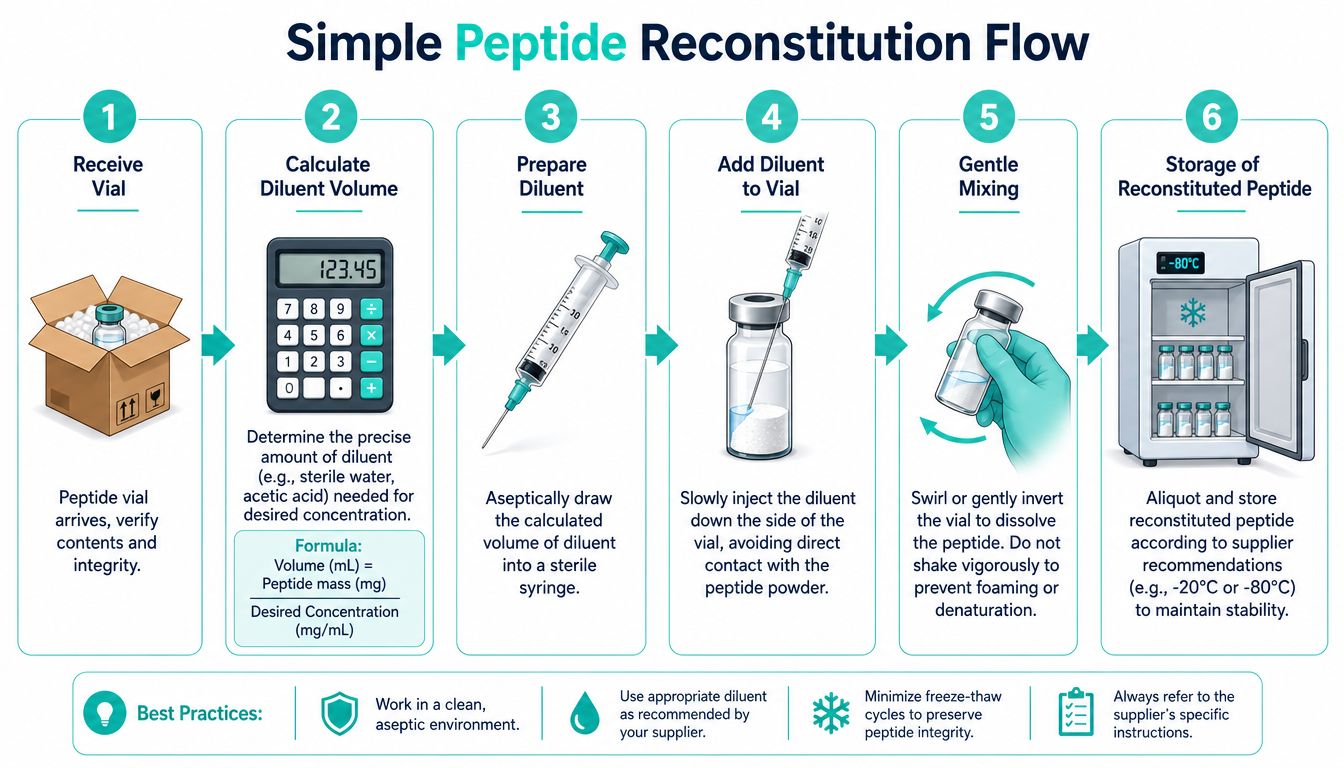
Use this formula:
Volume to add (mL) = Peptide mass (mg) / Desired concentration (mg/mL)
That gives the reconstitution volume. Then do one more check that new researchers often skip. Ask whether the resulting solution volume will be consumed within your lab's real handling window.
For a broader walkthrough of solvent choice, mixing, and storage decisions, use this peptide reconstitution guide for research workflows.
You have a 5 mg vial and need a final concentration of 2 mg/mL.
5 mg / 2 mg/mL = 2.5 mL
Add 2.5 mL of diluent, and the final concentration is 2 mg/mL.
Now check the bench reality. If the assay only uses small aliquots and the lab will not finish 2.5 mL promptly, the calculation is still correct but the plan may be poor. In practice, larger vials often result in hidden waste. The reconstitution math can be right while the purchase size was wrong for the study pace.
I tell new researchers to answer three questions before adding solvent:
How much peptide do you need per run?
Start with actual assay consumption, not the vial label.
How many runs will happen within the usable life of the reconstituted solution?
Base this on your schedule as it exists, not the schedule you hope to keep.
Does the full vial need to be reconstituted at once?
If not, a smaller presentation or an aliquoting plan may reduce discard.
That short check changes purchasing decisions. A larger vial may still be the right buy for a busy lab running the same assay every day. For intermittent work, it often creates more leftover solution, more freeze-thaw exposure, and more labeling risk.
Physical handling still matters after the math is done. A concentration target that fits your assay can still be awkward if the final volume is hard to mix cleanly, hard to withdraw accurately, or likely to be opened repeatedly over too many sessions.
Use these bench rules:
This short video is a useful companion for visual learners.
The right calculation is the one that fits both the assay concentration and the speed at which your lab can actually use the reconstituted material.
The purchase order is part of the experiment. Treat it that way. A weak supplier record, unclear documentation, or poor shipping practice can create problems long before you begin reconstitution.
Use a short checklist when reviewing suppliers:
Don't drop the shipment straight into routine use. Inspect it first.
For a more detailed handling reference after mixing, this guide on how to store reconstituted peptides is a useful operational checklist.
Good peptide work starts before the first pipette touches the sample. It starts with ordered documentation, correct storage, and a vial you can actually use as intended.
Choosing among peptide vial sizes isn't a minor catalog decision. It affects concentration planning, sterility, inventory turnover, and how much of your budget ends up in the waste container.
The strongest ordering habit is simple. Match the vial to actual lab usage, not to the most flattering price per milligram. A larger vial only saves money when your team can consume it within the practical handling window after reconstitution. If usage is intermittent or slow, smaller lyophilized presentations often protect more usable material even when the unit price looks worse.
Keep three questions in front of every order:
If you can answer those clearly, you won't guess your way through ordering. You'll buy the amount your research can use, reconstitute it cleanly, and avoid the most common waste trap in peptide procurement.
Celonyx Labs supplies research peptides for laboratory use with an online catalog, product support, and published quality information. If you need a dependable source for upcoming peptide orders, review the available products and documentation at Celonyx Labs.
Most advice on how to mix Melanotan 2 stops at “add water and swirl.” That
You're standing at the bench with a peptide vial, a vendor purity claim, and a

PBS is a water-based salt solution of NaCl, KCl, Na2HPO4, and KH2PO4, adjusted to about
FOR RESEARCH USE ONLY. Products sold by Celonyx Labs are intended exclusively for laboratory and scientific research. They are not intended for human or veterinary use, consumption, diagnosis, treatment, cure, or prevention of any disease. By purchasing from this site, you acknowledge that you understand the intended research purpose of these materials and agree to comply with all applicable laws and regulations.