

Peptide molecular weight benchmarks by compound 2026
Compare peptide molecular weight by compound: use compound-specific g/mol values, distinguish mass from purity, and
Lipo Pure is not a single standardized peptide; published descriptions list a multi-ingredient lipotropic blend of methionine, inositol, choline and methylcobalamin, often with L-carnitine, so identity must be verified lot by lot. The word peptide on the label doesn't establish what's inside.
Advice to choose a product by its name or headline purity percentage skips the most important question: what did the laboratory test? For academic laboratories, preclinical teams and contract research organizations, the useful starting point is the lot's composition and analytical records, not a presumed peptide sequence.
The most precise-looking part of a Lipo Pure label, the milligram amounts, is often the least verifiable. Lipo Pure works as a formulation name, not a molecular identity. Published descriptions place it among MIC-B12 or Lipo-C preparations: multi-ingredient lipotropic blends, not a single standardized peptide. The name points to a category to investigate. It does not establish what the lot contains.
The published Lipo Pure formulation description lists approximate amounts of 25 mg methionine, 25 to 50 mg each of inositol and choline, 1 mg methylcobalamin, and 50 mg L-carnitine in some formulations. Treat those figures as descriptive. They are not a validated universal specification, and they do not show that every product sold under the name uses the same recipe.
The table separates ingredients commonly described in these blends from additions whose quantities are not given in the published description. The role column records the rationale offered for including an ingredient. It does not show a demonstrated benefit for the finished product.
| Component | Typical amount | Role claimed in lipotropic blends |
|---|---|---|
| Methionine | About 25 mg | Sulfur-containing amino acid and methyl donor |
| Inositol | About 25 to 50 mg | Cell-signaling component linked to lipid metabolism |
| Choline chloride | About 25 to 50 mg reported as choline; confirm the chemical form and reporting basis | Methyl donor and phospholipid precursor |
| Methylcobalamin (vitamin B12) | About 1 mg | Cofactor for methylation reactions |
| L-carnitine | About 50 mg in some formulations | Supports transport of fatty acids into mitochondria |
| L-arginine | No amount given in the published description | Amino acid listed in some formulations |
| Vitamins B5 and B6 | No amounts given in the published description | Coenzyme precursors listed in injectable versions |
| Lidocaine, benzyl alcohol, sterile water | No concentrations given in the published description | Excipients rather than the proposed lipotropic actives; relevant to assay interpretation |
An amount without a denominator is not a concentration. A description stating milligrams does not establish whether that quantity applies to a vial, a volume of solution or another unit. Do not convert these descriptive amounts into an experimental exposure without checking the original label and analytical report.
The same caution applies to chemical form. A quantity reported as choline should not automatically be read as the same mass of choline chloride. Record whether the assay reports the salt, the parent compound or an equivalent amount.
A seller's product page for a Lipo-C formulation is a starting point for identifying the proposed material, not a substitute for its lot documents. Before preparing an experiment, extract the following information:
For a blend, the usable evidence is component by component: identity and amount for each active, the complete vehicle, and the analytical method behind each figure. A product name or a single purity headline cannot cover that gap.
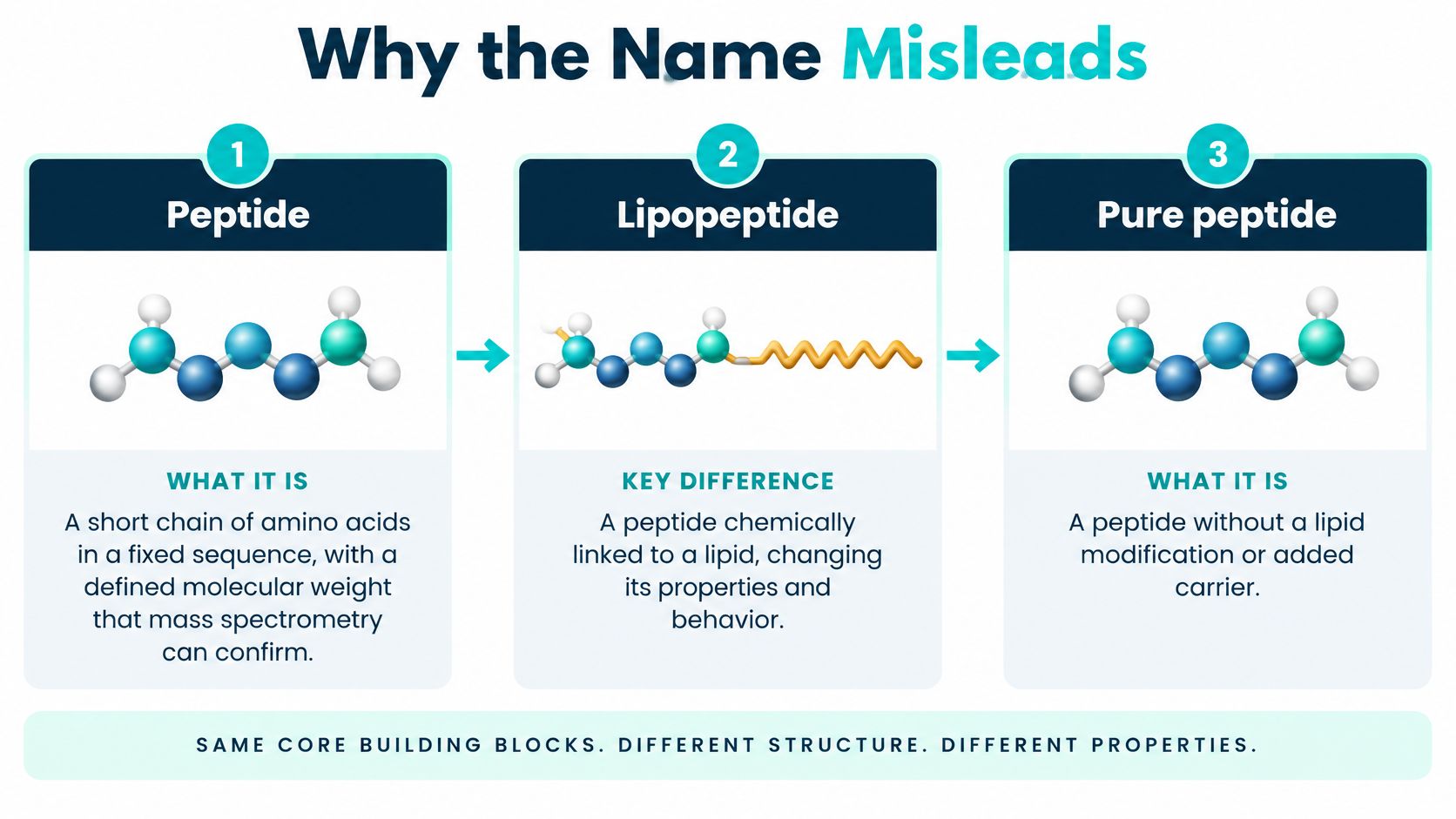
A peptide is a chain of amino acids connected in a particular sequence. Its expected molecular mass follows from that structure, although mass alone doesn't establish every structural detail. A lipopeptide is a peptide chemically linked to a lipid or fatty-acid group.
A lipotropic blend belongs to a different category. It combines ingredients under a proposed metabolic purpose without making them one covalently connected molecule. A peptide resembles beads strung in a fixed order; a lipotropic blend resembles different beads placed in the same bag.
| Category | What connects the ingredients | What the laboratory needs to establish |
|---|---|---|
| Peptide | Amino acids joined in a defined sequence | Sequence, molecular identity and content |
| Lipopeptide | A peptide covalently linked to a lipid group | Peptide structure, lipid modification and resulting properties |
| Lipotropic blend | Ingredients combined in a formulation | Identity and concentration of each component, plus the vehicle |
The structural comparison below helps explain why the terms aren't interchangeable. Its pure-peptide category shouldn't be interpreted as proof of analytical purity or suitability for a particular use.
In a peer-reviewed study of lipo-oligoarginine constructs, researchers assessed cellular uptake, toxicity and metabolic stability using methods including flow cytometry, viability assays and mass spectrometry. Constructs with D-arginine at the N-terminus showed greater metabolic stability than those with D-arginine at the C-terminus.
That finding concerns specific engineered molecules. It doesn't validate Lipo Pure, but it demonstrates why sequence and stereochemistry matter when someone claims lipopeptide behavior. Researchers can't infer uptake, persistence or toxicity from the prefix lipo.
The name Lipo Pure peptide places terminology from different chemical categories side by side. Unless the supporting documents identify a peptide sequence and, where claimed, its covalently attached lipid, there's no basis for assigning that structure to the material.
Naming rule: Ask for the composition and structure the seller can substantiate. Don't let a product name determine the analytical method.
Claims about Lipo Pure commonly center on faster lipid mobilization, improved energy, metabolic support and fat loss. Their biological rationale comes from the functions of individual nutrients. A plausible ingredient rationale isn't a measured outcome for the finished formulation.
For example, carnitine's involvement in fatty-acid transport offers a reason to investigate a transport-related endpoint. It doesn't establish that adding a carnitine-containing blend will improve that endpoint in a particular model, much less produce weight loss in humans.
| Claim | Basis offered | Evidence status for Lipo Pure |
|---|---|---|
| Faster lipid mobilization | Carnitine transport and lipotropic theory | No formulation-specific peer-reviewed study identified in the available record |
| Better energy or metabolism | Methionine, choline and B12 roles in metabolic pathways | No product-specific clinical outcome data identified |
| Fat-loss percentage | Marketing claim | No reliable percentage can be assigned from the available evidence |
| Support for vitamin B12 status | Methylcobalamin is an established form of B12 | Nutrient identity is established; an outcome for this product isn't demonstrated |
The PubMed-indexed review on lipopolysaccharides and antimicrobial peptides concerns different molecules and mechanisms. It isn't evidence for a MIC-B12 or Lipo-C preparation, even if a search engine displays it beside results for Lipo Pure peptide.
The available product-specific record doesn't establish a randomized clinical trial, meta-analysis or regulatory assessment supporting quantified efficacy or safety. That's a limit of the evidence identified, not proof that every possible biological effect is absent.
Ingredient biochemistry can justify a hypothesis. In-vitro or animal findings can support a result within the tested system. Product-specific human studies are needed to support claims about clinical outcomes for the actual formulation.
These levels aren't interchangeable. A methylation assay on methionine alone doesn't establish the effect of a mixture containing methionine, preservatives and other nutrients. An experiment measuring a cellular marker also doesn't establish a change in body composition.
Reporting on the peptide regulation debate reinforces the distinction between preclinical promise, human evidence and regulatory review. It also distinguishes compounded products from approved drugs and research-use materials from products intended for human use.
When assessing a benefit claim, identify what was measured, in which system, against which control and using which formulation and lot. If those details are missing, treat the claim as a proposed use rather than a demonstrated result. The absence of an effect estimate also means there's no defensible basis for inventing a response rate or a reassuring product-specific safety percentage.
A headline purity figure doesn't establish identity, sterility, endotoxin status or safety for administration. For a multicomponent solution, it may not even be clear what the percentage describes: one ingredient, total solids or the area of selected chromatographic peaks.
The FDA's discussion of safety risks associated with certain bulk substances identifies characterization difficulties, peptide-related impurities and aggregation as concerns for certain peptide substances. Those concerns shouldn't be attributed automatically to Lipo Pure, but they show why a purity claim alone can't resolve material suitability.
A product-specific LIPO PURE MIC-B12 analytical document describes a mixture containing L-carnitine, choline chloride, L-arginine, methionine, inositol, vitamins B5/B6/B12 and excipients. Its LC-MS characterization concerns a mixture rather than a single peptide molecular mass.
For lot acceptance, request validated identity evidence for the relevant components. LC-MS can support molecular identification, but a spectrum without reference assignments, method details or a matching lot number is insufficient for a confident acceptance decision.
Quantitative HPLC or UPLC addresses a separate issue: how much of the stated ingredient is present. Chromatographic area percentage is not automatically absolute content, particularly when components respond differently to the detector. Ask which compounds the method measures and how the laboratory calibrated the assay.
| Test | What it confirms | What to request |
|---|---|---|
| LC-MS identity | Evidence supporting molecular identity of relevant components | Assigned spectrum and method tied to the lot number |
| HPLC or UPLC assay | Quantitative content and chromatographic purity within the method's scope | Method, calibration basis and distinction between area percentage and absolute content |
| Bacterial endotoxin | Endotoxin burden within the assay's capabilities | Lot-specific result, units, method and applicable acceptance criterion |
| Microbial sterility | Absence of detected growth under the test conditions | Result and method for material represented as sterile |
| Water content | Moisture in lyophilized material | Reported value or documented justification that testing isn't applicable |
| Residual solvents | Manufacturing-solvent residues within the analytical scope | Results and tested solvent panel, or justified non-applicability |
| pH and osmolality | Solution characteristics relevant to assay compatibility | Reported values and measurement conditions |
| Stability | Changes under intended storage conditions | Supporting data at the stated storage temperature |
Lidocaine and benzyl alcohol deserve explicit attention because they can affect cell viability, membrane permeability or assay readouts independently of the proposed actives. Confirm their concentrations rather than treating them as analytically irrelevant background.
Our guide to peptide certificates of analysis provides context for reading these documents. For a blend, evaluate whether the report covers its composition rather than assuming a peptide-oriented report template is sufficient.
A certificate is evidence about the material tested. Establishing that it represents the material delivered is a separate responsibility.
Research-use-only labeling states intended use, not a quality grade. Keep that distinction in the acceptance record, and don't interpret successful laboratory characterization as authorization for human administration.
Define the hypothesis and acceptance criteria before releasing material into the experiment. Specify which identity and content findings would cause rejection, which endpoint would support the hypothesis and which controls are necessary to interpret the result.
The workflow illustration emphasizes documentation and analytical confirmation before exposure begins.
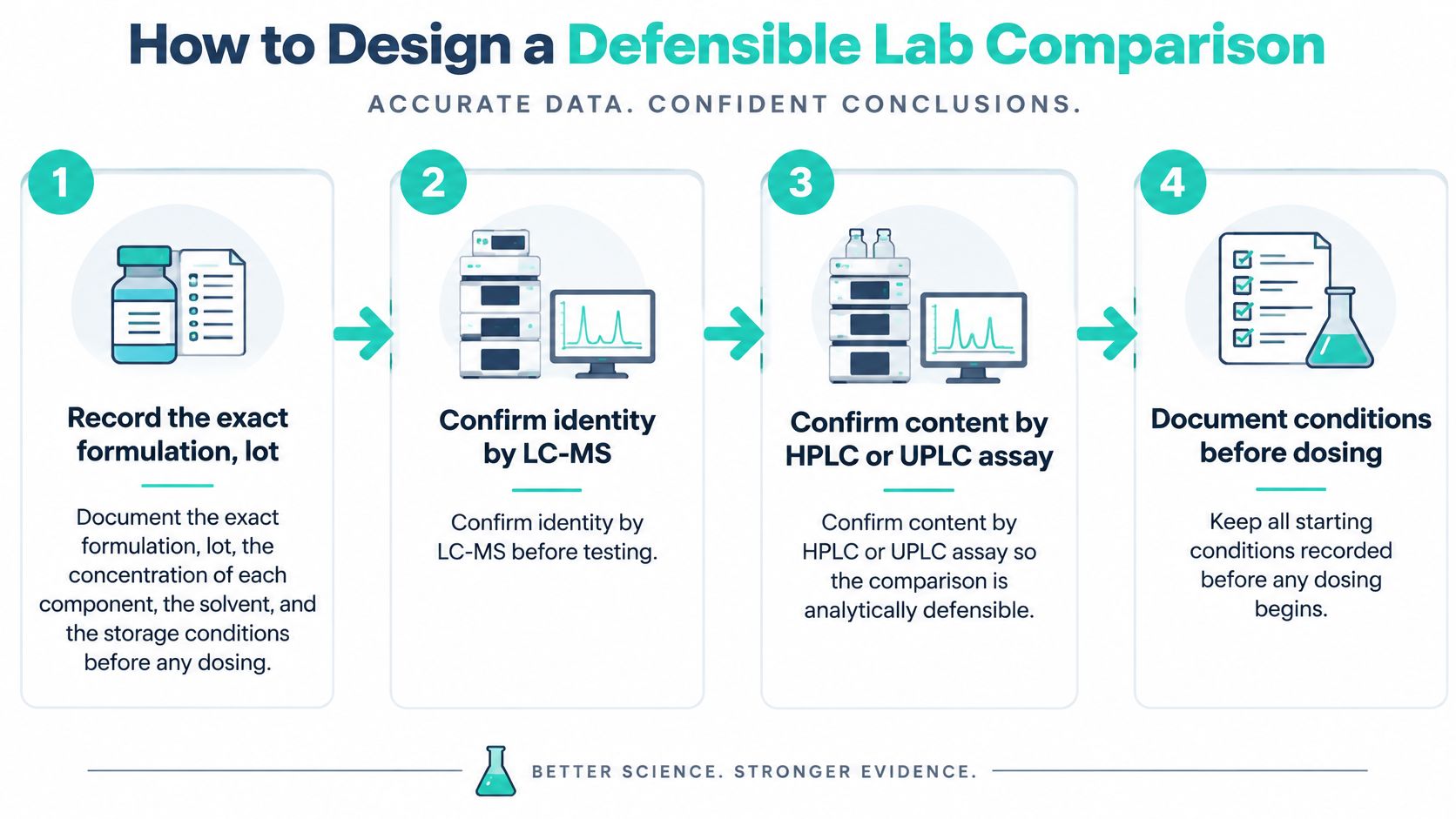
Record the starting material. Document the exact formulation, lot, component concentrations, solvent and storage conditions before dosing. Preserve these details with the raw data so another investigator can reconstruct the exposure.
Verify the analytical inputs. Confirm identity by LC-MS and content by an appropriate quantitative HPLC or UPLC method. When reviewing results, use our guide to interpreting HPLC chromatograms to distinguish what a chromatogram displays from what the validated assay establishes.
Match the vehicle control. Include the same solvent and excipient concentrations used in the blend, including lidocaine and benzyl alcohol where present. Otherwise, a vehicle effect could be mistaken for an ingredient effect.
Test individual contributions. Add component-only arms selected for the hypothesis, such as methionine alone or L-carnitine alone. Apply suitable identity and content checks to those materials too, so differences don't just reflect misassigned exposure.
Assess exposure with a suitable method. Use validated LC-MS measurements for selected intact components where feasible. Flow cytometry is appropriate only when a validated fluorescent or other compatible readout tracks the target without introducing an unexamined labeling effect.
Pair concentration-response measurements with viability. Repeat the comparison across independent batches and distinguish biological replication from repeated instrument readings. Record precipitation, color change and unexpected toxicity rather than excluding them without explanation.
Report uncertainty and limits. Associate each result with its formulation, lot, assay and uncertainty. Polymerize's guide to measurement uncertainty in materials R&D offers useful context for documenting uncertainty instead of reporting an assay value as exact.
A related video can supplement the written workflow, but it doesn't replace a validated protocol or lot-release criteria.
Keep conclusions as narrow as the experiment. If a blend changes a readout relative to the vehicle, report that observation under the tested conditions. Don't convert it into a claim about fat loss, clinical safety or every product sold under the same name.
Don't order, accept or use a lot until the relevant documents can be reconciled with the material. Before purchase, obtain the documents needed for a procurement decision. After delivery, complete the physical label and shipment checks before experimental release.
All Celonyx Labs peptides are labeled “For Research Use Only.” Read our Terms and Conditions, Privacy Policy, Refund and Return Policy, and Shipping Policy before checkout. Check specifically for any provisions affecting opened or temperature-sensitive vials rather than assuming a failed laboratory acceptance test creates an automatic right to return.
Procurement approval concerns whether the proposed purchase meets institutional requirements. Experimental release concerns whether the delivered material satisfies the study's prespecified acceptance criteria. Keep those decisions separate so an approved purchase doesn't become an automatic authorization to dose a model.
Those commercial terms help establish available remedies if the delivered material fails acceptance. Don't assume they guarantee reimbursement for failed identity, content or sterility checks unless the terms expressly provide it.
No-go decision: Undisclosed composition, an untraceable lot or a certificate that doesn't match the delivered label is a reason to hold the material out of experiments.
A product name alone isn't an acceptance criterion. Release only material that passes the document review and analytical requirements for the intended laboratory comparison. Even a fully characterized research lot remains research material, not a product cleared for use on people.
Celonyx Labs offers research peptides for laboratory investigators through our online catalog. Visit Celonyx Labs to review research-use information and contact our team about the documentation needed for your proposed purchase before placing an order.
Compare peptide molecular weight by compound: use compound-specific g/mol values, distinguish mass from purity, and

Celonyx Labs university e-procurement portal setup starts with approval. Verify supplier onboarding, requisition routing, and

Automatically notify safety officer peptide orders through confirmed lab receipts. Set up traceable alerts, prevent
FOR RESEARCH USE ONLY. Products sold by Celonyx Labs are intended exclusively for laboratory and scientific research. They are not intended for human or veterinary use, consumption, diagnosis, treatment, cure, or prevention of any disease. By purchasing from this site, you acknowledge that you understand the intended research purpose of these materials and agree to comply with all applicable laws and regulations.