

Peptide molecular weight benchmarks by compound 2026
Compare peptide molecular weight by compound: use compound-specific g/mol values, distinguish mass from purity, and

The mean peptide molecular weight by compound in this five-compound reference set is 817.5 g/mol, ranging from 390.4 g/mol for Epithalon to 1,419.5 g/mol for BPC-157. This 2026 comparison explains the molecular forms behind those values and how to use them for laboratory calculations—not as batch-specific specifications for Celonyx Labs research peptides.
Equal peptide masses do not contain equal numbers of molecules. If you compare compounds using only mg/mL, you are comparing mass concentrations rather than equivalent molar concentrations.
For a 2026 research protocol, record the compound identity, molecular form, and calculation basis before preparing a stock. A correct calculation attached to the wrong molecular form still produces the wrong concentration.
Molecular weight describes the mass of a molecule relative to the atomic mass standard. For laboratory calculations, the corresponding molar mass is expressed in g/mol; its numerical value matches the molecular mass expressed in daltons to the precision used here.
The overall mean is 817.5 g/mol for the five specified molecular entities below. It is an arithmetic reference point, not an average for all peptides or a product-quality target.
| Compound | Molecular entity used for comparison | Average molar mass, g/mol | Main interpretation limit |
|---|---|---|---|
| Epithalon, also called Epitalon | Unmodified Ala-Glu-Asp-Gly tetrapeptide | 390.4 | Does not include an unspecified counterion or hydrate |
| Ipamorelin | Amidated ipamorelin molecular entity | 711.9 | Terminal chemistry must match the reference identity |
| Selank | Unmodified Thr-Lys-Pro-Arg-Pro-Gly-Pro peptide | 751.9 | Salt content is separate from the peptide reference value |
| Semax | Unmodified Met-Glu-His-Phe-Pro-Gly-Pro peptide | 813.9 | Chemical modification changes the expected molecular mass |
| BPC-157 | Unmodified BPC-157 peptide | 1,419.5 | The reference value does not establish batch identity or purity |
| Overall: five-compound set | Unweighted arithmetic mean of the displayed values | 817.5 | Describes this selection only |
BPC-157 has the highest molar mass at 1,419.5 g/mol; Epithalon has the lowest at 390.4 g/mol. Neither position indicates greater purity, biological activity, or suitability for an experiment.
Source and methodology: NIH PubChem compound records for Epitalon, ipamorelin, Selank, Semax, and BPC-157 provide the molecular-identity reference basis for this 2026 comparison; values are rounded to one decimal place, and the overall figure is the unweighted mean of the displayed values. These are compound reference values, not measurements of supplied lots, and they do not describe unspecified salts, water content, or peptide content per vial.
The 817.5 g/mol mean gives you a yardstick within this table. It does not predict the molecular weight of another peptide, and it should never replace a compound-specific value in a preparation worksheet.
The table is deliberately limited to defined molecular entities. Broad product labels do not supply enough structural information to assign an exact reference mass without confirming the sequence, modifications, and terminal groups.
For Celonyx Labs research peptides, the stated 99% purity and third-party testing are quality signals, not substitutes for matching the reference entity to the material used. Use the benchmark to select the calculation basis; use batch documentation to evaluate the supplied material.
The benchmark table uses average molar mass. That is the appropriate starting point for ordinary mass-to-mole calculations when the stated molecular entity matches your material.
Mass-spectrometry interpretation requires additional care. An exact or monoisotopic mass and an observed mass-to-charge ratio answer different questions from an average molar mass.
| Reference or measurement | Best for | Strength | Limitation |
|---|---|---|---|
| Average molar mass | Converting a defined peptide mass into moles | Accounts for natural isotopic abundance | Is not the exact mass of a particular isotopic composition |
| Monoisotopic mass | Evaluating an assigned molecular formula | Provides a defined exact-mass reference | Requires the correct molecular formula and ion assignment |
| Observed mass-to-charge ratio | Interpreting a mass spectrum | Describes the detected ion signal | Depends on charge state and adducts; it is not automatically the neutral molecular mass |
| Lot-specific peptide content | Assessing the amount used in a preparation | Addresses the supplied material rather than an idealized molecule | Requires a suitable measurement and a clearly defined reporting basis |
A multiply charged ion does not appear at the neutral peptide mass on a mass-to-charge axis. Confirm the charge assignment before comparing a spectrum with a reference value.
Do not reject or accept a batch by comparing an unexplained spectral peak directly with this table. First establish whether the report gives average mass, monoisotopic mass, deconvoluted mass, or an observed ion signal.
A peptide name is a starting point, not a complete chemical specification. Sequence, terminal groups, covalent modifications, and the supplied salt form all affect how you interpret the material.
Use the following order when building your preparation record:
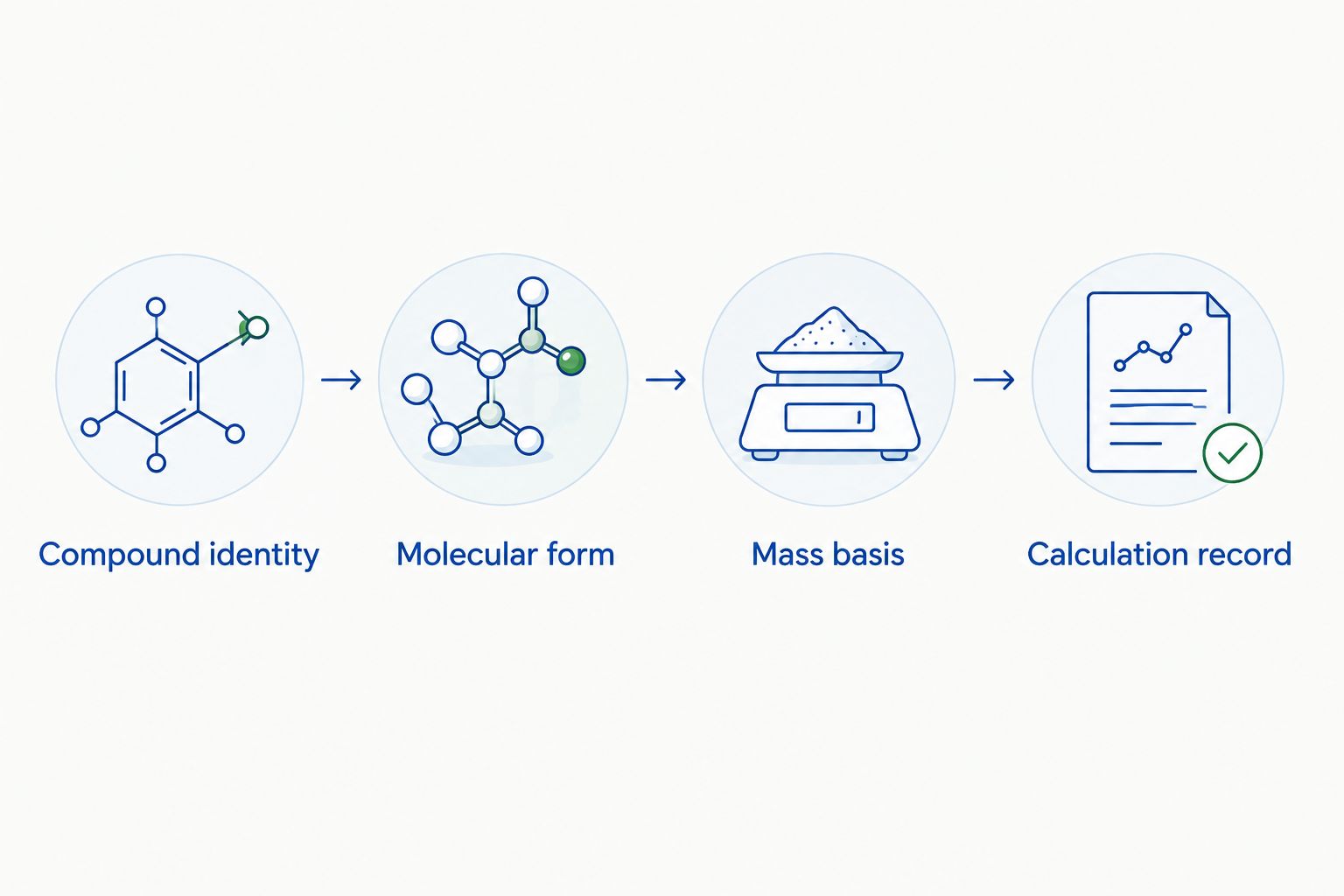
An acetate or trifluoroacetate designation requires attention to the reporting basis. Do not add a guessed counterion contribution to the peptide mass or assume a fixed salt composition without supporting documentation.
The same discipline applies to metal-binding compounds. A free peptide and its metal complex are different molecular entities, so their names and reference masses are not interchangeable.
A label such as 5 mg or 10 mg describes an amount of material, not the mass of an individual molecule. The same peptide can be supplied in different labeled quantities without changing its molecular weight.
Changing the amount of solvent also does not change the peptide's molecular weight. It changes concentration, provided the material dissolves and the preparation remains chemically unchanged.
For your 2026 worksheet, keep separate fields for labeled quantity, documented peptide content, molar mass, and final solution volume. Combining these into a single free-text note makes later review harder.
The basic relationship is amount in moles = peptide mass in grams ÷ molar mass in g/mol. Divide that amount by the final solution volume in liters to obtain mol/L.
This relationship is dimensional arithmetic, not a dosing recommendation. Apply it only to a laboratory protocol with a confirmed compound identity and a justified mass basis.
Write units beside every input and intermediate result. A worksheet that retains grams, g/mol, liters, and mol/L makes unit errors easier to identify than a calculator displaying only a final number.
Do not treat mg/mL and mol/L as interchangeable labels. Moving between them requires the compound-specific molar mass, which is why the difference between Epithalon and BPC-157 matters even when their weighed masses are identical.
Chromatographic purity and peptide content are different measurements. A chromatographic area percentage does not, by itself, establish the fraction of the weighed material that is the target peptide.
Water, counterions, and other sample constituents affect the relationship between total material mass and peptide mass. The analytical method and reporting basis determine what a percentage actually means.
Celonyx Labs describes its research peptides as 99%-pure and third-party tested. When evaluating that documentation, distinguish the reported purity measurement from any separate content measurement; the peptide purity grade benchmarks address that adjacent quality question.
A research product name does not establish equivalence to an approved drug substance or finished medicine. Similar names can conceal differences in sequence, modification, formulation, or intended use.
When a research project compares a compound with a regulated medicine, searching official drug-label data helps establish the labeled active ingredient and dosage form; those records do not certify the identity of a separate research vial. Match the actual chemical entity before transferring any molecular-weight value between documents.
For a 2026 comparison file, keep regulatory records and supplier analytical documents in separate, clearly identified categories. They answer different questions: what a medicine contains according to its label, and what evidence supports the research material under review.
Research peptides are for research use only, not for human or veterinary administration. Molecular-weight calculations do not establish clinical safety, suitability for administration, or therapeutic equivalence.
A reusable molecular-weight reference needs more than a number. Your record should allow another researcher to identify the same molecular entity and reproduce the calculation without guessing.
Capture these fields together:
Save the source identity rather than copying an isolated search-result value. A search result can omit the salt designation or display a different molecular form under a familiar name.
This benchmark page does not establish lot-specific identity, peptide content, stability, or solvent compatibility. Those decisions require the corresponding analytical evidence and an appropriate laboratory protocol.
What is the average peptide molecular weight by compound?
The mean is 817.5 g/mol across the five defined compounds in this comparison. The range is 390.4–1,419.5 g/mol; neither figure represents all research peptides.
Which peptide has the highest molecular weight in this table?
BPC-157 has the highest average molar mass in this table at 1,419.5 g/mol. This describes the specified unmodified peptide, not every possible formulation or salt.
Is peptide molecular weight the same as the amount printed on a vial?
No. A vial quantity describes an amount of material, while molecular weight characterizes a molecular entity. Changing the vial quantity does not change the molecule’s reference mass.
Should I use average or monoisotopic mass for concentration calculations?
Use average molar mass for ordinary mass-to-mole calculations when it matches the documented molecular entity. Monoisotopic mass is used for exact-mass interpretation with an appropriate formula and ion assignment.
Does 99% purity mean 99% of the vial mass is peptide?
Not automatically. A chromatographic purity percentage does not by itself establish peptide mass content, water content, or counterion contribution.
Can molecular weight prove that a peptide vial is authentic?
No. An appropriately interpreted mass result supports identity assessment, but molecular weight alone does not establish sequence, purity, content, or overall suitability for an experiment.
Can I use this table for Celonyx Labs solution preparation?
Use this table as a reference only after matching the documented molecular entity and mass basis. Celonyx Labs research peptides are for research use only; these benchmarks are not batch certificates or administration instructions.
A molecular-weight match cannot distinguish every peptide sequence. Different sequences can share the same elemental composition and therefore the same molecular mass.
Before signing off a reference standard, ask whether the evidence supports the required structural identity—not just an expected mass. That distinction protects the meaning of every concentration calculated afterward.
Compare peptide molecular weight by compound: use compound-specific g/mol values, distinguish mass from purity, and

Celonyx Labs university e-procurement portal setup starts with approval. Verify supplier onboarding, requisition routing, and

Automatically notify safety officer peptide orders through confirmed lab receipts. Set up traceable alerts, prevent
FOR RESEARCH USE ONLY. Products sold by Celonyx Labs are intended exclusively for laboratory and scientific research. They are not intended for human or veterinary use, consumption, diagnosis, treatment, cure, or prevention of any disease. By purchasing from this site, you acknowledge that you understand the intended research purpose of these materials and agree to comply with all applicable laws and regulations.