
Integrity Research BPC 157: How to Judge Vendor Claims
The advice you'll hear most often about buying BPC-157 for the bench is short: demand
The most popular piece of advice about buying research peptides is to look for the highest purity percentage you can find. It's easy to compare, it sits in large type on every supplier page, and on its own it tells you less than almost any other fact about the vial in your hand. A purity figure is one measurement, taken one way, on one sample, at one moment. Everything else you need to know about the material sits outside it.
Buyers get caught out because the number feels conclusive. It's a percentage, so it reads like a summary of everything in the vial. In practice it describes how much of one detected signal corresponded to the target peptide on a particular chromatography run, and it can be reported with no statement about molecular identity, actual peptide content, water, salt form, or how that lot will behave in six months.
Treating a headline figure as the whole of quality produces a predictable sequence: an order placed on the strength of a number, a certificate that turns out to be generic, and an assay that drifts from the last batch in a way nobody can explain. The alternative costs a few extra minutes per order.
Two vials arrive from the same supplier with the same figure printed on both labels: 99% purity. One goes into a cell-based assay and behaves exactly as your protocol predicts. The other contains the right percentage of the wrong sequence, or four milligrams of peptide in a vial labelled five, and the assay fails in a way that takes a week to trace back to the material.
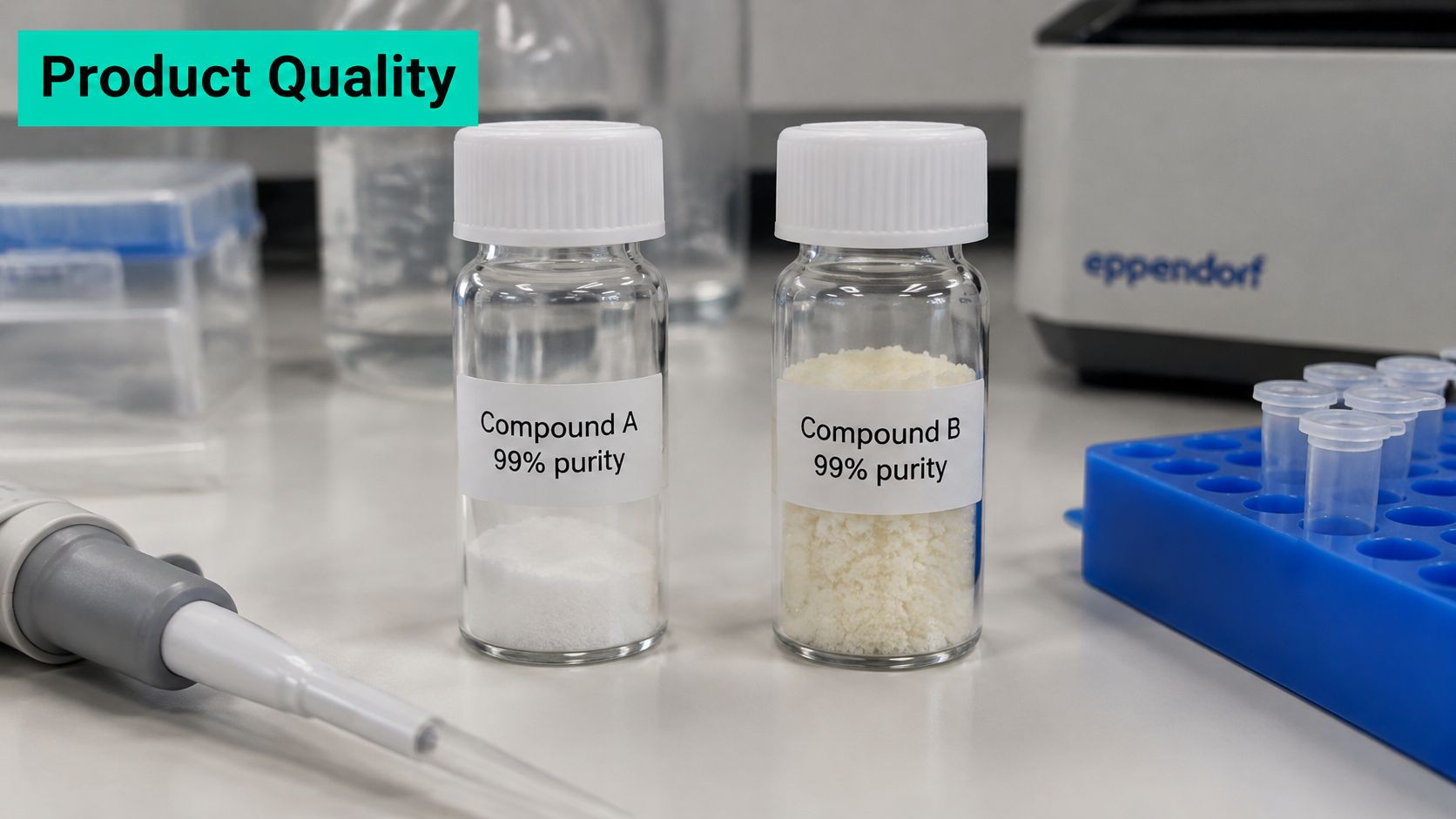
Both passed the same headline check. What separated them is product quality, which is a judgment about whether the material meets the requirements of the work it's being used for. A car built for a 200 mph top speed isn't a good car if the brakes fade and the tank empties every 90 miles. Top speed is a real, measured attribute. It just isn't a description of the machine.
For peptides, that judgment rests on two long-standing ideas. Joseph Juran's formulation of quality as "fitness for use" asks whether a product performs reliably in the application it was bought for, and the 1978 ANSI/ASQC consensus definition framed quality as "conformance to requirements." Both treat a written specification as the starting point for a judgment rather than the judgment itself, as this statistical quality control text from Montana State University sets out.
That gap is why the question of what is product quality deserves a precise answer for a research buyer. The requirements break into separate questions, each needing its own evidence.
A purity figure answers the second question well and the other four not at all.
Working definition: a peptide has good product quality when it conforms to a written specification, performs the way your experiment needs it to, and gives you consistent results from one batch to the next. All three parts have to hold. Two out of three is how labs end up repeating a month of work.
Seven dimensions decide whether a peptide is usable, and each one needs its own evidence.
| Dimension | What It Measures | Evidence to Request |
|---|---|---|
| Identity | Whether the molecular mass and sequence match the target | Lot-matched mass spectrum |
| Purity | Share of target peptide versus related impurities | Chromatogram with peak integration and method name |
| Content (assay) | Actual amount of peptide per vial | Stated content with calibration against a reference standard |
| Water and counter-ion | Moisture and salt form that change the weighed mass | Water content value and salt form per lot |
| Residual solvents | Leftover process solvents from synthesis | Result against a stated limit |
| Stability | Degradation over storage and shipping time | Stability data and retest date |
| Labeling and packaging | Whether label, quantity and lot match the contents | Lot number on vial matching the certificate |
A sample of the wrong sequence can be 99% pure. If the mass spectrum doesn't match the sequence you ordered, every other result on the page describes a different product, competently measured. Ask for the lot-matched spectrum rather than a spectrum.
Purity comes next and covers how much of the material is the target peptide rather than a related impurity such as a truncated sequence, an oxidation product or an aggregate. What that figure means depends entirely on the method behind it, which is why a chromatogram and a method name carry as much weight as the number itself. ISO's quality management guidance frames quality as the degree to which inherent characteristics fulfill requirements, and a stated purity value only fulfills a requirement when the method, sampling plan and acceptance criteria are defined alongside it.
A lyophilised peptide is rarely pure peptide by weight. Water and a counter-ion such as acetate or trifluoroacetate make up part of the powder, so a vial holding five milligrams of powder may hold meaningfully less than five milligrams of peptide. Every molarity you calculate from the label inherits that error.
Weigh the arithmetic, not the label. If a certificate reports peptide content in the low eighties as a percentage of powder mass, a 5 mg vial holds closer to 4 mg of material you can actually put into solution. That difference is invisible unless the certificate states content and water separately.
Residual solvents come from synthesis and purification, and they're reported against a stated limit because they're toxicologically relevant. Stability data tells you what the material does over months of storage and days in a warm delivery van. Labeling and packaging tie the whole thing to your vial: a lot number on a certificate that doesn't match the vial invalidates every result on the page.
One purity percentage covers one row of seven. A supplier who can only discuss the headline is telling you which rows they hold data for.
Every number on a certificate comes from a sample. A sample only speaks for a batch if the batch is uniform and someone documented how the sample was drawn. Test one vial from a hundred and you have characterised that vial. Present the result as a batch result without a sampling rationale and you have characterised your own optimism.
Testing follows a fixed order, and each step assumes the one before it.
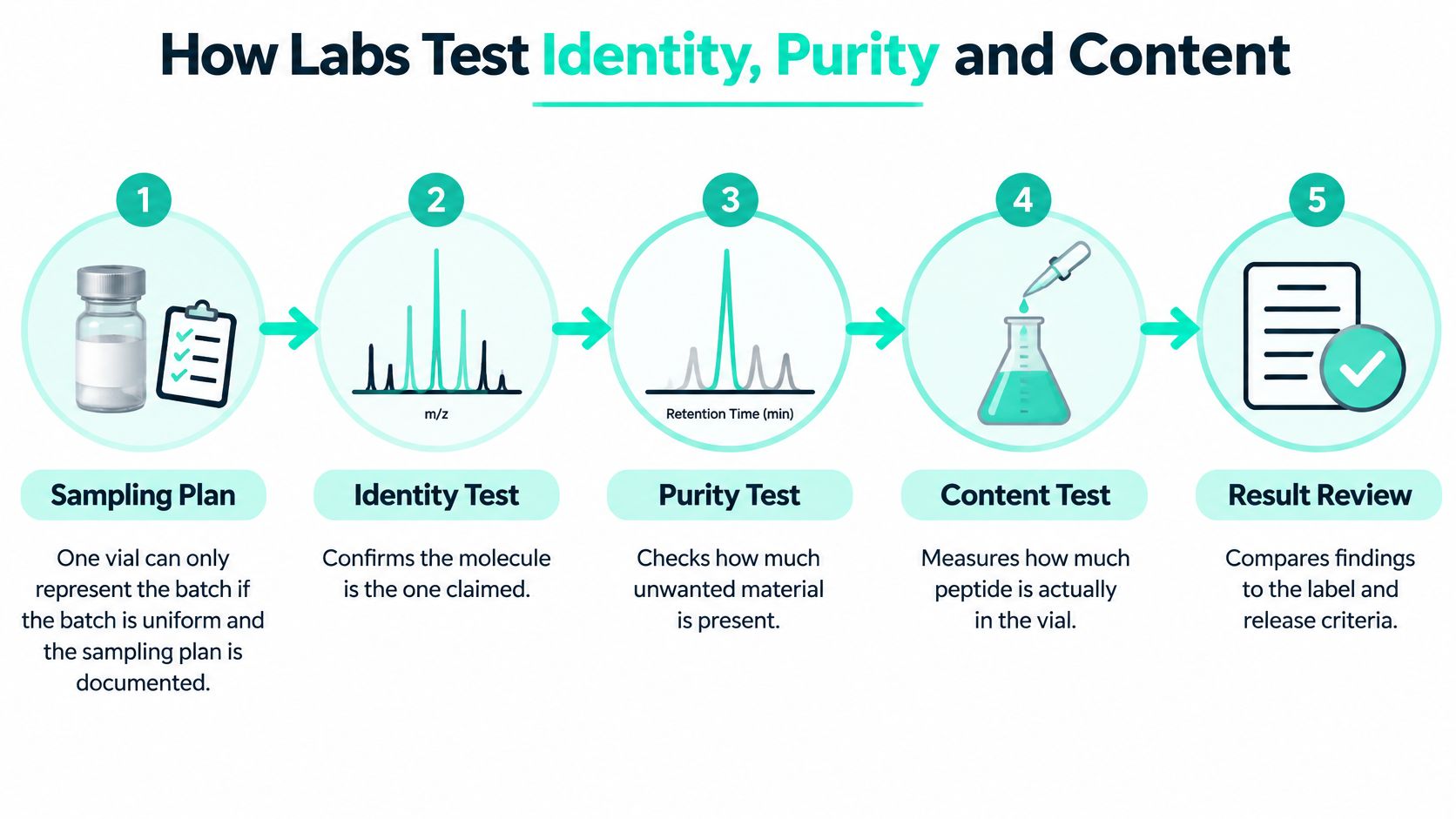
Mass spectrometry, usually run as LC-MS, confirms that the molecular mass of the main component matches the sequence you ordered. Run it first because every other test is conditional on it. A truncated sequence missing a residue can pass a purity check comfortably, since a chromatogram reports what separated, not what the peaks are.
HPLC or UPLC then separates the target from related species. The impurities that matter in a peptide are close relatives: sequences missing one or two residues, oxidised methionine or tryptophan, deamidated asparagine, aggregates that form in solution. The result is usually reported as area percent, meaning the target peak's share of the total integrated signal. That's a real measurement with a real limit. Two impurity profiles can both read 99% at one detection wavelength while containing quite different material, because the reading depends on how much each impurity absorbs at that wavelength.
If you want to see where method quality lives, the instrument side is worth an hour of your time.
A quantitative assay against a reference standard answers a different question: how much peptide the vial holds. That's the number that lets you calculate concentration without a correction factor, and it's only as good as the standard it's calibrated against, so ask where the reference material came from.
Different methods answer different questions, and each carries a blind spot worth knowing before you rely on it.
| Method | Question It Answers | Blind Spot |
|---|---|---|
| HPLC or UPLC purity | How much of the detected signal is the target peptide | Says nothing about how much peptide the vial holds |
| LC-MS or MS identity | Whether the molecular mass matches the sequence | Does not measure how much peptide is present |
| Quantitative assay against reference standard | How much peptide the vial actually contains | Depends on the quality of the reference standard |
| Karl Fischer titration | How much water the sample contains | Measures water only, not impurities |
| Gas chromatography | Whether residual solvents exceed limits | Covers solvents, not peptide-related impurities |
Accuracy is how close the mean result sits to the true value. Precision is how tightly repeated measurements cluster. The FDA's bioanalytical method validation guidance treats these as separate performance characteristics and draws the same line between repeatability within one lab and reproducibility across labs, which is why an independent confirmation is worth more than a second run on the same bench.
A result you can act on includes the raw chromatogram or spectrum, system-suitability data, reference-standard details, replicate values, analyst and instrument identification, and any documented deviation. A summary table with a tick and a percentage is marketing. Batch testing is routine work rather than a premium feature: every batch of our GLP-1 research peptide goes through HPLC, mass spectrometry verification, and purity and identity confirmation before release, and third-party testing labs will run the same panels on samples you already hold if you want an external check.
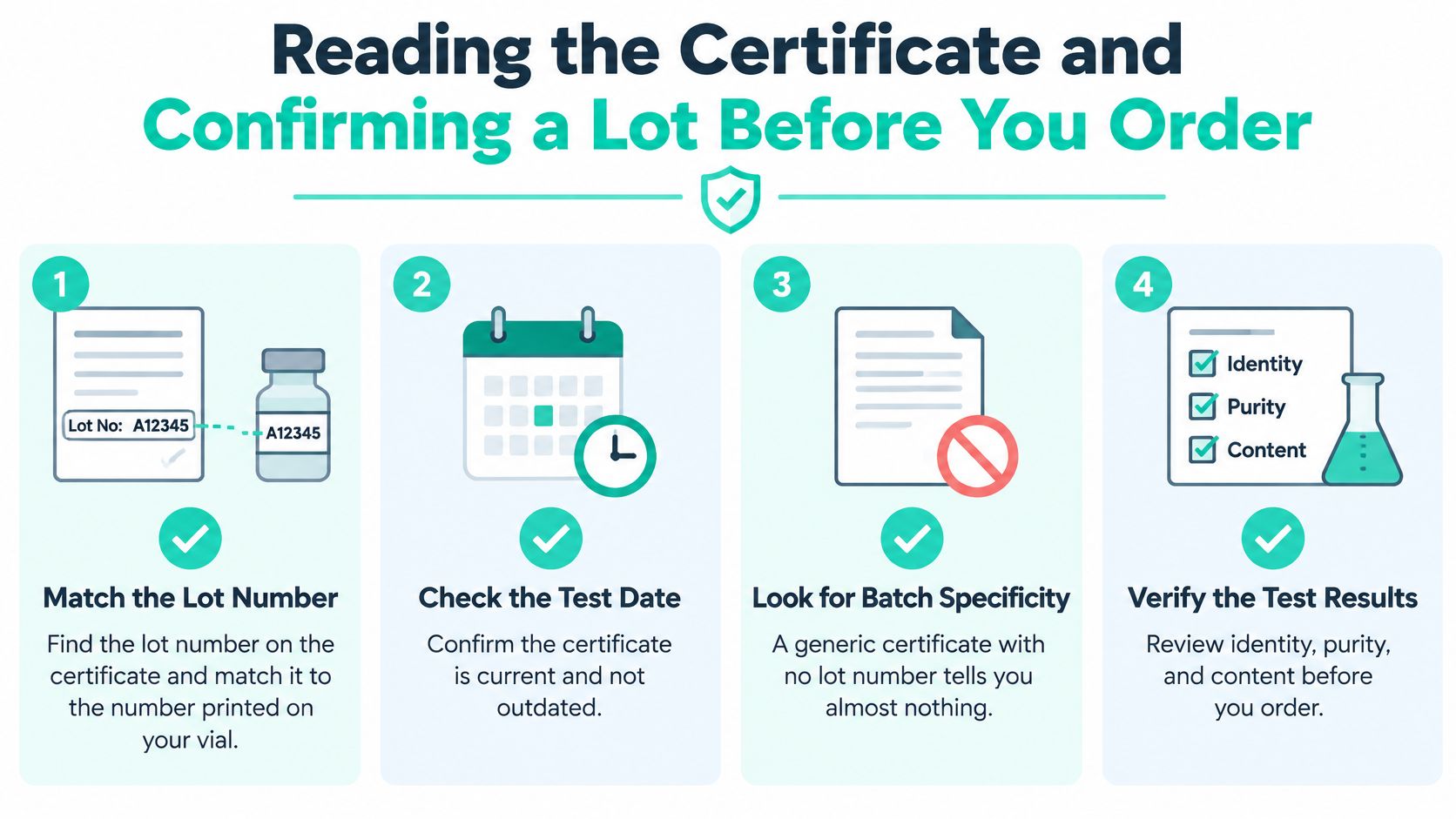
A certificate of analysis is useful only if its results match the vial you are buying. Treat the document like a map: the lot number connects the test results to a specific batch, while the methods and specifications explain what those results mean. Check each point before ordering.
Those six checks cover much of the practical risk and can take about five minutes.
Before paying, check the commercial details too:
Set acceptance limits for purity, content and identity before the vial arrives. That way, you judge results against defined criteria rather than a headline figure. If a field is missing, request the lot-specific document before purchase or use. After receipt, record the lot number alongside any assay result.
A supplement Certificate of Analysis uses the same basic logic: lot, method, result and specification must be clear enough to check. A peptide certificate of analysis can help you see which fields to look for. Celonyx Labs lists 99% purity as a headline feature, but that figure does not establish that every lot has the same result. The lot-specific certificate is what connects a stated result to the batch.
The quality question is whether a supplier's results hold across lots over time. One certificate can describe one batch; it cannot, by itself, show consistency from batch to batch. A repeatable record of lot-specific results gives you a better basis for judging that consistency.
Supplier claims aren't lies and they aren't evidence. They're compressed statements that become useful once you unpack them into questions with checkable answers. Two phrases do most of the work on peptide pages: the purity figure and the phrase third-party tested.
Which method produced it, and reported how? A certificate should name the chromatographic method and let you trace the figure to an integrated chromatogram. Which lots does it cover? One certificate from one good batch tells you that batch passed, nothing more. On which sample was it run? If the answer is a sample from a different lot than the one shipping to you, the result is background information.
The third-party testing claim breaks down the same way. Ask which independent laboratory ran the work, what it tested, whether the report names the same lot number as your vial, and when it was dated. An external report that can't be tied to your batch is a testimonial with a lab logo on it.
| Check | Supplier A | Supplier B |
|---|---|---|
| Certificate coverage | A certificate for every lot | One example certificate from two years ago |
| Tests reported | HPLC purity, MS identity and content | Purity only, no method named |
| Claim checkable against your vial | Yes, by lot number | No |
| Headline claim | 99% | 99% |
Read that table again. Both suppliers advertise the same number, and only one of them lets you check it against the vial in your hand. The difference isn't the purity; it's the traceability of the claim.
Percentage claims get stretched in every product category, and reading what 99% aloe on a gel label actually means is a useful exercise in asking what a percentage is a percentage of. Carry the same instinct to a peptide page. We use independent labs to verify the quality and purity of our products, and that arrangement is only worth something to you if you can pull the report for your lot. Our BPC-157 5mg listing carries a Third-Party Tested label, and the label is a pointer; the report naming your lot number is the evidence.
A single passing result doesn't show that the next batch will match. So ask for the lot certificates from the last several batches and look for whether the same tests were run each time, whether the results sit comfortably inside the limits or cluster against them, and whether any of them is missing a field the others had. That comparison tells you more than any single document, and it's the only way to judge a claim that's really about consistency.
A lab doesn't buy one vial. It buys one this month, another next quarter, and then writes a methods section that has to be accurate across both. Quality is therefore a property of a series of lots, not of a purchase.
Say your acceptance limit is 98.5% purity and two lots both report 98.9%. One came from a process that routinely lands between 99.2% and 99.6% and dipped after a solvent change; the other sits at the top of its usual range. Identical numbers, different material, and your assay will show it. Process capability is the difference between passing a specification once and being able to land inside it on demand.
Variation at that scale isn't cosmetic. Recent reporting in Scientific Reports described differences in titre, specificity and cross-reactivity capable of undermining assay validation, quality assurance and inter-laboratory comparability, with variability appearing both within runs and across them. The consequences arrive late, as unexplained scatter in experiments that were designed well. In 2025, 75% of global quality professionals surveyed by ETQ reported that their organization had experienced a product recall during the previous five years, according to ETQ's Pulse of Quality report, which is what quality failures look like once they've travelled far enough from the batch that caused them.
The signals that a supplier holds consistency are specific and checkable:
When two labs run the same peptide and get different values, the initial assumption is usually technique. Sometimes it's the material. Tracking your own assay performance by lot number is the only way to tell which, and it converts a vague suspicion into a record you can take to a supplier.
Decision rule: if a supplier can't send lot-level documents for the batch you're buying, don't buy it. If it can, the only quality question left is whether the next batch matches this one, and that question is answered by the next certificate, not this one.
Our own approach is batch-by-batch verification, where each lot is tested and documented rather than sampled once and described indefinitely. A quality system you can inspect is worth more than a number you have to trust.
Celonyx Labs supplies research peptides with lot-level documentation, so the claims you read on a product page can be checked against the certificate for the batch that ships to you. Every batch runs through HPLC, mass spectrometry identity confirmation and purity verification, and independent labs verify quality and purity on top of that. If you want to see how a lot certificate is laid out before you place an order, browse the catalog and pull the specification for the peptide you're considering at Celonyx Labs.
The advice you'll hear most often about buying BPC-157 for the bench is short: demand

Can cagrilintide be combined with GLP-1 peptides? Yes, in controlled research. Understand mechanisms, study controls,

Can Selank be combined with nootropic peptides? Yes, in controlled laboratory studies. Learn the controls,
FOR RESEARCH USE ONLY. Products sold by Celonyx Labs are intended exclusively for laboratory and scientific research. They are not intended for human or veterinary use, consumption, diagnosis, treatment, cure, or prevention of any disease. By purchasing from this site, you acknowledge that you understand the intended research purpose of these materials and agree to comply with all applicable laws and regulations.