
BPC 157 TB 500 GHK Cu Research Guide 2026
The popular advice to treat BPC-157, TB-500, and GHK-Cu as a ready-made regenerative stack skips
The cost of a research-grade MOTS-C vial is the current listed amount for its stated peptide content; check the live listing rather than treating a published guide as a fixed quote in 2026. Your laboratory budget also needs to account for applicable order charges, preparation materials, and any verification your protocol requires. Compare the documented material and total procurement requirements—not the vial alone.
A vial is a container, not a standardized quantity of peptide. You need the stated mass and supporting documentation before you can make a meaningful procurement comparison.
A purity claim also answers a different question from a content claim. The guide to whether 99% purity establishes research suitability explains an important distinction: analytical purity does not, by itself, establish suitability for every experiment.
Use the current listing to establish the purchase amount, then use the documentation to decide whether the material meets your protocol. Neither decision replaces the other.
For a 2026 purchase, use the current listing for the exact MOTS-C vial you intend to order. Record the stated peptide content alongside the quoted amount, and confirm the order total before submitting your purchase request.
Celonyx Labs lists MOTS-c 10mg, described as a mitochondrial-derived peptide studied in metabolic biology. The 10 mg designation states the listed peptide quantity; it is not a concentration, a recommended experimental amount, or evidence of a particular number of experiments.
Use this breakdown to separate the reagent purchase from the wider procurement decision:
| Budget component | What to verify | Why it belongs in your review |
|---|---|---|
| Research material | Exact compound name and stated peptide content | Establishes what your laboratory intends to purchase |
| Order charges | Applicable charges shown for the actual order | Separates the reagent listing from the order total |
| Preparation materials | Materials required by your approved laboratory procedure | Prevents preparation requirements from being overlooked |
| Analytical verification | Tests and records required by your laboratory | Establishes whether additional verification is necessary |
| Storage and handling | Product-specific instructions and your facility's capabilities | Confirms that your laboratory can handle the material appropriately |
These are review categories, not statements that a supplier includes or charges separately for each item. Confirm the actual order terms and your laboratory's requirements before assigning a budget.
A stated content of 10 mg equals 10,000 micrograms, or 0.01 g. These are equivalent mass units, not different vial formats or different amounts of material.
Keep the original listing unit in your purchasing records. If your laboratory worksheet uses another unit, document the conversion so procurement and experimental records refer to the same quantity.
Do not confuse milligrams with milliliters. Mass describes the amount of material, while volume describes the space occupied by a liquid; a vial's stated mass does not establish its solution concentration.
Start with material identity, then review content and documentation. Comparing purchase amounts before checking those fields risks treating different specifications as equivalent.
Use the following sequence for your 2026 procurement review. Each step resolves a separate question, and the result should be clear enough for another researcher to follow without reconstructing your decision.
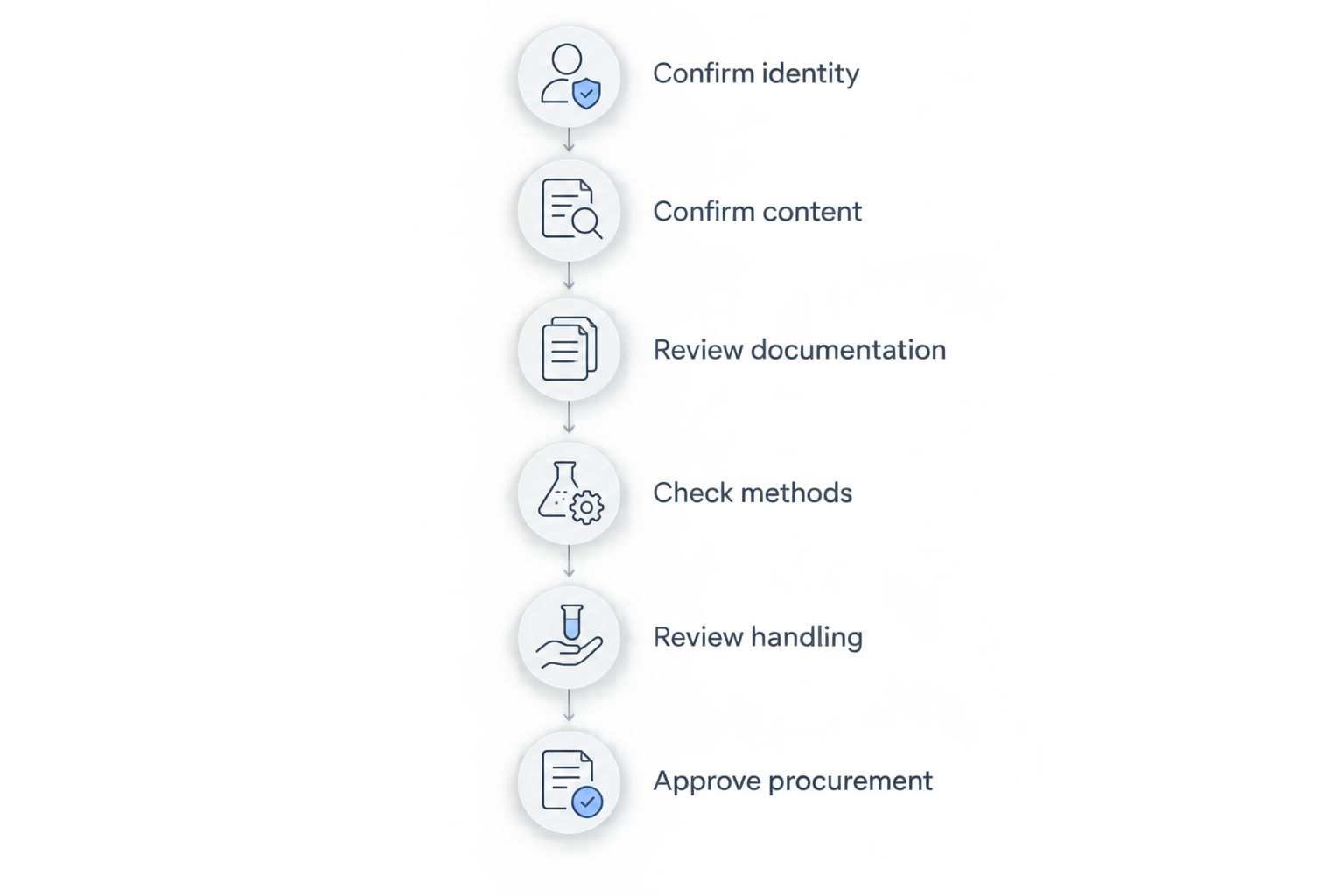
A complete procurement record connects the requested material, the supplied documentation, and the approved purchase. A screenshot of a general product description does not make those connections by itself.
The amount your laboratory needs to budget depends on the material specification and the work required to accept and use it. Treat the following as procurement considerations, not evidence that any particular supplier applies a premium or includes a service.
A useful 2026 budget separates confirmed purchase details from internal laboratory requirements. That separation lets you explain the request without presenting an assumption as a supplier commitment.
Celonyx Labs describes its research peptides as 99%-pure and third-party-tested. Those are relevant supplier quality statements, but your acceptance decision still needs to address the specific material and your experimental requirements.
For chromatographic testing, a reported purity percentage depends on the method and how the result is calculated. It is not automatically a measurement of net peptide content, and it does not establish sterility, endotoxin status, or biological performance.
Ask what the documentation demonstrates. An identity result and a purity result address different analytical questions; neither should be silently substituted for the other in your review.
Use the certificate of analysis to connect reported results to an identifiable material. Check the compound designation, relevant batch identifiers, analytical methods, reported results, and the relationship between the document and the supplied vial.
Do not treat every item on a certificate as an independent test. Read the method and result together, and distinguish measured results from descriptive specifications or acceptance limits.
If your procedure requires a particular attribute, request evidence for that attribute. A quality statement is useful only within the scope of what it actually measures or documents.
The stated 10 mg content is a purchasing specification, not a guarantee of experimental yield. Transfer losses, preparation choices, analytical sampling, and your protocol's acceptance criteria all belong in laboratory planning.
Do not convert a purity percentage into an exact usable mass without a valid analytical basis. Chromatographic purity, peptide content, water content, and counterion contribution describe different aspects of a material.
For planning, keep the supplier's stated content separate from any laboratory calculation of material required. Record the assumptions behind that calculation and have the appropriate researcher review them.
The 10 mg designation identifies stated peptide content; it does not establish which preparation materials are included. Confirm the actual product description and your approved procedure before adding solvents or consumables to a purchase request.
Solvent selection is an experimental compatibility decision. Do not assume that a commonly used laboratory diluent is suitable for MOTS-C under every assay condition.
Use product-specific instructions and a validated laboratory procedure for preparation and storage. This article does not provide reconstitution directions, experimental concentrations, or administration guidance.
No. Research-use-only MOTS-C is not supplied as a product for personal administration, and research material specifications do not establish clinical suitability.
Celonyx Labs research peptides are best suited to laboratory researchers and scientists, not personal use. The store's research positioning and stated testing are relevant to laboratory sourcing; they do not replace an institution's acceptance process or establish suitability for human or veterinary administration.
For your 2026 purchasing review, keep the limitation explicit: research material belongs within an approved laboratory workflow. Do not interpret a purity claim, product name, or available vial quantity as a treatment recommendation.
Create a short procurement record that another researcher or purchasing administrator can understand without reopening every browser tab. Keep the material specification and current commercial details together, while separating them from experimental instructions.
Include these fields:
This record is a decision trail, not a claim that the material will produce a particular result. Keep it with the relevant laboratory and procurement records according to your institution's procedures.
How much does a vial of MOTS-C cost in 2026?
Check the current listing for the exact MOTS-C vial and stated peptide content you intend to purchase. Confirm the final order total and account separately for preparation or verification required by your laboratory.
What does a 10 mg MOTS-C vial mean?
A 10 mg MOTS-C designation states the listed peptide mass, equivalent to 10,000 micrograms or 0.01 g. It does not specify solution concentration, container volume, or the number of experiments the material supports.
Does 99% purity mean a MOTS-C vial contains exactly that proportion of usable peptide?
No. A reported 99% purity result must be interpreted using its analytical method and reporting basis. Chromatographic purity does not automatically establish net peptide content or usable experimental yield.
Does third-party testing make MOTS-C suitable for every laboratory experiment?
No. Third-party testing supplies evidence within the scope of the tests performed. Your laboratory still needs to assess identity, quality documentation, handling requirements, and suitability for its specific protocol.
Should I include preparation materials in a MOTS-C research budget?
Include preparation materials when your approved procedure requires them and they are not already covered by laboratory inventory. Confirm compatibility rather than assuming that a particular diluent works for every peptide or assay.
Can I use research-grade MOTS-C for personal administration?
No. Research-use-only MOTS-C is intended for laboratory research, not personal administration. Purity statements and analytical testing do not establish clinical suitability.
What should I check before approving a MOTS-C order?
Confirm compound identity, stated content, applicable analytical documentation, current order details, and handling requirements. Retain the review with the purchasing record so the approval remains traceable.
Do not multiply a vial's stated mass by its chromatographic purity percentage and label the result “usable peptide.” That calculation combines measurements that do not necessarily share the same basis.
For a defensible 2026 purchase, preserve the distinction between listed content, analytical purity, and experimental suitability. Approve the material against your protocol—not against a single attractive quality claim.
The popular advice to treat BPC-157, TB-500, and GHK-Cu as a ready-made regenerative stack skips

How much does a vial of MOTS-C cost? Check the current listing, then compare peptide

Can PEG-MGF be combined with muscle-repair peptides? Study combinations only in controlled research; learn controls,
FOR RESEARCH USE ONLY. Products sold by Celonyx Labs are intended exclusively for laboratory and scientific research. They are not intended for human or veterinary use, consumption, diagnosis, treatment, cure, or prevention of any disease. By purchasing from this site, you acknowledge that you understand the intended research purpose of these materials and agree to comply with all applicable laws and regulations.