
Integrity Research BPC 157: How to Judge Vendor Claims
The advice you'll hear most often about buying BPC-157 for the bench is short: demand
Research peptide vial sizes by compound average 17 mg per listed peptide product, with a 5–100 mg range, in the Celonyx Labs catalog used for this 2026 benchmark. These figures describe labeled compound mass—not glass vial capacity, solution concentration, or a research protocol’s required quantity.
A vial label answers how much material the product contains. It does not tell you how much solvent to use, whether the container accommodates your intended final volume, or whether the compound matches your assay.
Celonyx Labs research peptides are best suited to laboratory researchers sourcing research-use-only compounds, not products for human use. The store describes its peptides as 99%-pure and third-party-tested; your procurement decision still needs compound-specific documentation and protocol review. Keep that review separate from package-size selection, using the guide to connecting peptide purity reports to your QMS platform when organizing quality records.
The metric below is the mass stated in each peptide product title, expressed in milligrams. Across the 15 peptide listings, the overall mean is 17 mg, the median is 10 mg, and the range is 5–100 mg.
| Compound or scope | Labeled mass options | Peptide listings | Mean labeled mass per listing |
|---|---|---|---|
| Overall: all peptide listings | 5–100 mg | 15 | 17 mg |
| GHK-Cu | 50 mg; 100 mg | 2 | 75 mg |
| GLP-3 | 5 mg; 10 mg; 20 mg | 3 | 11.7 mg |
| GLP-2 | 10 mg | 1 | 10 mg |
| Epithalon | 10 mg | 1 | 10 mg |
| MOTS-c | 10 mg | 1 | 10 mg |
| BPC-157 | 5 mg; 10 mg | 2 | 7.5 mg |
| Semax | 5 mg | 1 | 5 mg |
| TB-500 | 5 mg | 1 | 5 mg |
| GLP-1 | 5 mg | 1 | 5 mg |
| Selank | 5 mg | 1 | 5 mg |
| Ipamorelin | 5 mg | 1 | 5 mg |
GHK-Cu leads in labeled mass at 100 mg; the smallest listed mass is 5 mg, shared by seven peptide listings. GLP-3 has the widest selection of labeled masses, with 5 mg, 10 mg, and 20 mg options. A larger mass is not a higher quality grade or a better experimental choice.
Source and method: this 2026 benchmark uses the supplied Celonyx Labs product catalog, grouping 15 peptide listings into 11 named compounds and weighting each listing equally; GLP-3’s mean is rounded to one decimal place. It excludes the two NAD+ listings, described as a coenzyme, and the 10 mL Bacteriostatic Water listing; the results describe one catalog, not a market-wide average or independently measured vial contents.
The catalog’s peptide listings contain a combined labeled mass of 255 mg. GHK-Cu accounts for 150 mg of that total across its 50 mg and 100 mg listings, which explains why the mean sits above the median.
Twelve of the 15 peptide listings—80%—fall between 5 mg and 10 mg inclusive. The remaining listings are GLP-3 20mg, GHK-Cu 50mg, and GHK-Cu 100mg. For an initial view of package scale, the 10 mg median describes the middle listing more directly than the 17 mg mean.
Neither statistic should determine your order by itself. The overall mean combines different compounds and product configurations; it is a catalog summary, not a recommended vial size for any particular experiment.
Use the 2026 table to narrow your procurement review, then let the approved protocol determine the required mass. Four decisions matter:
For every choice, record the exact product title and labeled mass. A procurement record that says only “BPC-157” loses the distinction between its 5 mg and 10 mg configurations.
The phrase “vial size” often combines three separate questions. Keeping them separate prevents a package label from becoming an unsupported preparation instruction.
| Measurement | What it describes | What it does not establish |
|---|---|---|
| Labeled mass, in mg | Quantity of compound stated on the product | Container capacity or prepared concentration |
| Container capacity, in mL | Physical volume the container can accommodate | Compound mass or solvent compatibility |
| Solution concentration, in mg/mL | Mass per unit of final solution volume | Compound identity, purity, or stability |
A 10 mg product title supplies a mass value. It does not supply a container-volume specification. Likewise, the 10 mL in Bacteriostatic Water 10mL describes a liquid volume, so that product does not belong in a peptide-mass average.
Do not turn labeled milligrams into a solvent instruction. Determine solvent suitability and final volume from the compound documentation and your validated laboratory procedure. Container capacity needs its own confirmation.
Mass concentration follows the relationship: compound mass divided by final solution volume. Molar concentration also requires molecular weight, so equal masses of different compounds do not necessarily represent equal molecular quantities. Consult the peptide molecular weight benchmarks by compound when reviewing that distinction, and confirm the exact chemical form in your documentation.
A useful selection process starts with the experiment, not the largest vial. Apply the following sequence to your 2026 procurement records before authorizing an order.
Confirm that the product corresponds to the compound specified in your approved method. Preserve the supplier’s exact naming in the procurement record, and reconcile it with the documentation used by your laboratory.
Do not treat a family-style product name as proof of a particular molecular identity. Package mass cannot resolve an identity question; review the relevant documentation before comparing quantities.
Calculate the material required for the planned work using your laboratory’s approved method. Include controls, preparation losses, and repeat work only as justified by that method or your documented planning assumptions.
Then compare the resulting requirement with the listed mass options. A larger package is useful only when the planned work and handling procedure justify it.
Establish the compatible solvent, target concentration, final volume, and handling procedure before preparation. Treat those as compound- and method-specific decisions rather than properties inferred from the package mass.
Keep the distinction between final solution volume and added solvent volume explicit in the calculation record. The concentration calculation needs the volume defined by your method.
Match the received product and its lot identifier to the relevant quality records. Review identity, purity, and any additional specifications required by the experiment rather than relying on a package title alone.
Retain the original documents with your preparation and inventory records. A mass benchmark helps compare configurations; it does not replace acceptance criteria.
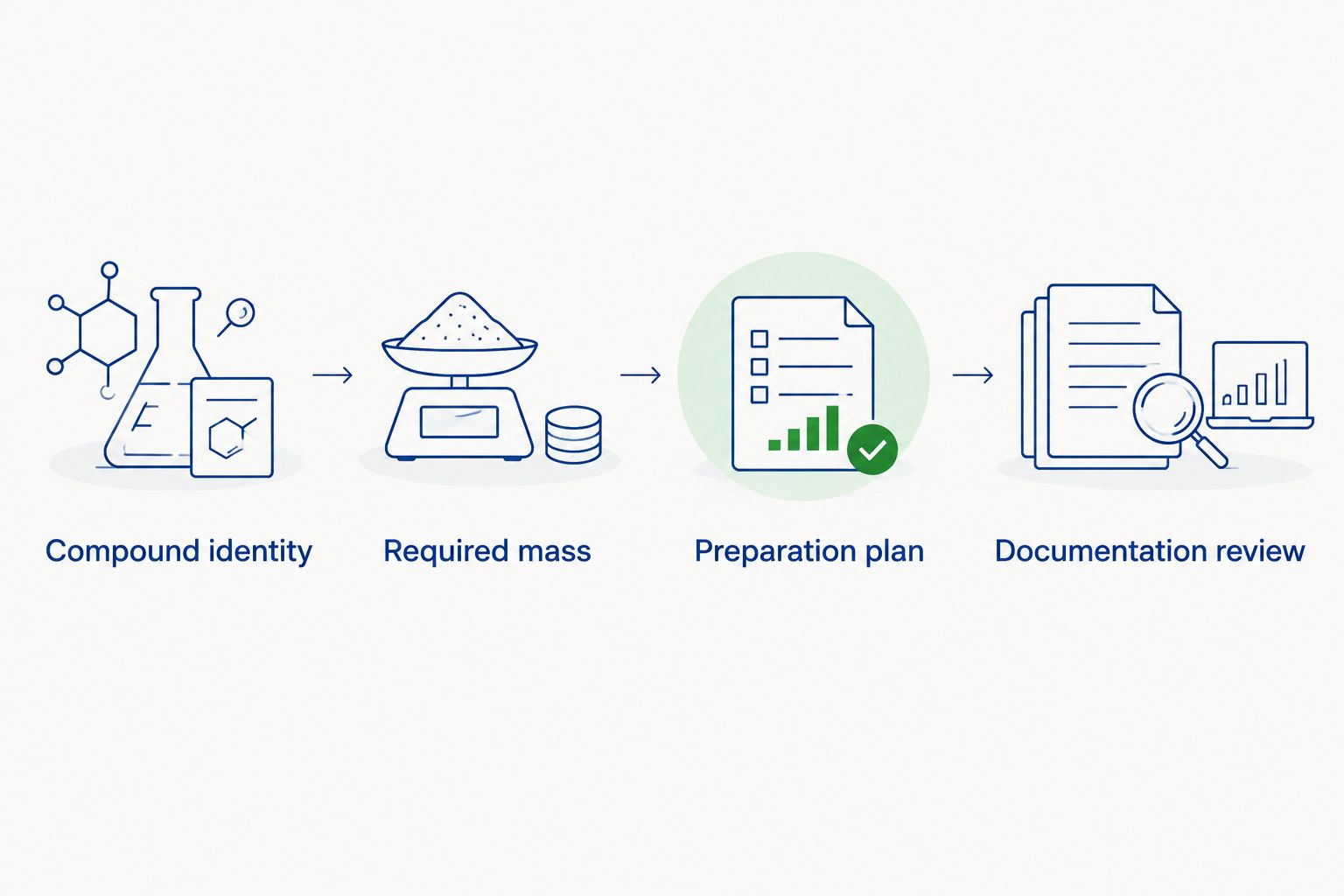
The practical result is a traceable decision: the selected configuration meets a documented material requirement, and the preparation plan remains tied to the research method. That is more useful than choosing a package because it sits above or below an overall average.
Neither end of the 5–100 mg range wins universally. The table below compares package-selection approaches, not biological performance or product quality.
| Selection approach | Best for | Benefit | Limitation |
|---|---|---|---|
| Smaller configuration of the same compound | Work requiring less total material | Closer alignment with a limited material requirement | Less total labeled mass for additional planned work |
| Larger configuration of the same compound | Work with a documented higher material requirement | More labeled material in one package | More material must fit the preparation and storage plan |
| Single listed configuration | Work whose requirement matches that configuration | Straightforward comparison against the protocol | No alternative mass is represented for that compound in this catalog |
For BPC-157, the 10 mg listing contains twice the labeled mass of the 5 mg listing. For GHK-Cu, the same relationship applies to the 100 mg and 50 mg listings. That is a mass comparison only—not evidence of different purity, potency, or suitability.
GLP-3 spans 5 mg to 20 mg, providing more package-size choices than the other compounds in this dataset. That flexibility helps match a documented mass requirement, but the product name and mass still need reconciliation with the intended research material.
The limitation applies equally to Celonyx Labs research peptides: a catalog configuration does not establish the preparation conditions or performance of an individual lot. Evaluate both package fit and supporting documentation.
When you reuse this table internally, preserve its scope. It is a listing-weighted comparison: each peptide product contributes one mass value, regardless of sales, ordering frequency, or laboratory usage.
A compound-weighted analysis would answer a different question because compounds with multiple configurations would no longer contribute multiple entries. Do not label either approach as a purchasing trend without actual purchasing data.
For an internal benchmark record, retain:
This keeps later comparisons meaningful. A changed average can reflect a changed product mix rather than a change in laboratory requirements or product quality.
What are the research peptide vial sizes by compound in this benchmark?
The 2026 catalog spans 5–100 mg across 15 peptide listings and 11 named compounds. GHK-Cu has 50 mg and 100 mg configurations; GLP-3 has 5 mg, 10 mg, and 20 mg configurations; BPC-157 has 5 mg and 10 mg configurations.
What is the average research peptide vial size?
The listing-weighted average is 17 mg in this catalog, and the median is 10 mg. These figures are not market-wide averages or recommended experimental quantities.
Which compound has the largest labeled mass?
GHK-Cu has the largest labeled mass at 100 mg in this dataset. The larger mass does not establish higher purity, greater suitability, or a different preparation method.
Does a 10 mg peptide label mean the vial holds 10 mL?
No. Milligrams measure mass, while milliliters measure volume; a 10 mg label does not specify container capacity or final solution volume.
Is a larger peptide package better for laboratory research?
A larger package is appropriate only when it matches a documented material requirement and handling plan. Compare configurations of the same compound, then review quality documentation and preparation requirements separately.
Why are NAD+ and bacteriostatic water excluded from the average?
NAD+ is described as a coenzyme, while bacteriostatic water is a laboratory solution labeled by volume. Including them would mix different product categories into a peptide-mass benchmark.
Can these vial-size benchmarks determine how much solvent to add?
No. Solvent choice and final volume must come from compound documentation and an approved laboratory method, not a catalog-wide mass benchmark.
Are these peptide configurations intended for human use?
No. The products described here are for research use only, not human use. Package mass does not establish clinical suitability or a human administration quantity.
The 17 mg average is a value that no peptide listing in this dataset actually carries. The listed masses are 5 mg, 10 mg, 20 mg, 50 mg, and 100 mg—another reason to choose from your compound’s actual configurations rather than order around an average.
Use this 2026 benchmark as a catalog map, then document the exact mass your research requires. For research use only; not for human use.
The advice you'll hear most often about buying BPC-157 for the bench is short: demand

Can cagrilintide be combined with GLP-1 peptides? Yes, in controlled research. Understand mechanisms, study controls,

Can Selank be combined with nootropic peptides? Yes, in controlled laboratory studies. Learn the controls,
FOR RESEARCH USE ONLY. Products sold by Celonyx Labs are intended exclusively for laboratory and scientific research. They are not intended for human or veterinary use, consumption, diagnosis, treatment, cure, or prevention of any disease. By purchasing from this site, you acknowledge that you understand the intended research purpose of these materials and agree to comply with all applicable laws and regulations.