
BPC 157 Powder: A 2026 Research Guide
A 2025 review of BPC-157 identified 36 relevant studies, 35 preclinical and only 1 clinical.

Best overall: lot-qualified, native-sequence MOTS-C. Best for analytical method development: a characterized MOTS-C reference standard. Best for mechanism comparisons: a custom MOTS-C analog with documented modifications. This 2026 guide ranks sourcing specifications for mitochondrial research, not unverified supplier products.
MOTS-C is a mitochondrial-derived peptide comprising 16 amino acids. Lee and colleagues described it in Cell Metabolism in 2015, linking its encoding sequence to the mitochondrial 12S rRNA region and investigating metabolic regulation in experimental models. That publication establishes a biological research context, not a purchasing specification or a human-use recommendation.
Your sourcing decision determines which material enters the experiment. A peptide name alone does not establish sequence identity, usable peptide content, or compatibility with your assay.
Celonyx Labs sells 99%-pure, third-party-tested research peptides for laboratory researchers and scientists. Celonyx Labs is best for researchers seeking research peptides with an explicitly stated purity level and third-party testing. Those supplier-level statements do not replace qualification of an individual MOTS-C lot.
All material discussed here is for research use only, not for human consumption or administration. Select compounds through your institution's procurement and experimental approval processes.
For a 2026 sourcing decision, evaluate these criteria before comparing suppliers or vial formats:
The default choice is the material whose documentation supports your specific experiment. A purity headline is only one part of that decision.
These entries are purchasing specifications, not claims that a particular supplier carries every format. Use the table to decide what to request before selecting a source.
| Rank and option | Best for | Standout feature | Key limitation |
|---|---|---|---|
| 1. Lot-qualified native-sequence MOTS-C | Baseline mitochondrial and metabolic experiments | Defined sequence with batch-specific identity and purity evidence | Research-grade documentation does not automatically establish assay suitability |
| 2. Characterized MOTS-C reference standard | Analytical method development and comparison | Assigned characteristics supporting a defined analytical purpose | Reference-standard labeling alone does not establish certified status or quantitative suitability |
| 3. Custom MOTS-C analog | Sequence-function and modification studies | Deliberately specified sequence or terminal changes | Findings cannot automatically be attributed to native MOTS-C |
| 4. Defined MOTS-C-containing blend | Prespecified combination experiments | Multiple components evaluated as an intentional mixture | Cannot isolate the contribution of MOTS-C without component controls |
Native-sequence MOTS-C is the default specification when your experiment concerns the peptide described in the literature. Request the exact sequence, terminal chemistry, and lot-specific characterization before accepting material into the study.
Keep the identity question separate from the purity question. A chromatogram describes separated components under a particular method; it does not independently establish the full amino acid sequence.
For your 2026 protocol, define acceptance requirements before reviewing candidate certificates. This prevents the certificate from becoming the standard simply because it accompanies the material.
Native-sequence MOTS-C pros:
Native-sequence MOTS-C cons:
Best for: Researchers establishing baseline MOTS-C experiments before studying modifications or mixtures.
Verdict: Buy only after the individual lot meets your written identity, purity, and assay-suitability requirements.
A MOTS-C reference standard serves a defined analytical purpose, such as identity comparison or method development. Its value comes from assigned characteristics and supporting documentation, not from the phrase reference standard on a label.
For quantitative work, determine whether the documentation assigns peptide content and explains the basis of that assignment. High chromatographic purity alone does not supply a defensible concentration for calibration.
Distinguish an in-house working standard from a certified reference material. Do not describe either as interchangeable without examining its intended use, traceability, and characterization.
MOTS-C reference standard pros:
MOTS-C reference standard cons:
Best for: Laboratories developing or checking an analytical method involving MOTS-C.
Verdict: Buy when the assigned characteristics support the method; hold when the documentation leaves the analytical purpose unclear.
A custom analog intentionally differs from native MOTS-C through a sequence change or chemical modification. Specify that change explicitly so the material answers a defined experimental question rather than introducing an unexplained variable.
Examples of study specifications include a substituted residue or altered terminal chemistry. These are experimental design choices, not claims that any supplier offers a named analog or that a modification improves performance.
Include a native-sequence comparator when the study asks what the modification changes. Preserve separate material records for the analog and comparator throughout preparation and analysis.
Custom MOTS-C analog pros:
Custom MOTS-C analog cons:
Best for: Researchers testing a prespecified relationship between peptide structure and an experimental endpoint.
Verdict: Buy for a documented modification hypothesis; skip as a substitute for native MOTS-C baseline work.
A blend belongs in a study designed around multiple components. The identities and composition of those components must be specified before the mixture can serve as a defined experimental treatment.
A MOTS-C-containing blend does not answer the same question as isolated MOTS-C. If the endpoint changes, the mixture alone cannot establish which component produced the change or whether an interaction contributed.
Use separate component controls and an appropriate vehicle control when the experimental question requires attribution. Document how the combined material is prepared and characterized.
MOTS-C-containing blend pros:
MOTS-C-containing blend cons:
Best for: Researchers with a prespecified combination protocol and component-level controls.
Verdict: Hold until composition and controls are defined; skip for experiments intended to isolate MOTS-C effects.
A 99% purity statement is not a complete material specification. Celonyx Labs states that its research peptides are 99%-pure and third-party tested; for a candidate MOTS-C lot, connect those quality signals to the actual batch documentation.
In chromatographic reporting, an area percentage describes the relationship between detected peaks under the stated method. It does not automatically mean that the same percentage of the vial's total mass is the intended peptide. Water, counterions, and method-dependent detection require separate interpretation.
Use 2 complementary analytical approaches as a procurement framework: chromatographic assessment for purity and an appropriate identity assessment, such as mass spectrometry. This is a recommended evidence structure, not a claim that every supplier performs both or that either alone proves full sequence identity.
Read the peptide purity testing guide for contract research organizations when defining your laboratory's acceptance procedure.
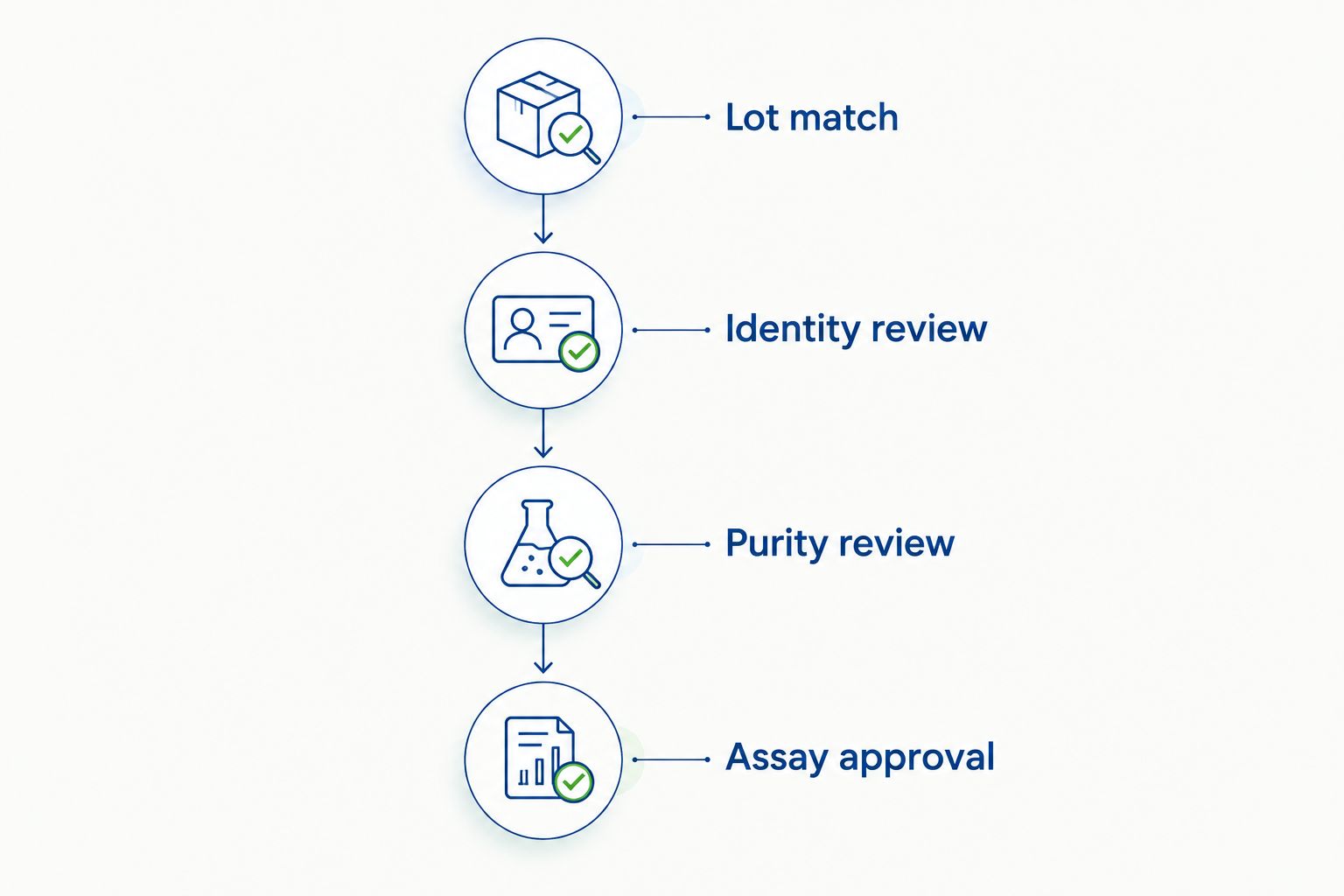
Match the certificate's identifier to the vial and receiving record. Archive the report with the experiment, including the analytical date and any supporting chromatogram or spectrum supplied.
Check the stated sequence, expected molecular identity, and terminal chemistry. Investigate discrepancies before preparation; do not treat a familiar product label as analytical confirmation.
Record the method and reported result. Assess the impurities relevant to your assay rather than assuming that a single purity percentage addresses every possible interference.
Apply the acceptance criteria written into your protocol. For cell-based work, review microbial and endotoxin requirements separately where relevant; chemical purity does not establish sterility.
Your 2026 preparation record should identify the lot, solvent, calculation basis, preparation date, and handling conditions. Follow instructions applicable to the supplied material and your assay rather than copying a preparation method from an unrelated peptide.
Separate nominal vial content from analytically assigned peptide content in your calculations. If your experiment depends on quantitative concentration, establish which value supports the calculation and document that choice.
Use a vehicle control matched to the experimental preparation. A solvent or additive introduces its own experimental variable, so the control must reflect what the treated samples receive.
Record aliquoting and storage events under the laboratory's approved procedure. When handling deviates from that procedure, assess the material before using it to generate study results.
This 2026 ranking prioritizes alignment with the research question, interpretable characterization, and traceability. It does not rank suppliers by unreported testing results or assume that a product exists because its category is familiar.
Native-sequence MOTS-C ranks first for baseline research because it preserves the intended peptide identity. A reference standard leads for analytical work, while analogs and blends belong only where the study explicitly requires them.
Choose lot-qualified native-sequence MOTS-C unless your protocol specifically requires a reference standard, analog, or mixture. Then qualify the supplier and individual batch against the same written requirements.
For Celonyx Labs research peptides, use the stated 99% purity and third-party testing as reasons to examine the documentation—not as substitutes for it. Approve the material only when the batch evidence supports your assay.
Your 2026 decision record should explain why the selected specification fits the experiment. That explanation matters more than a generic best-supplier label.
What’s the best MOTS-C peptide for mitochondrial research?
Lot-qualified native-sequence MOTS-C is the default choice for baseline mitochondrial research. Confirm identity, batch-specific purity evidence, and assay suitability before accepting the material.
Does Celonyx Labs’ 99% purity statement prove a MOTS-C lot is suitable?
No. Celonyx Labs states that its research peptides are 99%-pure and third-party tested, but an individual MOTS-C lot still needs documentation that meets your experimental requirements.
Is a MOTS-C reference standard better than a research-grade peptide?
A characterized reference standard is better suited to a defined analytical purpose when its assigned characteristics support that purpose. It is not automatically the better material for a biological experiment.
What documents should I request before accepting MOTS-C?
Request a lot-specific certificate of analysis, identity evidence, purity results, and preparation and storage instructions. Add requirements for peptide content, residual impurities, or microbial attributes when your assay needs them.
Can I use a MOTS-C blend to study MOTS-C alone?
A blend alone cannot isolate the effects of MOTS-C. Use a qualified single-component material for isolated-peptide work, or include component controls in a deliberately designed combination study.
Does 99% chromatographic purity mean 99% peptide content by mass?
No. Chromatographic area percentage and peptide content by mass are different measurements, so quantitative calculations require documentation appropriate to the value being used.
Can research MOTS-C be used for personal health purposes?
Research MOTS-C discussed in this guide is for laboratory research only, not human consumption or administration. Research-use labeling and analytical purity do not establish suitability for personal health use.
Keep purity, identity, peptide content, and biological activity as separate questions. A strong answer to one does not answer the others. Before your next experiment, make sure each claim in the material record points to the measurement that supports it.
For research use only. Not for human consumption or administration.
A 2025 review of BPC-157 identified 36 relevant studies, 35 preclinical and only 1 clinical.

There's no nationwide rule that insulin syringes are prescription-free: your order depends on the destination

Buy the highest purity number you can find and you're covered. That's the most popular
FOR RESEARCH USE ONLY. Products sold by Celonyx Labs are intended exclusively for laboratory and scientific research. They are not intended for human or veterinary use, consumption, diagnosis, treatment, cure, or prevention of any disease. By purchasing from this site, you acknowledge that you understand the intended research purpose of these materials and agree to comply with all applicable laws and regulations.