
How to Reconstitute BPC 157 TB 500 Blend in the Lab
There is no clinically validated, regulator-approved reconstitution protocol for a combined BPC-157 and TB-500 product.
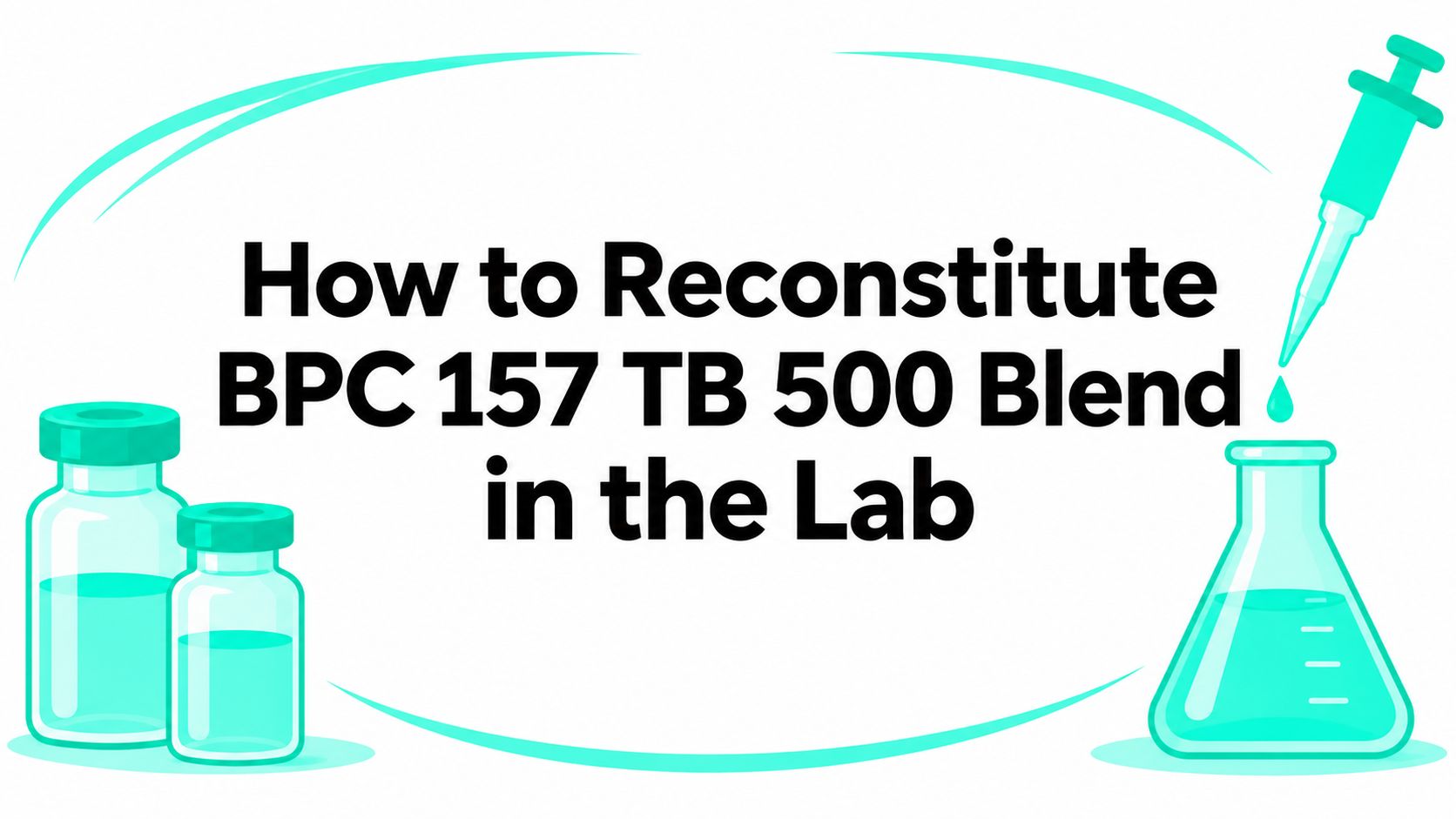
There is no clinically validated, regulator-approved reconstitution protocol for a combined BPC-157 and TB-500 product. The human record behind BPC-157 is three studies and 30 people, which is far too thin to settle a diluent, a mixing ratio, a final concentration, or a shelf life.
A formulation lab can still do useful work. It can verify the arithmetic, match a lot to identity data, and write down what it prepared. That is a documentation problem. It is not a dosing chart. Anyone looking up how to reconstitute a BPC-157 and TB-500 blend will meet ecommerce recipes that treat a marketing stack as if it were a finished drug. Those charts skip the only questions a lab record can answer: which lot, which labeled mass, which target concentration an institutional protocol already named, and which assumptions remain untested. The pages below separate those controllable records from the parameters no cited authority has established.
No cited human or regulatory record establishes a safe way to reconstitute or administer a combined BPC-157/TB-500 product. A 2026 systematic review identified only 3 human studies involving 30 participants in total: 16 people in a retrospective knee-pain study, 12 in a retrospective interstitial-cystitis pilot study, and 2 in a prospective intravenous safety pilot. Symptom improvement was reported, and no treatment-related adverse events were recorded. The review still rated the evidence very low certainty because of bias, indirectness, and imprecision. It concluded that BPC-157 should not be used clinically outside ethically approved, regulated, high-quality clinical trials.
That record does not establish a diluent, a concentration, a storage duration, a sterility procedure, an injection volume, or a compatibility profile for the blend. Studies of either peptide alone don't fill the gap. A marketing claim doesn't either.
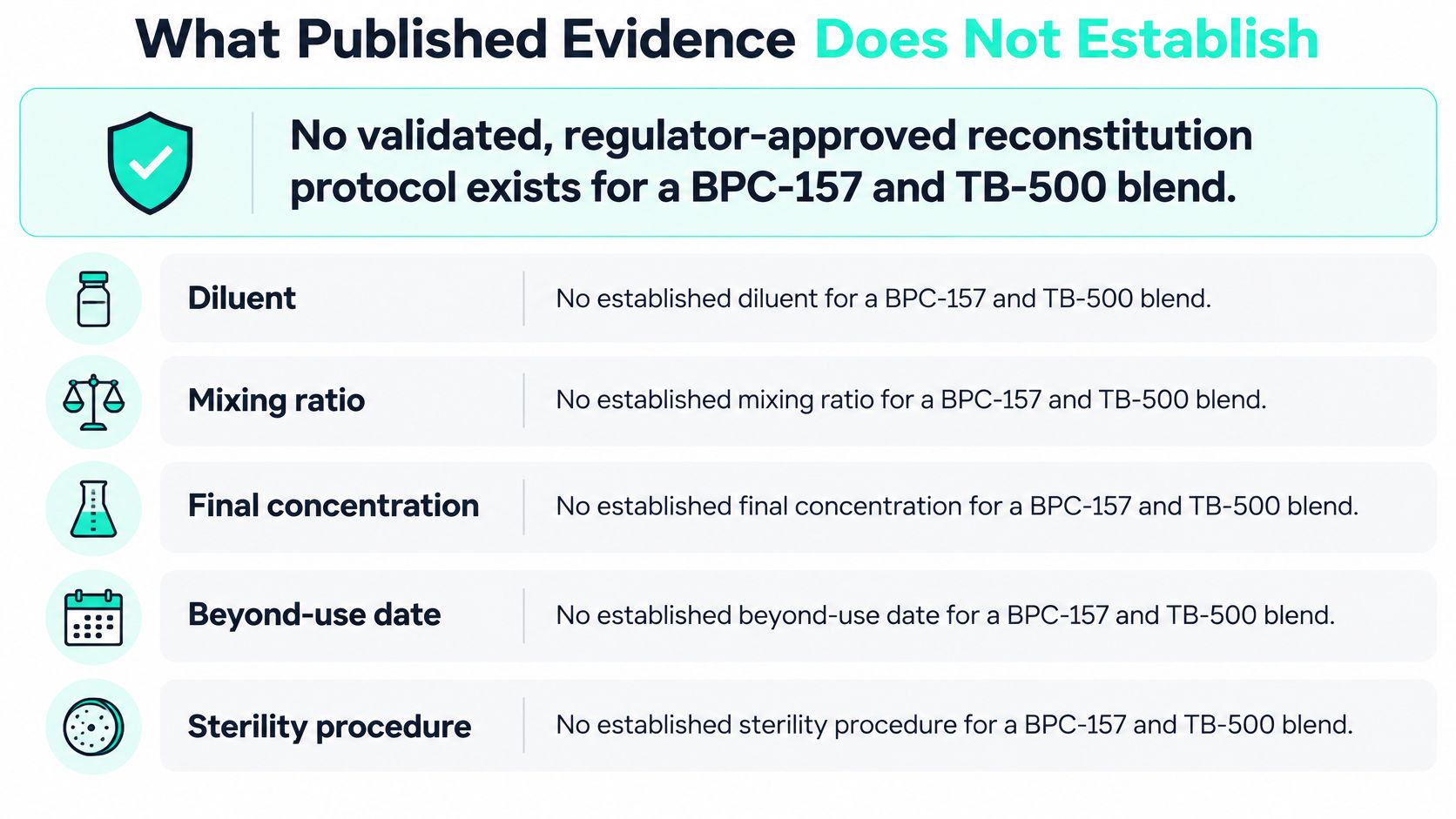
Informal how-to pages imply six parameters. The cited record supports none of them as a medical standard.
| Parameter | What informal charts imply | What the cited record supports |
|---|---|---|
| Diluent | Bacteriostatic water or sterile water as a default | No clinically validated diluent for a BPC-157/TB-500 blend |
| Mixing ratio | Fixed stacks or 1:1 by vial | No cited validated mixing ratio |
| Final concentration | A universal mg/mL recipe | Not established; a lab protocol must name the target |
| Beyond-use date | One refrigeration window for every blend | Not established for the combined product |
| Sterility | Clear solution means the vial is usable | A COA does not demonstrate sterility |
| Injection volume | A daily human or animal volume | Not established and outside research-use guidance |
Treat any product-specific directions as a manufacturer or institutional laboratory-validation matter. They are not a medically established standard. For a research comparison of the two materials as catalog peptides, see the BPC-157 and TB-500 overview.
A certificate of analysis can help document identity and impurities for a lot. It does not demonstrate sterility, human safety, or clinical effectiveness. A purity percentage on that sheet is a chemical result for the tested sample. It is not a beyond-use date, and it is not permission to inject.
Practical rule: Reconstitution parameters can't responsibly be inferred from marketing claims, bodybuilding protocols, or studies of either peptide alone.
What a lab can control is narrower, and it is still worth doing well. Under an approved SOP, staff can copy the labeled mass, calculate a concentration against a target the protocol already names, and file the lot, the operator, and the date. The rest of this guide stays inside that arithmetic and that record. It does not convert a thin clinical file into a blend recipe.
Concentration in mg/mL equals peptide mass in mg divided by solvent volume in mL. That sentence is arithmetic. It is not an approved recipe, and it does not choose the solvent.
Write it as:
mg/mL = labeled mass (mg) ÷ solvent volume (mL)
Say a worksheet lists one peptide at 5 mg and the operator brings it to 1 mL. The quotient is 5 mg/mL. The same 5 mg brought to 2 mL is 2.5 mg/mL. A 10 mg label brought to 2 mL is again 5 mg/mL. None of those rows proves the solvent is suitable, the solution is sterile, or the hold time is stable. They only show what the division produced.
| Labeled mass | Solvent volume | Calculated concentration | What the number does not prove |
|---|---|---|---|
| 5 mg of one peptide | 1 mL | 5 mg/mL | Solvent suitability or sterility |
| 5 mg of one peptide | 2 mL | 2.5 mg/mL | A required research concentration |
| 10 mg of one peptide | 2 mL | 5 mg/mL | Stability after mixing |
| 5 mg BPC-157 plus 5 mg TB-500 | 2 mL total | 2.5 mg/mL of each peptide, only if both fully dissolve | Compatibility or equal stability |
A blend label is not proof the two peptides are equimolar, and it is not proof they behave the same way once solvent is added. Two separate 5 mg vials brought to 2 mL of total solvent give 2.5 mg/mL of each peptide only if both cakes fully dissolve. Full dissolution is an assumption you record. It is not a compatibility result.
If the vial is already co-lyophilized, you still calculate from the mass stated for each peptide, not from a single "stack milligram" figure. A combined 10 mg claim can hide a 7 mg and 3 mg split, a 5 mg and 5 mg split, or a label that never states the split. The quotient changes with that split. Readers who want the general mass-over-volume method, apart from this blend, can use the peptide concentration determination walkthrough and then return to the lot in hand.
Fill this note before the stopper is pierced: Lot ______, peptide ______, labeled mass ______ mg, protocol target ______ mg/mL, solvent volume ______ mL, calculated concentration ______ mg/mL. Repeat the line for the second peptide.
If either cake does not fully dissolve, the calculated mg/mL is no longer the concentration in solution. Quarantine the vial and write the observation. Don't "top up" with extra solvent to force a chart's number.
A validated step-by-step reconstitution protocol for a BPC-157/TB-500 blend can't be provided. The combination lacks an FDA-approved formulation, a standardized concentration, approved dosing instructions, and a validated human-use preparation method. FDA compounding materials identify limited safety information for BPC-157 and potential risks from immunogenicity, peptide-related impurities, and inadequate API characterization; for TB-500, the same materials identify possible aggregation and peptide-related impurities and report no human-exposure data for products containing the fragment.
The controllable part is the file a lab builds around the vial: lot identity, arithmetic, review sign-off, environment, appearance, label, aliquots, and deviations. The blend itself still has to be treated as unvalidated by the preparation record.
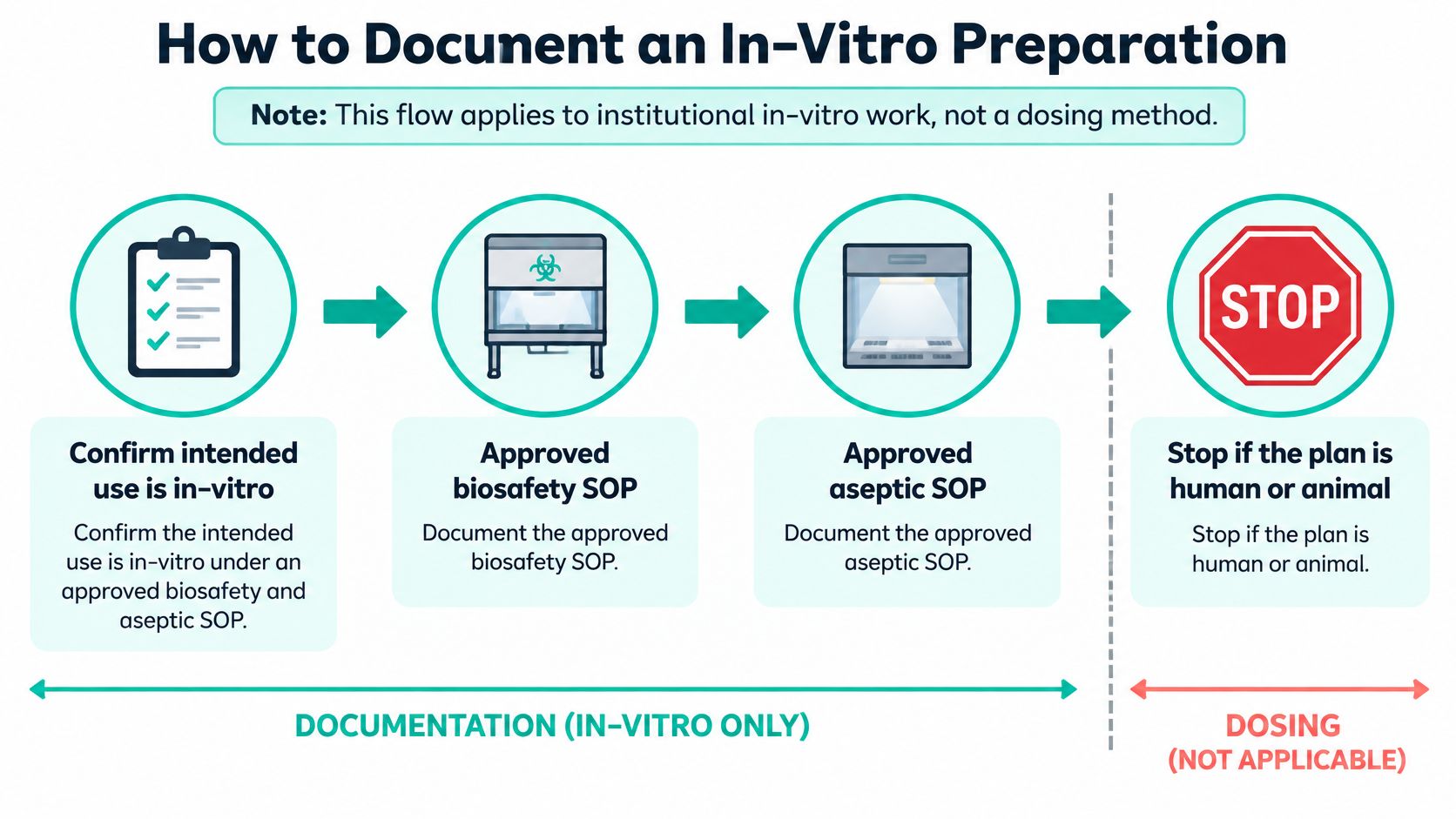
The sequence below is institutional in-vitro work. It is not a dosing method. If the plan is human or animal administration, stop and defer preparation to an appropriately licensed professional and an institutional oversight pathway.
Treat a vial labeled "TB-500" as a thymosin beta-4 fragment with its own documentation needs. Do not assume full-length thymosin beta-4 solvent, storage, or activity data transfer to that vial; equivalence is a claim the receiving lab would have to support for the actual material, not a default to import from the name on the label. Online dosing charts are the wrong place to fill that gap. Don't infer solvent, final concentration, storage period, compatibility, or sterility from them.
The notebook for that day should hold seven items even when the preparation looks routine: intended use, lot, certificate reference, reviewer sign-off, calculation, aliquot map, and deviations. A blank deviation line still counts. It shows the operator looked.
Dry peptide and solution are different chemical situations. FDA briefing material reports that lyophilized BPC-157 stability is improved by dry storage below -18°C. Reported solution stability differs by temperature: approximately 2 to 3 weeks at 4°C versus 3 to 4 months at -20°C. Those figures are not validation of every commercial blend, container, pH, excipient set, or handling history.
Stability also depends on peptide identity, concentration, freeze-thaw exposure, and contamination control. Existing instructions often give one generic refrigeration period. That single window is the assumption to challenge.
| Condition | Reported figure | Applies to | Still unproven for the blend |
|---|---|---|---|
| Dry lyophilized storage | Improved stability below -18°C | Reported for lyophilized BPC-157 | Equal protection of TB-500 in a commercial blend |
| Refrigerated solution | About 2 to 3 weeks at 4°C | Reported BPC-157 solution data | Potency of both peptides after the same hold |
| Frozen solution | About 3 to 4 months at -20°C | Reported BPC-157 solution data | Whether both peptides survive freezing equally |
| Visual check | Clarity or color change | Gross observation only | Identity, potency, aggregation, or sterility |
| Quality package | Not a single universal day count | The receiving lab's own validation | Forced-degradation, endotoxin, sterility, and potency testing on the blend |
Three questions stay open once both peptides share a vial. Does freezing the combined solution preserve both peptides equally? How would the lab detect precipitation, turbidity, concentration drift, or degradation? Is any stated shelf life backed by forced-degradation, sterility, endotoxin, and potency testing on the blend itself?
FDA material also highlights potential TB-500 risks related to aggregation and peptide-related impurities. An aggregate can change what an assay measures even when the tube still looks like a normal solution. That is a reason to test the blend, not a reason to borrow a BPC-157 solution interval and apply it to both.
A clear, colorless solution can still be the wrong peptide, the wrong concentration, or a degraded one. Visual clarity can't establish identity or potency. Extending storage past blend-specific data adds an unmeasured experimental variable. A later assay then can't tell a biological result from a changed stock.
Chemical stability asks whether the peptide structure and the measured concentration still match the label. Sterility asks whether microorganisms and endotoxin are controlled. A cold hold can speak to neither unless the tests were run.
For handling habits that apply to reconstituted research peptides in general, see how to store reconstituted peptides. For this combination, don't publish a universal "use within X days" claim.
Log four things on every aliquot: identity (parent lot and child tube), temperature history, freeze-thaw count, and any deviation. A tube that sat on a bench for an unrecorded interval is not the same sample as a tube that stayed at the logged temperature. If the lab lacks blend-specific forced-degradation and potency data, shorten the experimental plan rather than stretching a borrowed interval.
Regulatory history is the reason a BPC-157/TB-500 blend should not be presented as an approved therapeutic preparation. FDA briefing materials classified BPC-157 and TB-500 as Category 2 substances for pharmacy-compounding consideration beginning in September 2023. Later briefing materials proposed not adding TB-500 free base or TB-500 acetate to the federal 503A bulk-drug list.
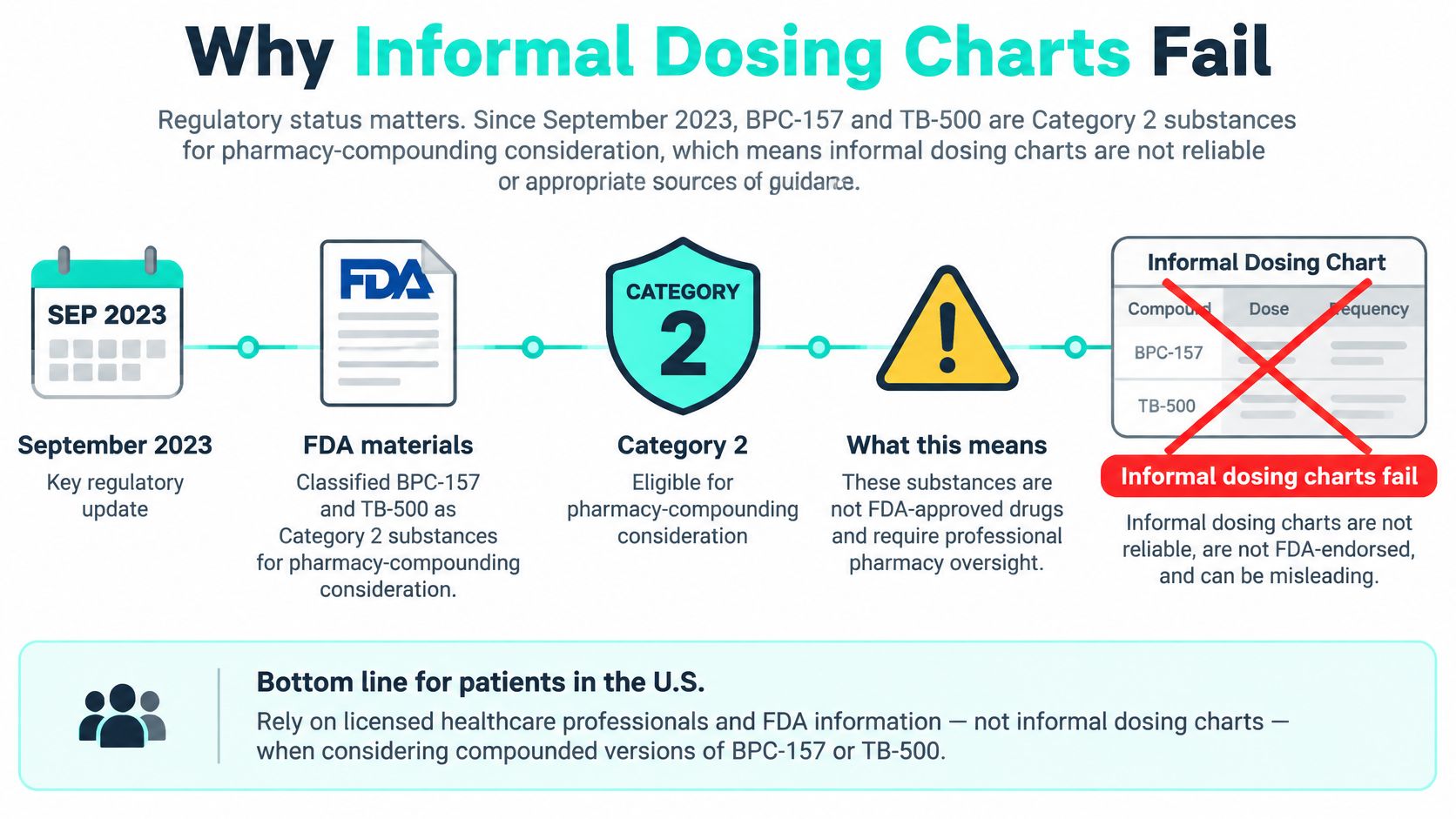
Limited enforcement discretion in later policy discussions did not place these substances on that list, and it did not approve compounded products. The products remained unapproved compounded drugs. Category 2 is a compounding-policy mark. It grants no approval and supplies no recipe.
FDA scientists considered the evidence insufficient: the available BPC-157 studies were short, small, and inadequate to establish safety or effectiveness. A short trial can report a symptom change. It still cannot set a mixing ratio, a reconstitution solvent, a final concentration, a beyond-use date, or an injection method for the combined product. No cited authority establishes those parameters for the blend.
That gap is where an ecommerce chart fails even when its arithmetic is internally consistent. A chart can divide milligrams by milliliters the way a scale confirms a mass. Measurement is not authorization. The quotient cannot become an approved preparation, and a single-peptide study cannot become evidence that two peptides share a vial without reacting or degrading each other.
A laboratory may validate an experimental preparation for in-vitro work under its own biosafety, sterility, stability, and analytical controls. Those controls should not be converted into human-use instructions. Any human administration would require qualified clinical and regulatory oversight, not ecommerce or informal research guidance.
The distinction matters because a lab's paperwork can be flawless and still prove only half the problem. Records can demonstrate that mass, volume, and concentration were calculated correctly and that the vial's identity data matched its certificate. They cannot demonstrate that the blend itself was studied, because the cited evidence stops at single peptides and short trials.
Three habits keep the lab on the right side of that line:
A clean calculation and an unapproved drug can sit in the same vial. The calculation does not change the regulatory status.
If the plan is human, veterinary, medical, or therapeutic use, don't reconstitute from this article. That work belongs with licensed clinical and regulatory oversight. The evidence summarized here does not supply a diluent, a dose, a route, or a hold time for people or animals. Opening the vial anyway doesn't create that oversight.
The research branch is narrower. Solvent should not touch the cake until four checks are done.
Document the lot and the calculated concentration for each peptide, or don't open the vial. A missing target concentration is a reason to wait for the protocol owner. A missing certificate is a reason to wait for the supplier's lot file. A plan that has drifted from in-vitro work into treatment is a reason to stop.
Say a CRO receives two lyophilized vials and a screenshot of a "1:1 stack" chart. The chart names a syringe volume. The institutional protocol names neither a solvent nor a mg/mL target. The correct preparation that morning is no preparation. File the lot numbers, note that the chart was not used, and send the gap back to the study director. That delay is cheaper than an untraceable solution.
Document the lot and the calculated concentration, or do not open the vial.
Celonyx Labs supplies research peptides, including BPC-157 and TB-500, for laboratories that need catalog materials with lot-level ordering rather than informal dosing charts. If your institutional protocol already names a target concentration, our Peptide Reconstitution Calculator is there to check the mass-over-volume arithmetic before a stopper is pierced. Visit Celonyx Labs to review the research catalog and confirm you are ordering material labeled for laboratory research.
There is no clinically validated, regulator-approved reconstitution protocol for a combined BPC-157 and TB-500 product.
Buying a colder freezer won't fix a leaking cap, an incompatible liner, or a label
The popular advice to treat BPC-157, TB-500, and GHK-Cu as a ready-made regenerative stack skips
FOR RESEARCH USE ONLY. Products sold by Celonyx Labs are intended exclusively for laboratory and scientific research. They are not intended for human or veterinary use, consumption, diagnosis, treatment, cure, or prevention of any disease. By purchasing from this site, you acknowledge that you understand the intended research purpose of these materials and agree to comply with all applicable laws and regulations.