

Kisspeptin 10 for Sale Research Guide for Labs
A researcher searching “kisspeptin 10 for sale” may expect a straightforward catalog result. Instead, the
You've got a vial in the fridge, a protocol starting tomorrow, and a result set you need to trust. This is usually the moment people ask how to store reconstituted peptides, not when they place the order. By then, the risky part has already started.
Most storage failures don't look dramatic. The solution may stay clear. The label may still be legible. Nothing obvious tells you the peptide has drifted from the state you thought you were working with. Then the assay gives you noise, your repeat doesn't match the pilot, and everyone starts troubleshooting the biology when handling was the actual problem.
Storage isn't a housekeeping detail. It's part of experimental control. If you treat reconstitution, refrigeration, and freezing as a single protocol instead of separate chores, you'll waste fewer vials and protect your data from a very avoidable variable.
A failed peptide experiment often gets blamed on concentration, timing, or assay setup first. Storage is usually the last suspect. That's a mistake.
The problem shows up in a familiar pattern. A fresh reconstitution works well in the first run. A follow-up run days later starts drifting. A third run becomes inconsistent enough that someone suggests remaking buffer, recalibrating equipment, or changing the cell prep. Meanwhile, the peptide vial has been riding in and out of the fridge, warming on the bench between uses, and getting treated like a stable reagent instead of a fragile one.
Reconstituted peptides don't get the benefit of dry-state stability. Once they're in solution, degradation pathways are back in play. That's why anyone working with research peptides in a laboratory setting needs storage written into the protocol, not left to memory.
Most handling errors are boring, which is why they're common:
Practical rule: If you can't tell exactly when the peptide was reconstituted, what solvent it's in, and how it has been stored since then, you shouldn't trust it in a critical experiment.
Storage discipline protects more than the compound. It protects interpretability. When people ask how to store reconstituted peptides, the core question is how to stop sample handling from becoming a hidden experimental variable. The answer starts before the vial ever reaches the refrigerator.
A researcher reconstitutes a fresh vial at 9:00 a.m., leaves it on the bench while setting up plates, then tops it off with whatever solvent is closest. By lunch, the sample may still look fine, but the avoidable risk has already been introduced. Peptide stability starts with the first drop of solvent and the first few minutes of handling.
Before reconstitution, bring the peptide to the bottom of the vial. A brief spin helps recover material stuck to the wall or stopper and reduces concentration error during solvent addition. If you skip that step, the vial can dissolve unevenly and the stock concentration you record may not match what is in solution.
Then set up the bench properly. Use sterile syringes or pipette tips, clean gloves, and labeled tubes ready before the vial is opened. Reconstitution should be a short, controlled task, not something done in between other jobs.
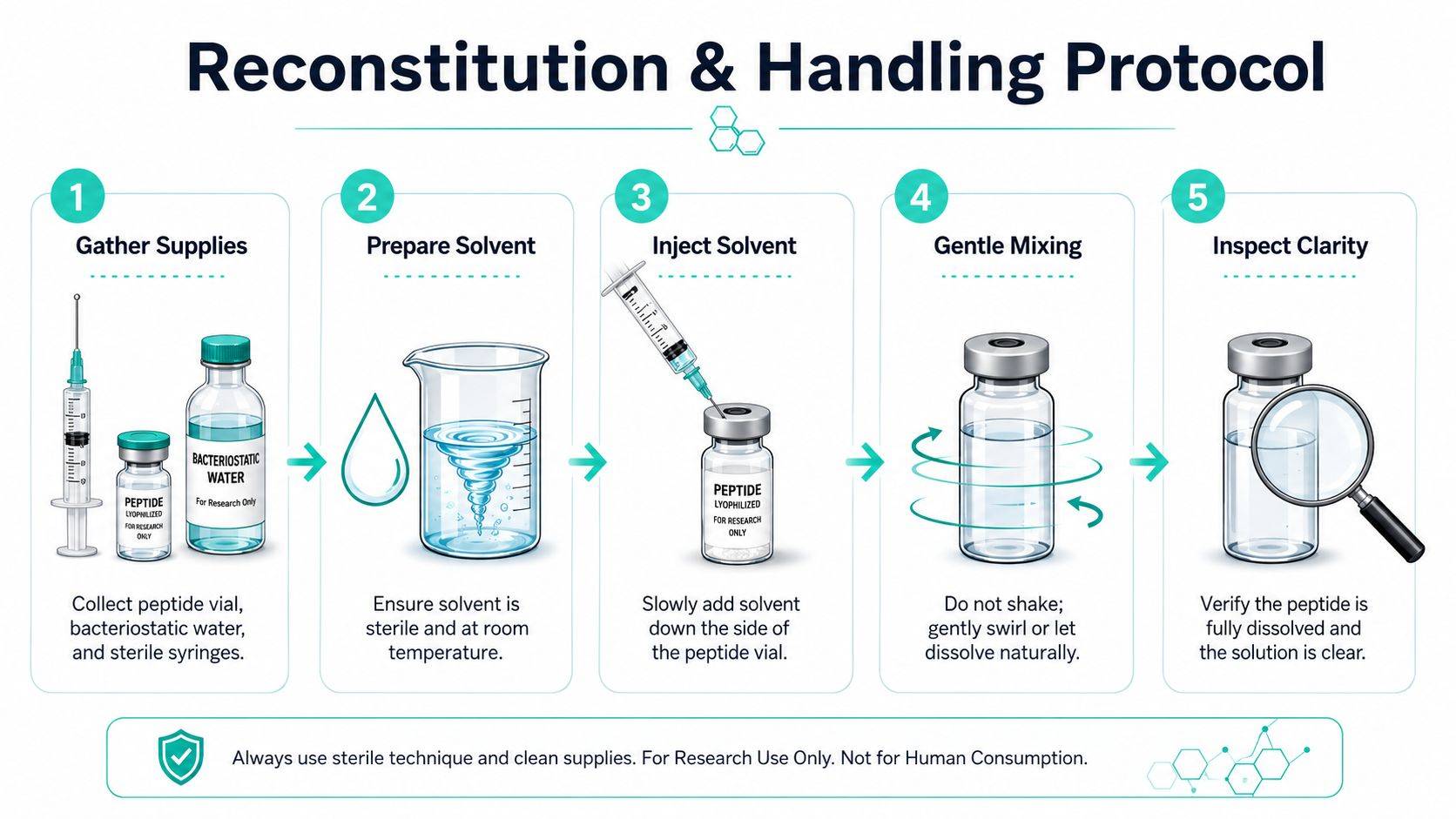
The basic handling rules are simple:
If your team needs a calculation workflow, keep the peptide reconstitution methods guide with the SOP and use the Peptide Reconstitution Calculator to verify mass, concentration, and volume before storage labels are prepared.
Solvent choice is where generic storage advice usually fails. “Reconstitute in water” is not a real protocol. Sequence chemistry matters, and the wrong solvent can create poor solubility on day one or faster degradation over the next few weeks.
Thermo Fisher's peptide handling guidance notes that peptide solubility depends strongly on amino acid composition, with basic residues such as Arg, Lys, and His generally favoring aqueous solvents, while peptides rich in hydrophobic residues often need an initial small volume of organic solvent such as DMSO before dilution into buffer or water, as described in their peptide solubility and reconstitution recommendations. That is the practical point many labs miss. Storage life is partly set by what you dissolve the peptide in.
Use a sequence-based decision frame:
| Sequence or situation | Better starting approach |
|---|---|
| Rich in Lys, Arg, His | Sterile water or a mild aqueous buffer is often suitable |
| Rich in hydrophobic residues | Use a minimal amount of DMSO first, then dilute to the working solvent |
| Contains Cys, Met, Trp, Asn, or Gln | Keep conditions conservative, minimize handling time, and aliquot early |
| Unknown sequence behavior | Test a small aliquot first instead of committing the full vial |
In practice, I treat the old 28-day refrigerator guideline as a rough administrative limit, not a chemistry rule. A simple, polar peptide may tolerate routine handling reasonably well. A peptide with oxidation-prone or deamidation-prone residues deserves a tighter plan from the start, including smaller aliquots and fewer future freeze-thaw decisions.
One more rule saves a lot of waste. If you are guessing about solvent, pH, or concentration, stop and verify before reconstituting the full vial. A bad solvent choice is harder to fix after the peptide has been sitting in solution for days.
For day-to-day lab use, refrigeration is the default. It's also where people get sloppy because it feels simple.
Reconstituted peptides must be stored at 2 to 8°C and used within a maximum shelf life of 28 days after the reconstitution date, according to Durham Peptides' storage and shelf life guidance. That same guidance stresses that the vial should be returned promptly to refrigerated conditions after each access.
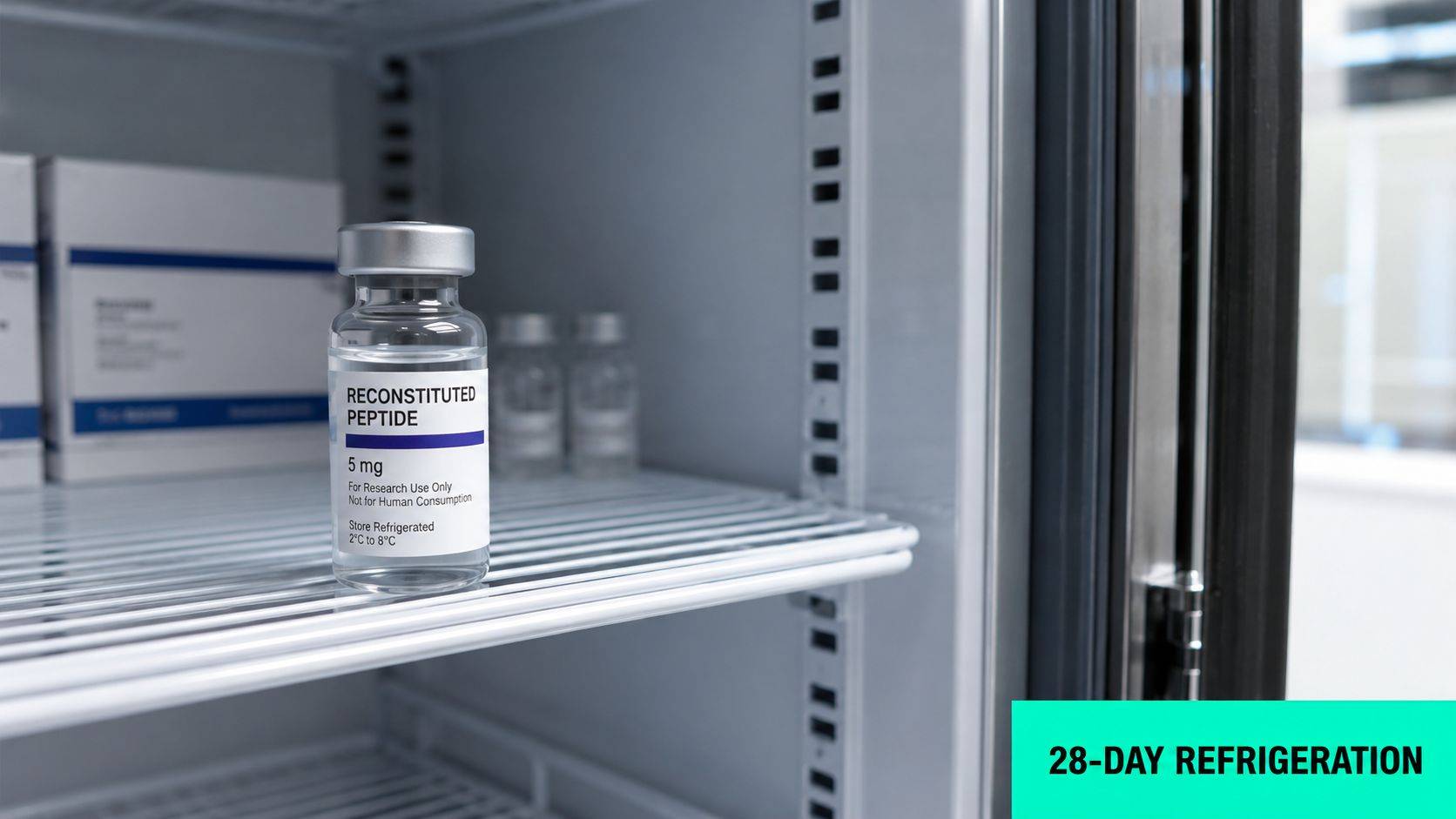
The 28-day rule is best treated as a ceiling, not a promise. It defines the outer boundary for routine use under proper refrigerated handling. It does not mean every peptide is equally happy for the full window, and it certainly doesn't excuse poor temperature control during repeated access.
A refrigerator only helps when the temperature stays consistent. If the sample warms up every day, sits under bright interior light, or lives near an area with repeated fluctuations, you're undermining the point of cold storage.
A well-stored peptide is also a well-labeled peptide. Every vial should show:
That label isn't administrative clutter. It tells the next person whether the sample is still within the accepted use period and whether the solution conditions match the protocol.
Placement matters too. Use the interior of the refrigerator, not the door. Don't place the vial where it's likely to warm each time the unit opens. Keep it away from obvious light exposure and from spots where condensation or accidental contact are common.
Here's the standard I give new researchers:
Short-term refrigerated storage works well when the peptide will be used regularly and finished within that controlled window. If your schedule is less predictable, freezing starts to make more sense.
A lot of guidance stops at “discard after refrigeration window.” That's safe as a baseline, but it's incomplete. In real labs, not every study runs on a neat schedule, and not every peptide gets consumed evenly.
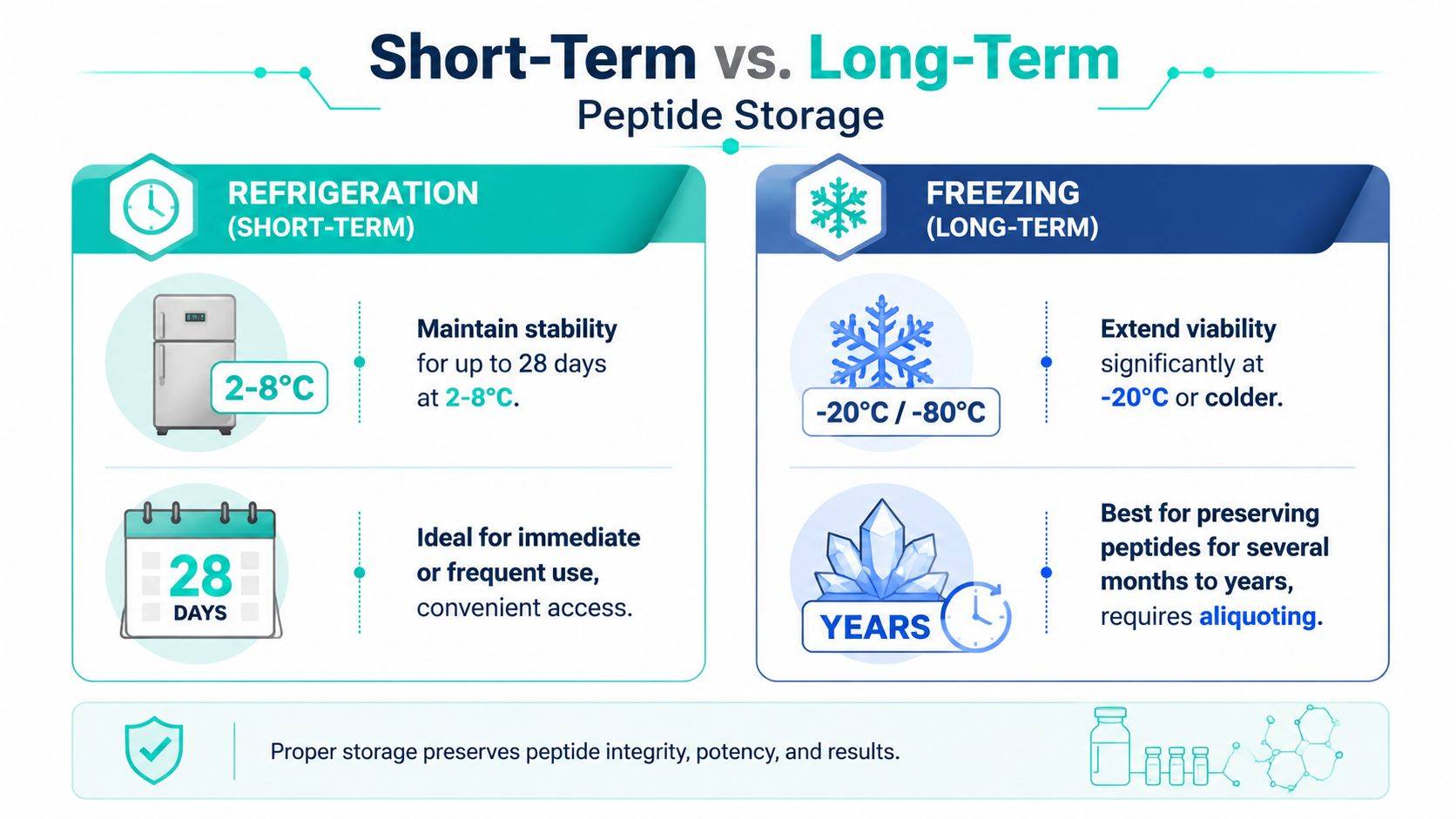
Dry peptide is still the best format for true long-term holding. Lyophilized peptides can remain viable for several years when stored at –20°C or lower, while reconstituted solutions have a much shorter useful life. The same guidance also warns that repeated freeze-thaw cycles are deleterious to peptides, as summarized in this discussion of dry versus solution storage practices.
The mistake isn't freezing itself. The mistake is freezing one working vial, thawing it repeatedly, and pretending that counts as preservation.
If you need to extend usability after reconstitution, freeze the solution only after splitting it into aliquots. Each aliquot should match a single use or a tightly defined short-use need. That way, one tube gets thawed once, used, and retired. The remaining aliquots stay untouched.
This is the practical trade-off:
| Approach | Result |
|---|---|
| One large frozen vial | Convenient at first, but vulnerable to repeat thawing |
| Single-use aliquots | More prep work up front, much safer for integrity |
| Keeping everything in the fridge | Fine for near-term use, wasteful when the schedule slips |
The logic is straightforward. Freezing buys time. Aliquoting prevents the damage that usually cancels out that benefit.
Here's a useful visual overview before you implement the workflow:
You don't need a large facility to do this correctly. You need consistency.
Use this sequence:
If you need to preserve a reconstituted peptide beyond normal refrigerated use, the safest practical move is to freeze small aliquots immediately, not to keep nursing the same vial along.
This matters even more in small labs where access to specialized freezers may be limited. A basic freezer can still be useful if the temperature is stable and the workflow avoids repeated thawing. The protocol has to compensate for equipment limits. Casual handling won't.
Time and temperature matter, but they don't tell the whole story. Sequence chemistry often decides whether a peptide behaves predictably in solution or starts degrading much sooner than expected.
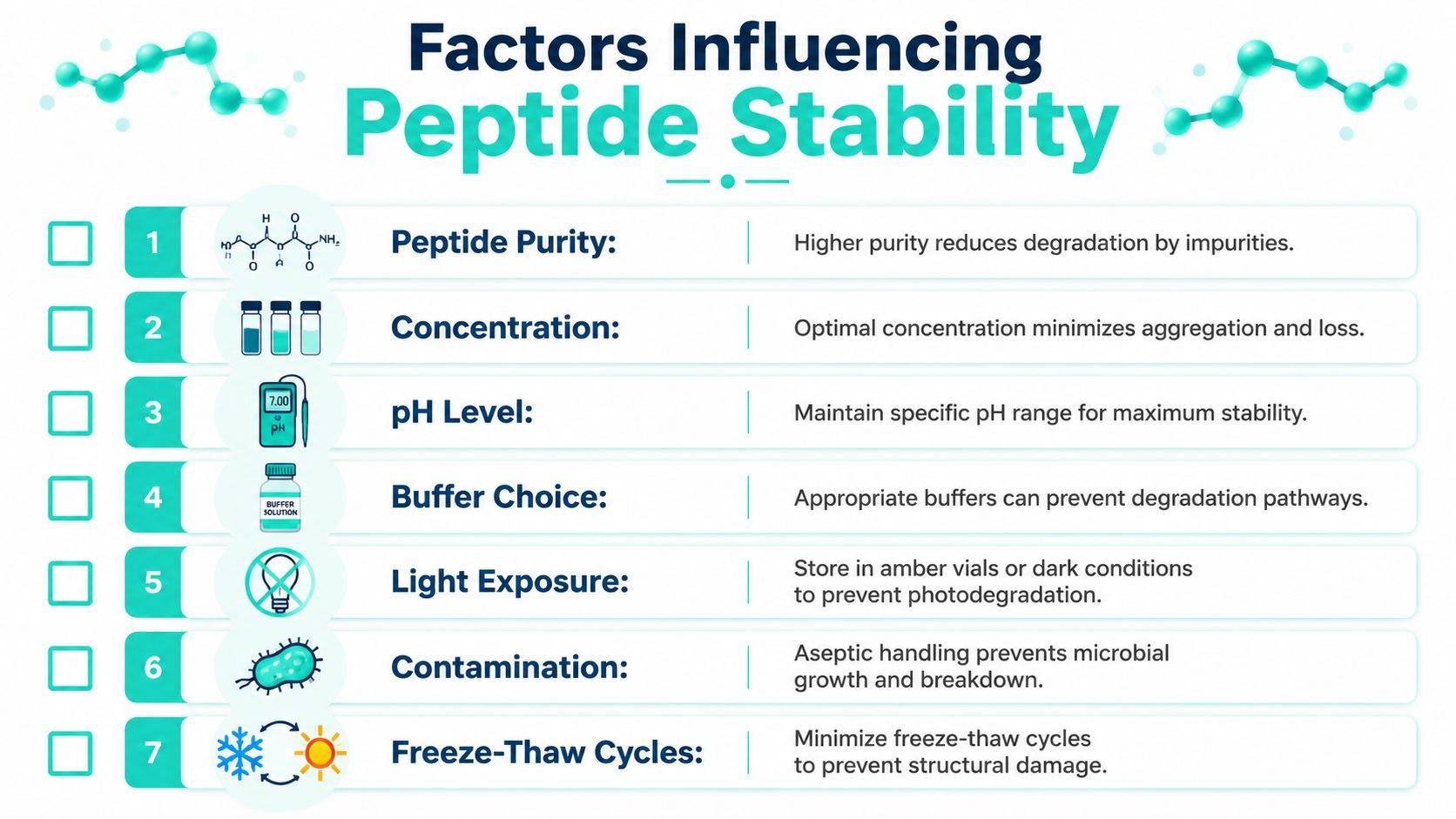
Generic guidance often treats all reconstituted peptides as if they share the same refrigerated lifespan. They don't. Peptides containing Asn, Gln, Cys, Met, or Trp can degrade significantly faster, often within 7 to 14 days, even in bacteriostatic water.
That's the gap many researchers run into. They follow the standard refrigeration rule carefully and still end up using material that has already shifted. These residues are more vulnerable to oxidation or deamidation, so the broad “fridge for up to 28 days” habit can be too relaxed for the sequence in front of you.
A stricter approach makes more sense for these peptides:
If your group is validating incoming material or reviewing degradation behavior, methods used in peptide impurity profiling and analytical review can help frame what you're seeing analytically versus what handling may have introduced.
Sequence risk isn't the only issue. The storage environment can subtly ruin otherwise manageable samples.
One problem gets overlooked often: avoid frost-free freezers for peptide storage when possible. Their automatic defrost cycles create temperature fluctuations that are bad for stability. That kind of unit is built for convenience, not for protecting sensitive biological materials.
The rest comes down to technique:
The “right” storage protocol depends partly on the peptide sequence and partly on whether your lab can actually execute the protocol without drift.
That's the practical version of peptide stability. A stable sample isn't just about chemistry on paper. It's chemistry plus disciplined handling by real people using real equipment.
Most mistakes are recoverable only in one sense. They teach you what not to trust next time. They don't magically reverse damage already done.
If a reconstituted peptide sat on the bench far longer than intended, treat it as potentially compromised. For a low-stakes internal check, you may choose to note the deviation and proceed cautiously. For anything important, remake it. The risk isn't just heat. It's uncontrolled exposure while the sample was outside its intended storage condition.
If the solution turns cloudy, don't try to talk yourself into keeping it. Cloudiness can reflect aggregation or contamination. Either way, that vial no longer belongs in a serious workflow.
If you accidentally thawed and refroze an aliquot, separate the question of “can I physically still use it?” from “should I rely on it?” Re-freezing defeats the whole reason aliquots exist. In noncritical exploratory work, you might document the event and reserve it for a low-priority application. In core experiments, replace it.
The most common confusion is still the most practical one: can you freeze a reconstituted peptide solution beyond 28 days, and how do you avoid freeze-thaw damage without a dedicated freezer? That question keeps coming up because standard guidance often stops before giving a usable protocol. The workable answer is simple. Freeze only when you aliquot first, keep the storage temperature as stable as your setup allows, and never depend on one repeatedly thawed master vial.
When in doubt, favor sample integrity over thrift. Saving a questionable vial is usually more expensive than repeating a compromised experiment.
If you need research peptides backed by published quality standards, catalog access, and lab-focused support, Celonyx Labs is a practical place to start. Their platform serves laboratories and investigators who need documented sourcing, consistent product information, and responsive ordering support for peptide research workflows.
A researcher searching “kisspeptin 10 for sale” may expect a straightforward catalog result. Instead, the

Ranked guide to the best tirzepatide peptides for research in 2026: lyophilized vials, reference standards,

The best cagrilintide peptides for research in 2026, ranked by purity, COA availability, and format
FOR RESEARCH USE ONLY. Products sold by Celonyx Labs are intended exclusively for laboratory and scientific research. They are not intended for human or veterinary use, consumption, diagnosis, treatment, cure, or prevention of any disease. By purchasing from this site, you acknowledge that you understand the intended research purpose of these materials and agree to comply with all applicable laws and regulations.