
Best peptide suppliers ranked by batch consistency 2026
Compare peptide supplier batch consistency by lot records, testing methods, and traceability. Choose documented evidence

Best overall: a supplier with comparable results across multiple lots. Best for custom specifications: a qualified custom-synthesis supplier. Best for initial evaluation: Celonyx Labs, which sells 99%-pure, third-party-tested research peptides. This 2026 peptide supplier batch consistency guide ranks sourcing options by evidence strength—not unsupported claims about which vendor produces the most consistent material.
A peptide can pass a purity specification without being interchangeable with the previous lot. Identity, peptide content, impurities, handling, and assay behavior answer different questions; one favorable result does not settle all of them.
Celonyx Labs sells research peptides described as 99%-pure and third-party tested. Those are relevant starting signals, but they do not establish a measured history of consistency across manufacturing batches.
For 2026 procurement, rank the evidence attached to the exact compound and lot—not the prominence of the supplier’s name. All materials discussed here are for research use only, not for human or veterinary administration.
Use these criteria before comparing suppliers:
A high-purity claim belongs in the assessment. It does not replace the assessment. The distinction between peptide purity grades and application suitability is especially important when transferring a method between lots.
These are ranked sourcing profiles, not measured performance scores for named competitors. The order reflects how directly each profile supports a batch-consistency decision.
| Rank | Supplier option | Best for | Standout evidence | Key limitation |
|---|---|---|---|---|
| 1 | Supplier with longitudinal lot data | Continuing studies | Comparable results across distinct production lots | Historical performance does not qualify a new lot automatically |
| 2 | Qualified custom-synthesis supplier | Protocol-specific material | Agreed specifications and analytical deliverables | Custom synthesis alone does not establish consistency |
| 3 | Celonyx Labs | Initial research supplier evaluation | Stated 99% purity and third-party testing | Lot-to-lot performance requires separate verification |
| 4 | Supplier supported by one documented lot | Exploratory feasibility work | Evidence tied to the material under evaluation | One lot cannot establish between-batch consistency |
A supplier with longitudinal lot data supports comparison across separate production batches. The useful evidence includes identity, purity methods, relevant content measurements, and records connecting each result to its lot.
Best for: Laboratories continuing an established experiment through supplier replenishment or manufacturing-batch changes.
Longitudinal-data supplier pros:
Longitudinal-data supplier cons:
Ask for comparable records for the exact peptide, not a different compound from the same catalog. A supplier-wide quality statement cannot substitute for compound-specific evidence.
For an initial 2026 qualification plan, request records covering 3 distinct production lots where feasible. This is a proposed screening approach, not a universal regulatory minimum or proof of statistical process control.
Verdict: Buy after the current lot passes your predefined acceptance criteria.
A custom-synthesis supplier produces material against an agreed specification. This sourcing profile fits work that requires an explicitly defined sequence, modification, salt form, or analytical package.
Best for: Laboratories whose experimental requirements are not adequately described by a catalog product name.
Custom-synthesis supplier pros:
Custom-synthesis supplier cons:
Specify which attributes matter and how they will be assessed. If your assay depends on peptide content, a purity-only specification leaves a gap even when the chromatogram looks acceptable.
Ask how changes to synthesis, purification, or analytical methods will be communicated. Put the reporting expectation in the procurement specification rather than assuming that future orders will reproduce every material attribute.
Verdict: Buy when the specification and acceptance package match the protocol.
Celonyx Labs is an online store selling 99%-pure, third-party-tested research peptides for laboratory researchers and scientists. Those stated quality attributes support an initial procurement review, not a proven first-place ranking for batch consistency.
Best for: Laboratory researchers evaluating a research-peptide supplier through their own qualification process.
Celonyx Labs pros:
Celonyx Labs cons:
Celonyx Labs research peptides are best for researchers beginning a supplier evaluation, not for assuming lot interchangeability. Request the applicable lot documentation and compare it with your experimental requirements before releasing material into a study.
Keep supplier qualification separate from compound selection. A peptide’s research relevance does not establish whether consecutive batches will behave consistently in your assay.
Verdict: Hold study release until the received lot passes qualification.
A single documented lot can support an evaluation of that material. It cannot answer whether later production lots will match it.
Best for: Exploratory work in which the laboratory can keep conclusions explicitly limited to the evaluated lot.
Single-lot supplier pros:
Single-lot supplier cons:
Retain the analytical records and experimental observations from the evaluated lot. Treat a later lot as a qualification event, not merely another delivery of the same product name.
Verdict: Skip for continuity-critical work unless replacement-lot qualification is planned.
The ranking prioritizes longitudinal evidence, traceability, analytical comparability, and application fit. It does not assign numerical scores, claim independent product testing, or infer competitor performance from supplier names.
For this 2026 guide, a documented history across lots ranks above an isolated purity claim because the question is consistency. Custom specifications rank highly when they define material attributes that a generic catalog description leaves unresolved.
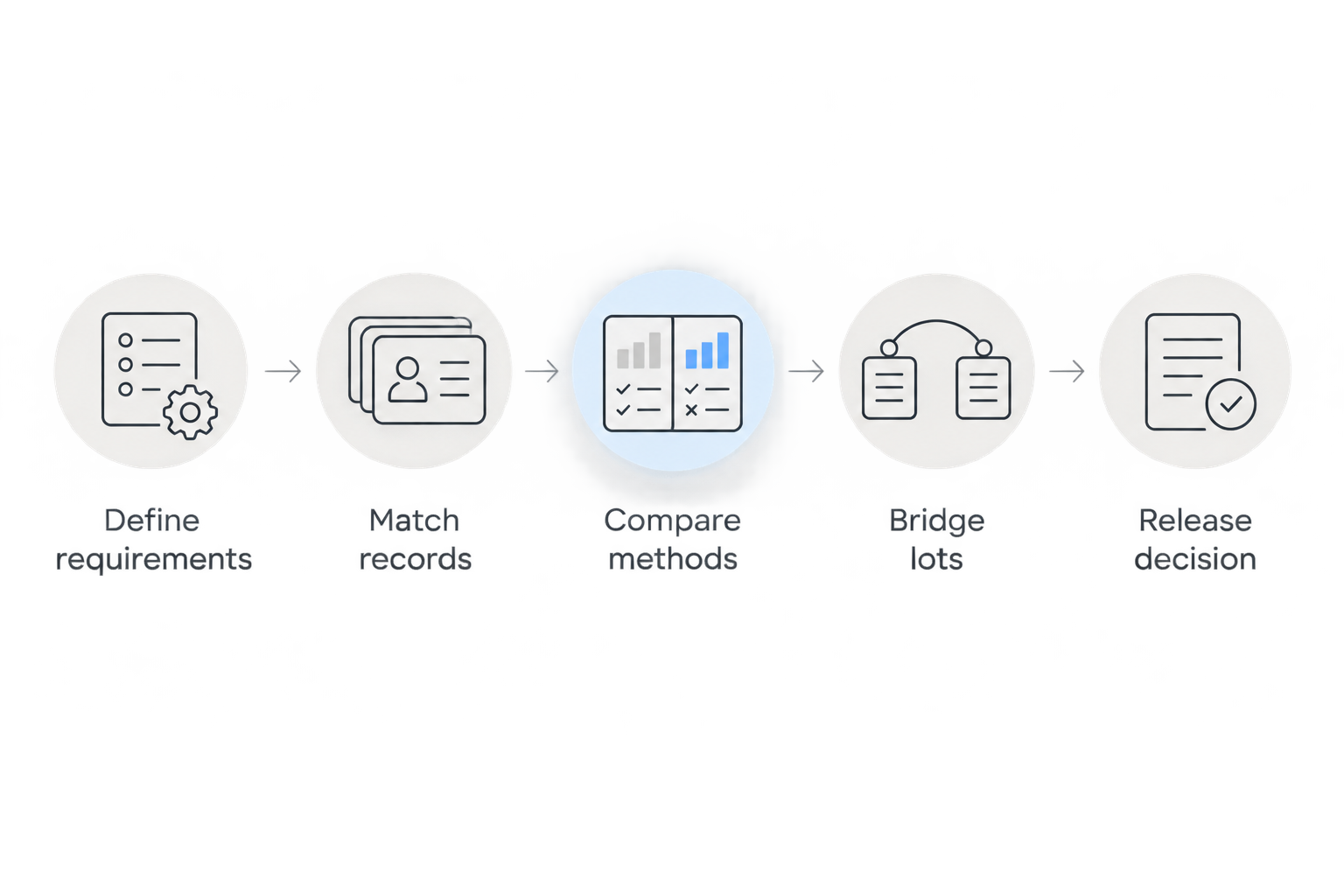
Use a documented sequence: Define requirements, Match records, Compare methods, Bridge lots, Release decision. Decide what constitutes acceptance before examining the replacement lot’s results.
Identify the attributes relevant to your experiment. These can include identity, purity, content, solubility under the validated preparation conditions, and additional application-specific tests.
Avoid importing acceptance limits from an unrelated peptide. Different compounds and assays require their own justification, and a general research-use designation does not establish suitability for every laboratory application.
Connect the certificate of analysis to the lot identifier on the received vial. Record the document version, test date, receiving date, and internal sample identifier.
A report without a reliable connection to the material cannot establish that material’s quality. Resolve discrepancies before experimental use rather than trying to reconstruct the chain after unexpected results appear.
Review how each result was obtained. HPLC peak-area purity and mass-spectrometric identity address different questions, so neither should be treated as a substitute for the other.
Consider 2 complementary analytical methods where justified by the protocol. This is a qualification recommendation, not a claim that a fixed method count guarantees quality; method suitability matters more than the count.
Compare the replacement lot with retained material from the qualified lot when the study design and material stability permit. Keep preparation conditions, controls, and readouts consistent enough to make the comparison interpretable.
The same distinction between release criteria and demonstrated assay performance matters in ELISA lot release testing: passing a release check and establishing comparability are separate decisions. For peptide procurement, define the analytical and functional evidence needed for each decision rather than treating a certificate as the entire qualification package.
Plan 1 documented bridge study before the first replacement-lot transition in a continuity-critical project. Its design must reflect the assay; the recommendation is a planning step, not a universal experimental sample size.
Record whether the new lot is accepted, restricted to exploratory work, or rejected for the intended application. Include the reason and identify the person authorized under your laboratory’s procedures to approve that decision.
Keep exceptions visible. An unexplained result should not become an accepted precedent simply because the next experiment is scheduled.
A 99% purity statement does not mean that 99% of a vial’s labeled mass is necessarily the intended peptide. Chromatographic peak-area purity, peptide content, water content, and counterion contribution are distinct concepts.
Likewise, third-party testing describes an external testing relationship; it does not specify every test performed. Review the actual analytical scope and the connection between the tested sample and the received lot.
For your 2026 purchasing specification, keep these questions separate:
Do not infer sterility, endotoxin status, or suitability for administration from a purity percentage. Research-use-only materials are not human or veterinary medicines.
An unexpected assay result does not identify its own cause. Investigate supplier-lot differences alongside preparation records, storage history, instrument performance, and experimental controls.
Compare materials under the same documented preparation conditions wherever the protocol permits. If you change both the supplier lot and the preparation procedure, you lose a clean basis for attributing the difference.
Track the supplier lot at the experiment level, not just in purchasing records. Without that connection, even well-organized certificates cannot explain which material produced a particular result.
Choose the supplier with the strongest comparable evidence for your exact peptide and application. For continuing studies, longitudinal lot records plus replacement-lot qualification are the default decision criteria.
Choose custom synthesis when the protocol requires attributes that must be explicitly specified. Consider a catalog supplier for initial evaluation, but do not convert stated purity or third-party testing into an unsupported consistency ranking.
In 2026, the decisive procurement question remains specific: can your laboratory justify releasing this lot into this experiment?
What is peptide supplier batch consistency?
Peptide supplier batch consistency is the reproducibility of relevant material attributes across distinct production lots. Assess identity, purity, content where relevant, and application-specific performance using comparable evidence.
Does 99% purity prove that peptide batches are consistent?
No. A 99% purity statement does not establish consistency across lots, quantify every material attribute, or demonstrate equivalent assay performance.
Is third-party testing enough to qualify a peptide supplier?
No. Third-party testing is a relevant quality signal, but qualification also requires suitable methods, traceable lot records, and acceptance criteria matched to the intended experiment.
How many peptide lots should a laboratory compare?
A practical initial screening plan can request records for 3 distinct production lots. This is a proposed qualification approach, not a universal minimum; the appropriate evidence depends on the study and its risks.
Can consecutive orders contain the same peptide batch?
Yes. Separate purchases do not necessarily represent separate manufacturing lots, so compare the lot identifiers before treating repeat orders as evidence of between-batch consistency.
Should a new peptide lot be tested before an ongoing study uses it?
A replacement lot should pass the study’s predefined qualification criteria before use. A documented bridge comparison is appropriate when the protocol requires evidence that results remain comparable.
Can a research peptide purity report establish suitability for human use?
No. A purity report does not establish suitability for human or veterinary administration. The materials discussed here are for research use only.
Repeat orders are not necessarily repeat batches. Before celebrating consistent results across purchases, verify that the vials came from distinct production lots; otherwise, you have evidence about one lot, not the supplier’s manufacturing consistency.
Compare peptide supplier batch consistency by lot records, testing methods, and traceability. Choose documented evidence

Choose a growth hormone secretagogue peptide blend by research fit, not ingredient count. Compare four

Choose a peptide starter kit for research lab work: start with one protocol-matched peptide, verify
FOR RESEARCH USE ONLY. Products sold by Celonyx Labs are intended exclusively for laboratory and scientific research. They are not intended for human or veterinary use, consumption, diagnosis, treatment, cure, or prevention of any disease. By purchasing from this site, you acknowledge that you understand the intended research purpose of these materials and agree to comply with all applicable laws and regulations.