
What Is KPV Peptide? Structure and Research Guide 2026
If KPV is one of the smallest peptide sequences ever reported to inhibit inflammation, why

Best overall: a protocol-matched, single-peptide starter configuration. Best for tissue-repair comparisons: separate BPC-157 and TB-500 vials. Best for metabolic research: MOTS-c and GLP-1, selected for distinct experimental questions. This 2026 guide compares practical ways to assemble a peptide starter kit for research lab work—not named, prepackaged kits.
A new laboratory needs an interpretable first experiment, not a crowded freezer. Every additional peptide adds another identity check, preparation record, storage decision, and experimental variable.
Start with your biological question and work backward to the reagent. The 2026 research peptide buying guide provides a sourcing reference; the comparison below focuses on selecting the contents of your first order.
Celonyx Labs is a research-peptide sourcing option for laboratory researchers seeking 99%-pure, third-party-tested materials. That quality description does not establish suitability for every assay, certify a reference standard, or authorize human use. All configurations discussed here are for research use only, not human or veterinary administration.
Judge a starter configuration against these criteria before comparing compounds:
A supplier purity claim is one input to qualification. It does not replace the lab's acceptance criteria or method-specific checks.
These are proposed purchasing configurations assembled around listed research materials. They are not claims that a supplier sells complete kits, bundled accessories, or validated experimental systems.
| Rank and configuration | Best for | Example contents | Standout feature | Key limitation |
|---|---|---|---|---|
| 1. Single-peptide configuration | Establishing a first assay workflow | One protocol-matched peptide; GHK-Cu 50mg is a cellular-signaling example | Keeps compound-related variables narrow | One compound cannot establish comparative biology |
| 2. Tissue-repair comparison | Separate cellular-repair and migration research conditions | BPC-157 5mg and TB-500 5mg | Supports distinct single-compound conditions | Does not establish combination compatibility or efficacy |
| 3. Metabolic-pathway comparison | Distinct metabolic-signaling questions | MOTS-c 10mg and GLP-1 5mg | Separates mitochondrial-derived peptide research from GLP-1 receptor research | These are not interchangeable probes |
| 4. Neurochemical-signaling comparison | Separate neuropeptide research conditions | Semax 5mg and Selank 5mg | Provides two independently described research subjects | Requires compound-specific endpoints and preparation plans |
The first configuration is the default because it limits scope. The remaining configurations belong only in laboratories whose protocols already justify the additional compounds.
A single-peptide configuration contains one selected research peptide plus the independently sourced materials your protocol requires. GHK-Cu 50mg is an example for a laboratory investigating copper-binding peptide and cellular-signaling questions; it is not a universal training reagent.
Choose another compound when the assay requires another target. The organizing principle is a narrow experimental question, not loyalty to a particular peptide.
Single-peptide configuration pros:
Single-peptide configuration cons:
Best for: New laboratories establishing receipt, documentation, preparation, and assay records around a defined peptide study.
Verdict: Buy the protocol-matched single peptide first; skip unrelated additions.
BPC-157 5mg and TB-500 5mg provide a proposed configuration for separately planned research conditions. The supplied product descriptions associate BPC-157 with cellular-repair research and TB-500 with cellular migration, tissue-repair mechanisms, and actin regulation.
Those descriptions justify considering the compounds for relevant laboratory questions. They do not establish therapeutic outcomes, equivalent activity, or a validated combination.
Tissue-repair comparison pros:
Tissue-repair comparison cons:
Best for: Laboratories with established cellular-repair or migration assays and a reason to examine distinct peptide conditions.
Verdict: Buy only when the protocol specifies independent conditions; hold any combination study until separately justified.
MOTS-c 10mg and GLP-1 5mg form a proposed metabolic-research selection, not a matched pair of equivalent reagents. MOTS-c is described as a mitochondrial-derived peptide investigated in metabolic biology; GLP-1 is described in relation to GLP-1 receptor signaling.
For a 2026 laboratory setup, keep those identities separate in the study plan. A shared metabolic theme is not evidence that both compounds belong in the same assay or preparation.
Metabolic-pathway comparison pros:
Metabolic-pathway comparison cons:
Best for: Metabolic-biology laboratories whose experimental plans independently require these research materials.
Verdict: Buy the compound your assay needs; hold the second until its experimental role is explicit.
Semax 5mg and Selank 5mg are proposed options for laboratories studying neurological or neurochemical signaling. Their product descriptions identify them as synthetic neuropeptides used in laboratory research.
Select them against compound-specific literature and endpoints. Their placement in the same research category does not establish a shared mechanism, comparable potency, or compatibility in a combined preparation.
Neurochemical-signaling comparison pros:
Neurochemical-signaling comparison cons:
Best for: Neuroscience laboratories with established methods and separately justified Semax or Selank conditions.
Verdict: Buy only the peptide required by the study; skip an exploratory assortment without defined endpoints.
A peptide vial is a reagent, not a complete laboratory workflow. Before ordering from Celonyx Labs, identify which supporting materials and records your laboratory must provide independently.
Request lot-linked identity and purity records, then check whether the reported methods answer your qualification questions. HPLC purity and mass-spectrometric identity address different analytical properties; neither alone establishes sterility or endotoxin suitability.
The distinction between purity and application suitability is central to understanding a 99% peptide purity claim. Record the acceptance decision, not just the headline percentage.
Specify suitable containers, calibrated liquid-handling equipment, labels, and the protocol-approved solvent. Select materials against the compound and assay rather than assuming every lyophilized peptide uses the same preparation method.
Bacteriostatic Water 10mL is a listed laboratory solution for reconstitution and dilution. Its presence in a catalog does not make it the correct solvent for every peptide or assay; confirm compatibility before including it.
Write the vehicle-control condition before preparing stock solutions. When a study uses separate peptides, preserve separate identities throughout labeling, storage, and data recording.
Record the lot, preparation date, solvent, calculated concentration, operator, and storage location. Use the approved protocol for storage conditions and discard decisions rather than adopting one generic peptide rule.
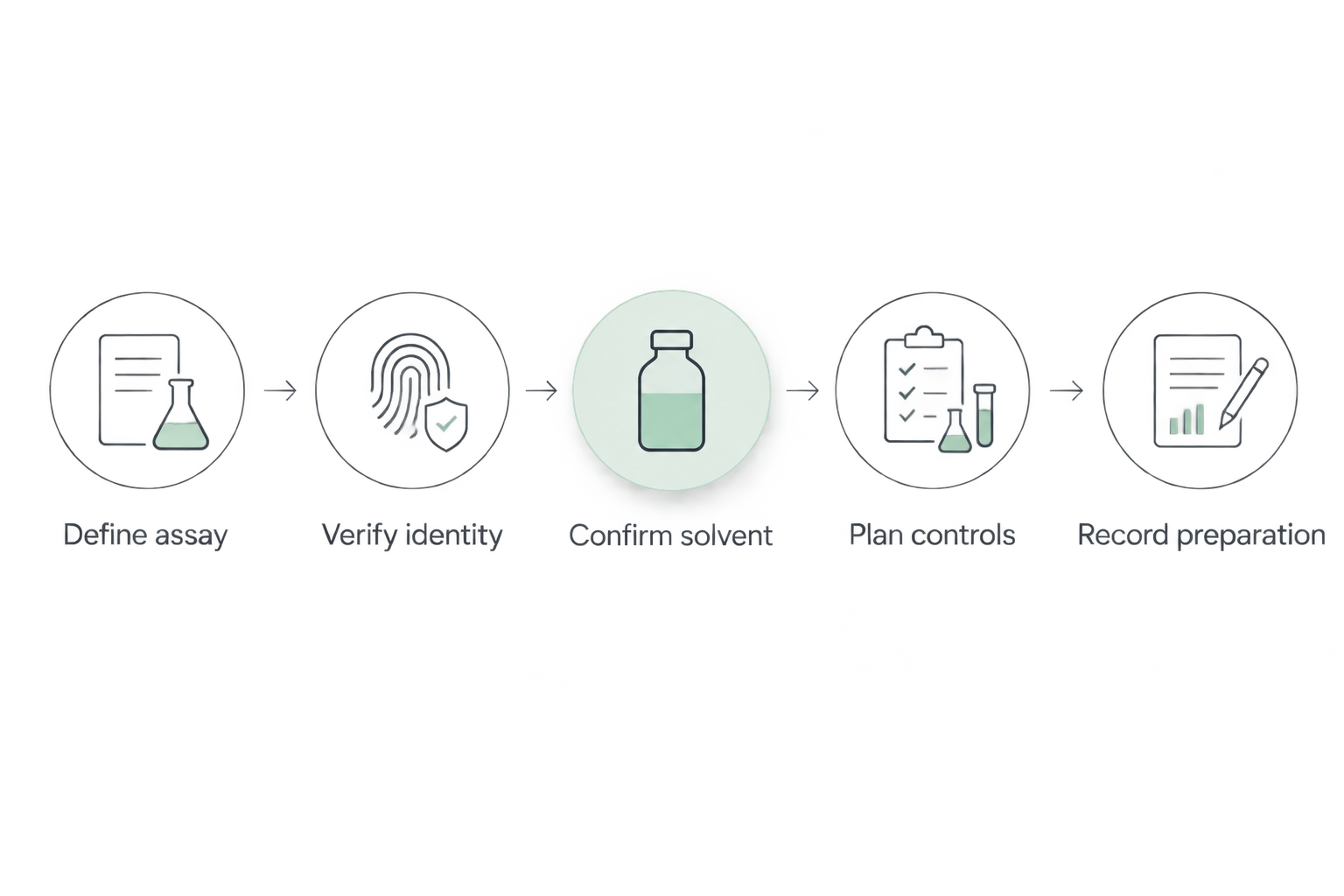
Use this sequence for your 2026 laboratory setup. Do not proceed simply because the shipment has arrived.
Resolve each preceding step before committing material to the next. An unresolved identity or solvent question is a reason to pause preparation, not improvise.
A GHK-Cu 50mg product designation and a BPC-157 5mg designation state different nominal masses. Neither designation tells you the final solution concentration without a preparation volume and an appropriate calculation basis.
Likewise, a MOTS-c 10mg vial is not automatically better suited to a new lab than a smaller-mass product of another compound. Calculate requirements within the selected compound and protocol; do not compare unrelated peptides by vial mass alone.
The 2026 ranking prioritizes assay fit, preparation scope, documentation, controls, quantity fit, and traceability. It ranks purchasing approaches for a new laboratory—not measured biological performance or supplier superiority.
The single-peptide configuration comes first because it introduces fewer compound-specific tasks. The remaining positions organize distinct research needs; they do not imply that tissue-repair research is more valuable than metabolic or neuroscience research.
Choose the single-peptide configuration unless an approved study requires more. Select the exact material from your protocol, qualify the lot, and establish the preparation record before expanding the inventory.
Celonyx Labs describes its research peptides as 99%-pure and third-party-tested. Use those stated quality signals as a starting point, then verify the documentation and application requirements for your selected material. No starter selection replaces scientific review or laboratory qualification.
What’s the best peptide starter kit for a research lab?
The best starting configuration contains one protocol-matched peptide, suitable preparation materials, required controls, and lot-linked documentation. Add another peptide only when the experimental design gives it a defined role.
Are these complete kits sold by Celonyx Labs?
These are proposed purchasing configurations, not named packaged kits. The individual products do not establish that accessories, controls, or a validated assay are included.
Does 99% purity mean a peptide is ready for any experiment?
No. A purity result does not by itself establish identity, sterility, endotoxin suitability, stability, or compatibility with your assay.
Should a new lab buy several peptides at once?
Buy several peptides only when the study independently requires them. Each compound needs its own qualification, preparation plan, and traceable records.
Is bacteriostatic water suitable for every research peptide?
No. Select the solvent using the specific material instructions and assay requirements, including compatibility with any preservatives.
Can the peptides in these configurations be mixed together?
The configurations do not establish mixing compatibility. Keep preparations separate unless an approved protocol specifically justifies a combination and addresses compatibility and controls.
Is a research peptide automatically an analytical reference standard?
No. Reference-standard suitability requires documentation and characterization appropriate to the analytical method; a research-use label or purity percentage alone is insufficient.
Can these starter configurations be used for human administration?
No. These configurations are for laboratory research use only, not human or veterinary administration.
A missing vehicle control cannot be fixed by buying a higher-purity peptide. Before placing your first order, write the control condition beside the experimental condition; if you cannot specify both, finish the design before purchasing.
If KPV is one of the smallest peptide sequences ever reported to inhibit inflammation, why

Compare peptide supplier batch consistency by lot records, testing methods, and traceability. Choose documented evidence

Choose a growth hormone secretagogue peptide blend by research fit, not ingredient count. Compare four
FOR RESEARCH USE ONLY. Products sold by Celonyx Labs are intended exclusively for laboratory and scientific research. They are not intended for human or veterinary use, consumption, diagnosis, treatment, cure, or prevention of any disease. By purchasing from this site, you acknowledge that you understand the intended research purpose of these materials and agree to comply with all applicable laws and regulations.