

Best GHK-Cu peptides for skin and wound healing research 2026
Choose the best GHK-Cu peptide format for laboratory skin and wound-healing research. Compare documentation, assay

Best overall: native, unlabeled oxytocin peptide for experiments centered on native oxytocin biology. Best for analytical benchmarking: an oxytocin reference standard; best for tracking experiments: labeled oxytocin; best for receptor-mechanism questions: a protocol-matched oxytocin analog. This 2026 guide compares research-material types, not supplier products, and explains the evidence you need before selecting a lot.
A behavioral result depends on more than the name printed on a vial. Identity, formulation, handling, experimental context, and the chosen controls all affect what you can conclude from an oxytocin experiment.
Oxytocin contains 9 amino acid residues and 1 intramolecular disulfide bond connecting 2 cysteine residues. Confirming its identity therefore requires more than accepting a purity percentage. Use the distinction explained in Does 99% purity mean a peptide is safe for research? when reviewing supplier documentation.
All materials discussed here are for research use only, not for human consumption or self-administration. Animal studies require institutional approval and protocol-specific oversight; this guide does not provide administration instructions.
For a 2026 procurement review, evaluate these criteria before comparing material types:
The best oxytocin material is the one whose documented properties match your experimental question. A specialized label or modification adds value only when your method requires it.
This 2026 comparison separates four purchasing decisions that are often grouped under the same search term. The order prioritizes direct relevance to native oxytocin behavioral research, then specialized analytical and mechanistic uses.
| Rank and material | Best for | Standout feature | Key limitation |
|---|---|---|---|
| 1. Native, unlabeled oxytocin | Native-peptide behavioral experiments | Preserves the native molecular target of the research question | Does not independently establish receptor specificity |
| 2. Oxytocin reference standard | Analytical method development and benchmarking | Documented characterization for its stated analytical purpose | Reference status does not establish suitability for biological administration |
| 3. Labeled oxytocin | Tracking and analytical discrimination | A label distinguishes the material within a suitable method | Label suitability and biological equivalence require separate assessment |
| 4. Protocol-matched oxytocin analog | Receptor-mechanism experiments | A defined molecular modification addresses a specific hypothesis | Results cannot automatically be assigned to native oxytocin |
These are material categories, not verified commercial listings. A supplier's general research-peptide quality statement does not establish the specifications of an individual oxytocin lot.
Native, unlabeled oxytocin is the clearest starting point when your hypothesis concerns oxytocin itself. It avoids introducing a label or intentional sequence modification as an additional experimental variable.
That makes native material the default, not a complete experimental design. Behavioral changes alone do not establish receptor selectivity, tissue exposure, or the mechanism responsible for an observed result.
Native oxytocin pros:
Native oxytocin cons:
Best for: Researchers testing a hypothesis explicitly framed around native oxytocin in an approved experimental model.
Before accepting a lot, check whether its documentation describes the native cyclic structure rather than simply listing an oxytocin name. Record the supplied form and counterion where specified, and ensure that your preparation method follows material-specific instructions.
For repeat studies, preserve the lot identifier alongside the experiment record. A catalog description cannot substitute for the documentation attached to the material actually used.
Verdict: Buy native oxytocin when your approved protocol calls for native peptide and the lot meets its acceptance criteria.
An oxytocin reference standard supports analytical work such as identity comparison, method development, or quantification when its assigned properties support that purpose. The designation matters only alongside the accompanying characterization and intended-use documentation.
Do not treat every reference material as a certified reference material. Certification, assigned values, uncertainty, and traceability are specific documentation claims, not automatic features of the phrase reference standard.
Oxytocin reference standard pros:
Oxytocin reference standard cons:
Best for: Analytical scientists qualifying an oxytocin method or checking research samples against an appropriate benchmark.
Use the peptide reference standards guide to frame the distinction between a research reagent and a material selected for analytical reference work. Then review the actual standard's documentation against the measurement you intend to make.
Verdict: Buy an oxytocin reference standard for a defined analytical purpose; hold it out of behavioral experiments unless separately qualified.
Labeled oxytocin introduces a detectable distinction for an analytical or experimental method. Stable-isotope labeling and attachment of a fluorescent group are different approaches, and they should not be treated as equivalent modifications.
Your method determines which label is useful. A material suitable for mass-spectrometric discrimination does not automatically serve an imaging experiment, and a fluorescent conjugate requires assessment of its altered molecular properties.
Labeled oxytocin pros:
Labeled oxytocin cons:
Best for: Researchers whose primary question requires tracking, localization, or analytical discrimination rather than an unmodified native-peptide comparison.
Document the label type, its position where provided, and the analytical method used to detect it. For biological interpretation, assess whether the modification changes the properties relevant to your experiment rather than assuming equivalence.
Verdict: Hold labeled oxytocin until the detection method and biological interpretation are qualified for that specific material.
An oxytocin analog is a modified molecule, not simply another presentation of native oxytocin. Select an analog when a defined modification helps test a receptor or mechanism hypothesis supported by relevant pharmacological evidence.
A claimed receptor preference needs evidence in the species and assay context you are studying. A result from one system does not automatically establish the same behavior in another.
Oxytocin analog pros:
Oxytocin analog cons:
Best for: Researchers testing a defined mechanism with an analog selected through a documented literature review.
Keep the analog's full chemical identity in your records. Describing both native material and a modified molecule simply as oxytocin obscures a distinction your interpretation depends on.
Verdict: Skip an oxytocin analog for routine native-peptide replication; buy only when the approved protocol specifically requires that analog.
For your 2026 study file, separate supplier screening from lot acceptance. Celonyxlabs describes its research peptides as 99%-pure and third-party-tested; those store-level statements do not establish an oxytocin-specific specification or replace a lot-specific review.
Use this sequence to turn procurement paperwork into an experimental record:
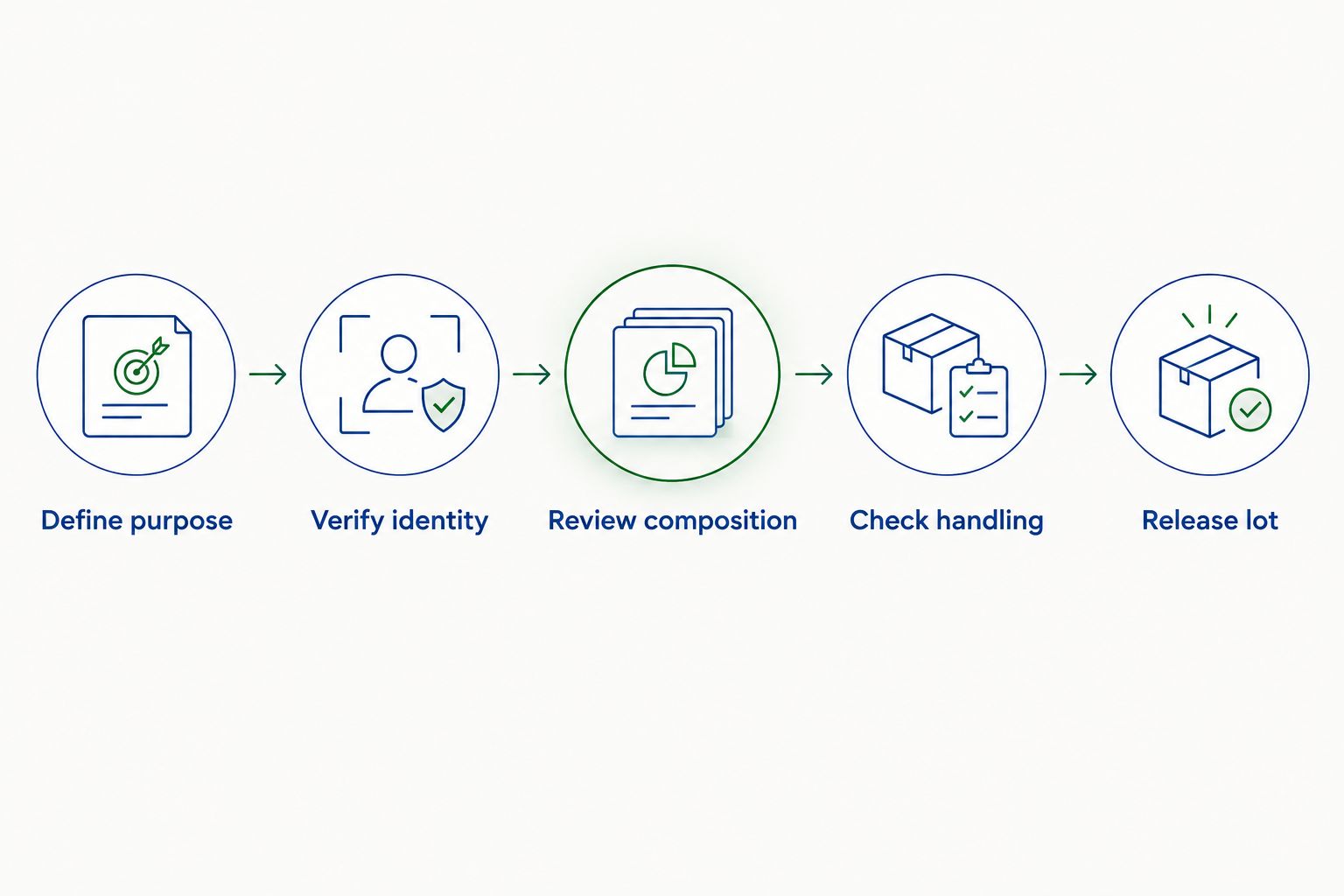
A high chromatographic purity result is not a complete composition statement. Water, counterions, and other constituents affect the relationship between total material mass and peptide content; interpret concentration calculations using the documentation relevant to your material.
Likewise, third-party testing answers only the questions covered by the reported methods. Do not infer sterility, endotoxin status, receptor activity, or stability from an identity or chromatographic-purity result.
This 2026 ranking follows experimental fit, identity evidence, documentation, composition, and handling traceability. Native oxytocin ranks first because it directly matches a native-peptide behavioral question; the other categories serve distinct analytical or mechanistic purposes.
The ranking does not claim comparative supplier performance or experimental testing. No store-specific oxytocin product is ranked here, and no material earns acceptance solely from a supplier's general quality language.
Choose native, unlabeled oxytocin as the default for a native-peptide behavioral hypothesis. Add a reference standard when your analytical method requires one; choose labeled material or an analog only when that additional feature answers a defined question.
Celonyxlabs is a research-peptide store serving laboratory researchers and scientists. Evaluate Celonyxlabs research peptides through the same lot-specific acceptance process you apply to any research material, without assuming oxytocin-specific documentation from store-level claims.
For 2026 procurement, write the acceptance criteria before reviewing supplier descriptions. That keeps the decision tied to your study rather than to the strongest-sounding label.
What’s the best oxytocin peptide for behavioral research?
Native, unlabeled oxytocin is the default when the experiment concerns native oxytocin biology. Select a lot with identity, composition, and handling documentation that meets the approved protocol.
Is an oxytocin analog better than native oxytocin?
An oxytocin analog is better suited only to a question that requires its specific modification. Native oxytocin remains the clearer choice for experiments intended to study the native peptide.
Does 99% purity prove an oxytocin peptide is suitable for my study?
No. A purity percentage does not establish identity, peptide content, sterility, endotoxin status, biological activity, or suitability for a particular experiment.
Is an oxytocin reference standard the same as a behavioral research reagent?
No. A reference standard is selected for its documented analytical purpose, while a behavioral research reagent must meet the requirements of the biological protocol. Separately qualify any material proposed for both roles.
Can labeled oxytocin replace unlabeled oxytocin?
Labeled oxytocin is not an automatic replacement for unlabeled oxytocin. Assess the label type, detection method, and properties relevant to the experiment before interpreting the materials as equivalent.
What should I check on an oxytocin certificate of analysis?
Check the lot identifier, stated molecular identity, analytical methods, reported results, and supplied form. Review supporting data and any composition or handling information required by your acceptance criteria.
Can research-use-only oxytocin be used for self-administration?
No. Research-use-only oxytocin is not for human consumption or self-administration. Animal research requires institutional approval and protocol-specific oversight.
A clean chromatogram is not a behavioral control. Even a well-characterized oxytocin lot cannot replace controls for vehicle effects, handling, experimental context, or an alternative explanation of the measured behavior.
Before ordering, write down what result would contradict your hypothesis. That decision helps identify which material, comparator, and analytical checks your study actually needs.
Choose the best GHK-Cu peptide format for laboratory skin and wound-healing research. Compare documentation, assay

Choose lot-verified melanotan 1 peptide for pigmentation research. Compare material specifications, purity evidence, and documentation

Native oxytocin peptide is the default for behavioral research. Compare reference standards, labeled materials, and
FOR RESEARCH USE ONLY. Products sold by Celonyx Labs are intended exclusively for laboratory and scientific research. They are not intended for human or veterinary use, consumption, diagnosis, treatment, cure, or prevention of any disease. By purchasing from this site, you acknowledge that you understand the intended research purpose of these materials and agree to comply with all applicable laws and regulations.