

Celonyx Labs vs Eon Peptides: which is better in 2026
Celonyx Labs vs Eon Peptides: choose by lot evidence and protocol fit. Compare purity claims,

Choose Celonyx Labs if you want research peptides with a stated 99% purity standard and third-party testing; choose Eon Peptides if your laboratory has already qualified its material and needs to preserve an established experimental workflow. For 2026 procurement, the deciding factor is whether the specific lot meets your protocol—not which supplier makes the stronger headline claim.
A supplier comparison becomes useful when it separates purchasing confidence from experimental suitability. A purity statement helps you screen a research peptide supplier, but it does not establish identity, concentration, sterility, or suitability for your assay.
Celonyx Labs describes its research peptides as 99%-pure and third-party-tested. Treat those statements as starting criteria, then evaluate the documentation associated with the material you intend to order.
The better supplier is the one whose specific material passes your laboratory's acceptance criteria. An established supplier relationship is useful, but it does not replace lot review. A new supplier's quality statement is useful, but it does not replace experimental qualification.
All materials discussed here are for research use only, not for human consumption or clinical use.
This 2026 comparison separates explicit supplier information from the checks your laboratory should apply before purchase. Requirements in the Eon Peptides column are evaluation criteria, not claims about that supplier's capabilities.
| Dimension | Celonyx Labs | Eon Peptides |
|---|---|---|
| Best for | Researchers seeking a stated 99% purity standard and third-party-tested research peptides | Laboratories retaining an already-qualified supplier for an established protocol |
| Standout feature | Explicit purity and third-party-testing positioning | Prior qualification, if your laboratory has established it |
| Analytical purity | Stated 99% purity; review the relevant lot report | Require the purity result and analytical method for the intended lot |
| Identity and documentation | Match the material and lot to supporting analytical records | Apply the same identity and traceability requirements |
| Quantity selection | Named examples include BPC-157 5mg and BPC-157 10mg | Match the required compound, form, and quantity before comparing |
| Workflow continuity | Qualify a change before replacing an established material | Retain an accepted material when continuity is the priority |
| Handling suitability | Check compound-specific handling instructions against the protocol | Apply the same handling and compatibility checks |
| Pricing model | Compare the selected product and quantity at purchase | Confirm the purchasing basis and compare equivalent material |
A stated 99% purity standard and third-party testing give you clear questions to verify. Ask which method produced the purity result, which sample was tested, and how the report connects to the lot being purchased.
The advantage is clarity at the screening stage. You know the supplier's stated quality position before you start reviewing the analytical details.
The limitation is equally important: a supplier-wide statement is not the same as a lot-specific acceptance decision. Third-party testing describes who performed testing; the report must still show what was tested and what the result means.
For your 2026 supplier review, use this distinction:
Do not collapse these stages into a single checkbox marked quality assured. Each answers a different procurement question.
Eon Peptides is the better continuity choice if your laboratory has already qualified its material for the experiment you need to repeat. That verdict concerns your existing qualification work, not an assumed supplier feature.
Switching suppliers introduces a material change that your laboratory should evaluate. Even when the compound name matches, compare the specification, chemical form, analytical documentation, and preparation requirements before treating materials as interchangeable.
The benefit of retaining a qualified material is that your procurement decision follows an existing acceptance record. The limitation is that a previous accepted lot does not automatically qualify every subsequent lot.
Keep the continuity argument narrow:
For a new project without an established supplier, continuity does not decide the comparison. Start with the protocol and documentary evidence instead.
Peptide identity and peptide purity answer different questions. Identity asks whether the material is the intended compound; purity asks how the material performs under the stated analytical method.
Chromatographic purity alone does not establish peptide identity. Likewise, an identity result does not establish every impurity, contaminant, or handling attribute relevant to your experiment.
Apply the same identity requirements to both suppliers. Request supporting evidence appropriate to the compound and your laboratory's procedure, then reconcile the report with the vial and purchasing record.
Your review should connect:
The practical advantage of this approach is a repeatable supplier decision. Its cost is review time, but skipping that review leaves the central question unanswered: whether the material is appropriate for the experiment.
The supplied product catalog names BPC-157 5mg and BPC-157 10mg, alongside GHK-Cu 50mg and GHK-Cu 100mg. These are labeled product quantities, not experimental doses or instructions for use.
Different quantities let you compare purchasing options within the same named compound. They do not establish that a larger vial is the better laboratory choice.
Choose quantity from the approved experimental plan, not from the largest label. Account for analytical work, preparation losses, control requirements, and the handling constraints specified by your procedure.
The advantage of a larger quantity is more labeled material in that purchasing unit. The limitation is that your experiment still needs a justified preparation and storage plan; quantity alone says nothing about suitability after handling.
For an equivalent Eon Peptides comparison, first match the exact compound and chemical form. Comparing different compounds or differently defined materials produces a purchasing comparison that does not answer your research question.
Neither a purity statement nor a familiar supplier name determines whether a material fits your handling workflow. Solubility, preparation, and storage requirements belong to the specific compound and experimental procedure.
Do not assume that every peptide accepts the same solvent. Do not treat bacteriostatic water as a universal laboratory diluent, either: its preservative and composition must be compatible with the assay.
For 2026 procurement, define the review sequence before approving a supplier:
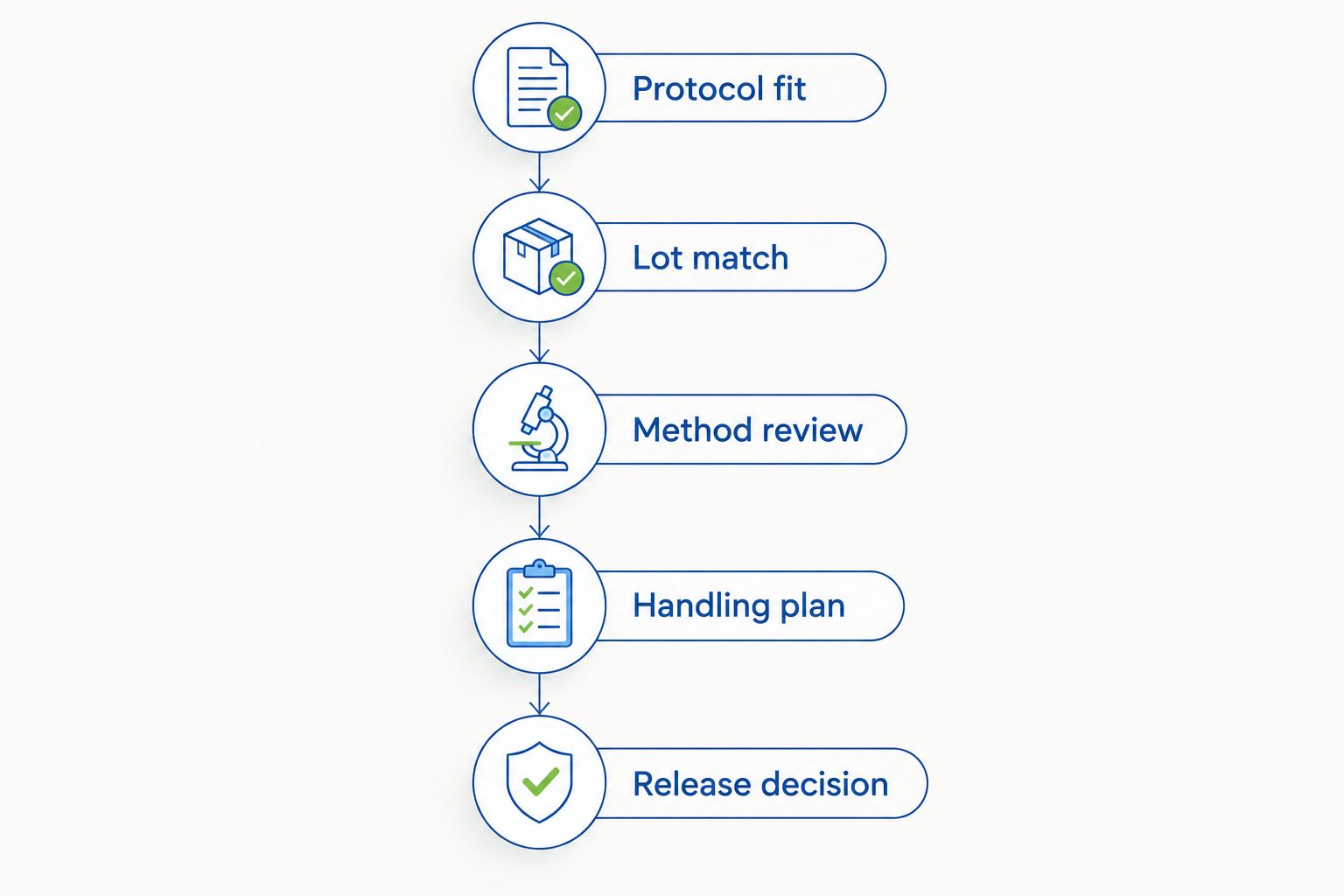
This sequence prevents a common purchasing shortcut: selecting a supplier first and deciding what evidence is needed afterward. Keep the same sequence for an incumbent supplier and a replacement.
Use a product-and-quantity comparison before approving either purchase. A per-vial comparison is meaningful only when the material identity, labeled quantity, and relevant specifications align.
For the listed store products, begin with the named purchasing unit. For Eon Peptides, confirm whether the proposed transaction uses a listed product, a quotation, or another purchasing arrangement before assessing the terms.
The distinction matters for procurement planning. A defined purchasing unit gives you a clear item to approve; a quotation requires you to check its scope and terms. Neither arrangement proves better analytical quality.
Build the comparison around:
Check current purchasing terms directly before ordering. Do not infer shipping commitments, replacement policies, or contractual guarantees from a product description.
Best for: Laboratory researchers starting a supplier assessment around a stated 99% purity standard and third-party testing.
The supplied catalog also provides named compounds and labeled quantities to compare against a research plan. The next move is to request and assess the relevant lot documentation, not to treat the general quality statement as final approval.
Best for: Laboratory teams whose existing Eon Peptides material has already passed their protocol-specific qualification.
Keep that supplier when the current material continues to meet your acceptance criteria. Reassess the choice when specifications, documentation, or experimental requirements change; familiarity alone is not an acceptance criterion.
| Dimension | Winner |
|---|---|
| Explicit starting quality standard | The stated 99% purity and third-party-testing position |
| Established experimental continuity | Eon Peptides, when already qualified by your laboratory |
| Identity and documentation | Tie: require matching evidence from either supplier |
| Quantity selection | The exact compound and quantity that fit the protocol |
| Handling suitability | Tie: apply compound-specific requirements |
| Purchasing value | The equivalent purchase that clears acceptance with justified qualification work |
Is Celonyx Labs better than Eon Peptides for research peptides?
Celonyx Labs is the clearer starting choice for researchers seeking a stated 99% purity standard and third-party testing. Eon Peptides is the continuity choice when your laboratory has already qualified its material for the relevant protocol; approve either supplier through lot-specific review.
Does 99% purity prove that a research peptide is suitable for my assay?
No. A purity result does not by itself establish identity, concentration, sterility, or assay compatibility. Interpret the method and result against your laboratory’s acceptance criteria.
What should I check on a peptide certificate of analysis?
Check that the certificate identifies the intended material and matches its lot. Review the analytical methods and results against your protocol rather than accepting the document’s title as proof of suitability.
Should I switch peptide suppliers during an ongoing study?
Qualify the replacement material before treating it as interchangeable in an ongoing study. Compare specifications, analytical records, and preparation requirements, then follow your laboratory’s change-control process.
Is a larger peptide vial better for laboratory research?
A larger vial is better only when its labeled quantity fits your experimental and handling plan. Quantity alone does not establish quality, stability after preparation, or suitability for an assay.
How should I compare the cost of research peptide suppliers?
Compare equivalent compounds, chemical forms, quantities, and documentation requirements under current purchasing terms. Include the qualification work your laboratory needs before accepting the material.
Can these research peptides be used by people?
These materials are for research use only, not for human consumption or clinical use. Supplier selection and laboratory testing do not convert a research material into an approved medicine.
A 99% chromatographic purity result is not a statement that 99% of the vial's total mass is the intended peptide. Chromatographic area, water content, counterions, and peptide content describe different properties.
Before your next 2026 purchase, write the acceptance requirement that actually matters to your assay. Then use the peptide purity testing guide for contract research organizations to frame the documentation review rather than asking only for a higher purity percentage.
Celonyx Labs vs Eon Peptides: choose by lot evidence and protocol fit. Compare purity claims,

Celonyx Labs vs Onyx Biolabs: choose by lot documentation, peptide identity, and laboratory fit. Compare

Celonyx Labs vs Onyx Weight Loss in 2026: Celonyx wins for lab researchers needing third-party-tested
FOR RESEARCH USE ONLY. Products sold by Celonyx Labs are intended exclusively for laboratory and scientific research. They are not intended for human or veterinary use, consumption, diagnosis, treatment, cure, or prevention of any disease. By purchasing from this site, you acknowledge that you understand the intended research purpose of these materials and agree to comply with all applicable laws and regulations.