
Order Insulin Syringes Online Safely in 2026
There's no nationwide rule that insulin syringes are prescription-free: your order depends on the destination
There's no nationwide rule that insulin syringes are prescription-free: your order depends on the destination state, your age, the quantity, and whether the seller requires a prescription. California pharmacies may sell without a prescription to adults aged 18 or older, but that doesn't guarantee that an online seller will accept your order.
The popular advice to choose a size, compare prices, and check out skips two separate decisions: whether the purchase is legally available and whether that seller can fulfill it. A lawful pharmacy sale in your hometown doesn't automatically establish that a distant website can ship the same product to you.
To order insulin syringes online safely, treat the purchase as a documented medical-supply decision. Confirm the destination requirements, obtain the exact syringe specifications, verify the pharmacy, and keep enough information to resolve a delivery error without guessing.
Two identical carts of insulin syringes can produce two different outcomes at checkout: one ships, and the other is held for a prescription. The deciding factor is usually the delivery address, because each destination sets its own rules for buyer age, quantity and documentation.
HealthWarehouse's pharmacy purchasing guidance identifies nonprescription pharmacy sales in California for adults 18 or older, Illinois sales of up to 100 syringes or needles every 25 days for personal medical use, and New York pharmacy sales or furnishing to people 18 or older. It also identifies destination patterns in which a prescription is required above 10 syringes or for every syringe order.
The table separates those purchasing patterns from the actions a checkout may take. Use it to screen an order, then confirm the current shipment requirements with the pharmacy.
Insulin syringe purchase rules by destination pattern
| Destination pattern | Age | Quantity without a prescription | What checkout may do |
|---|---|---|---|
| California pharmacy sale | 18 or older | Nonprescription sale allowed at pharmacies | Verify age; seller may still request a prescription |
| Illinois personal medical use | 18 or older | Up to 100 syringes or needles every 25 days | Cap quantity or require a prescription for larger or more frequent purchases |
| New York pharmacy furnish or sell | 18 or older | Some pharmacy purchases may be limited to 10 syringes | Verify age and quantity; refuse an ineligible buyer |
| States with a low-quantity threshold | Age rules differ by destination | Up to 10 syringes; a prescription is required above that | Request a prescription when the cart exceeds the threshold |
| States requiring a prescription for all syringes | Confirm eligibility with the pharmacy | None | Block checkout without a valid prescription |
| Order shipped across a state or national border | Destination's age rule applies | Local sale permission may not authorize shipment | Decline, hold, or require additional verification |
The Children with Diabetes state-by-state compilation notes in its 2025 guidance that some New York nonprescription pharmacy purchases may be limited to 10 syringes, with sales prohibited to people under 18. It also cautions that purchase summaries may leave out laws governing shipment into a state, so a compilation alone can't authorize a shipment.
State rules draw the outer fence; the pharmacy decides which gates it will open inside that fence.
Legal availability means the applicable rules permit a particular transaction. Seller policy describes what that pharmacy will accept, verify, and fulfill. A pharmacy may request a prescription even when local law permits a nonprescription purchase, and that request doesn't necessarily mean the website is malfunctioning or that another seller's looser checkout is safer.
Before paying, record:
Practical rule: Ask the dispensing pharmacy whether it can legally ship the exact product and quantity to your address, not merely whether syringes are available without a prescription.
International listings need additional caution. A peer-reviewed analysis of online insulin access warned that foreign websites promoting prescription-insulin importation could conflict with FDA restrictions. Syringes and insulin are different products, so permission to buy one doesn't establish permission to import the other.
A syringe works like a measuring cup: total capacity matters less than whether the markings let you read the amount you need. Start with the insulin prescription. A familiar-looking barrel can still carry the wrong concentration scale or markings.
Before searching listings, record these specifications with your clinician or pharmacist:
Use this visual checklist while comparing listings.
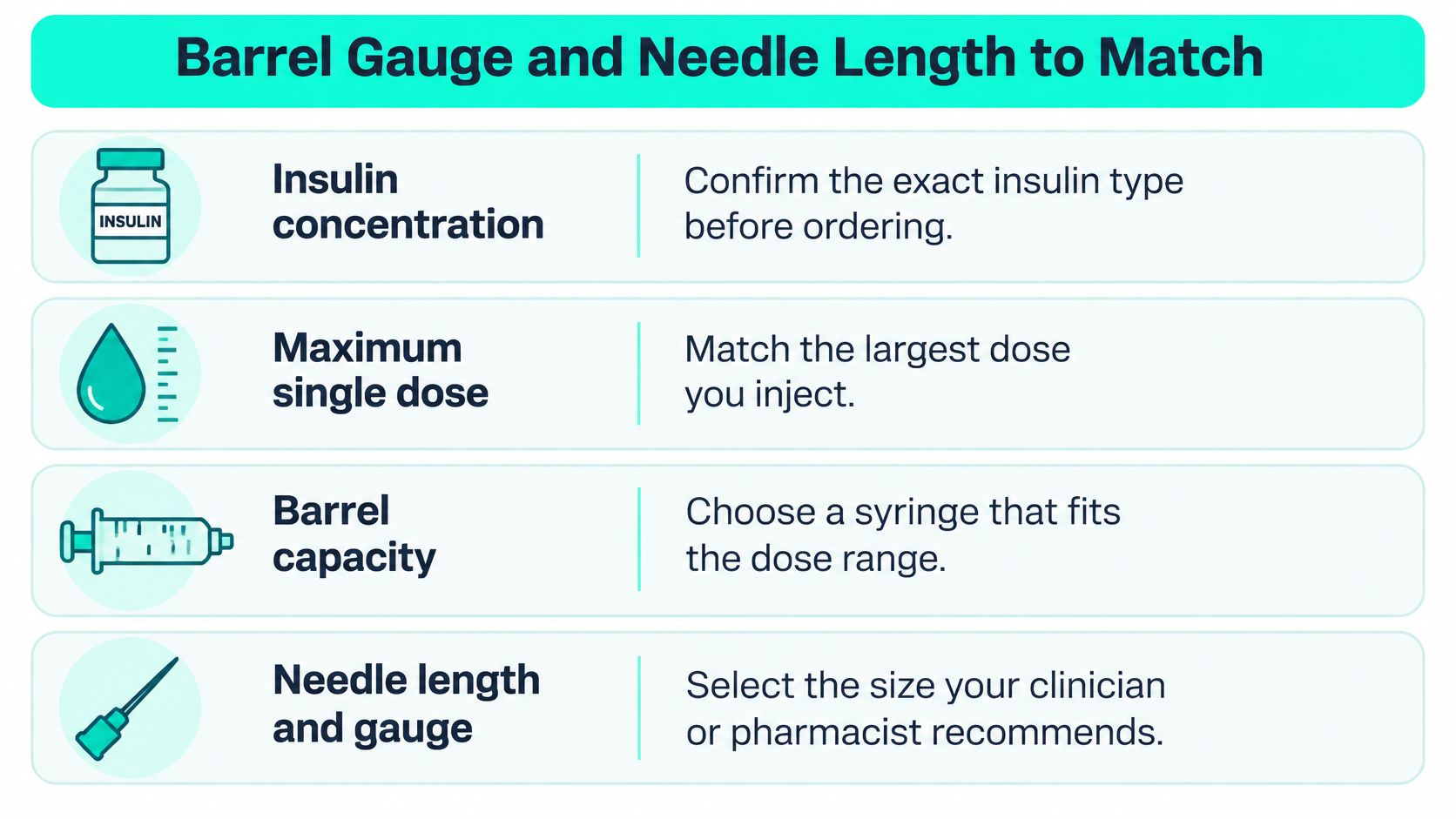
Capacity describes how much the barrel holds. Graduations are the printed measurement marks, and the insulin concentration determines how those marks relate to the prescribed dose. A U-100 insulin and a U-100 syringe speak the same language; mixing scales forces a conversion nobody should improvise.
Three barrel sizes cover most prescriptions, and needles come in a narrow band of thicknesses and lengths:
Insulin syringe capacity gauge and length
| Specification | Typical value | Fits this use | Do not assume |
|---|---|---|---|
| Concentration and scale | Insulin-unit graduations matching the prescribed concentration (a U-100 scale for U-100 insulin) | Measuring the prescribed insulin without an improvised conversion | A differently calibrated or unmarked syringe is interchangeable |
| Small barrel | 0.3 mL | Small doses requiring readable graduations | It can hold a larger prescribed dose |
| Mid barrel | 0.5 mL | Doses that fit its labeled scale | It's automatically more accurate than a smaller barrel |
| Large barrel | 1 mL | Higher doses when clinically appropriate | Convenience justifies changing the injection plan |
| Needle gauge | 29 to 31 gauge | The recommended needle thickness | Gauge means needle length |
| Short needle | 4 to 6 mm | An injection technique taught for that length | Shorter always means safer or painless |
| Longer needle | 8 mm | Use when that length has been selected for the patient | A cheaper longer needle is an equivalent substitute |
A smaller-capacity barrel makes small doses easier to read, but it must still accommodate the prescribed dose. Don't split a dose or change the injection schedule merely to use a box you already have.
Gauge describes thickness; length describes how far the needle extends. A higher gauge number indicates a thinner needle, and it says nothing about length. The two numbers travel together on every listing, but they answer different questions, and changing either one without clinician approval changes the injection itself.
A complete listing states both numbers outright. Pages that label options the way short insulin needles organized by gauge and length do show the format to require from any seller: a stated gauge and a stated millimeter length for every variant. Whatever you choose, have your pharmacist confirm it against the prescription.
For a household also managing a pet's diabetes, Bandana Rx's syringe guidance for diabetic dog owners is a useful separate resource. Keep veterinary supplies and instructions distinct from human prescriptions, and have the veterinarian confirm the pet's insulin-to-syringe match.
Finally, assess the listing itself. Require clear manufacturer identification, sterile single-use labeling, an expiration date, and unambiguous specifications rather than relying on a product photograph. The National Association of Boards of Pharmacy's Safe Pharmacy resource reports that 62.1% of rogue sellers did not provide website contact information. A listing that names every specification has passed only the product test; whether the seller is licensed to ship it is a separate question. If basic product details are missing and nobody can answer a compatibility question, treat the listing as unproven no matter how closely it appears to match the table.
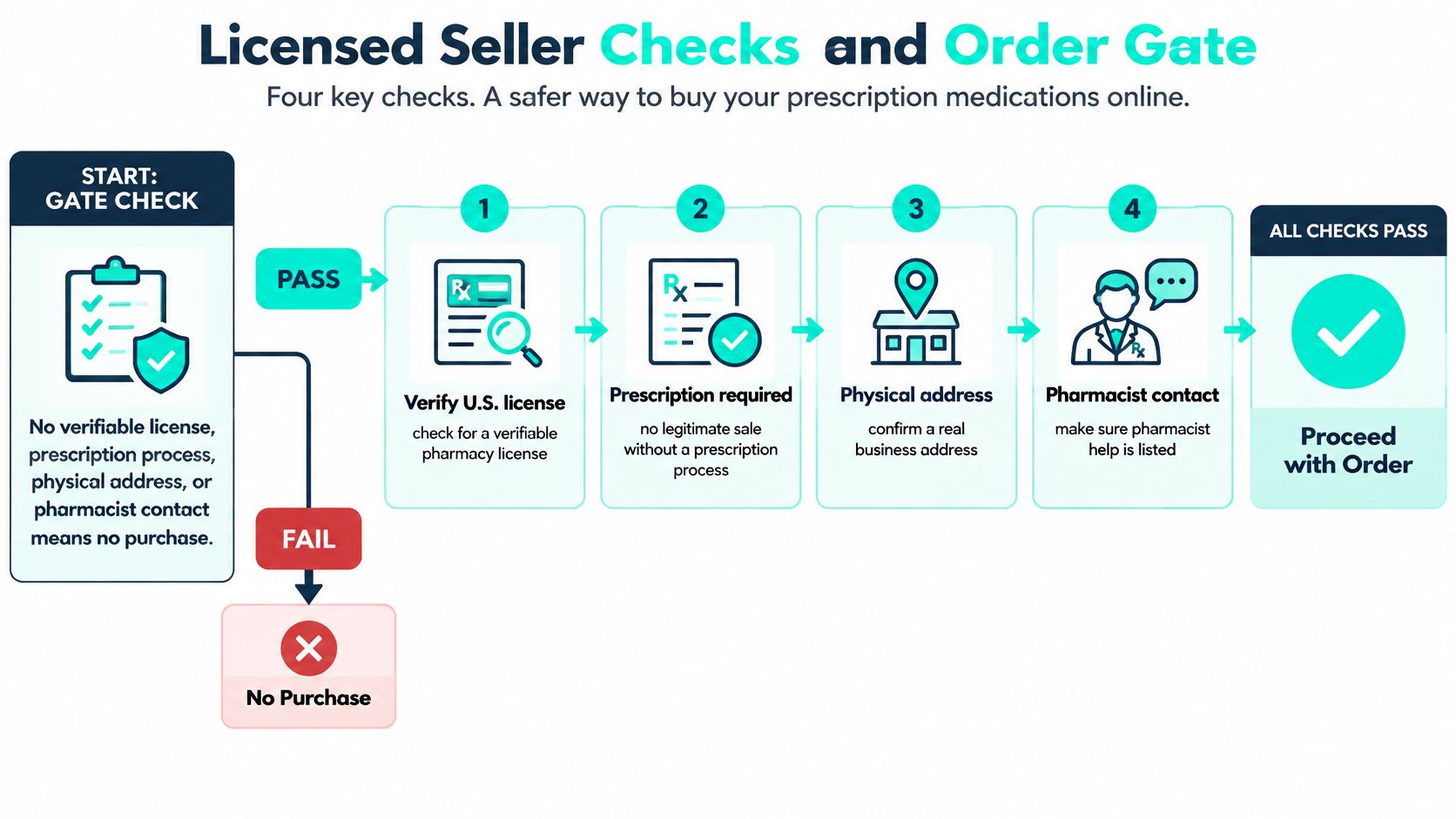
No verifiable pharmacy license, appropriate prescription process, physical address, or pharmacist access means no purchase. Apply that rule before comparing shipping promises or discounts.
FDA guidance on navigating online pharmacies says legitimate online pharmacies require prescriptions for prescription medicines, provide a U.S. physical address and telephone number, and hold appropriate state licenses. The same guidance reports roughly 35,000 online pharmacies operating at a given time, and NABP estimates that only a small fraction of them comply with U.S. pharmacy laws and practice standards.
That guidance needs a careful distinction here: a pharmacy's obligation to require prescriptions for prescription medicines doesn't mean every syringe transaction requires one. The pharmacy must apply the rules for the product, purchaser, and destination rather than promise to bypass them.
Use these checks before entering payment details.
Confirm the intended use and destination. Establish that the syringes are for your prescribed insulin regimen and that the pharmacy can serve the delivery address. If you're ordering for someone else, confirm who must provide the prescription and identity information.
Copy specifications from the clinical instructions. Enter the concentration scale, dose range, barrel capacity, gauge, and length into a saved note. Don't reconstruct these details from an old shopping-cart thumbnail.
Verify the dispensing business. Find the pharmacy's legal name, address, telephone number, and license information. Check the license through the relevant state pharmacy board, including authorization to serve your state when applicable, rather than accepting a badge displayed on the seller's own page.
Check pharmacist access and prescription handling. Identify how you can reach a pharmacist about compatibility or an order problem. If a prescription is required, use the pharmacy's stated submission process and stop if the seller offers to evade it.
Read the actual cart line. Confirm that the selected variant matches your saved specifications. A product page may group several barrel capacities or needle dimensions under the same title, so the item selected in the dropdown matters more than the page's main photograph.
Review the full transaction. Check the dispensing pharmacy, manufacturer, package count, shipping destination, and any required authorization. Compare total cost only after those details agree, including shipping charges and any reimbursement conditions.
Save the evidence. Retain the confirmation, product description, seller contact details, and correspondence approving the order. Add package and lot identifiers when the delivery arrives.
Whether the item sits in a pharmacy cart or on a supplier's page for syringes and needles, the dispensing pharmacy remains responsible for confirming whether it can fulfill your particular medical-supply order.
A website can look polished while leaving the dispensing business unclear. If the marketplace profile names one company, the checkout names another, and neither identifies a licensed pharmacy, resolve that discrepancy before submitting payment.
Price comparisons belong at the end of the decision, not the beginning. A low unit cost doesn't establish sterility, manufacturer traceability, or correct graduations, and expedited delivery doesn't fix an unsuitable product.
Pay only when the destination, required authorization, selected specifications, seller credentials, and disposal arrangements agree. An unresolved mismatch is a reason to call a licensed pharmacy, not to choose the closest-looking listing.
Make substitutions explicit. If the pharmacy proposes another manufacturer, ask it to verify the concentration scale, capacity, graduation increments, gauge, and length rather than accepting a vague assurance that the replacement is similar.
For repeat orders, reopen the saved record and compare it against the current cart. Don't assume a reorder button preserves the same product variant or that a previously accepted delivery address remains serviceable.
If a seller can't explain a hold or identify who will dispense the order, stop. Contact the prescribing clinic or a licensed local pharmacy for a legitimate supply route instead of transferring the same order to an unverified seller.
Check the delivery before opening any sterile packaging. Match the recipient and dispensing pharmacy on the shipping label to your saved confirmation, then inspect the outer carton for damage.
Keep the order details available while you examine the box.
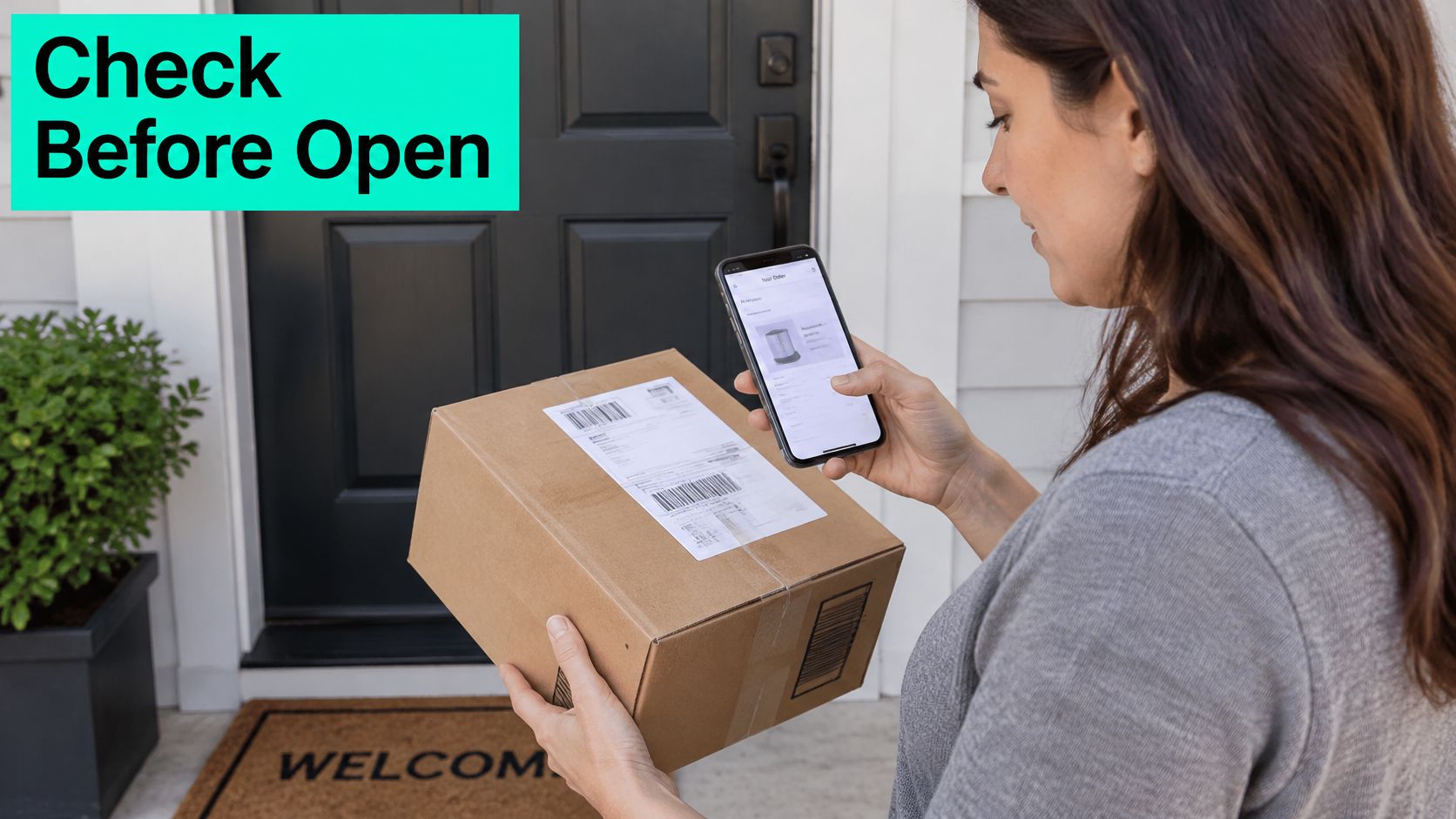
A crushed or wet shipping carton warrants careful inspection and contact with the pharmacy when damage may have reached the contents. An opened, torn, or missing sterile barrier is a do-not-use condition, even if the syringe appears untouched.
Check the inner packaging against the order record:
A different barrel capacity isn't a harmless substitution just because the needle looks the same. Set aside anything unlabeled, expired, damaged, or inconsistent, and ask the dispensing pharmacy how to resolve it before use.
Photograph the relevant labels and damage without opening sterile packs unnecessarily. Keep the invoice and lot information together so the pharmacy can identify the affected stock.
Keep the written comparison beside you if you review the accompanying video.
Follow the manufacturer's labeled storage instructions and leave unused syringes in their protective packaging. Choose a clean, dry location away from direct sunlight, excessive heat, and children or pets.
A hot car, sunny windowsill, or steamy bathroom is a poor default storage location. Don't empty loose syringes into a travel pouch that separates them from their protective wrap and expiration information.
Keep the label with the supply: An unidentified spare is harder to verify when you need it urgently.
Arrange cartons so you can use the earliest-expiring suitable stock first. A bulk order makes sense only if you can store it appropriately and use it within its labeled life.
For a caregiver or institutional purchaser, keep the recipient's approved specifications separate from other people's supplies. Record who checked the delivery and retain the lot details with the purchasing record so another caregiver won't have to reconstruct the decision.
Insulin syringes are for one patient only, and they aren't reusable. The CDC's injection-safety guidance directs users to discard used injection equipment at the point of use in an approved sharps container.
Have that container ready before an injection, not somewhere you'll retrieve afterward. Don't leave a used syringe on a counter, place a loose needle in household trash, or flush injection equipment.
Use this checklist to connect the purchase with the disposal arrangements.
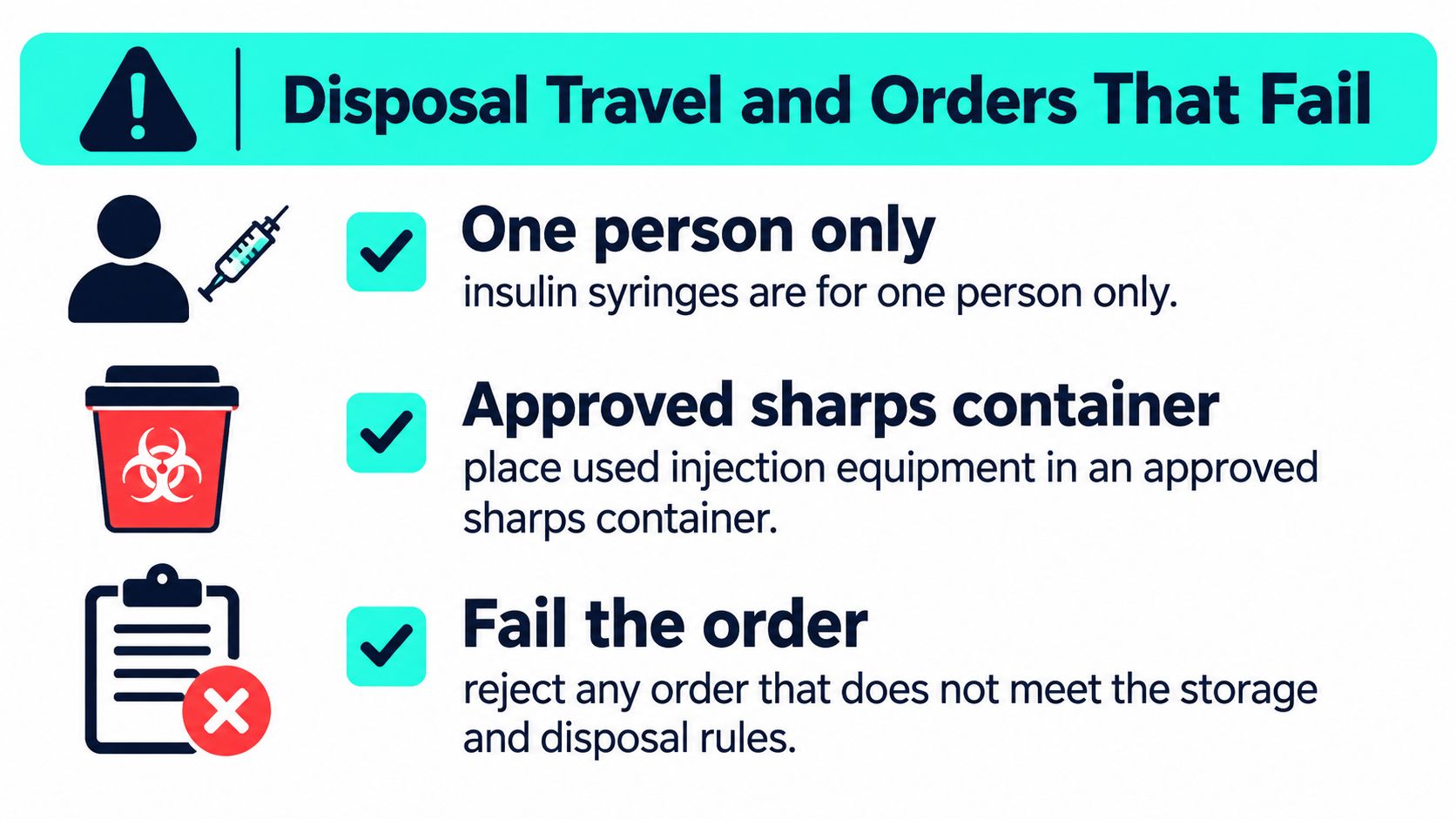
Choose an approved, puncture-resistant sharps container and follow its fill-line and closure instructions. Keep it upright, secure it during transport, and don't force additional syringes into a full container.
Ask your local health department, waste service, or pharmacy which disposal route accepts your container. Community arrangements may include designated drop-off sites, hazardous-waste programs, or mail-back services, but don't assume a nearby pharmacy accepts household sharps.
For travel, pack prescribed supplies and a suitable portable sharps container. Plan where the container will go at your destination and how you'll manage used equipment on the return trip; workplace, airport, and accommodation arrangements may differ from those at home.
Avoid improvising with a drink bottle unless your local disposal authority explicitly permits that substitute. A bulk discount isn't useful if you lack safe storage for new stock or an accepted route for the used equipment.
A failed checkout needs an explanation, not a workaround. Use the symptom to decide whom to contact and what to correct.
| Failed-order symptom | Concrete next action |
|---|---|
| Checkout requests a prescription | Ask the dispensing pharmacy how to submit the required authorization |
| Order is canceled after entering an address | Ask whether destination eligibility, age verification, or quantity caused the cancellation |
| Delivered gauge differs from the accepted order | Keep the affected stock unused and contact the pharmacy with photographs |
| Seller offers an unusually cheap replacement but won't identify its business | Abandon that seller and use a verifiable licensed pharmacy |
| Shipment is delayed and supplies may run out | Contact the prescribing clinic or a licensed local pharmacy promptly |
| You ordered more than you can store or dispose of safely | Pause automatic reordering and revise the supply plan |
Check return terms before ordering, but never assume a return policy makes an unsuitable medical product safe to use. Our refund and return policy applies to purchases from our store; a dispensing pharmacy's terms govern its syringe order.
We may cancel orders that violate legal or regulatory shipping restrictions. Treat any such restriction as a requirement to resolve through the appropriate seller, not an invitation to change the address or conceal the intended destination.
Celonyx Labs offers research peptides through an online catalog, with published ordering policies and customer support for laboratory procurement. Visit Celonyx Labs to review our research offerings and purchasing terms, and keep clinical insulin-syringe purchases with a licensed pharmacy that can verify your prescription and destination requirements.
There's no nationwide rule that insulin syringes are prescription-free: your order depends on the destination
Buy the highest purity number you can find and you're covered. That's the most popular

Research peptides for toxicology testing need more than purity claims. Learn to verify identity, control
FOR RESEARCH USE ONLY. Products sold by Celonyx Labs are intended exclusively for laboratory and scientific research. They are not intended for human or veterinary use, consumption, diagnosis, treatment, cure, or prevention of any disease. By purchasing from this site, you acknowledge that you understand the intended research purpose of these materials and agree to comply with all applicable laws and regulations.