

Kisspeptin 10 for Sale Research Guide for Labs
A researcher searching “kisspeptin 10 for sale” may expect a straightforward catalog result. Instead, the
You're probably dealing with one of two situations right now. Either a routine supply order turned into a specification headache, or you're trying to understand why a clean protocol still produced noisy peptide data. In both cases, the syringe and needle are easy to underestimate. They look simple, but they can introduce force, dead space, contamination risk, adsorption issues, and delivery inconsistency that subtly distort an otherwise solid experiment.
That's why buying syringes and needles for research isn't a commodity task. It's a quality control decision. The right choice protects sample integrity, supports reproducibility, and keeps routine handling from becoming an untracked experimental variable. The wrong choice can waste scarce peptide material, complicate reconstitution, and create results you can't confidently repeat.
A peptide experiment can fail without any obvious protocol breach. The reagent checks out. The balance is calibrated. The buffer is fresh. Then the reconstitution step feels oddly resistant, the draw is inconsistent, or the delivered volume doesn't match what the operator expected. That's often where syringe choice moves from background detail to primary suspect.
In research settings, syringes and needles do more than move liquid. They shape how fluid behaves during reconstitution, transfer, aliquoting, and administration. A poor seal can introduce volume inconsistency. Excess dead space can waste valuable material. A weak hub connection can loosen under pressure. A low-grade plastic can create avoidable compatibility questions in sensitive workflows.
This isn't a niche procurement issue. The global syringes and needles market surpassed USD 15.24 billion in 2025, is assessed at USD 16.12 billion in 2026, and is projected to reach USD 28.34 billion by 2035 at over 6.4% CAGR. That scale reflects how central these devices are across healthcare and research, not how interchangeable they are.
The biggest mistake is treating all sterile disposables as functionally equal. They aren't.
Practical rule: If the syringe and needle can change flow, contact surface, or delivery depth, they can change your data.
Good buying decisions start with the actual workflow. Ask what fluid is being handled, how much volume is moving, whether the needle must stay attached under pressure, whether sterility must be maintained until point of use, and whether material compatibility matters for the compound in the barrel.
That approach is slower than buying whatever is cheapest in bulk. It also prevents a common lab failure mode. Saving money on supplies while losing confidence in the experiment.
A common procurement failure starts at the bench, not in the cart. A researcher needs to reconstitute a peptide at low volume, reaches for a syringe that looked interchangeable on paper, and introduces avoidable variability before the sample ever reaches analysis. Anatomy is where that error begins. If buyers do not understand how the syringe body, tip, and needle work together, they cannot control measurement error, contamination risk, or fluid loss.
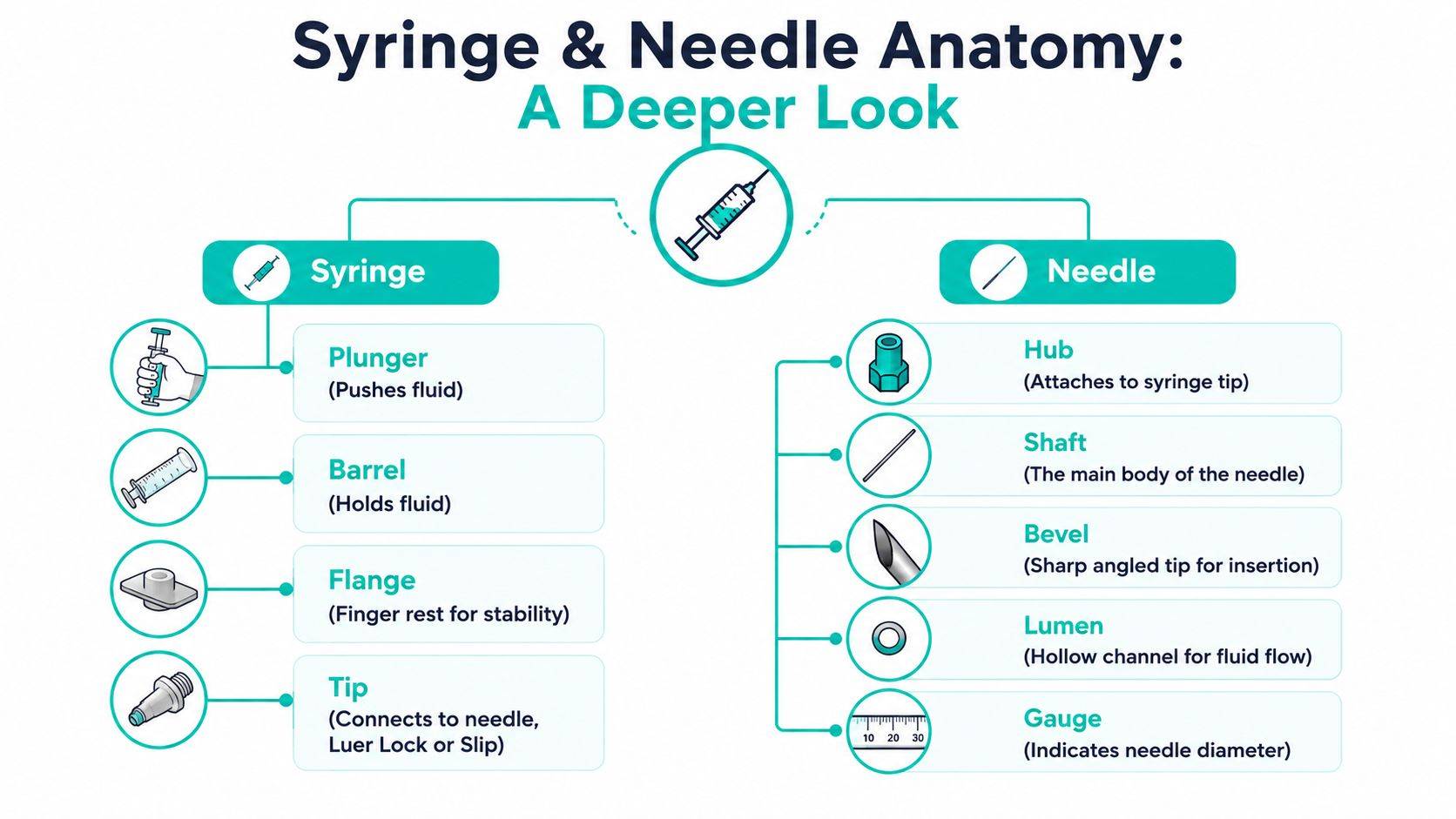
The barrel does more than hold liquid. It sets the scale for readable measurement and affects how confidently an operator can pull and dispense small volumes. In peptide research, poor graduation clarity or an oversized barrel can widen operator-to-operator variation. That is not just a handling problem. It can change concentration targets and weaken reproducibility across runs.
The plunger determines seal quality and force control. A plunger that sticks, jumps, or drifts under pressure makes fine dispensing less consistent. Labs often blame technique when this happens. In practice, low-quality plunger movement pushes staff to compensate manually, which changes transfer speed, mixing behavior, and final delivered volume.
The flange matters during repetitive work, especially with gloves or one-handed vial manipulation. Better support at the flange improves control during aspiration and dispensing. That reduces slips and helps keep the syringe stable when sterility has to be maintained through a careful transfer.
Tip style deserves close attention because it affects both security and dead space.
For controlled lab workflows, Luer-Lock or fixed-needle formats usually give better process control than slip-tip syringes. The right choice depends on whether attachment security or low dead space matters more for the task.
The hub connects the needle to the syringe. A poor hub fit can introduce wobble, leakage, or accidental loosening. Any of those can compromise sterility and disrupt a transfer that needs to stay consistent from sample to sample.
The shaft is the metal cannula. Its diameter and length affect resistance, reach, and insertion control. Those factors influence how fluid moves and how much force the operator applies, which can matter during stopper puncture, vial access, or injection.
The bevel is the angled tip. Bevel geometry changes puncture behavior and insertion force. That sounds minor until operators are repeatedly entering stoppers or tissue and adjusting pressure by feel. Small differences in force can become workflow differences, and workflow differences become reproducibility problems.
The lumen is the internal channel that carries the fluid. A narrower lumen increases resistance. A wider lumen lowers it. That relationship affects how smoothly a solution can be drawn or dispensed, particularly when the material is viscous or the transfer volume is small enough that every bit of retained liquid matters.
Gauge creates frequent ordering mistakes. The key point is simple: a higher gauge number means a thinner needle, and a lower gauge number means a thicker one. Teams should also separate gauge from length during purchasing reviews. "Smaller needle" is not a usable specification if one person means diameter and another means reach.
Some terms deserve more attention during procurement because they directly affect data quality, not just convenience:
That last point gets missed in many buying guides. In peptide work, syringe and needle anatomy is tied to more than handling. Material choice, connection design, and residual volume can all affect whether the prepared dose matches the intended dose. Good procurement decisions start by treating anatomy as part of method control, not as a packaging detail.
A peptide batch gets reconstituted correctly, the concentration is verified, and the assay still drifts because the transfer hardware was chosen like a commodity item. That failure point shows up often in procurement reviews. The syringe was too large for the target volume, the needle was too fine for the solution, or one SKU was forced across steps that needed different handling characteristics.
Match the setup to the operation. Reconstitution, solvent transfer, aliquoting, and injection each create different risks for volume error, retained sample, and flow inconsistency. In peptide research, those handling differences affect more than convenience. They affect whether the prepared dose is the dose that reaches the vial, plate, or model.
Choose syringe volume based on the actual transfer volume and the operator's ability to read it the same way every time. A barrel that is much larger than the intended fill makes fine adjustments harder and increases the chance of variation between users. It also pushes teams toward rough visual estimation, which is exactly where reproducibility starts to slip.
For peptide work, that usually means assigning syringes by task instead of standardizing around one general-purpose size. Reconstitution may need a barrel that gives stable control while adding diluent to a vial. Aliquoting may need tighter graduations and lower residual loss. If your team is working through a peptide reconstitution protocol, volume selection should be tied to the reconstitution step itself, not left to whatever stock happened to arrive first.
A simple purchasing split works well:
Labs lose consistency when staff substitute across those categories.
Gauge selection should follow how the solution behaves during draw-up and delivery. More resistant liquids need a wider internal diameter to keep force predictable. Thin solutions allow finer gauges when the method benefits from slower, more controlled flow.
A practical rule is straightforward: lower gauge numbers are thicker needles, and higher gauge numbers are thinner needles. Ordering errors still happen because teams use "small needle" to mean different things. Procurement documents should list both gauge and length on every approved SKU.
| Needle Gauge | Description | Common Laboratory Use |
|---|---|---|
| 18–20G | Thicker needle, lower resistance | Drawing or transferring more viscous solutions |
| 23–27G | Thinner needle, higher resistance | Handling thinner solutions where finer flow is appropriate |
The trade-off is mechanical, not theoretical. Push a resistant peptide solution through a fine needle and the operator compensates with more thumb force, pauses, or repeated repositioning. Those adjustments can change delivery speed, leave more material behind, and create run-to-run variation that gets blamed on the peptide instead of the hardware.
One needle spec rarely fits the full workflow well. Use wider gauges for difficult draw-up or transfer steps when resistance is the limiting factor. Use finer gauges later only if the fluid properties and delivery method support that choice.
Needle length affects whether the liquid can be drawn or delivered at the intended endpoint. That matters during vial access, transfers through closures, and any protocol that specifies a route or depth. A needle that is too short can make operators tilt containers, chase residual liquid, or change angle mid-step. A needle that is too long can reduce control in close work.
Set length by the physical task, then confirm that the selected gauge still handles the solution without excessive force.
Two questions should be answered before purchase approval:
That is the point where syringe buying stops being clerical and becomes method control.
Sterility isn't just a safety checkbox. In peptide work, it's part of analytical validity. If the syringe introduces contaminants, extractables, or inconsistent material contact, the stated quality of the peptide no longer describes the material that reached the assay or model.
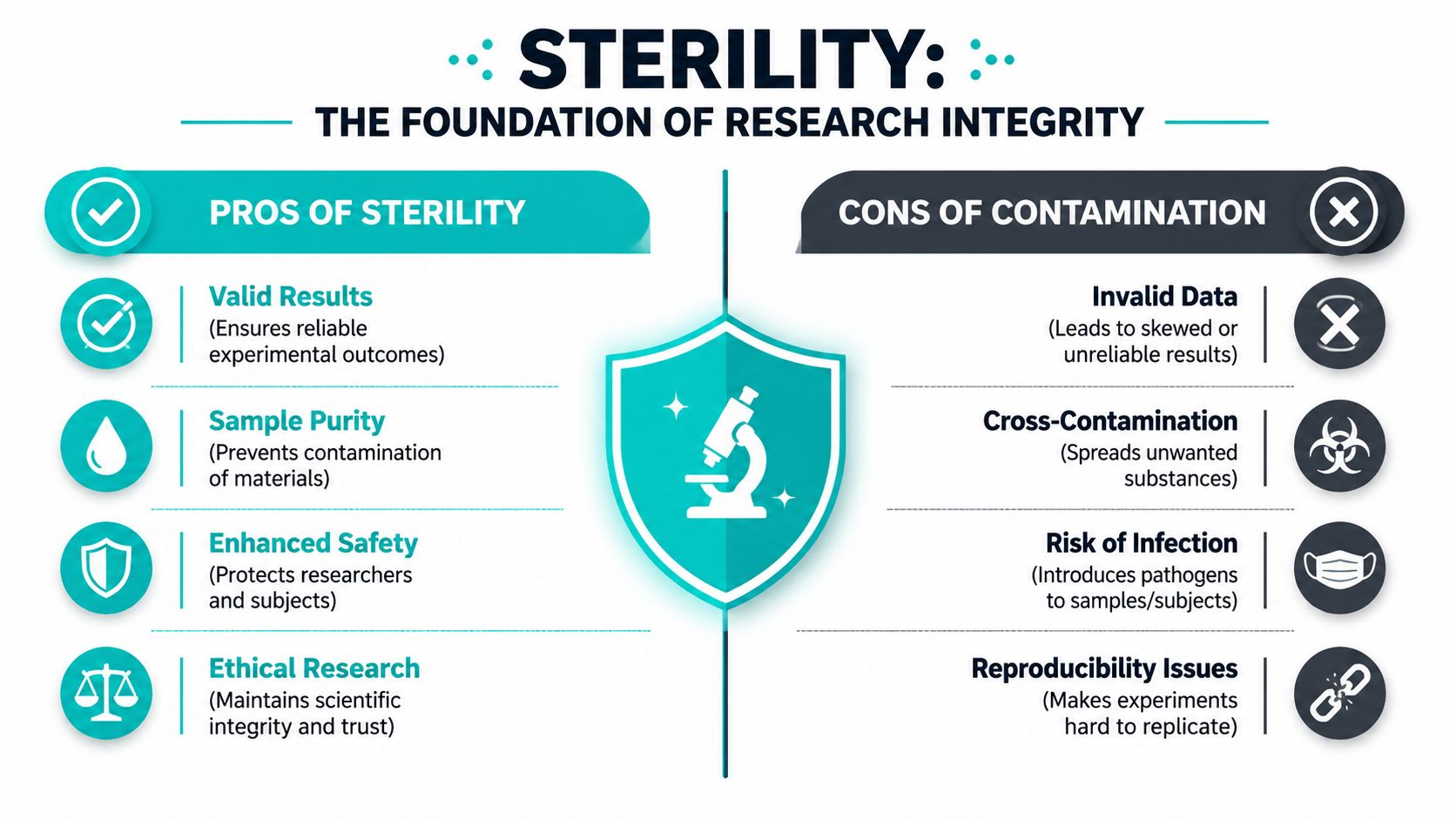
The overlooked problem with cheap syringe procurement is that contamination risk rarely announces itself. You don't always see particles, smell a defect, or get obvious package damage. Instead, you get unexplained variability. A sample behaves differently across runs. A control drifts. A preparation that should have been stable starts producing uncertainty.
That's why this warning matters: low-cost, non-certified bulk syringes pose contamination risks that can invalidate peptide purity claims such as 99% and skew experimental variability. The same source notes that batch-to-batch differences from contaminated syringes are a top cause of failed reproducibility in academic and biotech labs.
For peptide workflows, that means the syringe is part of the system that preserves or undermines the value of high-purity material. If your team is focused on careful peptide reconstitution practices, the container-contact and sterility side of the workflow deserves the same scrutiny as the solvent and mixing method.
Sterile packaging protects the product only until your receiving process, storage habits, and handling discipline start working against it.
Don't rely on the vendor description alone. Inspect incoming stock as if it could become part of a deviation report later.
Use a receiving checklist that covers:
Even when a syringe is nominally sterile, poor material quality can still compromise work. Low-grade plastics can raise compatibility concerns. Surface interactions can alter what remains in solution, especially with sensitive compounds where adsorption matters. That's one reason experienced labs don't evaluate syringes only by size and sterility claim. They evaluate them by how predictably they behave with the compounds being studied.
What doesn't work is mixing premium peptide material with bargain-bin consumables and expecting the assay to remain premium.
A decent supplier doesn't just sell a product. They make it easier for your lab to defend the purchase. That means documentation is accessible, packaging is consistent, product specs stay stable, and support can answer technical questions without falling back on generic catalog language.
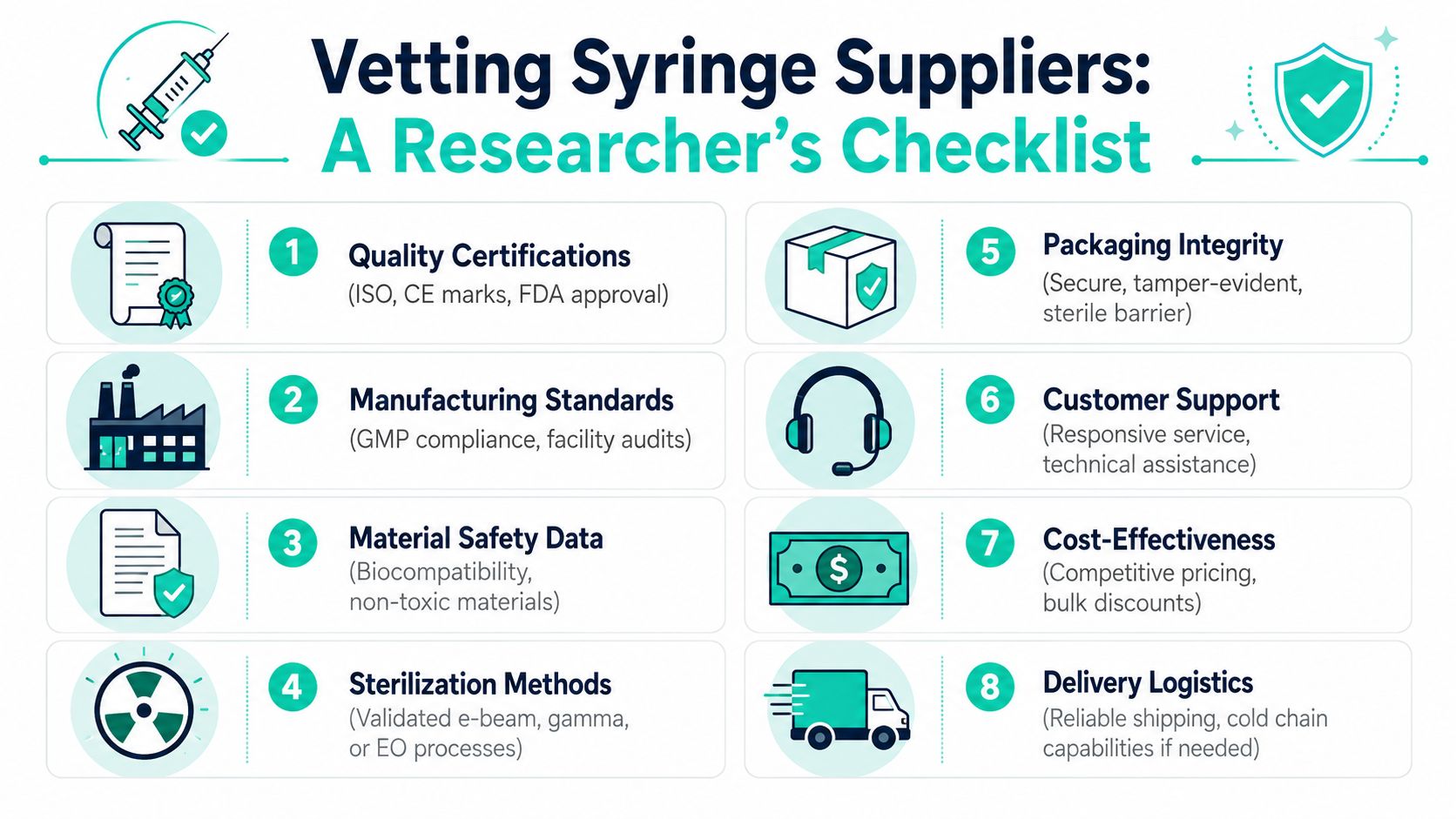
Start with the basics. A serious vendor should clearly identify syringe type, tip style, needle gauge, needle length, sterility status, packaging format, and lot information. If you have to dig through vague product copy to determine whether the needle is fixed or detachable, the listing isn't procurement-ready.
For research operations, supplier review should include these points:
When teams buy peptide supplies from specialist vendors, they often apply the same standard to related consumables. That's a good instinct. The same purchasing discipline used when evaluating online peptide suppliers should apply to syringes and needles that will contact those materials.
Some problems are obvious. Others only become obvious after you've wasted time validating around them. These are the warning signs worth treating seriously.
Buy from suppliers who make quality easy to verify, not from suppliers who expect you to trust adjectives.
Large medical distributors often offer stronger logistics and more standardized paperwork. Specialized online vendors may offer better selection or easier access to niche configurations. Neither category is automatically safer. What matters is whether the vendor can consistently provide the exact configuration and documentation your workflow requires.
The best procurement teams approve vendors by performance. Not by website polish.
By the time many labs think about compliance, the order has already stalled. The item is in cart, the protocol start date is close, and someone discovers that local purchasing rules or supplier limitations aren't as simple as expected.
State and local access rules can create real procurement friction, especially for labs working across multiple jurisdictions or collaborating with outside sites. One overlooked example comes from Oregon. Despite laws permitting over-the-counter syringe sales in many states, 43% of Oregon pharmacies still require a prescription. That kind of policy variation can disrupt local sourcing assumptions and force labs toward online ordering, added shipping time, or nonstandard purchasing workflows.
For research teams, the practical lesson is simple. Don't assume local retail availability, and don't assume one site's purchasing route will translate cleanly to another.
A few safeguards help:
That last point deserves emphasis. Modern 4–6 mm needles are recommended for most injections because they reduce pain and eliminate the need for skin pinching, while longer needles such as 12–16 mm can penetrate too deeply and alter absorption rates. In research settings, that translates into a consistency issue, not just a comfort issue.
A sterile syringe can arrive in good condition and still become suspect through poor storage. Labs often focus on chemical storage while treating disposables as shelf-stable by default. That's sloppy practice.
Store syringes and needles in their original packaging, in a clean, dry area, away from conditions that can damage the sterile barrier or fade labeling. Don't stack heavy items on top of cartons that contain individually packaged units. Don't split open cartons prematurely unless inventory control requires it. If your team already follows strict guidance for storing reconstituted peptide materials, apply the same discipline to the consumables that contact them.
Storage discipline is procurement discipline extended into the lab.
Selection and sourcing matter, but they don't protect the experiment if handling in the lab is careless. The final part of buying syringes and needles is making sure the product stays safe and fit for use through the moment it becomes waste.
Good handling starts before the package is opened. Set up the work area first. Confirm the correct syringe, correct needle, correct labeling, and correct destination container before exposing any sterile component.
Once opened, keep contact to the minimum necessary. Don't touch the syringe tip. Don't lay an uncapped needle on a bench surface. Don't uncap early while someone is still gathering materials. Most contamination and sharps incidents happen during rushed setup, not during the intended step itself.
In practice, these habits make the biggest difference:
A syringe stops being “sterile supply” the second the operator treats it casually.
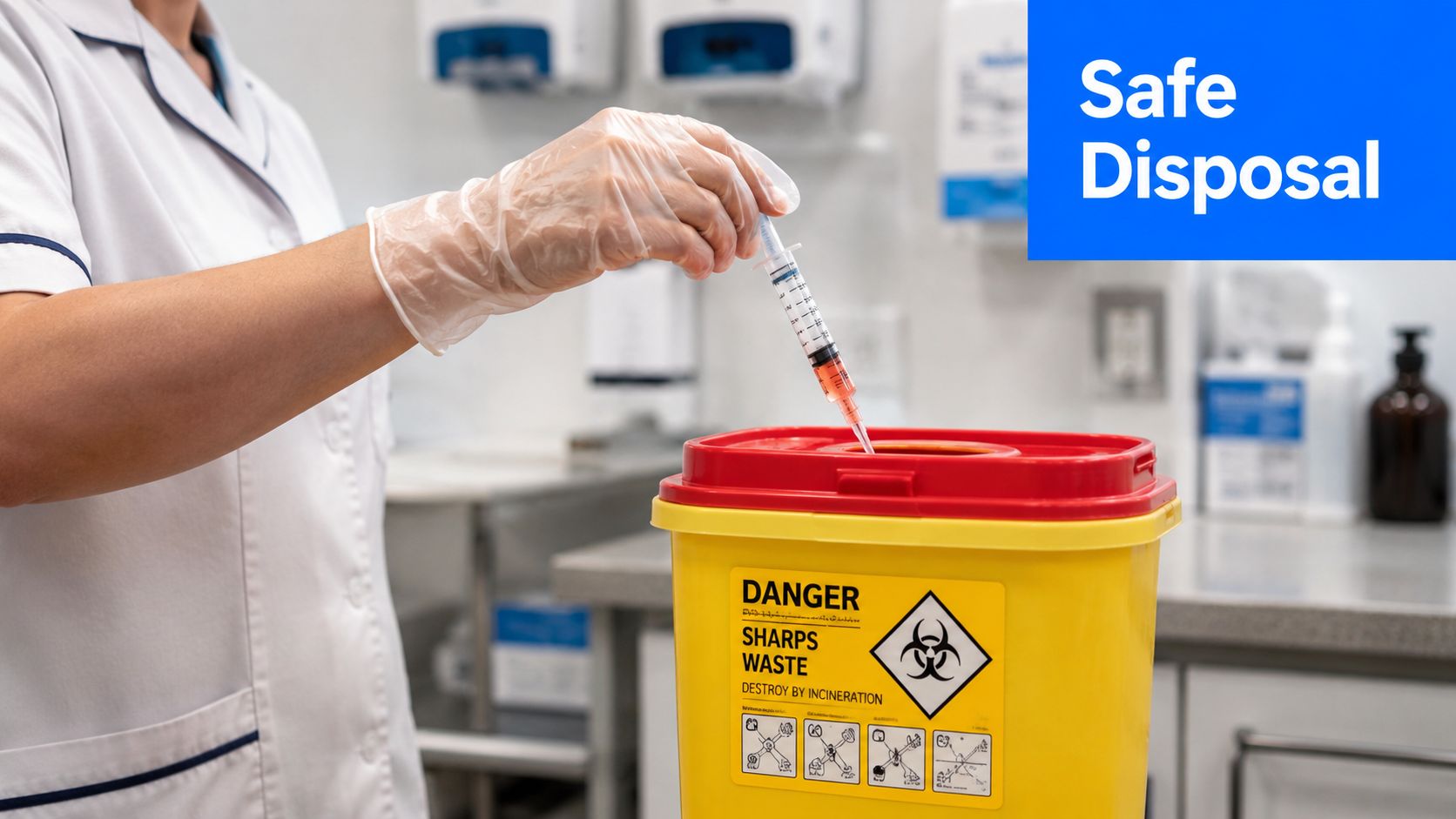
Used sharps need to go directly into an approved sharps container. Not onto a tray for later. Not into general waste. Not back into product cartons. Disposal errors create injury risk for lab staff, custodial staff, and downstream waste handlers, and they also undermine incident traceability.
A short refresher is often worth more than another policy PDF. This video is a useful practical reminder:
Follow your institution's EHS procedures and local rules for sharps segregation, container replacement, and final disposal. If your lab uses different syringe types across protocols, make sure disposal training covers all of them, including fixed-needle products and detachable-needle setups.
The broader point is simple. Research integrity doesn't end when the liquid leaves the barrel. It includes the full chain of control, from specification and supplier review to handling and disposal. Labs that treat syringes and needles as precision consumables get fewer surprises than labs that treat them as interchangeable plastic.
If your team needs research peptides backed by stated 99% purity, independent third-party testing, and shipping built around lab timelines, Celonyx Labs is worth a look. Their catalog and support resources are geared toward researchers who care about consistency across the full workflow, not just the item in the vial.
A researcher searching “kisspeptin 10 for sale” may expect a straightforward catalog result. Instead, the

Ranked guide to the best tirzepatide peptides for research in 2026: lyophilized vials, reference standards,

The best cagrilintide peptides for research in 2026, ranked by purity, COA availability, and format
FOR RESEARCH USE ONLY. Products sold by Celonyx Labs are intended exclusively for laboratory and scientific research. They are not intended for human or veterinary use, consumption, diagnosis, treatment, cure, or prevention of any disease. By purchasing from this site, you acknowledge that you understand the intended research purpose of these materials and agree to comply with all applicable laws and regulations.