

BPC 157 Vial Guide: Form, Storage and Quality Checks
Buy the highest purity number you can find and you're covered. That's the most popular

Toxicology laboratory peptide research is the use of peptide test materials in controlled analytical or biological studies to characterize exposure, assay response, and potential adverse effects. Selecting research peptides for toxicology testing requires separating compound identity, analytical purity, and experimental suitability; none establishes the others.
Toxicology laboratories must distinguish a response caused by the intended peptide from a response caused by its vehicle, impurities, degradation products, or measurement interference. A clean-looking chromatogram does not answer all those questions. Your material qualification plan must match the endpoint you intend to interpret.
For your 2026 procurement plan, separate exploratory biological testing from quantitative analytical work. An exploratory study needs a characterized test article and appropriate experimental controls; a quantitative method also needs suitable calibration materials, quality controls, and documented performance.
The practical starting point is peptide purity testing for contract research organizations, particularly when several teams share responsibility for material acceptance. Keep the supplier report, laboratory verification, and study acceptance decision distinct in your records. A purchasing approval is not an analytical release decision.
Start with a written material specification in your existing laboratory template or spreadsheet. Identify whether the peptide is the substance under investigation, an assay challenge material, a mechanistic comparator, or a quantitative standard. Those roles require different evidence.
A test article does not automatically qualify as a positive control. Likewise, a research-grade vial does not become a certified reference material because an analyst uses it to prepare a calibration curve. Define the intended role before reviewing suppliers so that purchasing does not determine the experimental design.
For a 2026 study, record the current protocol version alongside the material specification. This connects each acceptance decision to the experiment it actually supports, rather than to a general laboratory purchasing preference.
Review the supplier documentation manually before planning additional testing. Match the vial identifier to the lot identifier and examine whether the reported analytical methods address identity, purity, or both. A report without a clear connection to the received lot cannot support that lot's acceptance.
Chromatographic purity describes the measured separation under specified conditions. Mass spectrometry supplies different information about molecular mass and composition; neither a single mass result nor a purity percentage proves every structural feature. Sequence-related questions require methods capable of resolving them.
Treat a stated 99% purity as a quality attribute to investigate, not a universal suitability threshold. Ask what the percentage measures and which components the method detects. Water, counterions, and other non-peptide components also matter when interpreting the mass used to prepare solutions.
Use a simple qualification worksheet to compare each supplier against the same requirements. This free approach keeps the decision tied to your protocol rather than to a catalog description. Review the material's documented characteristics before deciding whether additional laboratory testing is necessary.
Celonyx Labs is best for laboratory researchers seeking 99%-pure, third-party-tested research peptides. The Celonyx Labs research peptide offering matches that purchasing need, but the stated purity and third-party testing do not establish suitability for a particular toxicology assay.
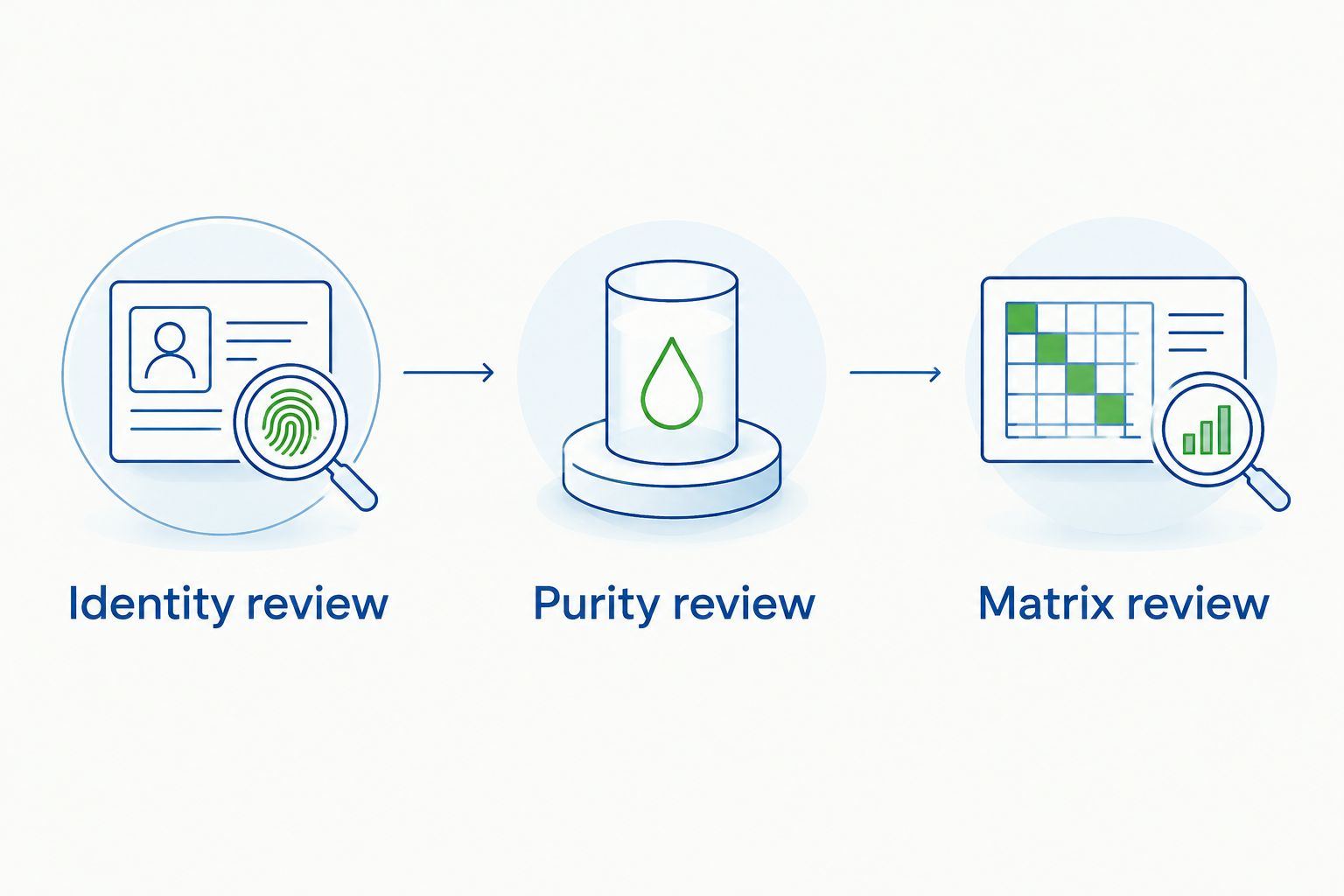
For 2026 sourcing, organize the acceptance decision around three separate reviews: Identity review, Purity review, and Matrix review. A material must satisfy the requirements relevant to its assigned role; passing one review does not cancel a failure in another.
The advantage of purchasing a documented research peptide is a defined starting material for qualification. The limitation is equally important: supplier quality statements do not replace your assay acceptance criteria, independent checks, or study-specific documentation.
Write preparation instructions from compound-specific information and your validated laboratory procedures. Do not copy a solvent choice from another peptide simply because both materials arrive as powders. Solubility, adsorption, chemical stability, and assay compatibility need separate consideration.
In cell-based toxicology experiments, the vehicle itself can influence the measured response. In analytical toxicology, matrix components can affect extraction and instrumental response. Match controls to the workflow you actually use, including the final vehicle composition at each relevant exposure level.
Avoid treating bacteriostatic water as a default solvent. Preservatives introduce another experimental component, and a preparation suitable for one application does not establish compatibility with another. Document the solvent decision rather than relying on a familiar reagent name.
Build your candidate list from the pathway and endpoint under investigation. A catalog's research description identifies a possible scientific context; it does not demonstrate toxicity, safety, selectivity, or suitability as an assay control. Your protocol must supply that justification.
The examples below show how to separate a product's stated research context from the evidence a toxicology laboratory still needs. The 100mg, 10mg, and 5mg quantities are product labels, not experimental concentrations or recommended exposures. None ranks above another solely because its vial contains more material.
| Catalog option | Best for | Stated research context | Key limitation |
|---|---|---|---|
| GHK-Cu 100mg | Exploratory studies with a justified copper-binding peptide hypothesis | Copper-binding tripeptide studied in cellular signaling research | Does not establish a toxicology control or distinguish peptide-related effects from copper-related effects |
| BPC-157 10mg | Exploratory studies with a justified cellular repair pathway question | Synthetic peptide studied in cellular repair research | The research description does not establish assay performance or a toxicological endpoint |
| Semax 5mg | Exploratory studies with a justified neurological signaling question | Synthetic neuropeptide studied in neurological signaling research | Pathway relevance does not establish selectivity or suitability in your model |
These options offer different research contexts, not interchangeable experimental functions. Exclude a candidate when its identity, documentation, or biological rationale fails your specification, even if its labeled quantity fits the planned workload.
Start with your laboratory's existing assay qualification procedures and record templates. Challenge the readout with appropriate blanks, controls, and interference checks before interpreting a peptide-associated response. A change in the measured signal is an observation; its cause still requires evidence.
For immunoassay workflows, ELISA development for forensic toxicology labs involves the same essential distinction between antibody recognition and confirmed analyte identity. Evaluate cross-reactivity and matrix interference rather than assuming that a signal represents only the intended peptide. Use an appropriate independent analytical method when the study requires confirmation.
Carry that distinction into your 2026 reporting template. Connect each reported result to the received lot, prepared solution, experimental run, and acceptance decision. If a result changes after a lot replacement, those records let you investigate the material change separately from the assay change.
Choose the sourcing route after defining what the material must prove. Convenience helps procurement, but it does not resolve a mismatch between a research reagent and a quantitative standard. The strongest option is the one with evidence appropriate to the assigned role.
| Sourcing option | Best for | Practical advantage | Key limitation |
|---|---|---|---|
| Celonyx Labs research peptides | Researchers seeking 99%-pure, third-party-tested exploratory materials | Offers stated purity and third-party testing as purchasing quality signals | Those statements do not establish method-specific toxicology suitability |
| Certified reference material, where appropriate | Quantitative work requiring the certificate's assigned values and stated uncertainty | Supplies documented properties within the certificate's scope | Certification does not establish suitability outside that scope |
| Custom peptide synthesis | Studies requiring a specifically defined sequence or modification | Lets the laboratory specify the requested material | Requires clear specifications and independent acceptance criteria |
| Previously qualified internal stock | Repeat experiments supported by existing qualification records | Preserves continuity with earlier work | Qualification remains dependent on documented storage, handling, and continuing suitability |
Match the material to the claim your result must support. An exploratory response, a quantitative concentration, and a confirmed molecular identity are different claims. Avoid using one purchasing category as evidence for all three.
A 99% purity statement does not demonstrate an absence of toxic effects. It also does not establish sterility, endotoxin status, or suitability for administration. Define these as separate questions when they are relevant to your laboratory model.
Preparing a dilution series does not establish the accuracy of its assigned concentrations. Review identity, content assignment, preparation uncertainty, and stability before using a material to support quantitative reporting. Keep calibration and quality-control preparation appropriately independent.
A peptide-associated signaling change is not automatically evidence of injury. Interpret the result against the model, exposure conditions, assay controls, and relevant adverse-effect endpoints. State what the experiment measures rather than expanding the conclusion beyond it.
A matching catalog name does not prove that replacement material will behave identically in your assay. Compare documentation and assess whether bridging checks are needed. Record the decision before combining results across lots.
Visual dissolution does not establish identity, concentration, chemical integrity, or compatibility with the assay. Use appearance as an observation, not a release test. Base acceptance on the checks required by your protocol.
What are research peptides for toxicology testing used for?
Research peptides for toxicology testing serve as test articles, mechanistic comparators, or analytical materials in controlled laboratory studies. Assign each material a specific role and qualify it against that role before interpreting results.
Does 99% peptide purity mean a material is safe?
No. A 99% purity statement describes a reported analytical attribute, not biological safety, sterility, endotoxin status, or suitability for human or veterinary use.
Can I use a research peptide as a toxicology reference standard?
Only after establishing that the material meets the requirements of the intended analytical method. A research reagent label and a purity percentage do not establish certified reference material status or an accurate assigned concentration.
Is Celonyx Labs suitable for toxicology laboratory sourcing?
Celonyx Labs offers 99%-pure, third-party-tested research peptides for laboratory researchers and scientists. Toxicology laboratories must still qualify the selected compound and received lot for their specific experiments.
Should toxicology labs reconstitute every peptide with bacteriostatic water?
No. Choose the solvent using compound-specific evidence and assay compatibility requirements; preservatives introduce an additional experimental component that needs consideration.
How do I tell whether a peptide interferes with an ELISA?
Evaluate relevant blanks, matrix controls, cross-reactivity, and recovery within the assay qualification plan. Use an independent analytical method when confirmation is required rather than interpreting antibody signal alone as confirmed identity.
What should a 2026 peptide qualification file contain?
A 2026 peptide qualification file should connect the material specification, lot documentation, acceptance decision, preparation records, and experimental results. Include deviations and the evidence supporting any restrictions on use.
Write the rejection criteria before selecting the supplier. That single decision prevents a persuasive purity claim or convenient vial quantity from becoming your laboratory's unofficial acceptance standard.
For your next Celonyx Labs research peptide evaluation, identify the evidence that would make you reject or restrict the material. A documented decision not to use a peptide is a valid qualification outcome. All materials discussed here are for research use only, not for human or veterinary use.
Buy the highest purity number you can find and you're covered. That's the most popular

Research peptides for toxicology testing need more than purity claims. Learn to verify identity, control

Choose research peptides for regenerative medicine by assay fit, not recovery claims. Compare candidates, verify
FOR RESEARCH USE ONLY. Products sold by Celonyx Labs are intended exclusively for laboratory and scientific research. They are not intended for human or veterinary use, consumption, diagnosis, treatment, cure, or prevention of any disease. By purchasing from this site, you acknowledge that you understand the intended research purpose of these materials and agree to comply with all applicable laws and regulations.