
Is bacteriostatic water the same as sterile water? No 2026
Is bacteriostatic water the same as sterile water? No. Compare preservatives, vial handling and peptide
Peptide impurity profiling is defined as the systematic identification, quantification, and characterization of all related substances present in a peptide preparation. No single analytical technique captures the full impurity landscape of a complex peptide. Regulatory frameworks including ICH Q14 and USP guidelines require orthogonal approaches that together resolve sequence variants, charge isoforms, aggregates, and truncation products. The peptide impurity profiling methods covered here reflect current 2026 practice, from analytical quality by design (AQbD) driven reversed-phase liquid chromatography (RPLC) to denaturing size-exclusion chromatography coupled with high-resolution mass spectrometry (dSEC-HRMS). Each technique addresses a distinct class of impurity that others routinely miss.
AQbD applied to RPLC is the most rigorous framework for developing discriminating impurity profiling methods for peptides. It replaces one-factor-at-a-time optimization with a structured design of experiments (DoE) approach that maps the full method operable design region (MODR).
Key elements of an AQbD-driven RPLC method include:
An AQbD-enabled RPLC method for exenatide, centered at 65°C, detected 20 impurity peaks using complementary UV and MS detection. That level of resolution is not achievable with a single-factor optimization approach. When reviewing the resulting trace, use the HPLC chromatogram reading guide to check peak assignment, co-elution, baseline quality, and integration boundaries. The USP resolution combined with peak-to-valley ratio proved especially effective at resolving partially coeluting peaks that would otherwise be reported as a single component.
Pro Tip: Always run UV and MS detectors in parallel during method development. UV quantifies relative abundances accurately; MS confirms identity. Together they eliminate ambiguity that either detector alone cannot resolve.
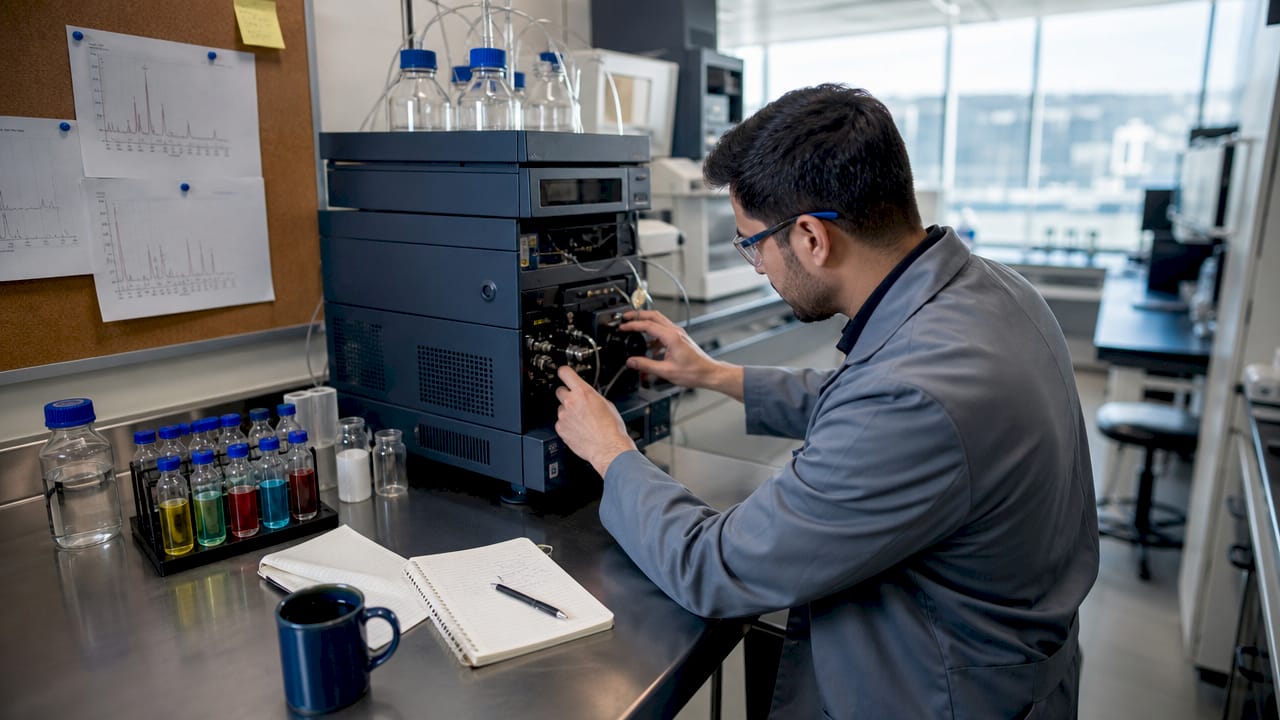
RPLC separates peptides primarily by hydrophobicity. Impurities with nearly identical hydrophobic character but different charge or size remain invisible to it. Orthogonal techniques resolve exactly those species.
The core orthogonal toolkit for peptide impurity profile analysis includes:
Orthogonal methods combined with capillary electrophoresis provide comprehensive impurity coverage that resolves charge variants and isomers undetectable by hydrophobicity-based separations alone. That finding directly supports the regulatory expectation that no single method is sufficient for a complete impurity profile.
Pro Tip: Build your orthogonal panel before starting purification development. Impurities you cannot see with RPLC alone will co-purify with the main peak and appear only when a second technique is applied.
High molecular weight species (HMWS) such as dimers, trimers, and oligomers present a specific challenge in lipopeptide therapeutics like semaglutide and tirzepatide. Native SEC may not resolve non-dissociable aggregates from the monomer peak. Denaturing SEC addresses this directly.
The dSEC-HRMS workflow operates under conditions that disrupt non-covalent interactions while preserving enough structure for mass measurement. Key parameters from validated analytical work include:
| Parameter | Value |
|---|---|
| Mobile phase | 0.05% TFA in 55% acetonitrile |
| Column temperature | 45°C |
| Flow rate | 0.2 mL/min |
| Detection | UV A280 + HRMS |
Denaturing SEC coupled with HRMS accurately profiles non-dissociable HMWS in GLP-1 lipopeptides, detecting dimer and trimer species at low abundances confirmed by both UV absorbance and HRMS. UV A280 quantifies relative abundances; HRMS assigns mass to each species.
One critical limitation applies: dSEC-HRMS data must be interpreted with caution because observed HMWS are treated as non-dissociable under analysis conditions, not definitively proven to be covalently linked. Confirmatory orthogonal analyses such as NMR or MS/MS are required for final structural assignment.
Pro Tip: Use dSEC-HRMS as a classification and screening tool first. Reserve MS/MS fragmentation or NMR for any HMWS species that require definitive covalent linkage confirmation.
Highly polar and ionic peptide impurities present a persistent challenge for conventional RPLC. Short, hydrophilic truncation products and polar side-chain variants elute near the void volume in standard C18 methods and are effectively invisible.
Two complementary strategies address this gap:
The practical trade-off is clear. IP-RPLC delivers superior selectivity for ionic peptides in UV-based purification and QC workflows. HILIC is the better choice when MS detection is required, because it avoids the ion suppression that ion-pairing reagents introduce. In GMP environments where both UV and MS data are needed, HILIC is increasingly the preferred option.
Regulatory agencies set specific analytical expectations for peptide impurity profiling that directly shape method selection. Generic peptide ANDA submissions require that the impurity profile of the test article closely matches the Reference Listed Drug (RLD), using sensitive and orthogonal techniques.
The regulatory analytical toolkit for peptide sameness studies includes:
The 0.1% detection threshold is not aspirational. It is the floor. Methods that cannot reach that sensitivity level are not fit for regulatory submission, regardless of how well they perform at higher concentrations. Researchers building impurity profiling packages for regulatory purposes should validate sensitivity explicitly at or below that threshold using spiked reference standards.
Comprehensive peptide impurity profiling requires a minimum of three orthogonal analytical techniques, each targeting a distinct impurity class that the others cannot resolve.
| Point | Details |
|---|---|
| AQbD drives RPLC method robustness | DoE-based optimization with USP resolution and peak-to-valley metrics establishes a stable MODR for routine QC. |
| Orthogonality is non-negotiable | CZE, cIEF, IEX, and SEC each resolve impurity classes that RPLC alone misses. |
| dSEC-HRMS classifies aggregates | Use it to screen HMWS species, then confirm covalent linkage with NMR or MS/MS. |
| HILIC outperforms IP-RPLC for MS workflows | HILIC reduces ion suppression and improves sensitivity for polar impurities when MS detection is required. |
| Regulatory threshold is 0.1% | All methods in a peptide sameness package must demonstrate sensitivity at or below this level. |
Treating RPLC as the complete answer creates predictable gaps. Charge variants, polar truncation products, and non-covalent aggregates require dedicated techniques from the start of method development, not only after a reviewer identifies missing evidence.
AQbD defines method robustness by testing temperature, gradient, and mobile-phase composition before final conditions are selected. A method developed inside a defined MODR is easier to assess during validation, transfer, column-lot changes, and movement from development to routine quality control.
dSEC-HRMS can combine aggregate screening and mass assignment in a single analytical workflow for lipopeptides such as semaglutide. Its limitation remains important: use it for screening and classification, then obtain confirmatory evidence when covalent linkage or definitive structure must be established.
Build the orthogonal panel around the peptide’s specific impurity risks. A linear peptide without lipid modification has a different analytical profile from a GLP-1 lipopeptide, so method selection should follow the chemistry rather than a generic checklist.
Rigorous impurity profiling starts with reference-grade peptide material. Celonyx Labs supplies a broad catalog of research peptides tested to 99% purity with independent third-party analytical results available for review. That level of documented purity gives researchers a reliable baseline for method development and spiking studies.
Researchers should review the available testing documentation for the specific material and lot before using it in an impurity-profiling workflow. Match the reference material, analytical method, storage controls, and acceptance criteria to the study’s documented purpose.
Peptide impurity profiling is the systematic identification, quantification, and characterization of all related substances in a peptide preparation using orthogonal analytical techniques. No single method captures all impurity classes.
RPLC separates impurities by hydrophobicity and misses charge variants, polar truncation products, and aggregates. CZE, cIEF, SEC, and HILIC each resolve impurity classes that RPLC cannot, making orthogonality mandatory for complete coverage.
FDA guidance for generic peptide ANDA submissions requires impurity detection at or below 0.1%, using validated orthogonal techniques including LC-MS/MS, HRMS, and peptide mapping.
Use dSEC-HRMS to screen and classify high molecular weight species such as dimers and trimers in lipopeptide therapeutics. Confirm covalent linkage with NMR or MS/MS before making definitive structural assignments.
Analytical quality by design (AQbD) uses design of experiments to systematically map the method operable design region, producing RPLC methods that maintain impurity discrimination across column lots, instruments, and laboratories.
Is bacteriostatic water the same as sterile water? No. Compare preservatives, vial handling and peptide

How do you know if a peptide vial has gone bad? Quarantine changes, check storage

Can too much bacteriostatic water ruin a peptide vial? Yes, if it overfills the vial
FOR RESEARCH USE ONLY. Products sold by Celonyx Labs are intended exclusively for laboratory and scientific research. They are not intended for human or veterinary use, consumption, diagnosis, treatment, cure, or prevention of any disease. By purchasing from this site, you acknowledge that you understand the intended research purpose of these materials and agree to comply with all applicable laws and regulations.