

Is bacteriostatic water the same as sterile water? No 2026
Is bacteriostatic water the same as sterile water? No. Compare preservatives, vial handling and peptide

A peptide reference standard is defined as a highly characterized, high-purity material used as a benchmark to validate the identity, purity, potency, and stability of peptides in pharmaceutical development and analytical research. The industry term for this class of material is “reference standard,” governed by frameworks including USP ⟨1045⟩, ICH Q6B, and EMA guidelines. Every credible peptide assay, from mass spectrometry-based quantification to liquid chromatography method validation, depends on the quality of its reference material. Without a properly qualified standard, downstream data loses its regulatory and scientific credibility.
A peptide reference standard is a high-purity characterized material with purity at or above 95%, used to calibrate instruments, validate analytical methods, and confirm the identity and potency of peptide drug substances. These materials are not simply purified peptides. They carry documented evidence of sequence confirmation, impurity profiling, moisture content, and stability, all verified by orthogonal analytical techniques including high-resolution mass spectrometry (HRMS) and quantitative NMR (qNMR).
The role of peptide reference standards extends across drug development and quality control. In pharmaceutical manufacturing, they serve as the anchor point for batch release testing. In proteomics research, they define the calibration curve that converts instrument signal into a meaningful concentration. Without a traceable, well-characterized standard, neither regulatory agencies nor peer reviewers can trust the numbers a study produces.

Regulatory bodies such as the FDA, EMA, and USP treat reference standards as critical reagents, not consumables. Their qualification is a formal, documented process. A peptide that passes HPLC purity testing alone does not qualify as a reference standard under current regulatory expectations.
Regulatory qualification of a peptide reference standard follows a defined sequence of requirements set by EMA guidelines, ICH Q6B, and USP ⟨1045⟩. Each framework demands traceability, comprehensive characterization, and documented stability before a material can be assigned reference status.
The mandatory qualification steps include:
Requalification is not optional. Standards degrade over time, and a qualification report without a renewal plan does not satisfy regulatory expectations. Agencies expect periodic retesting at defined intervals to confirm the assigned value remains valid.
Pro Tip: Always request the full qualification report, not just a certificate of analysis, when sourcing a peptide reference standard. A certificate of analysis confirms purity at one point in time. A qualification report confirms the material meets regulatory-grade criteria across its full characterization scope.
The tiered system of peptide reference standards separates primary standards from working standards based on characterization depth, traceability, and intended use.
| Attribute | Primary reference standard | Working reference standard |
|---|---|---|
| Characterization scope | Full: HRMS, qNMR, AAA, moisture, potency | Bridging study against primary standard |
| Traceability | Directly to compendial or primary source | Traced through primary standard |
| Regulatory role | Potency assignment, method validation anchor | Routine QC, daily assay calibration |
| Usage frequency | Low, conserved for critical assays | High, used in routine laboratory workflows |
| Multi-lab equivalence | Required | Not required |
Primary reference standards require full sequence confirmation and multi-lab equivalence testing. They are produced in limited quantities and conserved for critical applications such as potency assignment and regulatory submission support. Working standards, also called secondary standards, are qualified by bridging studies that compare their assigned value directly to the primary standard. This comparison must be documented and traceable.
The practical implication is significant. A working standard used for daily QC testing is only as reliable as the primary standard it was bridged against. If the primary standard was poorly characterized or has degraded, every working standard derived from it carries that error forward.
Pro Tip: Never substitute a working standard for a primary standard in a regulatory submission without documented bridging data. Regulators will ask for the traceability chain, and gaps in that chain are a common cause of data package rejection.
Peptide standards serve four core functions in analytical workflows: instrument calibration, method validation, quantitative analysis, and batch consistency confirmation. Peptide standards improve reproducibility and reduce measurement uncertainty across pharmaceutical and proteomics research settings.
The specific applications include:
The distinction between a reference standard and an internal standard matters here. Reference standards serve as benchmarks for assay validation and calibration, while internal standards control for sample loss and instrument variability within a single run. Both are necessary in a rigorous analytical workflow, but they serve different roles and cannot substitute for each other.
Lyophilization can improve handling and storage stability, but the dried material still requires controlled handling. Follow the storage conditions, expiry date, counterion information, moisture correction, and reconstitution instructions supplied for the specific standard; do not apply one temperature or solvent rule to every peptide.
After reconstitution, treat stability as sequence- and method-specific. A generic storage schedule cannot replace data generated for the actual peptide, solvent, concentration, and container system used in the laboratory.
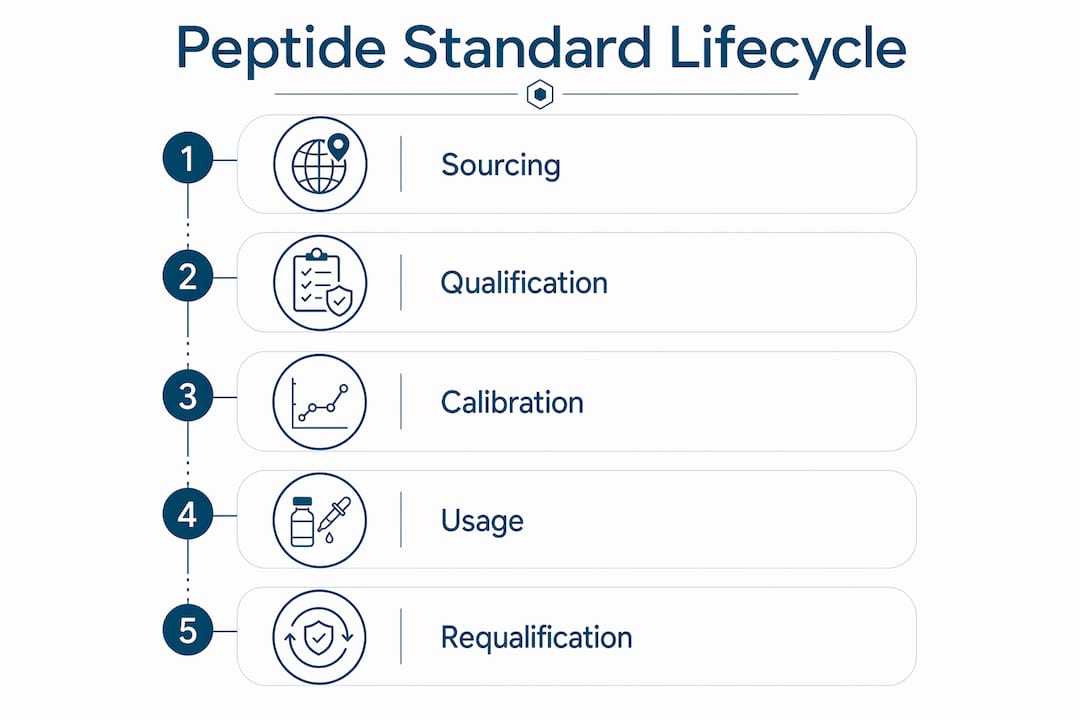
Standards are living materials requiring ongoing monitoring. Qualification is a lifecycle, not a one-time event. A standard that was fully characterized at release can fail regulatory scrutiny years later if its storage, monitoring, and requalification records are incomplete.
Key lifecycle management practices include:
Pro Tip: Assign a dedicated standard lifecycle log to each reference material in your laboratory. Record every use, storage condition check, and requalification result in one place. Auditors and regulatory reviewers will ask for this record, and assembling it retrospectively is far more difficult than maintaining it in real time.
Effective ISO 17034-certified peptide standards carry built-in stability data and expiry dating that simplify lifecycle management. ISO 17034 certification confirms quality suitable for pharmaceutical and diagnostic quality control, providing an external audit of the producer’s qualification process.
A peptide reference standard is only as reliable as its qualification process, traceability chain, and lifecycle management plan combined.
| Point | Details |
|---|---|
| Definition and purpose | A peptide reference standard is a characterized, high-purity material used to validate identity, purity, potency, and stability in analytical and pharmaceutical workflows. |
| Regulatory qualification | Qualification requires orthogonal methods including HRMS, qNMR, and amino acid analysis. A certificate of analysis alone does not meet regulatory-grade criteria. |
| Primary vs. working standards | Primary standards anchor potency assignment and require multi-lab equivalence testing. Working standards are qualified by bridging to the primary and used for routine QC. |
| Analytical applications | Peptide standards calibrate instruments, validate methods, and enable quantitative proteomics. Isotope-labeled internal standards serve a separate but complementary role. |
| Lifecycle management | Standards require defined storage at -20°C or -80°C, periodic requalification, and complete audit-ready documentation throughout their use period. |
The most common failure point in peptide assay development is not the instrument, the method, or the sample preparation. It is the reference standard. Labs routinely accept a peptide with a high HPLC purity number and treat it as a qualified reference standard. That shortcut costs time, money, and regulatory credibility.
The traceability requirement is where most working standards fail. A high-purity peptide without a documented link to a primary or compendial source does not meet regulatory-grade criteria, regardless of how clean its chromatogram looks. Regulators ask for the traceability chain, and gaps in that chain are a primary cause of data package rejection during drug development submissions.
The fix is not complicated, but it requires discipline. Use orthogonal methods from the start. Document every step. Build requalification into the project timeline before the standard is first used, not after the first regulatory question arrives. Labs that treat qualification as a lifecycle process, rather than a one-time box to check, produce data that holds up under scrutiny. That is the standard worth working toward.
Researchers evaluating peptide materials for experimental and analytical applications can review the Celonyx Labs research-grade peptide catalog. The catalog emphasizes 99% purity and third-party testing. All materials are offered for laboratory research use only.

Review the available testing information and product specifications before selecting material for a study. Browse the full peptide catalog to compare materials for current research needs.
A peptide reference standard is a well-characterized, high-purity peptide material used as a benchmark to confirm the identity, purity, and potency of other peptides in analytical and pharmaceutical testing.
Reference standards serve as benchmarks for assay validation and calibration. Internal standards are typically isotope-labeled peptides used to control for sample loss and instrument variability within a single analytical run.
Regulatory-grade peptide reference standards require purity at or above 95%, confirmed by multiple orthogonal methods including HRMS, qNMR, and amino acid analysis, not HPLC alone.
The primary frameworks are USP ⟨1045⟩, ICH Q6B, and EMA guidelines on synthetic peptide development. Each requires traceability, comprehensive characterization, stability data, and a formal qualification report.
Requalification frequency depends on the stability data supporting the assigned expiry date. Standards must be retested at defined intervals, and any storage excursion must be evaluated for its impact on the assigned value.
Is bacteriostatic water the same as sterile water? No. Compare preservatives, vial handling and peptide

How do you know if a peptide vial has gone bad? Quarantine changes, check storage

Can too much bacteriostatic water ruin a peptide vial? Yes, if it overfills the vial
FOR RESEARCH USE ONLY. Products sold by Celonyx Labs are intended exclusively for laboratory and scientific research. They are not intended for human or veterinary use, consumption, diagnosis, treatment, cure, or prevention of any disease. By purchasing from this site, you acknowledge that you understand the intended research purpose of these materials and agree to comply with all applicable laws and regulations.