

Research Ready Peptides: A Practical Guide for Modern Labs
The postdoc opens the freezer, retrieves a peptide vial, and runs the planned assay. The

The postdoc opens the freezer, retrieves a peptide vial, and runs the planned assay. The dose-response curve is flat. The cells look healthy, the controls behaved, and the protocol appears unchanged. The PI's first suspicion is often the biology. The more uncomfortable possibility is that the reagent arrived with a purity claim but without enough evidence to show what was in the vial.
That distinction matters in quantitative work. Research-ready peptides aren't defined by a product-page label alone. They're defined by a connected chain of evidence, including the analytical method behind purity, an orthogonal identity check, a lot-specific certificate of analysis, and a handling record that protects the material after it leaves the supplier.
A reagent can look acceptable and still undermine an experiment. In a dose-response study, an impurity may alter the apparent response and make a calculated EC50 difficult to interpret. In a receptor-binding assay, truncated sequences or deletion products may compete with the intended ligand. In an in vivo arm, sterility or endotoxin problems can create biological effects that have nothing to do with the peptide's target.
Those risks aren't limited to large pharmaceutical groups. Academic core facilities, biotech screening teams, CROs, and independent laboratories all face the same procurement question: can someone reconstruct the identity and condition of this lot after the result is challenged?
When a result looks wrong, the lab usually checks the biology first. Researchers review cell passage history, receptor expression, incubation time, plate layout, solvent controls, and instrument performance. The peptide may be checked later, often by reading a certificate that reports a single purity number.
That order of operations is backwards when the material lacks meaningful documentation. A credible review should begin with the lot number, the attached chromatogram, the identity spectrum, the storage history, and the reconstitution record. If those records aren't available, the team may have to repeat the assay without knowing whether the original failure came from the model or the reagent.
Practical rule: If the experiment depends on concentration, binding, selectivity, or biological response, treat undocumented peptide quality as an experimental variable.
A pilot blot may tolerate more uncertainty than a quantitative binding assay. A screening campaign may accept a different impurity profile than an animal study. The material should match the risk of the application.
The checklist is straightforward once the problem is framed correctly. You're not merely buying a peptide. You're buying a characterized lot, a defined handling chain, and evidence that supports the experiment's conclusions.
The phrase research-ready sounds precise, but suppliers don't always use it consistently. One useful way to understand the difference is to compare peptide quality with coffee preparation.
Crude lyophilized powder is like an unlabeled bag of ground beans. It might be usable for a rough pilot, but you don't know the roast, composition, or preparation history. Standard research-grade material is closer to a filtered brew with basic records. It may work for routine cell culture experiments, yet still leave important questions unanswered.
Research-ready material is the polished cup placed beside a certificate. The molecule may be the same, but the documentation allows another scientist, quality reviewer, or auditor to reconstruct what was supplied and how it was handled.
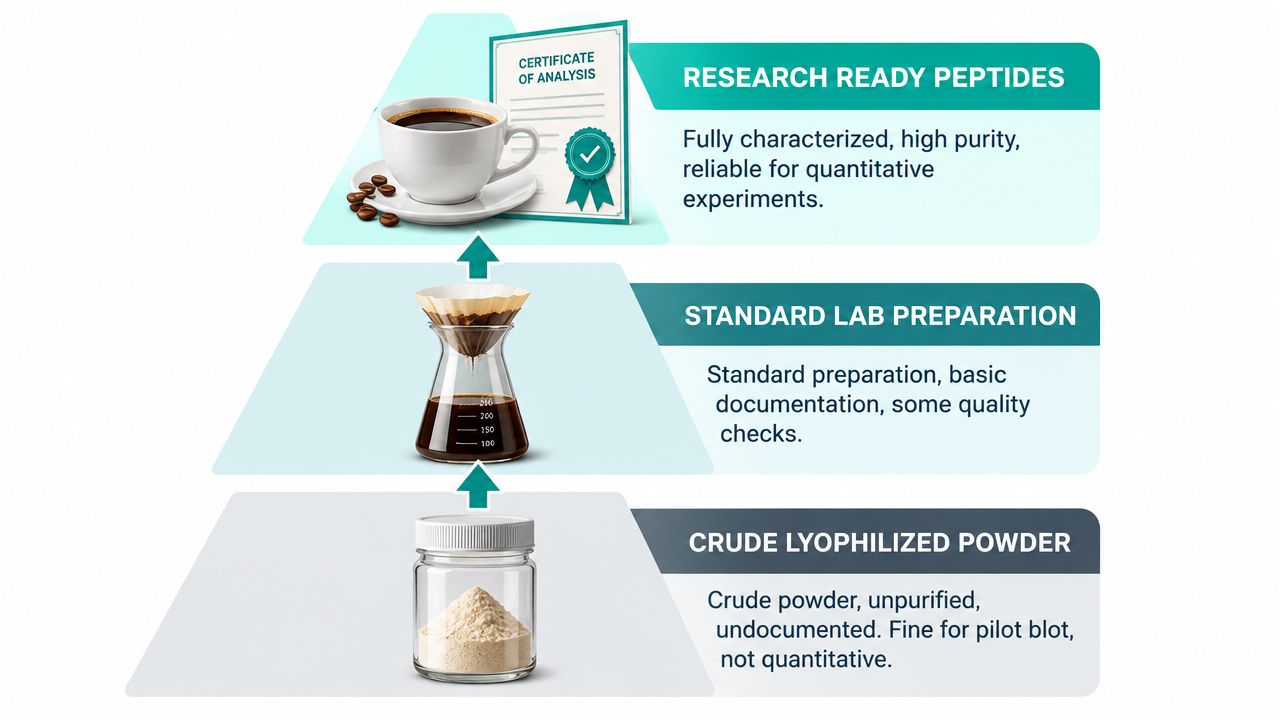
Crude material is unpurified or lightly characterized. It may have a place in exploratory work where the result is directional, but it isn't a sound choice for experiments that depend on accurate concentration or molecular selectivity.
Research-grade material has undergone purification and basic characterization. Industry guidance commonly describes research-grade peptides as starting at 95% purity, while higher-end quantitative work often targets 98–99% purity. The technical guidance on peptide analytical standards describes 99% or higher as ultra-high purity and identifies the 98–99% range as especially suitable for quantitative research, binding assays, and structural studies.
Research-ready material adds the evidence chain. At minimum, that means:
The label is only the starting claim. Your job as the buyer is to test whether the supporting signals are complete, consistent, and specific to the lot you'll use.
A product page that says 99% purity may be communicating a useful result, but the number needs interpretation. For synthetic research peptides, the standard purity assay is generally reverse-phase HPLC with ultraviolet detection near 214–220 nm, where peptide bonds absorb strongly. The reported value is usually the area of the main chromatographic peak divided by the integrated peak area used in the method.
That isn't the same as saying that 99% of the vial's mass is the intended peptide sequence. Chromatographic area purity can exclude or underrepresent substances that absorb differently, co-elute, remain associated with the product, or require another analytical technique to identify. The Bachem guide to peptide quality control explains the practical distinction between HPLC purity and mass-spectrometric identity confirmation.
HPLC answers a separation question: how much of the detected signal appears in the selected main peak? Mass spectrometry answers an identity question: does the detected molecular mass match the intended molecule?
Neither method replaces the other. Impurity peaks may represent deletion sequences, truncated products, oxidized variants, or residual synthesis reagents. Those species can confound binding, dose-response, and proteomics work even when the primary HPLC peak looks strong. A defensible record therefore includes the chromatogram, the integration approach, and an identity spectrum, not just the headline number.
| Analytical Method | What It Confirms | What It Misses | Minimum Acceptable Output |
|---|---|---|---|
| Reverse-phase HPLC with UV detection | Separation profile and chromatographic area purity | Some co-eluting species, non-chromophoric material, and the exact identity of peaks | Chromatogram, wavelength, column, method, and integration details |
| Mass spectrometry | Observed molecular mass against the expected sequence | Complete impurity quantification and every structural distinction | Lot-specific spectrum with expected and observed mass |
| Orthogonal identity testing | Additional support for sequence or composition | The full stability and contamination profile | Method description and result tied to the same lot |
| Sterility and endotoxin testing | Suitability for workflows where biological contamination matters | Sequence identity and chromatographic purity | Result, method, sample lot, and applicable limits |
A reviewer asking whether a peptide is pure should receive the analytical context, not a marketing shorthand. For a practical overview, compare the supplier's documentation with this peptide purity testing reference.
A supplier's internal certificate can be useful, but it doesn't provide the same independence as external verification. Third-party testing checks the material outside the supplier's own quality system and can cover identity, purity, sterility, endotoxins, and heavy metals. Guidance on why independent testing matters for research peptides notes that ISO 17025-accredited laboratories are often used for independent certificates of analysis.
The important point isn't the logo on the document. It's whether the document contains enough detail to connect the test result to the exact vial. A generic PDF attached to several product pages doesn't establish lot-level control.
Start with identity and purity, then assess the parameters that match the experimental risk. A credible COA should identify the issuing laboratory, testing date, lot number, methods, and results. For an in vivo program, sterility and endotoxin data belong in the purchase specification. Heavy-metal screening may also matter when synthesis, raw materials, or the application makes that risk relevant.
| COA Field | Why It Matters |
|---|---|
| Lot or batch number | Connects the document to the vial received |
| Issuing laboratory | Shows who performed or reviewed the testing |
| Accreditation information | Helps assess the laboratory's independence and quality framework |
| HPLC result and method | Defines how chromatographic purity was calculated |
| Column and detection details | Makes the purity result more reproducible and interpretable |
| Mass spectrometry result | Provides an orthogonal identity check |
| Testing date | Places the result in the lot's production timeline |
| Manufacture and retest information | Supports inventory decisions and later review |
| Sterility and endotoxin results | Helps determine suitability for in vivo workflows |
| Water, solvent, and metal data | Identifies non-peptide contributors to mass or biological risk |
An attached chromatogram matters because it lets the lab see whether the trace contains shoulders, secondary peaks, or a suspiciously broad main peak. A COA that only states “99%” is difficult to defend during an audit, especially if the vendor can't provide the underlying data.
This is why the third-party-tested peptide documentation guide is useful as a purchasing prompt. Use it to ask what was tested, which method was used, whether every batch receives the same review, and whether the result belongs to your lot.
A well-characterized peptide can still lose integrity after delivery. The handling chain begins when the courier arrives, not when the vial reaches the freezer.
Inspect the lyophilized cake for collapse, visible moisture, cracked seals, or unusual discoloration. Confirm that the stopper and vial appear intact, review any temperature indicator or shipping record, and match the lot number on the vial to the packing list and COA. If the shipment condition conflicts with the supplier's instructions, quarantine the material until the discrepancy is resolved.
Lyophilized peptides are generally most stable when kept dry, dark, and cold. Common guidance describes multi-year stability at −80°C, 1–3 years at −20°C, months to about a year at 2–8°C, and only weeks to months at room temperature for short transit or bench exposure, as summarized in this research peptide storage and handling guide. These are broad operating windows, not universal guarantees. Sequence, formulation, residual moisture, packaging, and exposure history can change the result.
Once the peptide is in solution, stability usually falls sharply and becomes highly sequence-dependent. Room-temperature aqueous solutions may be usable for only hours, while refrigerated solutions can last from days to a few weeks. The supplier's sequence-specific instructions should control the final decision.
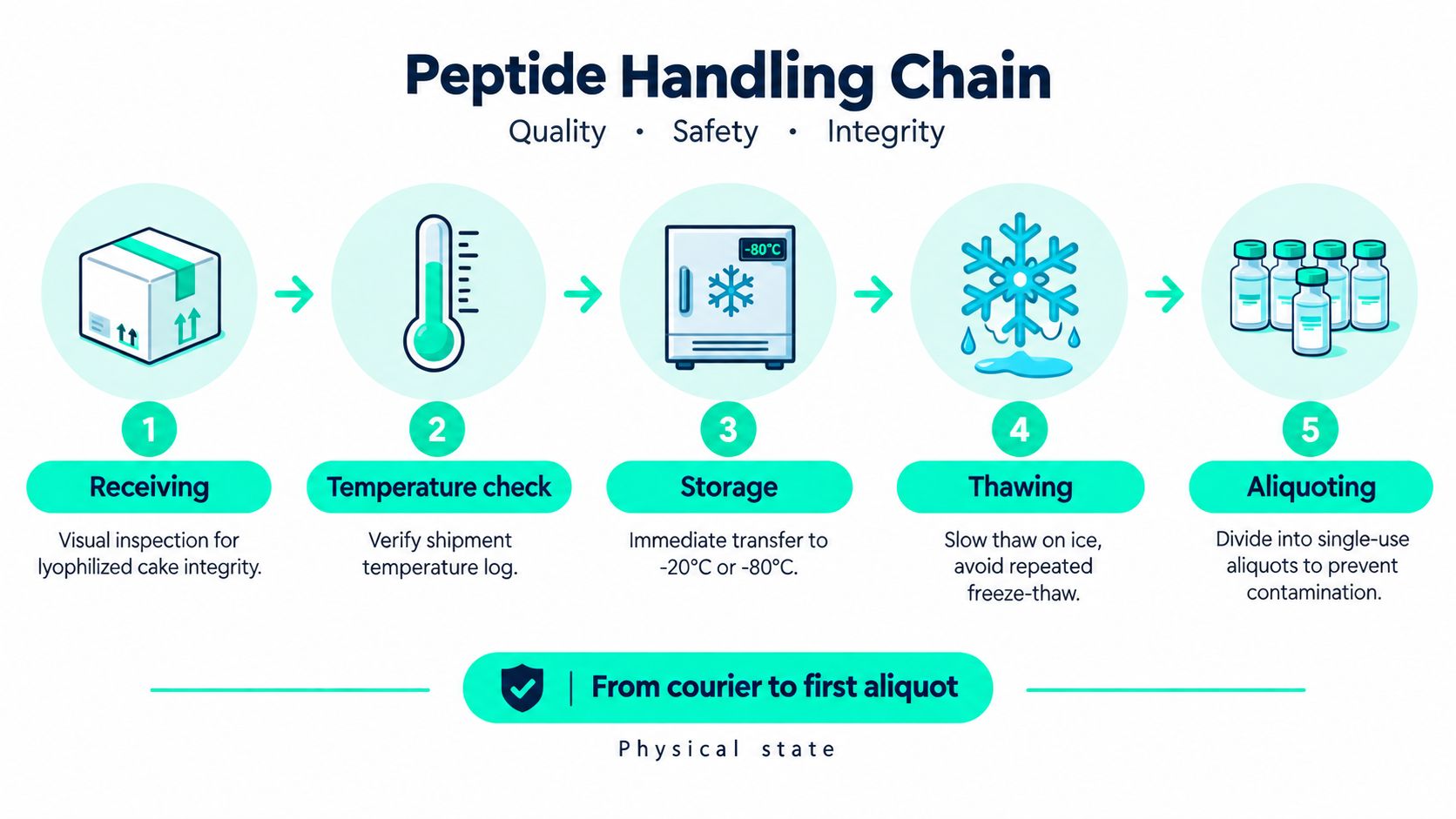
Choose DMSO or an aqueous buffer based on the peptide's solubility, the assay's solvent tolerance, and the vendor's preparation guidance. Add solvent carefully, allow the material to wet and dissolve gently, and avoid aggressive handling that can promote foaming or aggregation. Record the mass, solvent, final volume, concentration, operator, and preparation date.
Prepare aliquots that match actual experimental consumption. Small, single-use portions reduce repeated freeze-thaw exposure and limit contamination after the original vial is opened. Don't assume that a stable lyophilized cake will remain stable after reconstitution.
The peptide vial storage workflow is a useful bench reference. Tape a short version to the freezer door:
The handling demonstration below complements the receiving checklist.
Peptide selection should follow the biological question, not the popularity of a compound. A trend can identify an interesting research direction, but it doesn't establish that a sequence fits your model, survives your protocol, or has documentation strong enough for the intended use.
Industry coverage of research activity describes growing attention to GLP-1-class metabolic peptides and multi-receptor agonists, alongside tissue repair, antimicrobial peptides, mitochondrial longevity, and AI-assisted design. The same 2026 peptide industry report says over 180 peptide-related clinical trials were active globally, compared with about 120 in 2023. That expansion makes evidence quality and application fit more important, not less.
For metabolic and incretin-axis programs, including GLP-1 analogs and dual agonists, start with the receptor selectivity profile. A compound's label isn't enough if the assay depends on distinguishing activity at related receptors or comparing single- and multi-receptor mechanisms.
Tissue repair and regenerative models need a different screen. For sequences such as BPC-157 or thymosin fragments, examine stability against serum proteases and confirm that the proposed exposure window makes sense for the model. A peptide that disappears rapidly in the relevant matrix may be a poor choice even when its dry-state purity is strong.
Antimicrobial and host-defense work should prioritize the hemolysis index, along with activity across the organisms and media relevant to the experiment. Cationic antimicrobial peptides can show membrane effects that are useful in one assay and confounding in another.
Mitochondrial probes, including SS-31-class sequences, require attention to membrane potential dependence and cellular uptake conditions. AI-designed or stapled peptides need an especially careful review of predicted off-targets, conformational assumptions, and the analytical method used to verify the modified structure.
The procurement question is consistent across all five programs. Ask for identity data that matches the actual molecule, purity data generated by a stated method, and stability or handling information that fits the model. A compelling trend doesn't compensate for a weak COA.
Treat peptide buying as a repeatable quality workflow, not an email exchange followed by a purchase order. The process should produce records that procurement, the PI, the bench scientist, and the finance team can all understand.
Vendor evaluation comes first. Review manufacturing disclosures, quality certifications, synthesis and purification information, analytical platforms, and the supplier's ability to provide lot-level records. If a vendor won't explain whether its purity number comes from HPLC, don't treat that number as comparable to a fully documented chromatographic result.
Policy review protects the institution before money changes hands. Confirm research-use restrictions, import paperwork, institutional approvals, and any clauses that affect storage, transport, or downstream use. Ask the compliance or biosafety office early when the proposed work involves animal models, restricted materials, or external collaborators.
Order receipt creates the chain of custody. Log vial counts against the packing list, record lot numbers, inspect seals and physical condition, capture shipping-temperature information, and save the lot-specific COA in a searchable archive. Don't leave the document in an individual inbox.
Lot reconciliation is the final release decision. Compare the received label with the purchase order, check that the COA lot matches the vial, review HPLC and mass-spectrometry data, and record any reconstitution issue before the peptide enters an experimental queue.
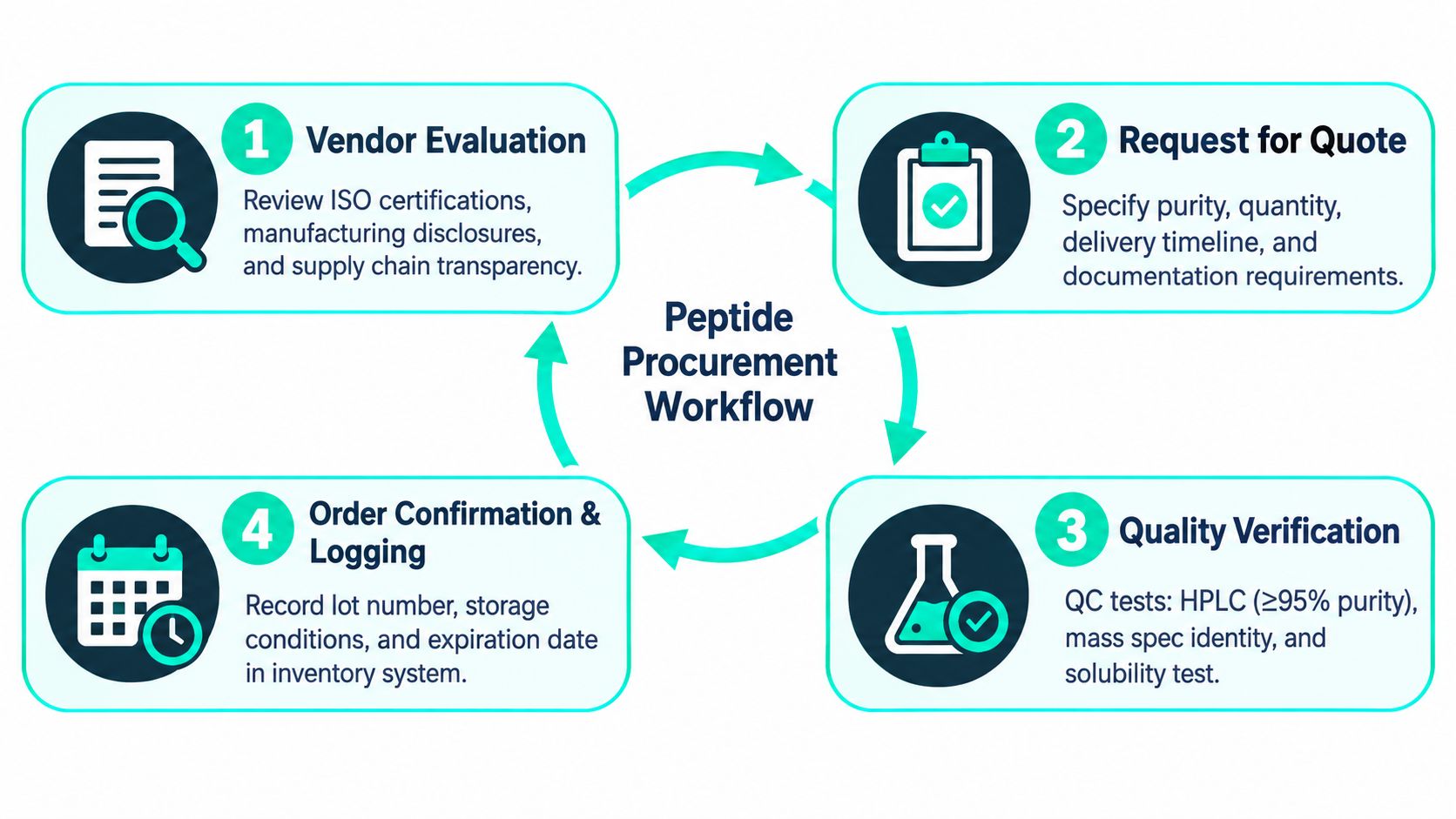
A procurement lead should specify the material and the evidence together. The request should state the intended use, required purity range, quantity, delivery conditions, acceptable storage format, and documentation package.
Use a scorecard that separates mandatory signals from preferences:
For inventory, record the lot, storage location, opening date, reconstitution details, aliquot identifiers, and disposition. This makes a failed experiment investigable instead of anecdotal.
A modern peptide program needs a release rule that a busy lab can apply without turning every order into a committee review. The rule is simple: no peptide moves from the receiving bench into an experiment unless four signals are present together.
This rule compresses a complex purchase decision into a practical receiving check. A technician can verify the lot, open the COA, inspect the chromatogram and identity result, compare the shipment record, and either release or quarantine the material. If any signal is missing, the experiment waits while procurement requests clarification.
The cheapest vial is the one that produces an interpretable result. A discount doesn't offset a failed assay when the lab can't determine whether the molecule, impurity profile, or handling history caused the problem.
Defensibility compounds over time. Each cleared lot strengthens the lab's records for a funding review, journal submission, client deliverable, or institutional audit. Each shortcut leaves a gap that becomes harder to explain after the result has already been generated.
The rule isn't aspirational. It's the minimum bar a modern peptide program should set before a reagent reaches the bench.
Celonyx Labs supplies research peptides through an online catalog and identifies product quality attributes such as stated purity and independent third-party testing. Review the available documentation, shipping information, and research-use policies, then contact Celonyx Labs to discuss the records your lab requires before placing its next order.
The postdoc opens the freezer, retrieves a peptide vial, and runs the planned assay. The

A peptide calculator to lab notebook workflow logs research calculations once. Follow 2026 steps for

Build a par-level sheet and calendar trigger to automatically reorder research peptides before your freezer
FOR RESEARCH USE ONLY. Products sold by Celonyx Labs are intended exclusively for laboratory and scientific research. They are not intended for human or veterinary use, consumption, diagnosis, treatment, cure, or prevention of any disease. By purchasing from this site, you acknowledge that you understand the intended research purpose of these materials and agree to comply with all applicable laws and regulations.