
What Are Procurement Documents and Why They Matter
Nearly 100 million federal contract actions and more than 72 million public contracts now sit
Nearly 100 million federal contract actions and more than 72 million public contracts now sit in large procurement data systems, but procurement documents themselves are the formal records that define what a buyer needs, how suppliers must respond, and what terms govern a purchase. They typically include requisitions, RFQs, RFPs, purchase orders, contracts, delivery notes, invoices, and payment records.
You may be holding a company purchasing card, managing a laboratory budget, or trying to order a critical reagent before an experiment starts. The supplier asks for a purchase order, finance asks for an approved request, and receiving asks whether the delivered material matches what someone ordered. Each person is looking at a different point in the same evidence trail.
That trail matters when a price is challenged, a shipment arrives incomplete, a supplier disputes the agreed scope, or an auditor asks who approved the purchase. Procurement documents aren't just forms to file after the fact. They connect the buyer's need, the supplier's promise, the delivery, and the payment into one controlled workflow.
Procurement documents are the formal records that capture buying intent, supplier commitments, and delivery evidence across a purchasing cycle. They show what the organization requested, which supplier was selected, what terms were accepted, what arrived, and why finance released payment. Construction and infrastructure standards describe procurement documentation as records used to initiate or conclude a contract or issue an order, while ISO 10845-2:2020 established a structured format for construction procurement documentation. The procurement documentation standard shows why the term means a controlled document set, not one purchase form.
Suppose you manage a lab and need a custom peptide for an upcoming study. You submit a purchase requisition describing the material, quantity, budget, required specifications, and business or research purpose. Before anything ships, that request establishes who wants the item and whether the purchase follows internal approval rules.
After sourcing, the team may retain supplier quotes, an evaluation record, a purchase order, and a contract or statement of work. When the package arrives, a delivery note or goods received note records what the lab accepted. The supplier's invoice and the final payment record complete the transaction.
Practical rule: If a document helps prove what was requested, approved, promised, received, or paid, it belongs in the procurement record.
The exact set changes with the purchasing method, the value and complexity of the order, and the rules governing the buyer. The important point is the connection between documents. A requisition without a PO leaves authorization unclear. An invoice without delivery evidence leaves receipt unconfirmed. A PO without the supplier's quote can make the agreed price difficult to defend.
A purchase usually starts with an internal request and ends with payment evidence. The documents in between answer different questions, so combining them into one generic file can make an audit trail harder to follow.
A purchase requisition is the buyer's internal request for approval. A lab manager might use it to request a peptide, describe its required purity or formulation, identify the cost center, and explain the experiment it supports.
An RFQ, or request for quotation, suits a standardized requirement where suppliers can price the same defined item or service. For example, a lab might request prices for a specified quantity of routine consumables with known delivery terms.
An RFP, or request for proposal, fits a more complex or customized requirement. A custom assay, equipment installation, or outsourced research service may require suppliers to explain their technical approach, timeline, staffing, and commercial terms. Teams comparing complex bids may also use specialized tools. For readers evaluating what is bid writing software, the relevant question is whether the tool helps suppliers organize compliant responses to structured buyer requirements.
A purchase order states what the buyer is ordering, including item descriptions, quantities, prices, and delivery timing. A contract or statement of work adds legally governed obligations, scope, milestones, acceptance criteria, confidentiality terms, or service conditions when the purchase needs more than a simple order.
A delivery note or goods received note records what the supplier delivered and what the buyer accepted. The receiving team should compare it with the PO, checking identifiers, quantities, packaging, and visible condition.
The invoice asks for payment and should be checked against the order and receipt. The payment record confirms that finance processed and reconciled the payment. Together, these post-purchase documents show that the buyer didn't pay merely because an invoice arrived.
| Document | Purpose | Issued By | Stage in Cycle |
|---|---|---|---|
| Purchase requisition | Defines the internal need and requests approval | Buyer or requesting department | Planning |
| RFQ | Requests comparable pricing for a defined requirement | Buyer or procurement team | Sourcing |
| RFP | Requests a detailed solution and commercial proposal | Buyer or procurement team | Sourcing |
| Purchase order | Authorizes and records the order details | Buyer | Commitment |
| Contract or statement of work | Establishes obligations, scope, and terms | Buyer and supplier | Commitment |
| Delivery note or goods received note | Records delivery and acceptance | Supplier and receiving team | Fulfillment |
| Invoice | Requests payment for supplied goods or services | Supplier | Payment |
| Payment record | Confirms settlement and reconciliation | Finance or accounts payable | Closeout |
Treat the documents as a chain of controls rather than a stack of attachments. The RFQ or RFP controls how the buyer defines and compares offers. The PO controls what the buyer authorizes. The contract controls the broader obligations. The goods received note controls acceptance. The invoice controls the payment request.
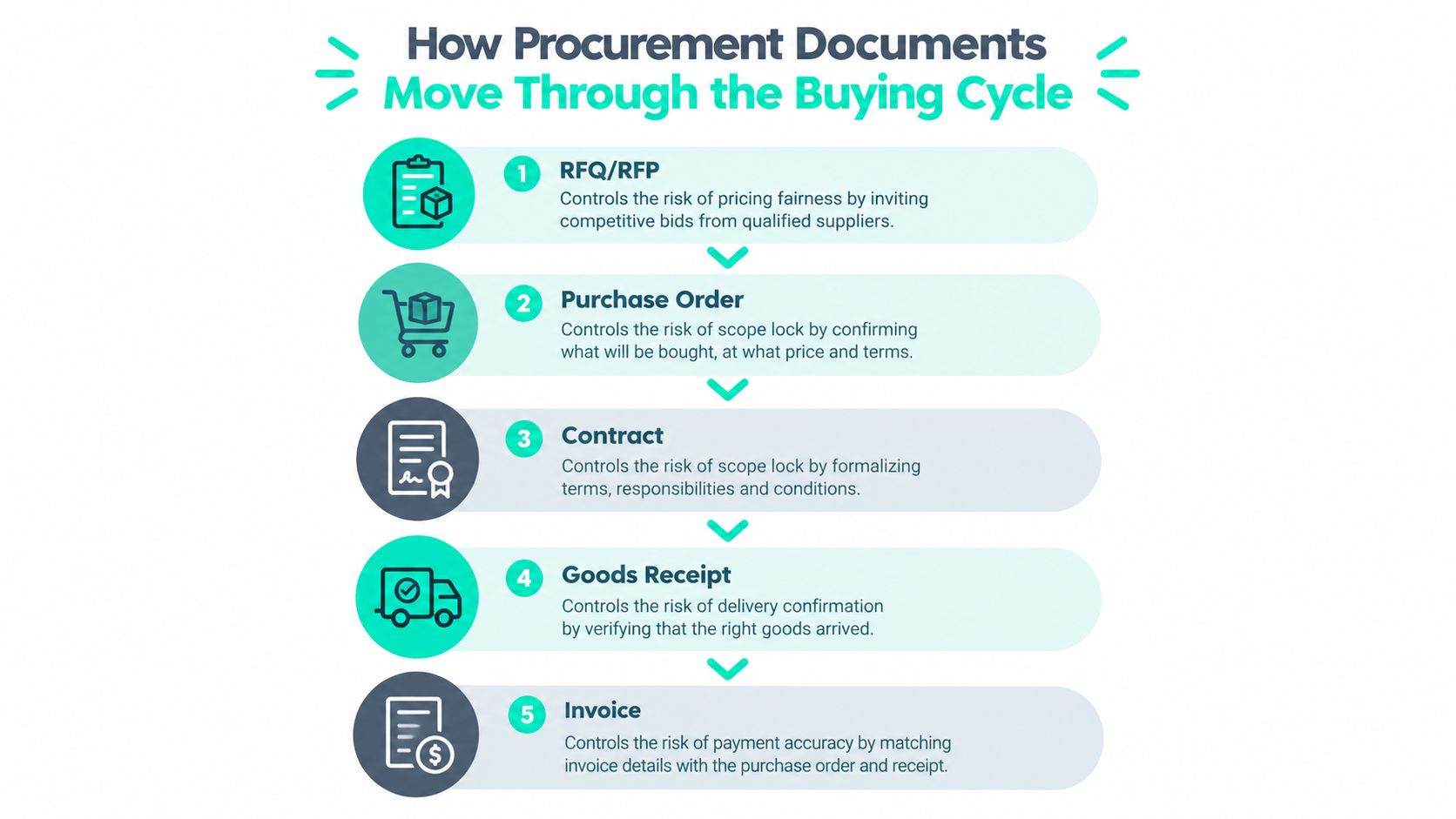
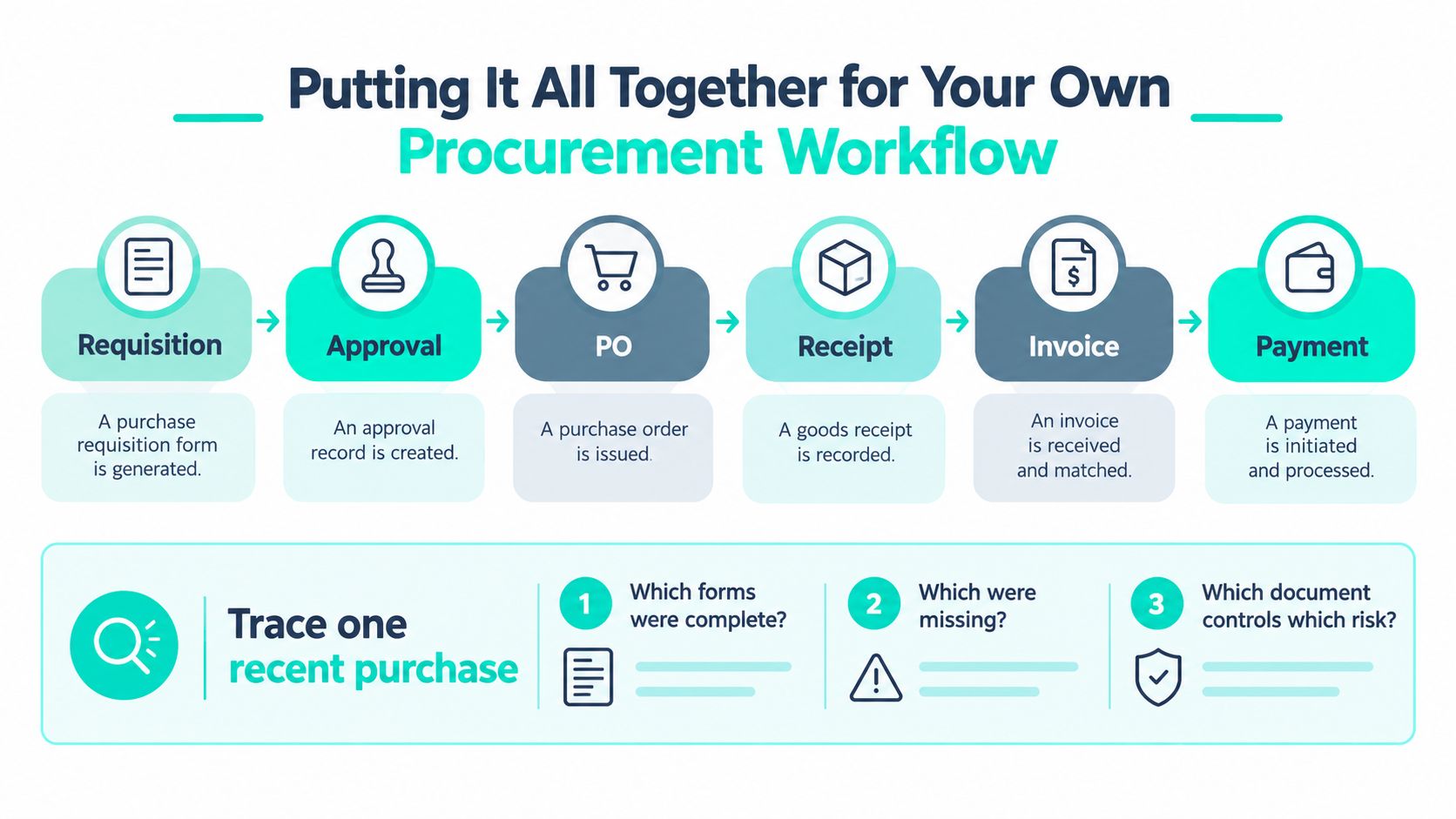
A typical sequence looks like this:
This sequence is often described as a purchase-to-pay process. Teams exploring automating the P2P cycle should preserve these control points rather than moving paper into a digital queue.
A lab may also connect the PO to a third-party testing explanation when quality documentation affects acceptance. The procurement record should make the relationship visible without forcing a reviewer to search through unrelated email threads.
You can think of each handoff as an answer to a specific question: Was the need authorized? Was the supplier response evaluated? Did the buyer commit to clear terms? Did the goods arrive? Does the invoice match the commitment and receipt?
When one handoff is missing, the risk becomes harder to isolate. A disagreement about price may reflect an unclear quote or an amended PO. A delivery dispute may reflect an unsigned receipt. An invoice error may survive because no one retained the final order version. The gaps are where disputes, unauthorized spending, and audit findings tend to concentrate.
The document set should match the risk of the purchase. A direct purchase of a routine item doesn't need the same evidence as a public tender or a procurement funded under multilateral rules.
For a simple direct purchase, the core file may contain an approved requisition, supplier quote or order confirmation, PO if the organization uses one, delivery evidence, invoice, and payment record. The buyer needs to show authorization, commercial terms, receipt, and settlement.
A public tender adds formal competition and procedural evidence. The file may include a general or specific notice, tender dossier, technical specifications, bidder questions, addenda, bid securities where required, evaluation reports, award documentation, a contract award notice, and a signed contract or framework agreement. These documents help demonstrate that bidders received the same requirements and that the award followed the stated process.
Multilateral procurement can add its own mandatory forms and notices. The World Bank's beginner's guide to investment project financing procurement identifies documents such as a Procurement Plan, Standard Procurement Documents, General Procurement Notice, Specific Procurement Notice, expressions of interest, prequalification materials, requests for bids, requests for proposals, contract forms, and addenda.
| Document | Direct Purchase | Public Tender | Multilateral, such as World Bank |
|---|---|---|---|
| Requisition or procurement plan | Requisition | Requisition and procurement planning records | Procurement Plan and requisition records |
| RFQ, RFP, or bid request | Often a quote request | Formal tender or bid request | Standard request documents and prescribed notices |
| Evaluation record | Simple comparison or approval | Formal evaluation report | Evaluation under applicable funding rules |
| Contract or framework agreement | Sometimes | Commonly required | Standard contract forms may apply |
| Addenda and clarifications | Occasional | Controlled and retained | Controlled under the applicable procedure |
| Delivery note and invoice | Core closeout records | Core closeout records | Core closeout records plus required reporting |
| Payment evidence | Finance record | Finance and contract record | Finance, contract, and funding record |
The PO, contract, delivery note, invoice, and payment record can appear in all three methods. What changes is the amount of planning, competition, evaluation, disclosure, and approval evidence wrapped around them.
A peptide order illustrates why laboratory procurement needs more than a commercial transaction record. The PO may identify the product and quantity, but the research team also needs evidence that the material received is the material evaluated for the experiment.
Start with the standard purchasing trail. The lab manager creates a requisition, obtains approval, selects a supplier, retains the quote or order confirmation, and issues or records the PO. The supplier then sends the material with an invoice and delivery documentation.
Now attach the scientific evidence to that same transaction:
These files shouldn't sit in separate folders with unrelated names. Link each document to the PO number, supplier, product identifier, lot number, and invoice. If the supplier sends a replacement lot, retain the original record and clearly document the change instead of overwriting the earlier file.
In a research environment, the procurement file can become part of the scientific evidence package.
A missing CoA may make it difficult to establish which quality information applied to the material used in an experiment. A lot number that doesn't match the receiving record can create uncertainty about traceability. Those problems don't automatically prove that research results are invalid, but they can weaken the team's ability to defend the work during an audit, investigation, or peer review.
A lab manager who has just received a purchasing card should also document supplier checks, approvals, delivery condition, storage requirements, and any substitution. The vendor qualification process can serve as a reference point for organizing supplier information alongside the transaction record.
Use fixed file names, consistent metadata, and controlled access. A practical name might identify the date, document type, supplier, PO, and lot. That discipline turns a folder of PDFs into a traceable record that another researcher or auditor can understand without relying on personal memory.
Procurement records have become inputs to large data systems, not isolated paper files. The European Union's Public Procurement Data Space is designed to make data accessible, reusable, and interoperable across tenders, contracts, suppliers, and procurement performance.
The scale is visible in the datasets themselves. Researchers have compiled nearly 100 million federal contract actions spanning 1979 to 2023, and a separate global dataset contains more than 72 million public contracts from 42 countries between 2006 and 2021, as described in the verified procurement data overview. The Open Contracting Partnership data also indicate that more than 100 publishers worldwide have released procurement datasets in OCDS format, including JSON, Excel, and CSV downloads.
Those records are useful because machines can search and connect them. A digital PO can link to an approval, supplier, receipt, invoice, and payment. A procurement team can then investigate a missing document, compare supplier activity, or review a transaction without opening boxes of paper or asking one employee to reconstruct the history.
Digital storage helps with more than convenience. It can preserve document versions, record who accessed or approved a file, enforce role-based permissions, and connect procurement activity to finance systems. It can also make repeated patterns easier to review, such as purchases split across transactions or invoices that don't align with the approved order.
That doesn't mean scanning paper automatically creates good control. A badly named PDF in a shared drive is still difficult to govern. The useful digital record keeps the relationships between documents visible and preserves the approval history, amendments, attachments, and final status.
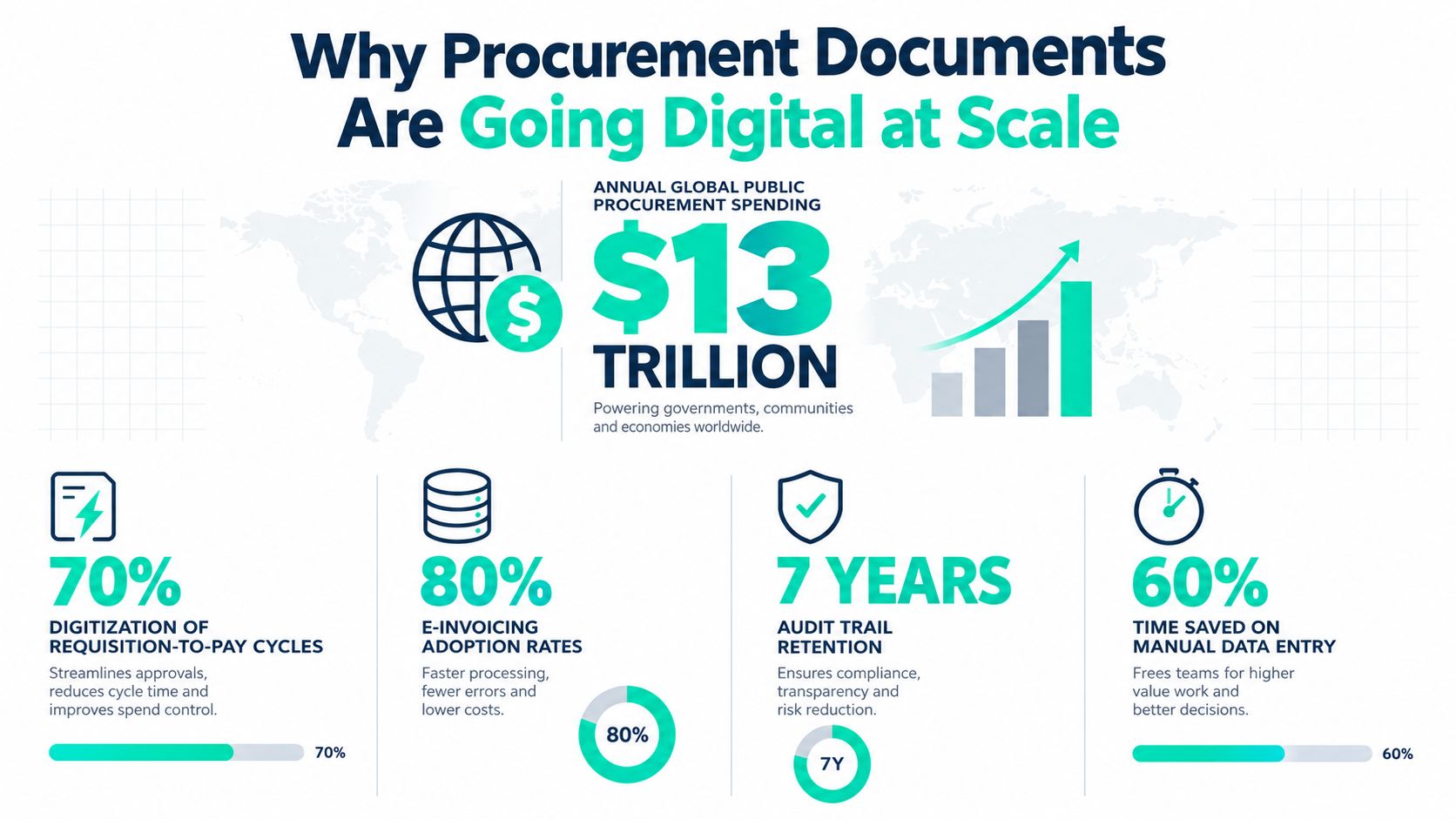
For a lab or small organization, the practical starting point is modest. Centralize procurement files, make the PO or contract number the common reference, attach quality and delivery evidence to the transaction, and prevent users from replacing the approved version with an untracked draft. The paper may disappear, but the control requirements remain.
A procurement file should remain understandable after the original buyer leaves the organization. Store it as long-lived evidence, not as a temporary collection of forms needed only until the invoice clears.
Use the PO number, contract number, or another stable transaction identifier as the organizing key. Keep the requisition, quote, evaluation, PO, contract, amendments, delivery note, quality records, invoice, and payment evidence together or logically linked.
A fixed naming pattern removes guesswork. For example:
YYYY-MM-DD_DocType_Vendor_PO123.pdf
The exact pattern matters less than consistent use. Apply it to CoAs, invoices, signed contracts, receiving records, and amendments. Include the lot number where it supports laboratory traceability, but don't make file names so long that staff stop using the convention.
The COA-to-compliance documentation workflow is a useful model for linking laboratory quality records to a broader compliance file rather than treating each certificate as a detached attachment.
Don't let a supplier's revised quote overwrite the quote used in the evaluation. Don't replace an original delivery note after a discrepancy is found. Add a correction note, retain the earlier version, and identify the person and date associated with the change.
Contracts and amendments deserve particular care. Keep the signed agreement, exhibits, statements of work, renewal notices, and change orders connected. A reviewer should be able to determine which terms governed the purchase at the time the supplier delivered the goods or performed the service.
Storage principle: A record is useful only if the right person can find the right version and understand its relationship to the rest of the transaction.
Start with one completed purchase, not with a large software project. Choose a recent lab order and trace it from the first requisition through approval, supplier selection, PO, delivery, invoice, and payment. Add the supporting quality records if the purchase involved research materials.
Create three columns as you review it:
This exercise usually reveals where the workflow breaks. One team may approve requisitions promptly but lose delivery notes. Another may retain invoices but fail to preserve the quote or final PO. A lab may have CoAs in a quality folder but no link to the lot used in the experiment.
Standardize the templates first. Give staff one requisition form, one RFQ or RFP structure where appropriate, one PO format, and one receiving checklist. Make required fields clear, including supplier, item, quantity, price, delivery requirements, owner, approval, and transaction reference.
Then route approvals consistently. A requisition should not move to ordering while its required approval is missing. A receiving record should identify the PO and note discrepancies. Finance should have enough information to review the invoice against the order and receipt.
After the basics work, add automation and reporting. A procurement platform can route requests, attach documents, preserve versions, and notify owners. A shared repository can work for a smaller team if it has clear permissions, naming rules, backup, and ownership. The tool matters less than preserving the chain.
Create a reference sheet with four fields for every document type:
| Document | Owner | Location | Retention rule |
|---|---|---|---|
| Requisition | Requesting department | Procurement repository | Applicable finance, grant, or policy rule |
| Quote, RFQ, or RFP | Procurement or buyer | Sourcing record | Applicable procurement rule |
| PO and contract | Procurement and legal or authorized signer | Contract record | Applicable contractual and regulatory rule |
| Delivery or goods received note | Receiving team | Transaction record | Applicable finance or quality rule |
| Invoice and payment record | Finance | Accounting and procurement record | Applicable finance and tax rule |
| CoA, SDS, and lot record | Laboratory or quality owner | Linked quality record | Applicable study, quality, and regulatory rule |
Review the workflow on a recurring schedule. Confirm that templates still match current policy, former employees no longer have unnecessary access, amendments are versioned, and laboratory quality files remain connected to the correct purchase. When staff change roles, make the handoff part of the process rather than an informal conversation.
The central idea is simple: requisitions control unauthorized need, quotes and bids control supplier comparison, POs control commercial commitment, contracts control obligations, receiving records control acceptance, invoices control payment requests, and payment records close the loop. Once those relationships are visible, procurement documents stop looking like administrative clutter and start functioning as a practical risk-control system.
If your laboratory needs research peptides with order records, downloadable invoices, and lot-specific certificates of analysis that can be attached to a procurement file, visit Celonyx Labs to review the catalog and purchasing information. Use the product and order details as part of the same traceable workflow from requisition through quality verification and payment.
Nearly 100 million federal contract actions and more than 72 million public contracts now sit

How long does it take for lyophilized peptides to dissolve? No fixed time applies. Learn

Is tirzepatide legal to buy for research use? Genuine lab purchases can be lawful. Learn
FOR RESEARCH USE ONLY. Products sold by Celonyx Labs are intended exclusively for laboratory and scientific research. They are not intended for human or veterinary use, consumption, diagnosis, treatment, cure, or prevention of any disease. By purchasing from this site, you acknowledge that you understand the intended research purpose of these materials and agree to comply with all applicable laws and regulations.