
What Are Procurement Documents and Why They Matter
Nearly 100 million federal contract actions and more than 72 million public contracts now sit
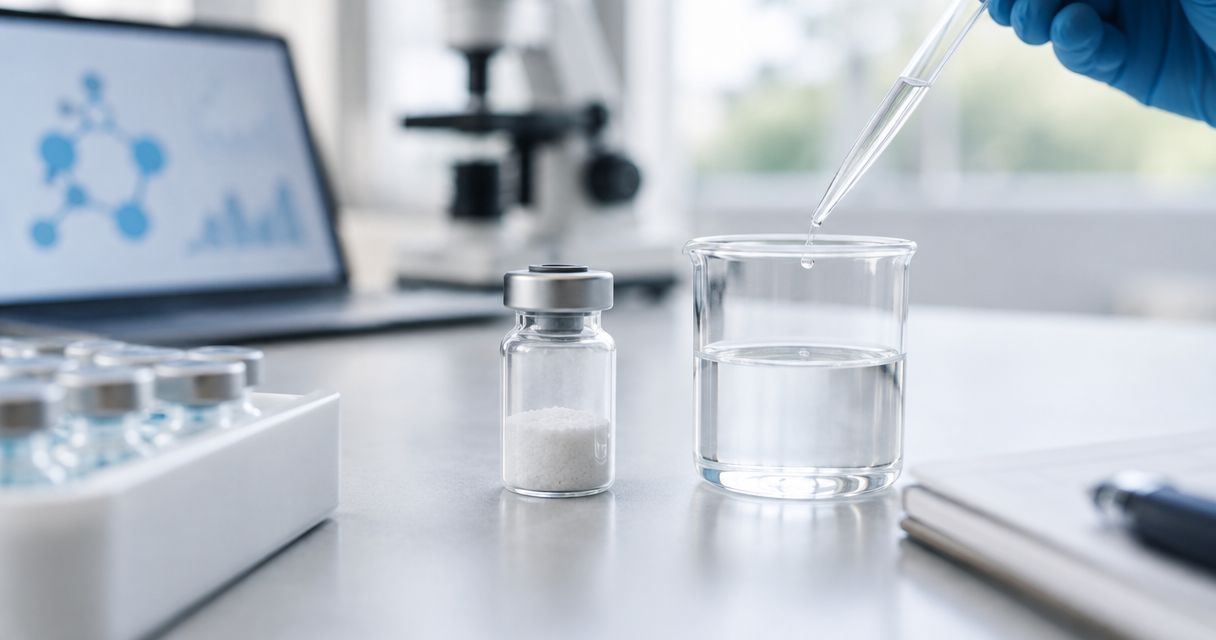
Lyophilized peptides do not have a universal dissolution time: the endpoint depends on the peptide, solvent, concentration, and reconstitution conditions. Use the peptide-specific protocol rather than a fixed waiting period, and confirm that no visible solid remains before treating the preparation as dissolved. A clear solution alone does not establish peptide identity, purity, stability, or suitability for your assay.
There is no defensible single time limit for all lyophilized peptides. Freeze-drying describes how the material was prepared; it does not guarantee that every peptide dissolves at the same rate or in the same solvent.
For your 2026 laboratory protocol, define completion by an observable endpoint and any required analytical checks. Do not define it solely by elapsed time. A vial that still contains particles has not met a visual dissolution endpoint, even if your usual waiting period has passed.
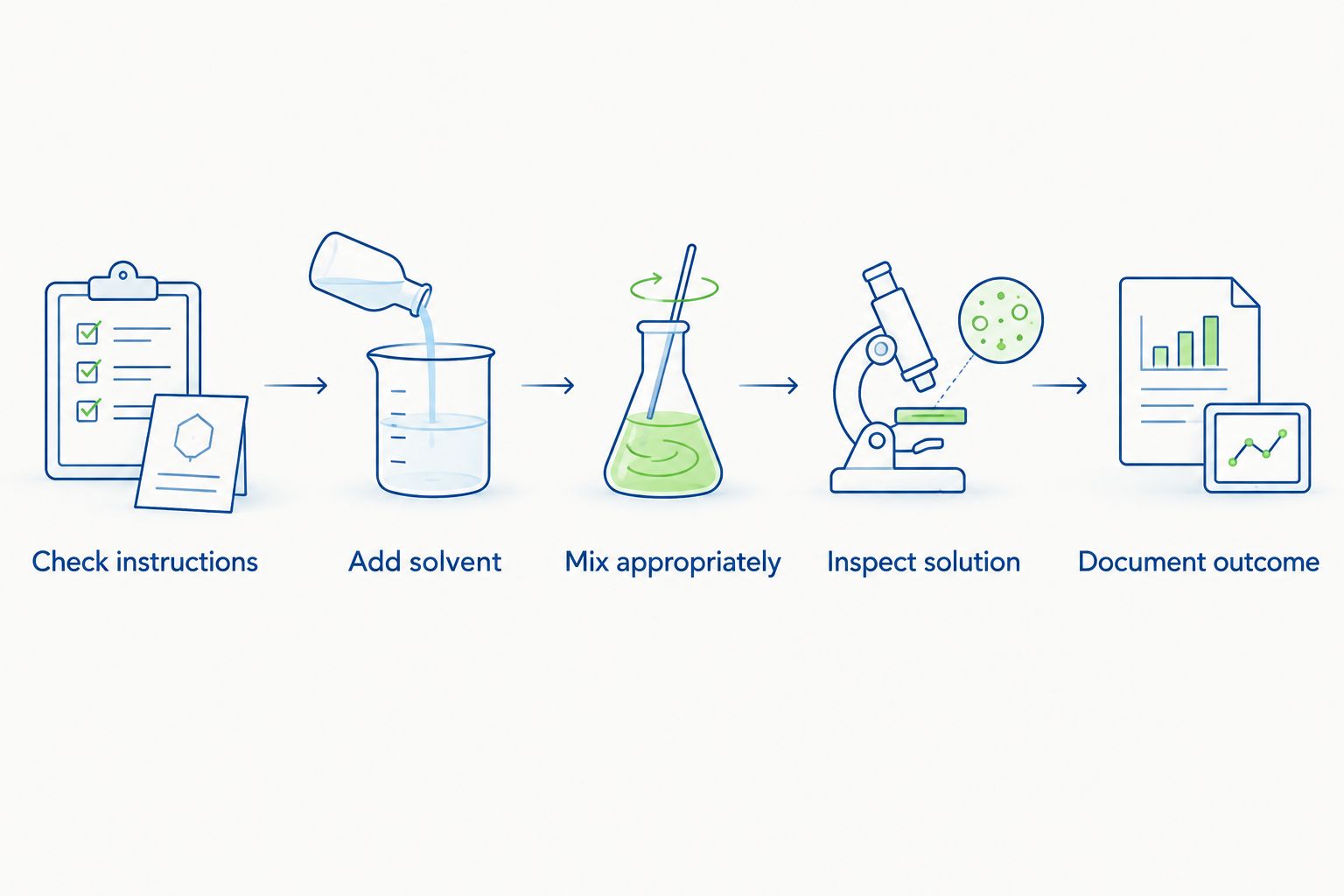
Use this sequence when assessing a preparation:
For workflow planning, the peptide reconstitution guide for biotech startup labs addresses the broader preparation process. Keep the dissolution check separate from concentration calculations and subsequent storage decisions.
A useful endpoint is reproducible under the same conditions. If a protocol requires analytical confirmation, visual inspection is only an intermediate check—not permission to skip that confirmation.
Incomplete dissolution creates uncertainty about what actually enters your experiment. Calculating concentration from the starting mass and solvent volume assumes that the relevant material has dissolved. Visible solids break that assumption.
This matters when comparing experimental runs. If one preparation contains undissolved material and another does not, the nominal concentrations can match while the preparations differ. More waiting does not automatically resolve that difference.
Your 2026 reconstitution procedure should distinguish three questions: has the material dissolved, is the resulting solution chemically suitable, and is it appropriate for the intended assay? Those questions require different evidence. A clear vial answers only the visual part of the first question.
Research peptides are for research use only. This guide concerns laboratory preparation, not human or animal administration, clinical dosing, or self-treatment.
The same waiting period cannot serve as a universal acceptance criterion because dissolution depends on the material and its environment. Evaluate these factors before changing a procedure:
These factors interact. For example, changing solvent volume changes concentration, while changing a buffer can alter both pH and assay composition. Treat each adjustment as a documented method change rather than an informal way to make the vial look clear.
Use the solvent specified for the peptide and experiment—not the solvent that happens to be on the bench. Bacteriostatic water is not a universal peptide solvent, and the presence of a preservative does not establish compatibility with your research system.
The following comparison describes solvent approaches, not interchangeable recommendations. Each has a legitimate laboratory role and a limitation that matters when troubleshooting dissolution.
| Solvent approach | Best for | Advantage | Limitation |
|---|---|---|---|
| Aqueous solvent | Peptides documented as soluble under the selected aqueous conditions | Avoids introducing an organic solvent | Does not resolve every hydrophobicity or pH-related solubility problem |
| Buffered aqueous solvent | Methods requiring controlled pH and compatible buffer chemistry | Provides a defined pH environment | Buffer components can affect downstream measurements or peptide behavior |
| Organic-containing solvent | Peptides with documented requirements for an organic component | Supports solubility for some poorly water-soluble sequences | Requires compatibility checks for the peptide, assay, and final solvent composition |
Choose between these approaches using the peptide's instructions and your laboratory's validated method. Do not infer the correct solvent from the appearance of the dry cake, the vial size, or another peptide's successful preparation.
If you change the solvent system, reassess the entire preparation. A solution that becomes clear after an adjustment is not automatically equivalent to the preparation specified in the original method.
A reliable check combines controlled preparation, observation, and documentation. In a 2026 laboratory workflow, the objective is a repeatable acceptance decision—not simply getting the dry material out of sight.
Read the peptide-specific preparation information before opening the vial. Confirm the intended solvent, concentration, and any restrictions on mixing or temperature. Resolve conflicting instructions before adding liquid.
Keep the product identity and lot information connected to the preparation record. Instructions for a different sequence or formulation are not a substitute, even when the vials look alike.
Measure the solvent volume using equipment appropriate to your laboratory method. Record the actual volume rather than relying on an estimate from vial markings or the apparent liquid level.
Distinguish material that has become wet from material that has dissolved. A wetted cake can break apart into suspended particles without producing a homogeneous solution.
Use the mixing method specified by the protocol. Do not escalate automatically to vigorous agitation, sonication, or heating when the first inspection shows remaining solid.
Those interventions change preparation conditions. If the method authorizes them, document their use; if it does not, investigate the solvent and concentration before improvising.
Examine the vial under consistent lighting and against a suitable contrasting background. Check the bottom, walls, and liquid for visible particles or persistent haze. Allow bubbles to resolve before deciding whether apparent cloudiness is suspended material.
Visual inspection has limits. It does not detect every aggregate, establish chemical integrity, or replace an analytical method required by your protocol.
Record the solvent, volume, mixing conditions, elapsed time, and final appearance. Include any deviation from the original method. If the preparation does not meet the acceptance criteria, mark it as unresolved rather than treating additional waiting as approval.
The record should let another researcher distinguish a successful repeat from an altered procedure. A note that says only that the vial looked fine does not capture the conditions that produced it.
Stop treating persistent solid as a timing problem until you have checked the preparation conditions. Confirm that the peptide identity, solvent, and intended concentration match the method. Then review whether the observed material is an intact cake, suspended particles, or precipitate that appeared after initial dissolution.
Those observations guide the investigation, but they do not establish a diagnosis. A dry cake that remains visible and a solution that turns cloudy later represent different preparation histories; record that difference rather than labeling both simply undissolved.
Use a controlled troubleshooting order:
Do not repeatedly add solvent without accounting for the resulting dilution. Do not remove visible particles and continue as though the original concentration remains established. Both actions change what you can claim about the preparation.
If the material remains unresolved, keep it out of the experiment until your laboratory determines an acceptable next step. That decision protects interpretability; it is not a judgment about the supplier based on appearance alone.
Purity and dissolution speed describe different properties. A purity result does not establish solubility in every solvent, and a rapidly clearing vial does not prove that the peptide is pure.
Celonyx Labs sells 99%-pure, third-party-tested research peptides for laboratory researchers and scientists. Those stated quality signals support sourcing review, but they do not supply a universal reconstitution time or replace peptide-specific preparation instructions.
For 2026 purchasing and preparation records, keep the supplier's quality documentation separate from the laboratory's dissolution observations. The peptide purity testing guide for contract research organizations provides a related documentation topic.
When evaluating Celonyx Labs research peptides, assess both the stated testing information and the requirements of your method. The benefit is a defined research-focused offering with stated purity and third-party testing; the limitation is that those claims alone do not establish assay compatibility, sterility, or a dissolution deadline.
A clear peptide solution has passed a visual check for obvious undissolved material, not every assay-readiness check. Confirm the preparation conditions, calculated concentration, solvent compatibility, and any analytical acceptance criteria required by your method.
Readiness depends on the experiment. A solvent suitable for preparing a stock solution can still require dilution or additional compatibility assessment before it enters the assay.
Leaving a peptide overnight does not guarantee dissolution. Waiting does not correct an unsuitable solvent or a concentration above the peptide's solubility under those conditions.
An extended hold also becomes part of the handling history. Use the protocol's permitted conditions and document the interval rather than assuming that longer is always better.
Adding more solvent changes the concentration and is appropriate only when the revised preparation fits the approved method. It is not a universal remedy for persistent particles.
If a documented troubleshooting procedure permits dilution, record the final volume and recalculate concentration. Do not retain the original concentration label after changing the preparation.
How long does it take for lyophilized peptides to dissolve?
Lyophilized peptides have no universal dissolution time. Follow peptide-specific solvent, concentration, and handling instructions, then assess the required dissolution endpoint rather than relying on a fixed wait.
Is it normal for a peptide cake to remain after adding solvent?
A visible cake after solvent addition means the material has not yet met a visual dissolution endpoint. Check the specified mixing conditions, solvent, and concentration before changing the procedure.
Can I shake a peptide vial to make it dissolve faster?
Use shaking only when the peptide-specific protocol permits it. Do not substitute vigorous agitation for the documented mixing method merely because particles remain.
Is bacteriostatic water the best solvent for every peptide?
Bacteriostatic water is not the best solvent for every peptide. Select the solvent using peptide-specific solubility requirements and compatibility with the research assay.
Does a clear peptide solution prove that it is sterile?
A clear peptide solution does not prove sterility. Visual appearance cannot replace the testing or preparation controls required by your laboratory method.
Do Celonyx Labs purity claims establish a dissolution time?
Celonyx Labs’ stated purity and third-party testing do not establish a dissolution time. Purity documentation and peptide-specific reconstitution requirements address different questions.
What should I record when reconstituting a research peptide?
Record peptide identity, lot information, solvent, measured volume, mixing conditions, elapsed time, and final appearance. Include method deviations and the acceptance decision so the preparation can be assessed and repeated.
The useful timing measurement is the time to a defined endpoint under recorded conditions. A stopwatch result without the solvent, concentration, and acceptance criteria is not a transferable reconstitution instruction.
For your next 2026 SOP review, replace an unsupported instruction to wait a fixed period with a documented inspection step and a clear response to persistent solid. Keep any validated timing requirement, but do not let it substitute for checking the preparation. All peptides discussed here are for research use only.
Nearly 100 million federal contract actions and more than 72 million public contracts now sit
How long does it take for lyophilized peptides to dissolve? No fixed time applies. Learn

Is tirzepatide legal to buy for research use? Genuine lab purchases can be lawful. Learn
FOR RESEARCH USE ONLY. Products sold by Celonyx Labs are intended exclusively for laboratory and scientific research. They are not intended for human or veterinary use, consumption, diagnosis, treatment, cure, or prevention of any disease. By purchasing from this site, you acknowledge that you understand the intended research purpose of these materials and agree to comply with all applicable laws and regulations.