

6 Acetic Acid: What It Means and Where It Fits in Research
What does “6 acetic acid” tell you about the bottle on your bench? Not much,
PBS is a water-based salt solution of NaCl, KCl, Na2HPO4, and KH2PO4, adjusted to about pH 7.4, that mimics the ion concentrations and osmolarity of the human body. In practice, that makes it the bottle people reach for when cells need to be washed, samples need to be diluted, or tissues need to be moved without upsetting them.
You're probably staring at a bench note, a protocol, or a rack of unlabeled bottles right now and trying to work out which one is safe for the next step. PBS looks simple, but the difference between the right buffer and the wrong one shows up later as weak signal, drifting pH, or cells that don't behave the way they should. For that reason, it's worth understanding PBS as a working tool, not just a recipe.
A researcher pulls a bottle of PBS from the fridge, rinses a cell layer, and gets back to work. That move looks routine, but it is doing a lot of quiet labor. PBS is gentle enough for cells, yet predictable enough that different people in different labs can use it and still get comparable handling conditions, which is why it shows up in cell culture, histology, biochemistry, and molecular biology workflows.
PBS is not a specialty reagent for one narrow task. It is a basic buffer system built to keep biological samples in a stable ionic environment while you wash, dilute, transport, or handle them. That is why it lives in so many protocols. It does not try to do the job of growth media, lysis buffer, or stain solvent. It keeps the sample from being shocked by a harsh change in salt balance or pH.
Practical rule: if the next step is about handling a specimen, not feeding it, PBS is often the first buffer people reach for.
The bottleneck for many new researchers is not whether PBS exists, it is whether it fits the exact step in front of them. A cell wash needs a buffer that will not rupture membranes. A blot rinse needs something that will not throw off the antibody interaction. A tissue transfer step needs something that preserves structure without adding a lot of chemical noise. PBS earns its place by staying in the background and letting the assay speak.
Long experiments make that quiet role more obvious. A buffer that looks fine at the start can still cause trouble later if its pH drifts, if contamination slips in, or if the formulation meets a reagent it should not, such as zinc-containing conditions that can trigger precipitation. Those failures are easy to miss at the bench because they often show up as a weak stain, odd background, or samples that behave inconsistently from one run to the next.
PBS is designed around osmotic balance and near-physiological pH, not around nutrition or active chemistry. That is why it behaves so differently from cell culture medium. Medium supports cells over time, while PBS keeps them steady during a short handling step. The distinction matters, because many first-time users treat any clear liquid as interchangeable and only find out later that a buffer cannot replace a medium.
PBS is also a family of solutions, not one universal bottle. Labs may use plain PBS, a concentrated stock, a detergent-containing wash version, or a calcium-free formulation depending on the experiment. Calcium-free PBS matters because calcium can change how cells and surface proteins behave, and in some workflows that extra adhesion or signaling is exactly what you do not want. Once you see PBS as a tool matched to a workflow, the recipe stops feeling arbitrary and starts feeling like a decision.
For a general reference on phosphate-buffered saline composition and preparation, see Wikipedia's PBS overview.
A PBS bottle can look ordinary at the bench, then behave badly when one salt is off. The classic formula works because each ingredient has a specific role. Sodium chloride and potassium chloride set the ionic background, while disodium hydrogen phosphate and potassium dihydrogen phosphate form the buffering pair that holds the solution near pH 7.4.
A common 1X PBS recipe contains about 137 mM NaCl, 2.7 mM KCl, 10 mM Na2HPO4, and 1.8 mM KH2PO4. Those numbers are not decorative. They are chosen to keep the solution close to the ion balance and osmolarity that biological samples expect, which is why PBS usually behaves well during cell washing, slide rinsing, and routine specimen handling.
The phosphate pair gives PBS its buffering behavior. One salt supplies the more basic phosphate form, the other supplies the more acidic one, and together they resist a pH shift when the solution meets small amounts of acid or base. The chloride salts do quieter work. They help match the ionic environment cells are already adapted to, so the wash feels familiar rather than harsh.
That balance matters in real assays. If a technician makes PBS too salty, some cells shrink and membrane behavior changes during a wash. If the phosphate salts are too weak or too strong, the pH can drift enough to change staining intensity or protein binding in a long immunoassay. In peptide work, a poor buffer choice can also make reconstitution less predictable, which is why protocols often point users to a reconstitution guide for delicate samples before they start mixing.
PBS is widely used because it is isotonic, stays near physiological pH, and is easy to prepare in a standard lab. Standard prep starts with water, then the salts are dissolved, the pH is checked and adjusted, and the solution is brought to its final volume. That workflow is simple enough for bench work, but controlled enough for routine reproducibility.
The appeal is partly chemical and partly practical. A buffer that sits near physiological conditions is less likely to disturb cell shape or basic membrane behavior. A buffer with a known composition is also easier to standardize across users and assays. That is why PBS shows up as the default wash in many protocols, especially when the experiment needs a neutral holding solution rather than a medium that keeps cells metabolically active.
PBS prep usually goes wrong before the bottle ever reaches the bench. Someone adds the salts in a rushed order, stops short of the final volume, or assumes the pH will land where it should without a check. Treating PBS like a calibration step, not background prep, prevents a lot of quiet assay problems later.
A standard preparation starts with distilled water at about 800 mL, then the salts are dissolved, the pH is adjusted to about 7.4, and the solution is brought up to a final volume of 1 liter. That basic workflow matches common preparation guidance for phosphate-buffered saline and keeps the buffer close to the conditions most bench assays expect Wikipedia preparation reference.
The part people miss is the order of operations. Start close to the final volume, check the pH, adjust in small steps, then top up to volume. If you begin with the full amount of water too early, a small correction can shift the finished composition more than you intended. That matters because PBS is not just salt water. It is a buffer, and the buffer only behaves predictably when the final mix is on target.
For powder-based prep, the usual 1X composition is straightforward to weigh out:
| Component | From Powder, per 1 L | From 10X Stock, per 1 L |
|---|---|---|
| NaCl | 137 mM | included in 10X dilution |
| KCl | 2.7 mM | included in 10X dilution |
| Na2HPO4 | 10 mM | included in 10X dilution |
| KH2PO4 | 1.8 mM | included in 10X dilution |
That table is useful at the bench because it keeps the recipe visible while you weigh and dissolve. If the buffer will be used in a sensitive assay, the final check still matters more than the starting recipe. A small pH mismatch can show up later as weak staining, uneven binding, or a wash that behaves differently from batch to batch.
If you already have a concentrated stock, the dilution step is simple. A common approach is 100 mL 10X PBS plus 900 mL water for 1 L final volume, which gives the expected working strength without requiring a fresh weigh-out every time Sigma PBS calculator and preparation guidance. That is helpful for routine prep, scale changes, or day-to-day consistency between users.
The stock, however, is only part of the story. A 10X bottle saves time, but it does not guarantee the final working solution is appropriate for every assay. If the downstream step is sensitive to contamination, leftover additives, or long storage, the final bottle still needs to be checked as its own preparation, not treated as a default.
For peptide work, a separate guide on peptide reconstitution practices can help you decide whether PBS is the right starting solvent before you commit to it.
PBS prepared for microbiology is commonly sterilized by autoclaving at 121°C for 15 minutes. That matters because a correctly mixed buffer can still create variability if contamination is introduced into a culture or assay. If you plan to add heat-sensitive components later, sterile filtration is the safer choice for the final working mix.
Sterility also affects longer experiments in a way that is easy to overlook at first. A buffer that looks clean on the day you make it can still become a problem later if it is handled carelessly, stored in a contaminated bottle, or mixed in glassware that was not properly cleaned. If the solution will touch live cells or a sensitive readout, the pH, cleanliness, and storage history all matter, because each one can alter how cells look, how antibodies bind, and how much background ends up in the data.
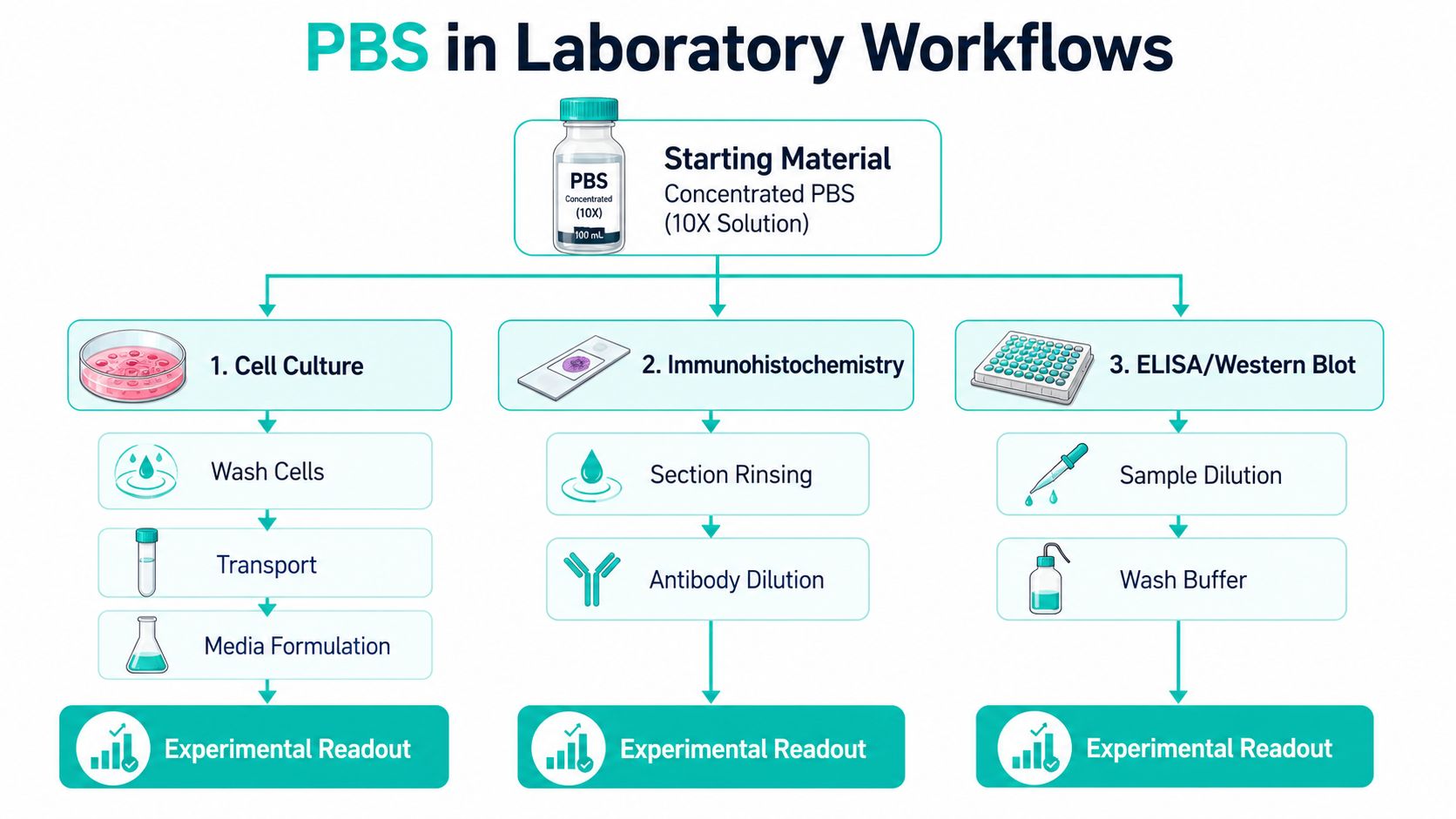
A PBS bottle often sits on the bench because it solves small problems reliably. A cell pellet needs a quick wash before counting, a tissue section needs a rinse before staining, or a sample needs dilution without introducing a new chemical environment. Those are ordinary steps, but they are the steps where a buffer can shape the result.
In cell culture, PBS is often used to wash cells or move them between containers because it is gentle and isotonic AAT Bio PBS overview. In immunohistochemistry and western blot work, it can rinse sections or membranes without stripping signal the way a harsher wash might. In ELISA and other immunoassays, it is a familiar base for dilution and washing when the protocol calls for a neutral, low-noise buffer. The comparison between PBS and related wash buffers matters because the wrong wash chemistry can raise background or flatten a signal Boster buffer comparison.
A practical example makes the difference clearer. A membrane wash in PBS may leave a weakly bound antibody in place long enough to read a clean band, while a detergent-containing wash can remove the same interaction and lower the apparent signal. That is helpful in one workflow and harmful in another, which is why buffer choice belongs to assay design, not just routine prep.
PBS is also common for tissue transport and for handling specimens that cannot yet sit in fixative. The solution keeps the sample in a stable, familiar environment until the next step is ready. It does not solve every compatibility problem, but it avoids adding a new one.
The choice usually comes down to what the assay is trying to preserve. For live-cell handling, PBS stays mild. For antibody-based methods, it provides a clean wash base. For tissue work, it gives researchers a low-disruption transport medium. When phosphate is a problem for the assay, another buffer may fit better, so people often compare PBS with TBS instead of assuming one system suits every protocol Boster buffer comparison.
There is another decision point that gets missed in simple buffer charts. If a workflow involves binding or reconstitution steps for research peptides, PBS may be acceptable for short-term aqueous handling, but it is still worth checking whether the ions and pH match the material you are working with. The buffer should support the sample, not alter its behavior.
The main habit is simple. Match the buffer to the job. PBS is strong when the experiment needs a quiet, physiological background. It is weaker when the readout depends on conditions that phosphate, salts, or a cation-sensitive step may alter.
Plain PBS is only the starting point. In a real lab, the bottle is often adjusted to fit the assay, and the wrong version can change how a readout behaves in ways that are easy to miss at the bench. A wash buffer can look harmless and still shift background, cell recovery, or binding efficiency enough to blur the result.
PBS-T is PBS with Tween-20, and it is used when the protocol needs fewer nonspecific interactions during washes. The detergent helps dislodge weak, unwanted binding without turning the wash into a harsh treatment. That is why it is common in ELISA and western blot wash steps, where background can otherwise crowd the signal. A PBS-T wash can be the difference between a clean membrane and one that still carries stray proteins into the next readout.
PBS-EDTA adds a chelator. Its job is to bind divalent cations so cell adhesion that depends on calcium can loosen, which is why the variant shows up in dissociation or flow-related workflows. For example, use calcium-free PBS when processing samples for flow cytometry antibody staining if you want to avoid cation-dependent effects during the early handling steps. A calcium- and magnesium-free PBS serves the same basic purpose when the protocol calls for keeping those ions out of the system entirely. When a step is enzyme-sensitive or adhesion-sensitive, the absence of those ions can matter as much as the buffer itself.
Some assays also become less predictable over time because of quiet chemistry problems. Phosphate buffers can cause trouble if a workflow brings in metal ions that do not mix well with them, and long runs can expose pH drift or contamination that a fresh bottle would not show. That is why variant choice is not just about what works on paper, it is about what stays stable through the whole experiment.
The wrong variant usually fails without a clear warning. A wash buffer with detergent may improve signal clarity in one assay and disrupt another. A cation-free wash may help detach cells but be too aggressive for a specimen that needs support from its normal ionic environment. The decision starts with asking what needs to stay attached, what needs to come off, and whether the protocol depends on divalent cations anywhere in the chain.
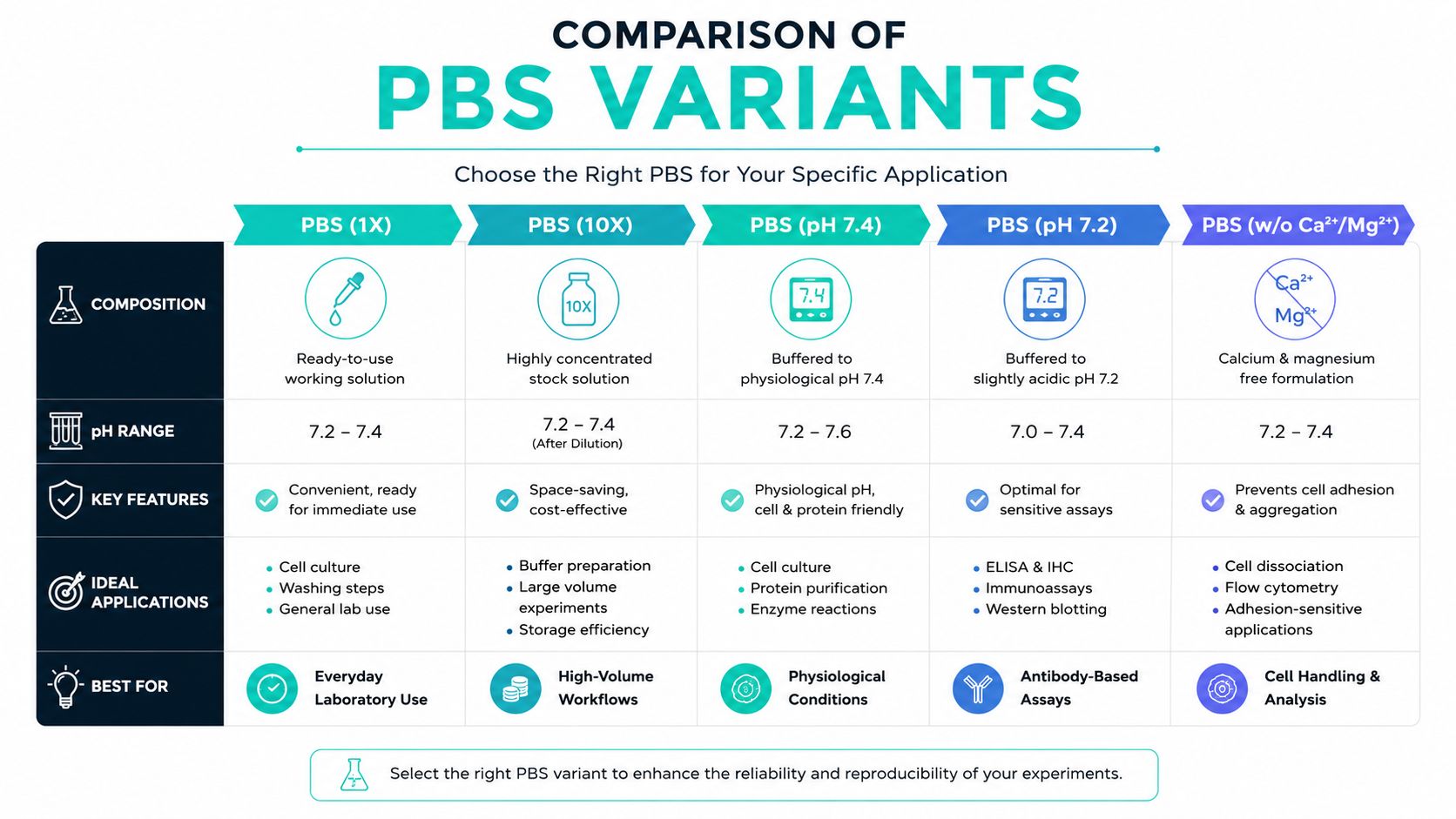
A useful habit is to think in terms of interference. If the assay is prone to background binding, detergent may help. If cells cling too strongly, EDTA may help. If a method is sensitive to calcium or magnesium, a cation-free option is the cleaner starting point. That logic prevents a lot of protocol drift that looks like biology but is really buffer choice.
PBS trouble is often subtle at first. A bottle can stay clear, and a wash can still be the reason an assay drifts, backgrounds rise, or cells behave differently than expected.
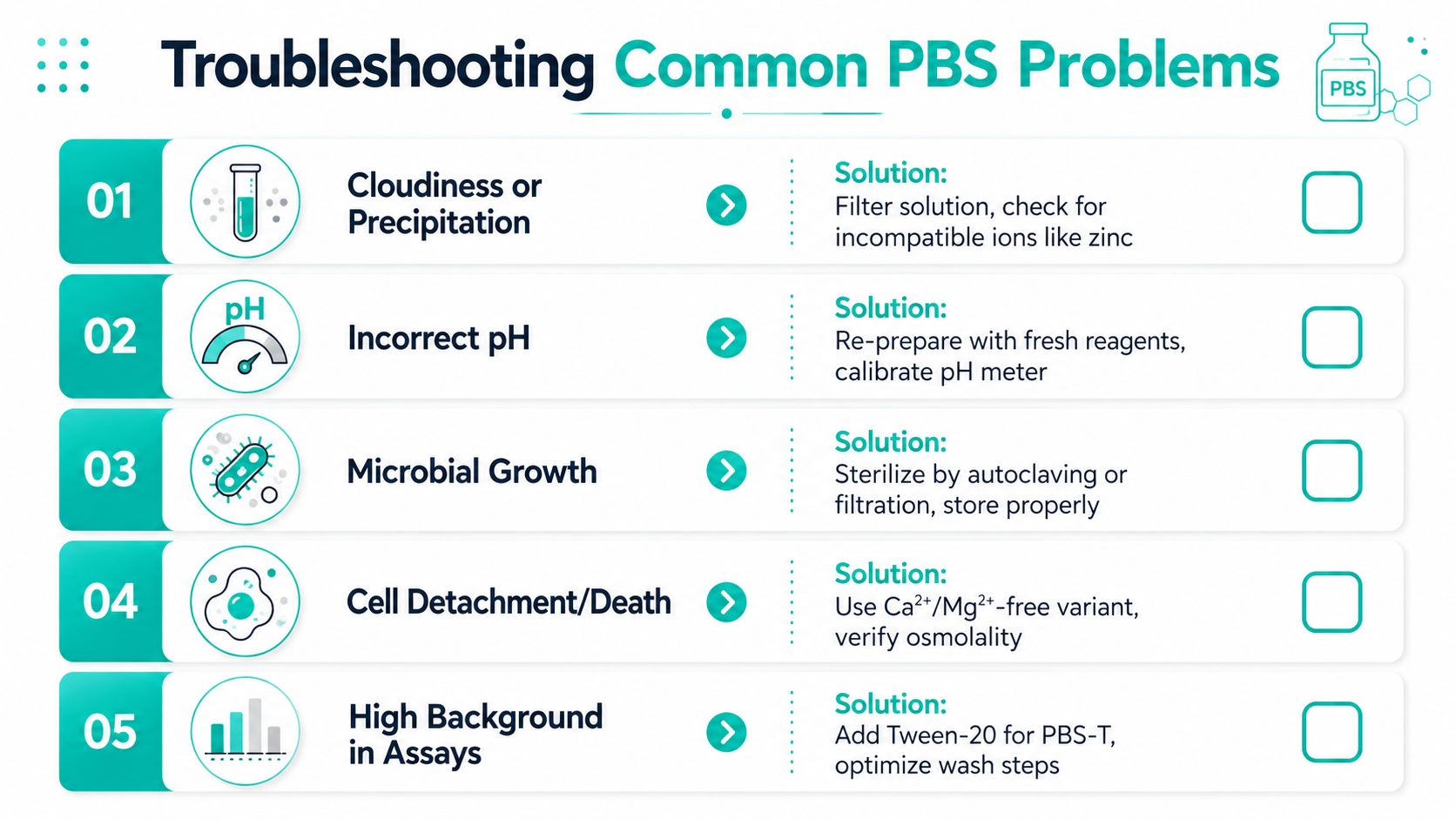
One common failure is precipitation after PBS meets incompatible metal ions. A simple example is mixing PBS with zinc-containing reagents in a metal chelation assay, which can produce cloudiness or tiny particles that were not there before. Once that happens, the buffer is no longer acting like a neutral carrier, and the chemistry of the assay has changed under your feet.
pH drift is another slow problem. PBS made from aged reagents, stored badly, or left sitting too long can drift away from its intended range, and that change may be invisible until the buffer starts handling cells or proteins differently. For long experiments, check the pH before the run starts, not after the result looks odd. A bottle that looks clean can still be off enough to matter.
A small habit helps here. If the experiment will run for hours or longer, verify the buffer first, then proceed.
Working bottles can pick up microbial contamination when they are opened repeatedly or stored without enough care. The liquid may look slightly hazy, or it may still look normal while a culture or assay becomes harder to interpret. Sterile prep helps, but bench handling matters just as much, because a clean bottle can stop being clean after enough use.
If a bottle is going to sit on the bench as a day-to-day working reagent, some labs keep an eye on related handling practices such as clean aliquoting and controlled storage, much like they would for other lab liquids used to protect samples and reagents, including bacteriostatic water handling principles. The point is the same. Reuse and exposure are where quiet contamination starts.
PBS can also raise background in some immunoassays when the wash conditions do not match the antibody system well Boster buffer comparison. In practice, that usually means the wash is part of the problem, not the whole assay. A detergent-containing variant may help with nonspecific binding, or a different buffer system may fit better if phosphate is interfering with the readout.
The safest mindset is to treat PBS as part of the assay design, not as a neutral extra. If the buffer clouds up, check compatibility first. If the signal gets noisier, look at wash behavior before blaming the biology. If cells detach too easily, the buffer choice may be too aggressive for that sample or surface.
A PBS bottle only stays reliable if prep, storage, and disposal are treated as part of the workflow, not as cleanup at the end. The same buffer can behave well in one lab and poorly in another if the handling habits differ. That is why the practical details matter at the bench.
For heat-stable PBS, autoclaving is standard. If you are preparing a basic buffer, sterilization by heat fits the job because the salts tolerate it well. If you are adding heat-sensitive components later, sterile filtration is the better path because it keeps those additions out of autoclave conditions.
A common pattern is to autoclave stable 10X stocks and filter working bottles that contain extras. That keeps the base buffer clean while protecting any additives that cannot take heat. A stock bottle and a working bottle often need different treatment because their contents are not the same.
Short-term use at room temperature is usually fine for a bottle that is being actively consumed, but working stocks are often kept cold to reduce handling issues and microbial risk. Some sensitive applications use frozen aliquots to limit repeated opening and contamination risk. The key is to match storage to how often the bottle is opened and how sensitive the downstream work is.
If you already think about sterile aqueous handling this way, the same logic applies to other lab liquids that are used to protect samples and reagents, including bacteriostatic water use. A clean bottle can still become a problem if it is opened, shared, or warmed more than the workflow can tolerate.
PBS that has touched biological material belongs in biohazard waste. Unused clean buffer may be discarded according to local lab policy and regulations. The label on the container does not decide disposal, the sample history does. That is the part people miss when they focus only on the recipe.
PBS is not a substitute for cell culture medium. It doesn't contain the nutrients or growth factors cells need, so it's only meant for short handling steps. It can support sample preparation, but not ongoing growth.
PBS can be used with freezing workflows only in the right context, usually with a cryoprotectant such as DMSO. On its own, it isn't ideal for protecting samples through a freeze-thaw cycle. For reproducibility, lab-made PBS is fine if the composition, pH, and sterility are controlled, while commercial PBS is useful when you want a standardized starting point.
The main checklist is simple. Use the right composition, verify pH near 7.4, choose the right sterilization method, and pick the variant that matches the assay. If one of those four is off, the buffer can become the hidden variable in an otherwise solid experiment.
If you're setting up a new workflow and want help choosing the right research materials, contact Celonyx Labs and review the catalog, support, and policy pages before you place your next order.
What does “6 acetic acid” tell you about the bottle on your bench? Not much,
Best sterility testing kits for 2026 peptide labs: Endosafe nexgen-PTS wins on speed, Steritest for
Compare the best peptide reference standards for analytical research in 2026, ranked by purity, COA
FOR RESEARCH USE ONLY. Products sold by Celonyx Labs are intended exclusively for laboratory and scientific research. They are not intended for human or veterinary use, consumption, diagnosis, treatment, cure, or prevention of any disease. By purchasing from this site, you acknowledge that you understand the intended research purpose of these materials and agree to comply with all applicable laws and regulations.