5 Amino 1MQ Capsules: A Researcher’s Sourcing Guide
A researcher opens a shipment of 5-amino-1MQ capsules, removes the powder for testing, and discovers
A researcher opens a shipment of 5-amino-1MQ capsules, removes the powder for testing, and discovers that the material doesn't match the paperwork. The supplier's certificate of analysis reports a clean batch, but the chromatogram tells a different story. At that point, the problem isn't just product quality. It's failed procurement control, wasted experimental time, and a chain-of-custody record that won't withstand serious review.
That gap between the advertised specification and the material that arrives is the central sourcing risk. 5-amino-1MQ is a synthetic small molecule, not a peptide, and its published evidence remains preclinical. Anyone buying it should treat the order as a research-chemical purchase, not a wellness-product transaction.
A purchase order for 5-amino-1MQ capsules can look like a routine supplement order until the lab checks what arrived. The procurement standard should be different from the start. 5-amino-1MQ is a synthetic small molecule, not a peptide, and its published evidence remains preclinical.
Academic medicinal chemistry work at the University of Texas Medical Branch identified the compound in a 2017 study as a selective nicotinamide N-methyltransferase, or NNMT, inhibitor. The reported IC50 was about 1.2 µM, with high membrane permeability, in the original UTMB research publication. Subsequent work examined the compound in diet-induced obesity mouse models.
That distinction matters when reviewing online listings. Sellers often place 5-amino-1MQ capsules beside peptide products or use peptide-market terminology. A small molecule is not a chain of amino acids, so the applicable expectations for analytical testing, storage, formulation, labeling, and regulatory handling differ.
Capsule form changes presentation, not evidence. It does not establish human bioavailability, clinical safety, therapeutic effectiveness, or approval for consumption.
Procurement rule: Treat every 5-amino-1MQ capsule order as a non-therapeutic research-chemical purchase unless formal human-use authorization exists through the appropriate institutional and regulatory channels.
The foundational animal work used subcutaneous mouse dosing of 20 mg/kg, administered three times daily for 11 days, and reported reductions in body weight, white adipose mass, and adipocyte size in diet-induced obesity models. Those findings support further laboratory investigation, not a human dosing recommendation.
Neutral summaries report no published human clinical trial data and no registered ClinicalTrials.gov studies for 5-amino-1MQ. The available evidence remains limited to cell and animal models, as described in this independent review of human trial status.
Before issuing a purchase order, require research-use labeling, a batch-specific COA, and records that connect the tested material to the shipped batch. Follow research-use-only handling guidance, while keeping the compound classified as a small molecule rather than a peptide.
A supplier lists 5-amino-1MQ capsules beside peptides and “metabolic support” products. Stop there. 5-amino-1MQ is a small molecule, not a peptide, and its evidence remains preclinical. Evaluate the material as a research compound, not as a finished human-use product.
NNMT is an enzyme involved in nicotinamide metabolism. 5-amino-1MQ is designed to bind with NNMT and inhibit its activity. In cell and animal models, NNMT inhibition has been associated with reduced nicotinamide N-methylation, greater intracellular NAD+ availability, and reduced lipogenesis in adipocytes, as described in the published mechanistic review. These findings explain why researchers study the compound. They do not establish human outcomes.
Procurement and research teams should separate three questions:
The evidence chain has a clear limit. A biochemical effect in a purified or cellular system does not prove that an orally administered capsule creates the same exposure in people. Animal findings also do not establish human efficacy, tolerability, pharmacokinetics, or an appropriate administration route.
Published in vivo work used subcutaneous mouse dosing of 20 mg/kg three times per day for 11 days. Do not convert that regimen into a human capsule amount. Species differences, metabolism, exposure, route, formulation, and body-surface-area assumptions all affect translation.
For procurement, ask a narrower question: can the supplier document capsule composition, dosage-unit uniformity, identity, degradation, and storage performance? Convenience of shipment or administration proves none of those points.
Evidence ceiling: 5-amino-1MQ is a preclinical NNMT inhibitor with a research rationale. Its mechanism supports controlled investigation, not self-directed human use.
A supplier can ship a capsule labeled “research only” while still presenting it as a consumer product. Reject that mismatch. 5-amino-1MQ is a small-molecule research compound, not a peptide, and its preclinical record does not establish clinical acceptance or a human-use pathway.
Available regulatory summaries describe 5-amino-1MQ as not FDA-approved, with no established legal prescription pathway in the United States, according to this regulatory and safety summary. Reviews also report no human clinical trial record. Keep those findings separate in procurement files: a research-use designation, regulatory status, and evidence of human safety are different controls.
Every vial, bottle, invoice, and packing document should identify the material as:
Reject supplier paperwork that calls the capsule a treatment, supplement, weight-loss product, or approved medication. Those descriptions create an institutional compliance issue and erase the boundary between laboratory work and human use.
The purchasing file should contain the supplier's legal identity, product specification, lot number, COA, SDS, shipping record, and return terms. If the compound enters a regulated laboratory workflow, the purchase order must use the same intended-use language as the approved protocol.
Published safety information remains incomplete. One 2026 summary states that the longest published safety study in any species lasted 10 weeks, with no studies assessing chronic toxicity, reproductive effects, or carcinogenicity. The available review also reports no published human trial following participants beyond 12 weeks.
Short animal studies cannot establish long-term safety. Handle the material as having uncharacterized hazard potential, regardless of reassuring supplier language.
IACUC documentation, institutional purchase orders, laboratory risk assessments, and SDS files should identify 5-amino-1MQ as non-therapeutic research material. Pregnancy, lactation, reproductive toxicity, carcinogenicity, chronic liver effects, and cardiovascular effects remain unresolved. Procurement teams should reject any human-use workflow justified by capsule availability or short-term tolerability claims.
A COA isn't a brochure. It is a quality document that should let your laboratory connect a specific batch to a defined analytical result. If it can't do that, it has limited procurement value.
Start with the identity block. The report should name the compound as 5-amino-1MQ, identify the lot, state the test date, and name the testing laboratory. A generic PDF with a supplier logo, a purity headline, and no laboratory identity belongs in the rejection pile.
Use this routine before approving a purchase order:
The testing laboratory's name matters, but so does its competence. Ask for accreditation information and the relevant scope, such as ISO 17025 or an equivalent quality framework, rather than accepting “third-party tested” as a complete answer.
A summary table can't show whether a vendor integrated a crowded baseline correctly. It can't reveal a poorly resolved impurity, an implausible retention profile, or a chromatogram reused from another lot. Request the original chromatographic trace and, where appropriate, the mass spectrometry output.
Use practical guidance on interpreting peptide and research-material test results as a starting point, but apply the same discipline to this small molecule. The inspection question is simple: Can another qualified analyst reproduce the acceptance decision from the document?
Reject the COA if the lot doesn't match, the testing laboratory is unnamed, the method is undisclosed, or the chromatogram is missing.
Reliable suppliers make verification routine. Marketing-driven suppliers make verification difficult and rely on phrases such as “lab-grade purity” without showing how the result was measured.
A dependable vendor should provide a batch-specific COA, linked chromatograms, the name of the independent analytical laboratory, written return and replacement terms, and a reachable technical contact. The supplier should also be able to answer storage, shipping, stability, and documentation questions without sending the buyer through a maze of generic support replies.
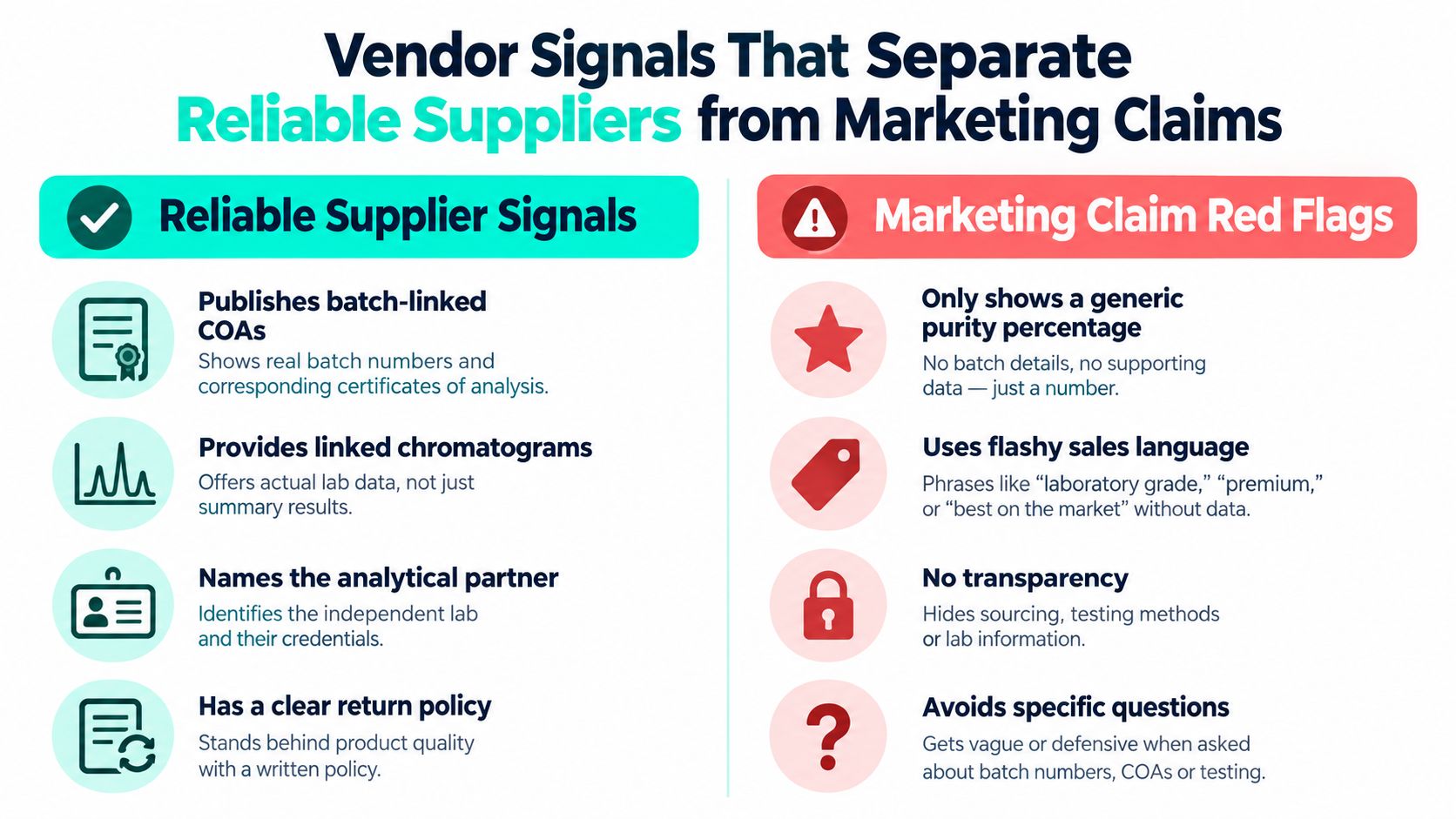
| Reliable supplier signals | Marketing claim red flags |
|---|---|
| Publishes a COA tied to the purchased lot | Shows one generic certificate across products |
| Names the analytical laboratory and method | Says “third-party tested” without details |
| Provides chromatograms and identity data | Displays only a purity number |
| Maintains written return and replacement rules | Handles failed QC through informal promises |
| Assigns a reachable technical contact | Hides behind an anonymous sales inbox |
| Explains storage and shipping conditions | Treats every product as shelf-stable without evidence |
A supplier that responds quickly but refuses raw data isn't transparent. A supplier with attractive packaging but no chain-of-custody documentation isn't controlled. Procurement should rank written evidence above website design, testimonials, discounts, or urgency-based sales language.
The cheapest per-milligram offer isn't necessarily the lowest-cost purchase. If the lab receives material with uncertain identity or unexplained impurities, the downstream cost includes delayed experiments, repeat analytical work, contaminated datasets, and rejected results.
That doesn't mean a higher price proves quality. It means the buyer should price documentation, testing, support, and remedy procedures into the decision. A supplier that can provide those records is offering a more defensible procurement process, not merely a more expensive capsule.
A 99% purity headline answers one question, and only one. It doesn't identify the remaining material, establish long-term stability, confirm that the impurity panel covered relevant solvents, or show how the compound behaves after shipping.
For 5-amino-1MQ, that distinction is especially important because the published evidence remains preclinical and long-term human safety is unknown. A purity percentage can't substitute for impurity identity, degradation analysis, or storage-condition data.
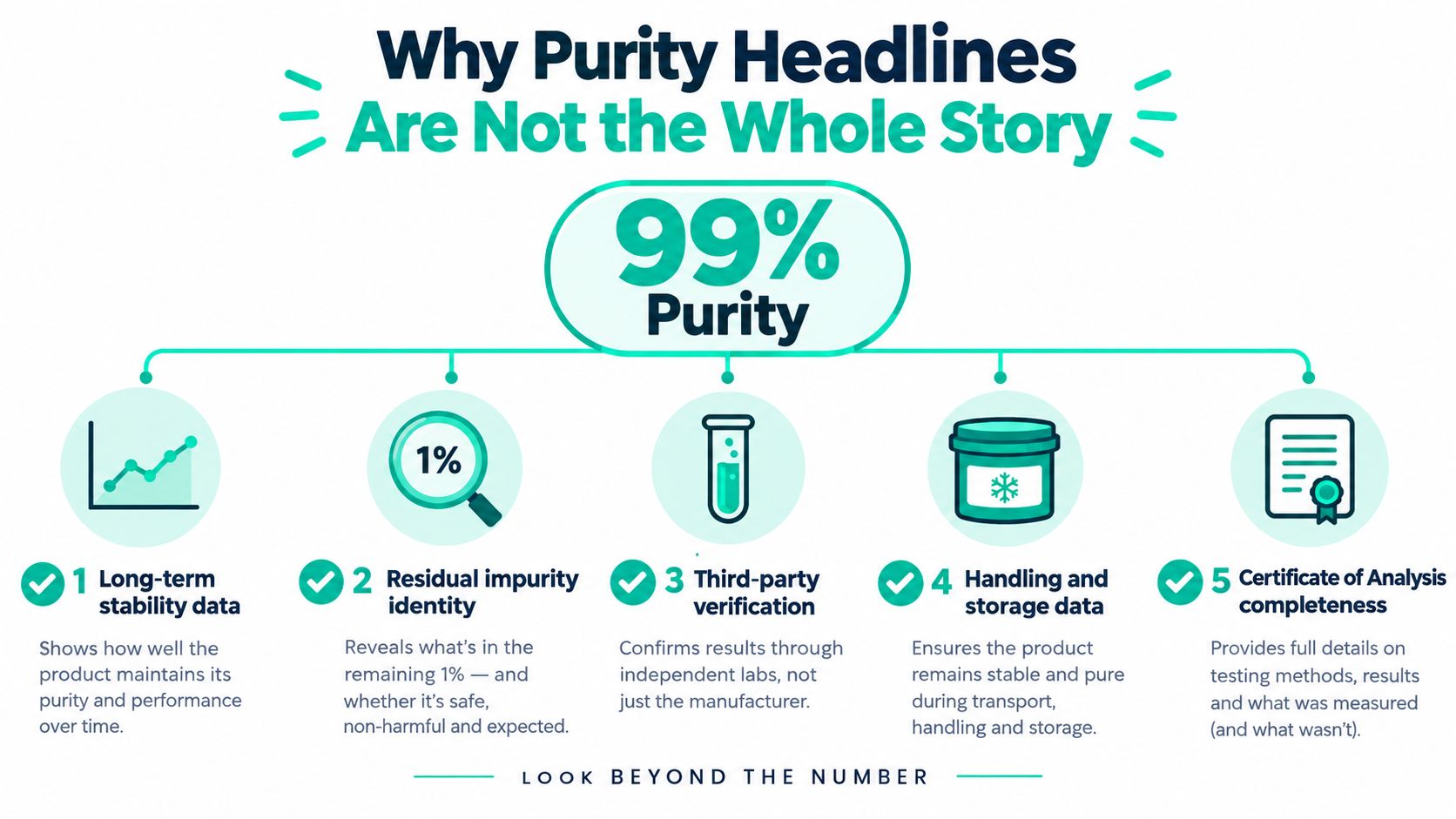
Two batches can carry similar headline purity figures yet differ materially in research usefulness. The difference depends on what the residual material is, whether it came from synthesis, formulation, degradation, solvent carryover, or storage exposure, and whether the test method can distinguish those components.
Your acceptance review should ask:
The research-purity testing resource offers useful procurement context, but buyers should apply the principle directly: a purity number is an entry point, not an acceptance decision.
Better question: “What are the impurities, and how do you know they aren't changing during storage?” is more useful than “Is it 99% pure?”
Use this checklist before approving any supplier. It combines intended-use controls, analytical verification, logistics, and post-delivery accountability. If a vendor skips more than two gates, reject the order regardless of price or advertised purity.
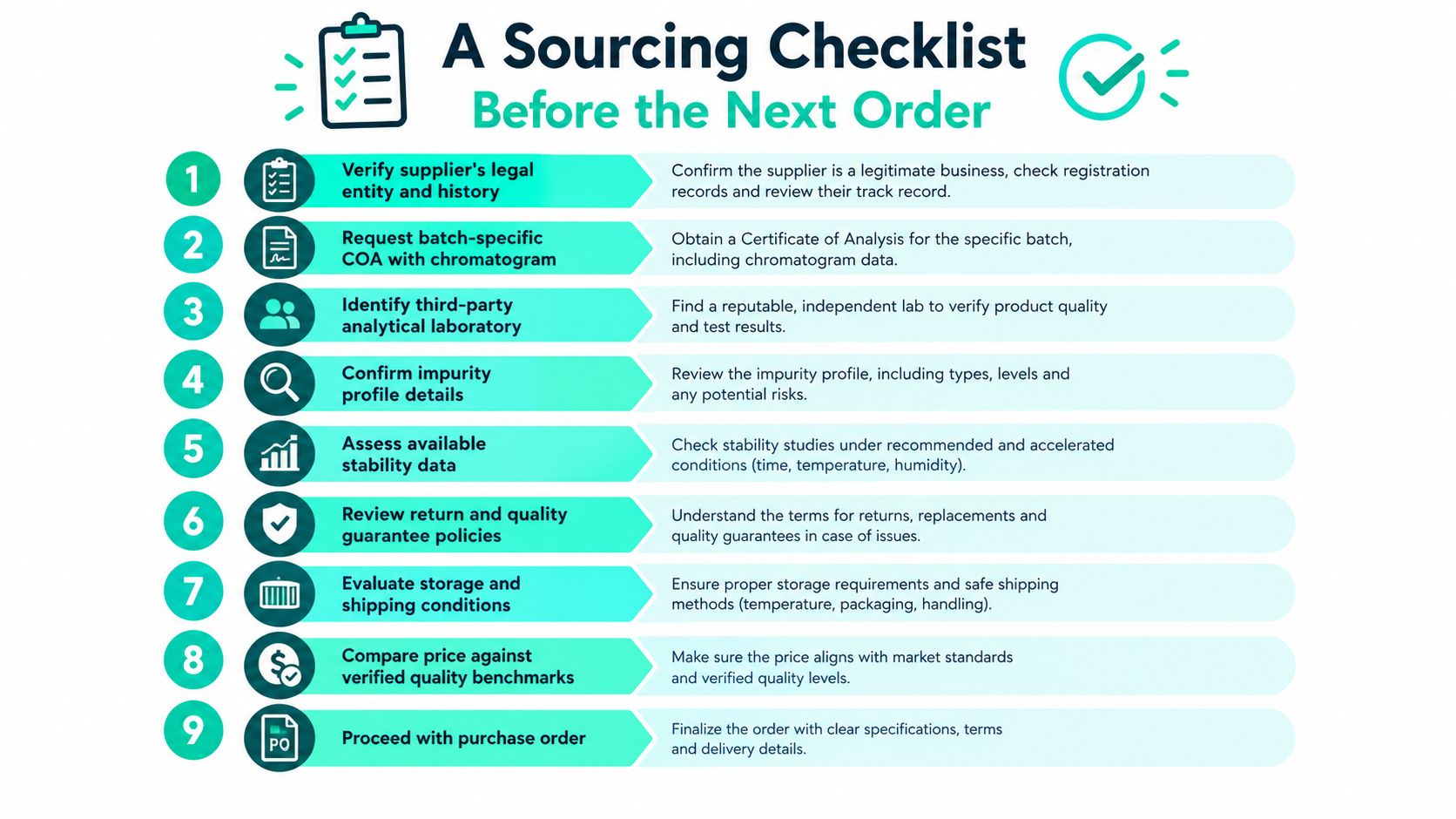
Run this process before the order, then repeat the lot-matching and packaging checks when the shipment arrives. The supplier's promise matters less than the evidence attached to the exact material your lab receives.
For a defensible purchase, archive the analytical documents before the material enters an experiment. That record protects the study, the lab, and the person responsible for approving the order.
Celonyx Labs offers research compounds through an online catalog and presents product quality information including third-party testing, product documentation, shipping policies, and customer support. If your lab is evaluating 5-amino-1MQ capsules, visit Celonyx Labs and request the batch-specific COA, identity data, storage information, and written remedy terms before placing a purchase order.
A researcher opens a shipment of 5-amino-1MQ capsules, removes the powder for testing, and discovers
What does “6 acetic acid” tell you about the bottle on your bench? Not much,

Best sterility testing kits for 2026 peptide labs: Endosafe nexgen-PTS wins on speed, Steritest for
FOR RESEARCH USE ONLY. Products sold by Celonyx Labs are intended exclusively for laboratory and scientific research. They are not intended for human or veterinary use, consumption, diagnosis, treatment, cure, or prevention of any disease. By purchasing from this site, you acknowledge that you understand the intended research purpose of these materials and agree to comply with all applicable laws and regulations.