1500 Mg Glutathione: What That Strength Really Means
You're comparing two bottles on a supplement shelf. One says 500 mg glutathione. The other
More than 80 peptide drugs are already approved for medical use, and roughly 140 peptides are in clinical trials worldwide, with hundreds more still in preclinical development, so research use only peptides sit inside a serious drug-development pipeline, not a hobbyist side market. At the same time, peptide therapeutics reached about $140.86 billion in 2025 and are projected to roughly double by 2033 (research peptide statistics), which explains why procurement teams now need to treat RUO sourcing like a controlled lab input, not a casual catalog click.
That scale hasn't made quality problems disappear. A consumer survey summary reported that 30% of research-grade peptide products failed basic quality checks, another source said two-thirds of tested gray-market vials failed basic purity standards, and FDA enforcement coverage described more than 50 warning letters to peptide sellers in a single month in 2025 (consumer survey report). If the label says RUO, the lab still has to prove the vial in hand is what it claims to be.
Research use only peptides sit inside serious drug-development workflows, not a hobbyist side market. The RUO label marks a legal boundary, but it does not verify identity, purity, or whether the material will behave the way your assay needs. A lab still has to check the lot before it trusts the result.
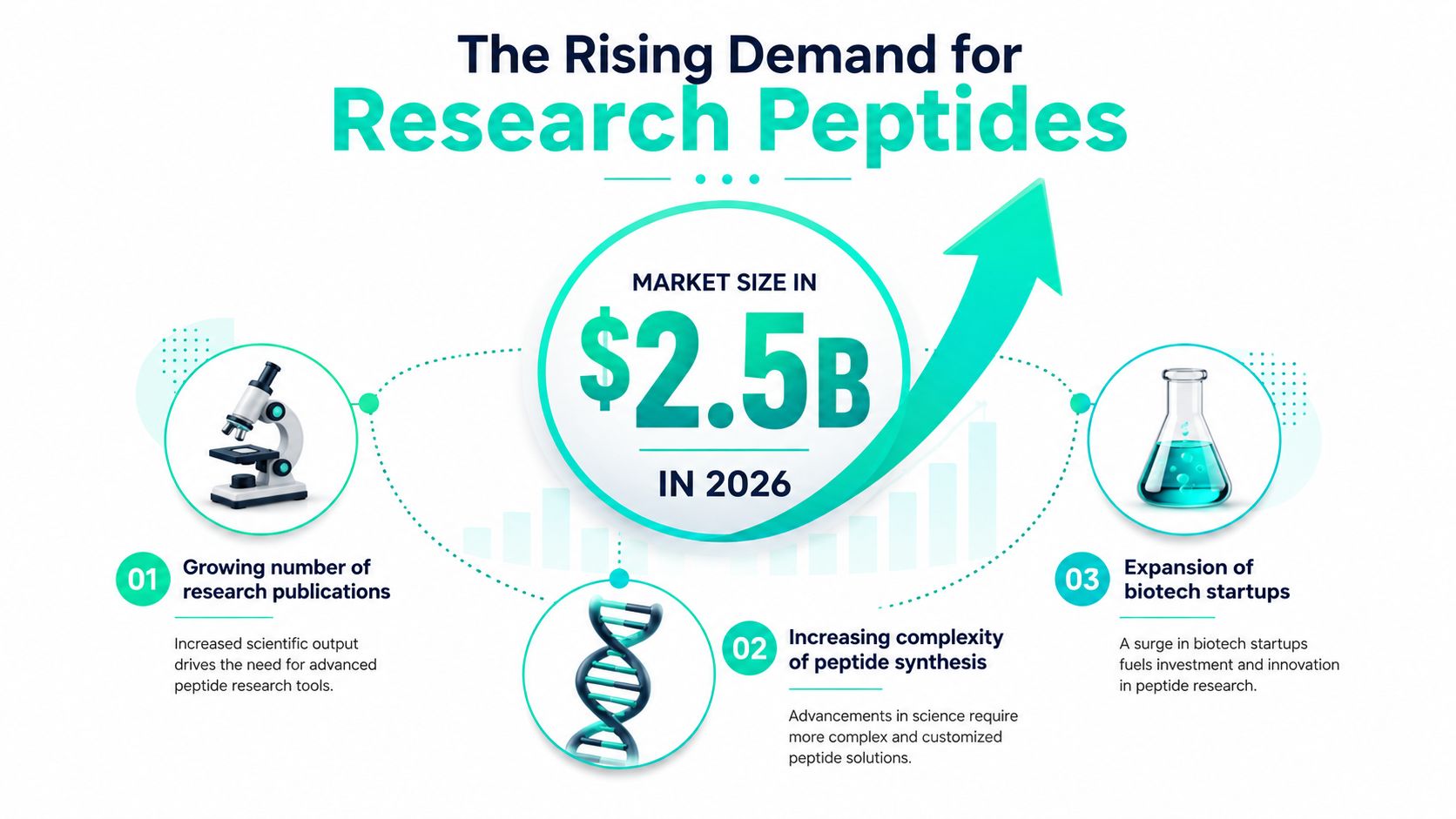
Peptide buying now sits closer to translational research than to simple reagent purchasing. With more than 80 approved peptide drugs and about 140 peptides in global clinical trials, procurement teams are handling material that supports target validation, method development, and preclinical screening, where weak documentation can distort an entire study (research peptide statistics). That shift matters because a missing batch record or a vague certificate can force a lab to repeat work or discard data that already consumed time and animals.
Price pressure adds another layer. The literature notes peptide production can range from $50 to $500 per gram depending on length, complexity, and synthesis method. A wider cost spread usually means more variation in sourcing decisions, and that makes clean procurement records more important, not less. If a vendor cannot show batch-specific support, the buyer is left guessing about what entered the freezer.
RUO language tells you what the product is not for. It does not tell you whether the vial is correctly identified, whether impurities are within an acceptable range for your use, or whether the peptide is stable enough for the protocol you planned. The practical burden stays with the buyer. If the supplier does not provide batch-level records, the lab has to prove usability after the fact.
Practical rule: treat the label as the starting point, not the decision point.
For sourcing teams, the issue is documentation quality at receipt. A batch-specific COA, identity confirmation, storage history, and a clear chain from order to vial are the details that separate usable material from an experimental confounder. That is the standard worth applying before a peptide ever reaches the bench. A recent consumer survey report reported basic quality failures in research-grade peptide products and also raised contamination concerns in gray-market testing, which is enough reason to verify every lot instead of assuming the label tells the whole story. A practical primer on what research peptides are can help clarify how that designation fits into an actual procurement workflow.
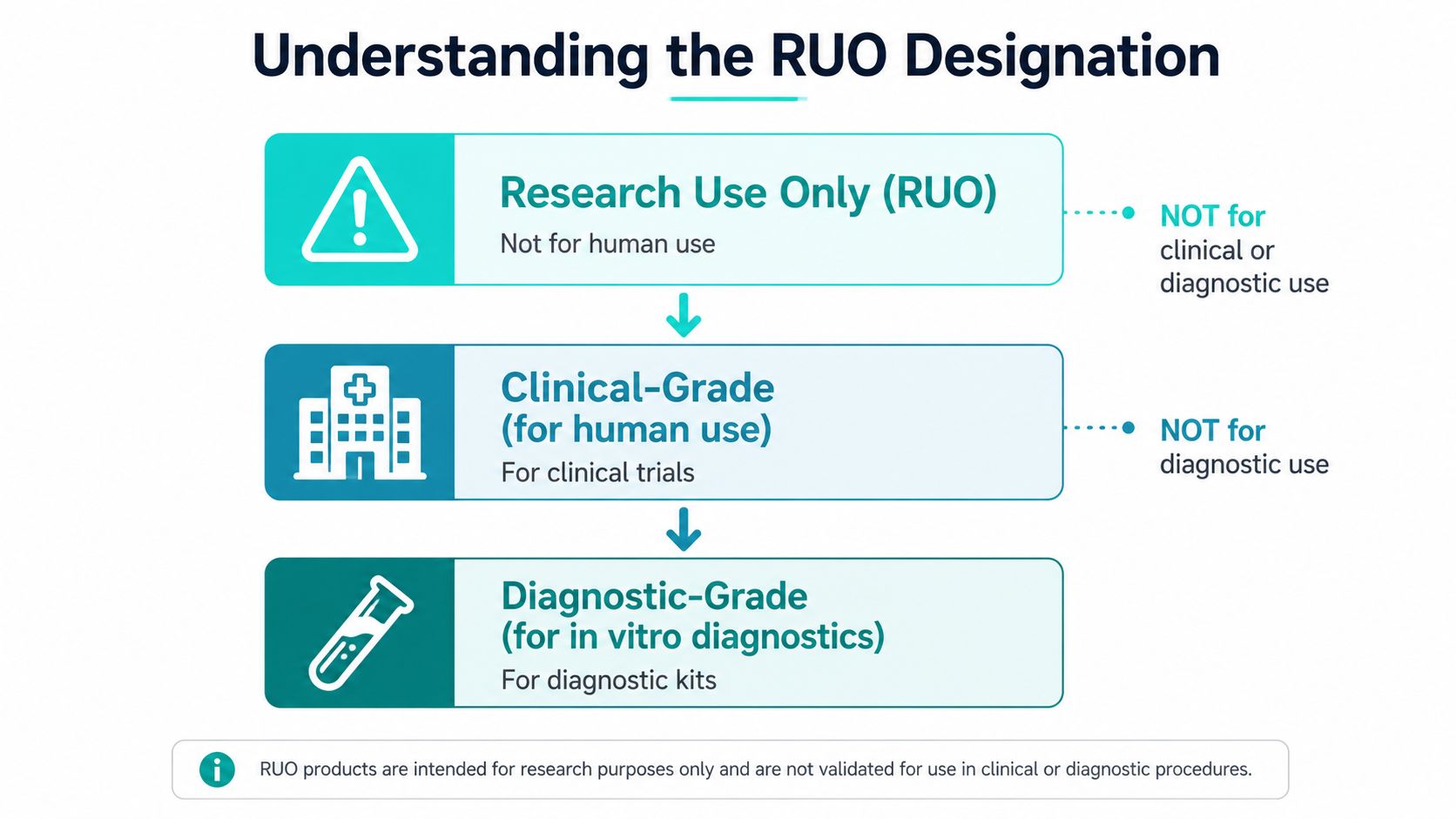
The RUO label is a legal and commercial designation, not a seal of scientific adequacy. It tells you the material isn't intended for human use, clinical use, or diagnostic use, and it also tells you the supplier isn't making the kinds of claims that would place the product in a regulated therapeutic or diagnostic category.
For a bench scientist, RUO peptides belong in in vitro research, exploratory assay work, and other non-clinical applications where the lab is evaluating biological response rather than administering a product to patients. That's a very different lane from clinical-grade material, which is built for human use, or diagnostic-grade material, which supports in vitro diagnostic workflows. The distinction matters because the wrong assumption can contaminate an experiment long before anyone notices the issue.
The clearest operational mistake is to hear “research use only” and assume the product has been vetted to a universal laboratory standard. It hasn't. The designation says the product is not for therapeutic or diagnostic use. The buyer still has to review the evidence that the lot is what the supplier says it is. For a concise primer on the category, see research peptide basics.
RUO status doesn't tell you anything useful about lot-to-lot consistency, sterility, endotoxin burden, or whether the peptide was handled in a way that preserves integrity after shipment. Those questions are separate, and they need separate documentation. The smartest procurement teams don't argue with the label, they work around its limits by requiring receipt-level evidence.
The supplier's disclaimer is not your validation file.
That's the operational truth. RUO gives the vendor a legal frame, but it doesn't excuse the lab from verifying whether the material can support reproducible work. If the intended experiment is sensitive to impurity, moisture, or identity errors, the burden on procurement gets heavier, not lighter.
Purity numbers look precise, but they can hide different meanings depending on how the supplier measured them. The phrase HPLC purity is common in peptide catalogs, yet it only describes chromatographic peak area. It doesn't automatically tell you how much peptide mass is in the vial.
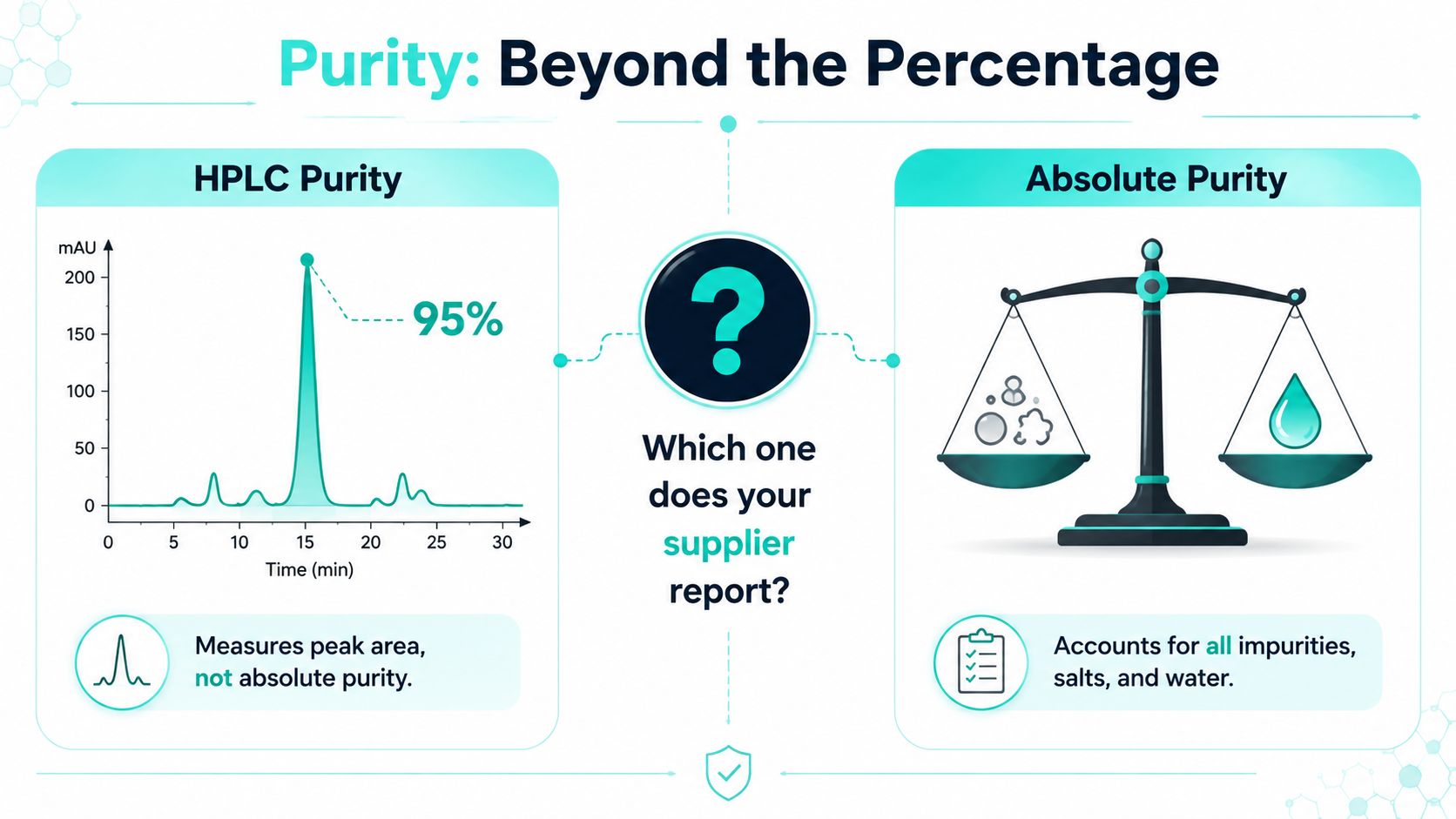
A supplier can report a high HPLC purity number and still leave you uncertain about identity if the COA doesn't include mass spectrometry confirmation. HPLC tells you what dominates the chromatogram. MS tells you whether the vial contains the intended molecular weight. For a lab manager, both are necessary because a clean-looking chromatogram doesn't rescue a misidentified compound.
That distinction matters even more when a peptide has salts, counterions, or residual moisture. Suppliers note that a highly purified peptide can still have lower solid-state peptide content once those non-peptide components are included. If a team calculates dosing from the wrong number, the assay can drift without anyone realizing why.
Technical references commonly treat 95%+ HPLC purity as typical for research use, with premium material often targeting ≥98%, and some catalogs advertising 99% purity (research-grade purity benchmark). That benchmark is useful, but only as a starting point. High purity can improve signal-to-noise and reduce confounding from side products, yet it doesn't replace identity confirmation, endotoxin review, or lot traceability.
A good COA should answer three separate questions. Is it the right molecule. How clean is the chromatographic profile. Can the lab trace this exact vial back to a specific batch and method. If any of those answers are missing, the headline purity number should be treated as incomplete.
The practical mistake is to shop by percentage alone. A 99% claim sounds strong, but without the method, lot, and identity record, it's just a number on a product page.
A defensible peptide purchase starts with the Certificate of Analysis for the exact lot in hand, not a generic PDF pulled from a product page. Batch-specific documentation is the difference between a real analytical record and a marketing handout.
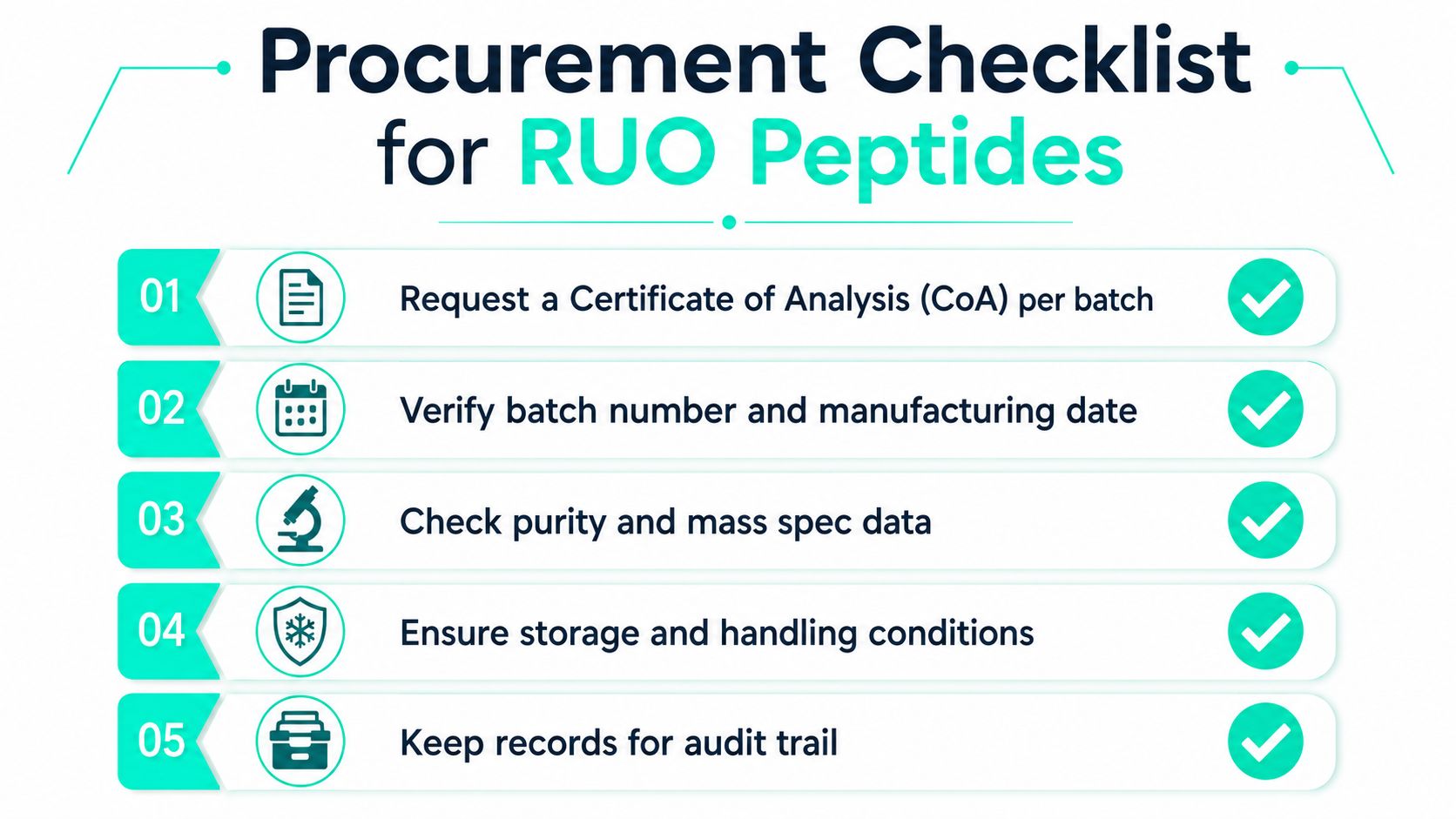
A usable COA should tie the lot number on the vial to the test record, the HPLC purity method, and the LC-MS identity confirmation for that same batch (batch documentation guidance). That linkage matters because the COA is not a catalog promise, it's the analytical record for the vial you received. If the lot on the vial doesn't match the lot on the document, the chain is broken.
A strong procurement checklist usually includes:
If the assay or biological system is sensitive, the lab should ask for more than purity and identity. Endotoxin information, heavy metal screening, and sterility-related details can be relevant depending on the application. The reason is simple, impurities that don't matter in a rough screening assay can wreck a macrophage study, an immune-sensitive model, or any workflow where background contamination changes the result.
If you can't trace the batch, you can't defend the result.
That's the standard I use in procurement reviews. A vendor that can't supply lot-matched records creates rework later, often after the experiment has already failed. For teams that want a third-party verification reference point, independent testing practices are worth reviewing before the next order.
The legal line around RUO peptides has gotten narrower, especially where sellers blur research labeling with consumer-health marketing. The safe rule is simple, RUO material must not be positioned as a therapy, a diagnostic, or a human-use alternative to approved drugs.
Recent reporting described more than 50 warning letters to peptide sellers in a single month in 2025, and the enforcement focus included sellers that used RUO language while implying therapeutic benefits (warning letter coverage). State-level warnings also tightened the atmosphere. In May 2026, Alabama's medical regulator warned clinicians against non-FDA-approved peptides, which signals that institutions can't assume the old gray-market tolerance still applies.
The compliance takeaway is direct. Academic labs, CROs, and startups need to review vendors for product claims, not just product labels. A site can say “research use only” and still create risk if it hints at weight loss, recovery, anti-aging, or clinical use. That kind of marketing pushes the item out of a clean research-purchase posture.
Vendor qualification should now include a hard look at catalog language, return policies, shipping terms, and the documentation package that arrives with the order. If a supplier is fuzzy about provenance or leans on disclaimers while promoting health benefits, that's a red flag.
The legal issue isn't just whether the label exists. It's whether the supplier's business model aligns with the actual boundary that regulators are enforcing. A useful deeper read on sourcing expectations is GMP-adjacent research peptide procurement.
A great COA won't save a peptide that was stored badly. Once the vial arrives, handling determines whether the material stays close to its documented state or starts drifting before the first assay run.
Lyophilized peptides should be placed into the right storage environment immediately after receipt, and reconstituted material should be treated as time-sensitive and handled with restraint. The biggest avoidable error is repeated freeze-thaw cycling, which can create variability even when the starting material was clean and well documented.
Aliquoting is the simplest protection. Small working portions reduce repeated exposure to temperature swings and cut down on contamination risk from repeated vial access. Light, moisture, and improper pH can all interfere with stability, so the handling environment matters as much as the original supplier record.
Solvent choice should follow the chemistry of the peptide and the intended assay. Some peptides reconstitute cleanly in aqueous buffers, while others need more careful solvent selection to avoid precipitation or degradation. The important point is that the lab should define the reconstitution method before the work starts, not improvising at the bench after the vial is open.
Storage logs help here. A technician who records when the vial was opened, what buffer was used, and how the aliquots were stored makes the workflow defensible later if the experiment needs to be repeated.
The best storage protocol is the one your team can repeat exactly.
That's why handling SOPs matter. Even strong sourcing gets undermined if one person warms a vial on the bench, another leaves it exposed to light, and a third uses a different reconstitution buffer without documenting it. Consistency protects the data as much as the peptide.
A reliable peptide supplier makes it easier to buy the right material without turning every order into a forensic exercise. The best vendors combine product quality, transparent documentation, and operational predictability, because labs need all three.
Stated purity matters, but only if it's backed by actual test data. Independent third-party testing gives buyers a second layer of confidence, especially when the lab is comparing multiple vendors or validating a new assay. Fast shipping also matters more than many teams admit, because delays can disrupt thaw schedules, animal work, and ordered reagent chains.
Operational transparency is just as important. A vendor that publishes clear refund and return policies, shipping rules, and direct support channels gives purchasing teams something they can work with during intake and audit review. Public phone and email access matter when a batch number needs clarification or a delivery has to be tracked before a study window closes.
For labs buying through formal channels, the best vendor is usually the one that reduces follow-up work. That means fewer gaps in paperwork, fewer surprises on receipt, and fewer arguments about what the vial contained.
If your team needs a source that aligns product selection with documentation discipline, quality transparency, and practical procurement support, review Celonyx Labs for its peptide catalog, third-party testing claims, and published store policies. It's a straightforward starting point for labs that want to source research use only peptides without letting the RUO label replace real verification.
You're comparing two bottles on a supplement shelf. One says 500 mg glutathione. The other

Is bacteriostatic water the same as sterile water? No. Compare preservatives, vial handling and peptide

How do you know if a peptide vial has gone bad? Quarantine changes, check storage
FOR RESEARCH USE ONLY. Products sold by Celonyx Labs are intended exclusively for laboratory and scientific research. They are not intended for human or veterinary use, consumption, diagnosis, treatment, cure, or prevention of any disease. By purchasing from this site, you acknowledge that you understand the intended research purpose of these materials and agree to comply with all applicable laws and regulations.