

Customer Support Email Contact for Celonyx Labs (2026 Guide)
Celonyx Labs customer support email is a practical first contact because 62% of customers used
Most advice on peptide nasal spray starts with the wrong question. It asks whether the route is easier, needle-free, or more comfortable, then treats those traits as proof that nasal delivery is broadly superior. That framing misses the core issue, because intranasal peptide delivery is a special-case route, not a universal substitute for injection, and the literature is clear that its success depends on peptide size, formulation, and target tissue, not marketing language.
The strongest human evidence still points to a narrow set of nasal peptide drugs, not a platform that works for everything. A review-style comparison notes that only a handful of peptides have FDA-approved nasal forms, including desmopressin, calcitonin-salmon, nafarelin, and buserelin, while for most peptides, human intranasal bioavailability data are absent or weak. That makes procurement and formulation decisions more like analytical triage than product selection, because the wrong molecule can turn a promising vial into a low-yield research burden.
The most useful way to think about peptide nasal spray is as a route with a narrow operating window, not as a gentler version of injection. The literature does not support the idea that a peptide can be moved from syringe to nasal pump and keep the same exposure profile. Published comparisons in the comparison brief say intranasal bioavailability is often under 20% for larger peptides, while subcutaneous injection typically achieves near-complete systemic exposure, and overall published nasal bioavailability is often in the 1 to 10% range.
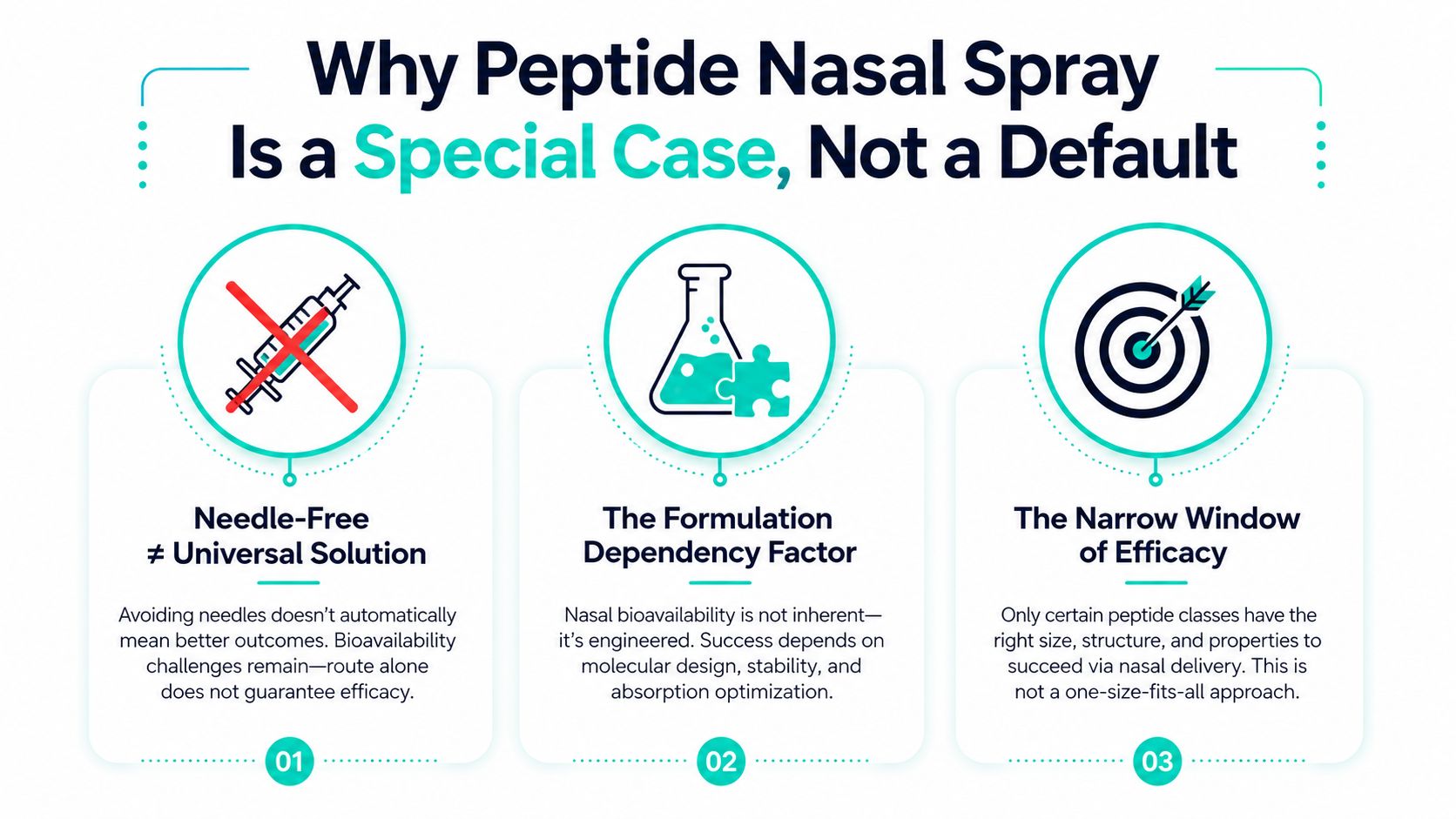
The route is established for only a few peptides, and that matters more than enthusiasm around convenience. Verified data names desmopressin, calcitonin-salmon, nafarelin, and buserelin as the FDA-approved nasal forms, which is a very short list compared with the broader peptide universe. That does not make intranasal delivery weak, it makes it selective.
A peer-reviewed review also frames the field as more mature for CNS-targeted molecules than for general systemic peptide replacement, with many programs still preclinical or in development PMC review. This is a useful procurement signal. If a vendor or protocol suggests the nasal route is a default fit for a broad peptide class, the claim is already out of step with the evidence.
Practical rule: if a peptide has no strong human intranasal data and no clear CNS rationale, the nasal route is a hypothesis, not a procurement standard.
A close look at the review literature shows a tighter, not broader, set of examples. It highlights a few better-supported peptides, such as semax, selank, oxytocin, desmopressin, and calcitonin, instead of treating nasal spray as a universal platform PMC review. That selectivity is a useful filter for buyers because it points to where the field has reproducible pharmacokinetics and where it does not.
For a procurement officer, the implication is direct. A nasal claim is only meaningful if the peptide class, molecular size, and formulation all align with known intranasal performance. Otherwise, you are buying a delivery story, not a validated exposure pathway.
The nasal cavity looks simple from the outside, but it works as a tight screening system once a peptide lands on the mucosa. The surface area is large and highly vascularized, yet the route is still limited by mucociliary clearance, local enzymes, and the fact that peptides are not small, inert molecules. The nasal mucosa is less a doorway than a checkpoint, screening by weight, polarity, and persistence.
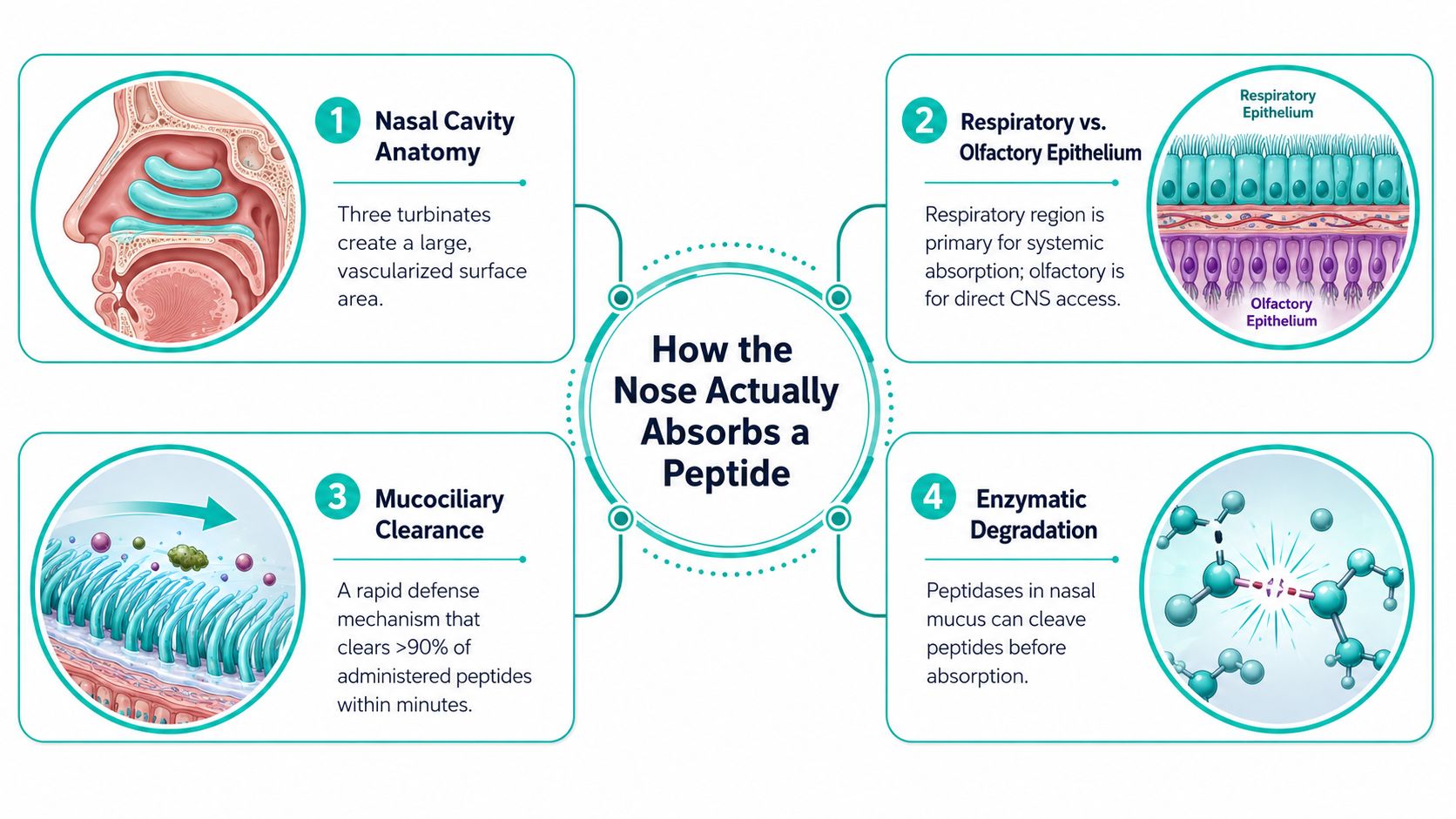
Most systemic absorption happens through the respiratory epithelium, the main vascularized surface inside the nasal cavity. The olfactory region is the exception because it can provide a route toward the central nervous system, but that pathway is still an active research area rather than a routine manufacturing assumption PMC review. That distinction matters because a peptide can perform well in a “nose-to-brain” context even if its whole-body exposure remains modest.
The comparison brief gives the clearest operational rule, and it is not generous to large molecules. Small peptides under roughly 1,000 Da may sometimes reach 10 to 40% relative bioavailability, while larger peptides above roughly 2,000 Da often fall below 5 to 10% without enhancers compare peptide nasal spray vs injection. For larger peptides, intranasal bioavailability data are often missing or weak altogether, which is a stronger warning than a low number because it means the route has not been convincingly characterized.
That is why a nasal peptide should be evaluated like a gated compound, not a broad-label drug class. Small, more permeable molecules survive the route more readily. Larger or more hydrophilic peptides are more likely to be cleared, degraded, or left behind before meaningful absorption occurs.
The mucosa does not care how elegant the target story is. It cares whether the molecule can stay intact long enough to cross.
A nasal spray label can look simple and still misstate what the vial will do in practice. Standard metered pumps usually deliver about 0.1 mL per actuation, so the concentration has to be calculated backward from the intended microgram-per-spray dose peptides.academy. If that math is off, the printed dose and the delivered dose separate immediately.
The worked example is straightforward. A 200 mcg target dose per spray requires a 2 mg/mL solution, so a 10 mg vial must be diluted to 5 mL to keep each actuation aligned with the intended dose. That calculation is not a cosmetic detail. It separates a reproducible research tool from a vial that changes dose with every spray.
| Peptide Size Class | Approximate MW | Typical Intranasal Bioavailability |
|---|---|---|
| Small peptides | Under roughly 1,000 Da | 10 to 40% in some cases without enhancers |
| Larger peptides | Above roughly 2,000 Da | Often below 5 to 10% without enhancers |
| Larger peptides in general | Larger peptide classes | Often under 20% intranasal bioavailability |
The comparison brief shows the practical boundary, and it is not friendly to large molecules compare peptide nasal spray vs injection. Small peptides under roughly 1,000 Da may sometimes reach 10 to 40% relative bioavailability, while larger peptides above roughly 2,000 Da often fall below 5 to 10% without enhancers. For larger peptides, intranasal bioavailability data are often missing or weak altogether, which is a stronger warning than a low number because it means the route has not been convincingly characterized.
A nasal peptide should be evaluated like a gated compound, not a broad drug class. Small, more permeable molecules survive the route more readily. Larger or more hydrophilic peptides are more likely to be cleared, degraded, or left behind before meaningful absorption occurs.
Buffer choice, pH, and permeation enhancers matter because the nose does not forgive unstable chemistry. The guide makes clear that not all sprays behave the same, and that claim is supported by the way formulation variables shift exposure peptides.academy. Enhancers can move a peptide above the baseline absorption ceiling, but the route still remains formulation dependent and far from universally efficient.
Fill-volume control and pump priming matter for another reason. If the solution is not mixed uniformly, or if the pump is inconsistent, the delivered dose becomes batch-sensitive. In a research setting, that kind of drift later gets misread as biology when it was caused by poor formulation control.
A procurement officer should treat the spray system as a chain, not a bottle. The peptide, the diluent, the bottle geometry, and the actuator all affect whether the nominal dose survives the trip from vial to nasal mucosa. For a practical check on whether a supplier can document that chain, see this third-party testing verification guide.
A credible Certificate of Analysis is not a PDF with a purity number on it. For a peptide nasal spray program, it has to tie identity, purity, batch history, and analytical methods together in a way a lab can audit later. Without that, the paper trail is too thin to defend a result or a purchase.
A defensible batch should be supported by HPLC or UPLC for purity, plus LC-MS or HRMS for identity. A procurement-grade file should also address residual solvents, endotoxin, moisture content, and the behavior of the material under storage or accelerated stability conditions. If a vendor leaves out the method, the lot number, or the batch tie, the number on the page has very limited value.
The sourcing standard should also include the practical fields that make the document auditable, not just impressive. A batch-specific COA should show the lot identifier, test date, method names, reported purity, and the responsible testing party. That's the minimum needed to link what was ordered to what arrived.
A generic purity claim does not tell you whether the material in a given vial matches the material in the vendor's marketing image. That's especially important for nasal programs because formulation steps, moisture uptake, and handling can change usable quality even when the peptide identity is correct. If the stability profile isn't documented, the spray may behave differently after storage than it did on release.
For teams that need an external check on stated quality, a vendor's third-party testing posture matters. The internal supplier file should be easy to reconcile with independent data, not built on trust alone. Celonyx Labs verification workflow is the kind of audit step procurement teams should expect from any serious peptide vendor.
Procurement rule: a COA without a lot number, a method, and a batch tie is a claim, not a control document.
The useful question is whether a peptide's size, polarity, and intended target fit nasal delivery at all. The route is narrow, not generic. The literature supports a short list of better-aligned candidates, while many larger peptide classes remain poor fits unless formulation work changes the absorption profile in a meaningful way.
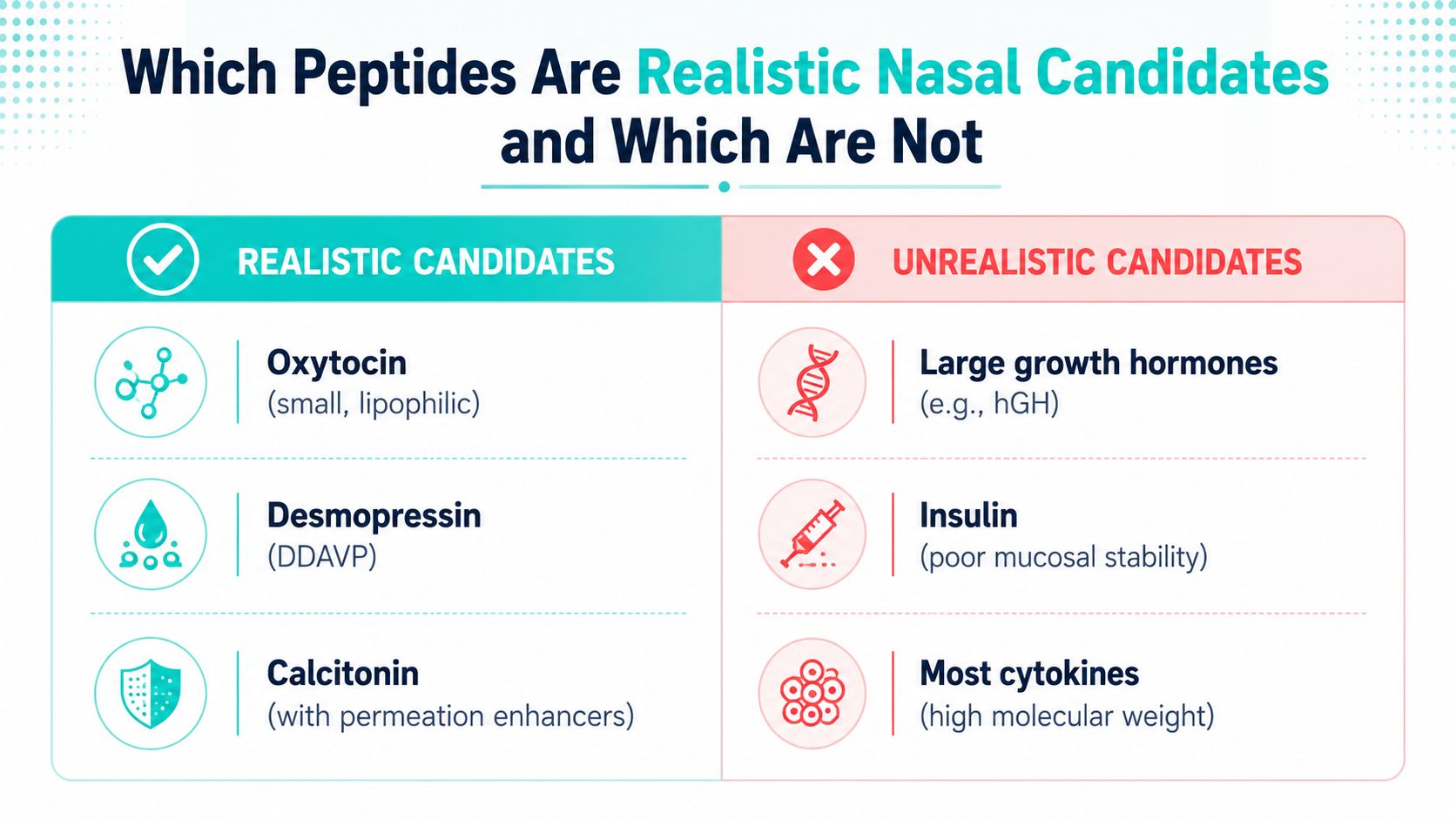
The comparison brief points to desmopressin, calcitonin-salmon, nafarelin, and buserelin as the core FDA-approved nasal examples. Those are the compounds that consistently show up when the route is discussed in a serious way. The review literature also places semax, selank, and oxytocin among the more visible CNS-oriented candidates, which fits the route's relative strength in neuroactive and pituitary-linked programs. That does not mean they behave the same way in practice, only that the evidence base around them is more credible than it is for most other peptide classes. For a closer look at one of the CNS-focused examples, see Selank peptide use.
Large growth hormones, insulin, and most cytokines are poor default candidates when the goal is reliable nasal absorption. The constraint is transport physics. Larger peptides and proteins generally absorb poorly without formulation help, and the cited review-style comparison notes that human bioavailability data for many peptides are absent or weak.
A procurement team should read that as a ceiling, not a promise. If a vendor is marketing a bulky peptide as a routine nasal candidate without showing why the molecule should cross the nasal barrier, the claim is ahead of the evidence.
A molecule earns nasal consideration when three conditions line up. Its size and physicochemical behavior need to make transit plausible. The target tissue also has to benefit from local nasal access or CNS access. The formulation then has to keep the peptide stable long enough for the route to matter.
That logic is restrictive by design. Most peptides fail one of the three tests, and many fail two. The ones that remain are the compounds worth evaluating first, because they fit the route instead of forcing the route to compensate for the molecule.
A workable protocol starts with storage, not the spray bottle. Lyophilized peptide stock needs handling that preserves identity and limits moisture exposure, because instability at the stock stage will contaminate every downstream measurement. If the material has already degraded before reconstitution, no amount of careful spraying will rescue the data.
Vehicle choice matters because the nasal cavity is sensitive to formulation chemistry. Buffer, pH, and any permeation enhancer need to be selected together, not one by one, since each component changes stability and absorption behavior. The formulation should also be treated as a controlled variable, not a convenience step.
The difference between two labs often comes down to whether they document the same mundane variables. A pump that was not primed, a spray that was delivered unevenly, or a formulation that sat too long at the wrong temperature can all move the result more than the peptide itself. That is especially true in intranasal work, where delivery efficiency already sits behind a biological gate.
If the protocol cannot survive a methods section, it probably won't survive review. Reproducibility is mostly paperwork plus discipline, with chemistry doing the rest.
Research-use peptides, GMP-adjacent production, and human exposure sit on different regulatory tracks, and those tracks should not be blurred in procurement language. A supplier can support laboratory research, but that is not the same thing as making an exposure claim for human use. The boundary matters because a nasal spray can look consumer-friendly while still being inappropriate outside a defined research or supervised clinical context.
A vendor's public documentation is often more revealing than its sales copy. Clear terms, a published shipping policy, and accessible contact channels are not just customer-service features, they are signs that the supplier expects institutional review and wants its orders traceable. In the same way, a lot number and batch history tell you the company understands auditability.
Fast shipping matters too, but only in context. Research timelines collapse when materials arrive late, yet a fast shipment is useful only if the vial is documented well enough to use without dispute. A procurement officer should ask whether the supply chain is designed to be quick, traceable, and supportable, not merely fast.
A stated purity percentage is not enough on its own. It becomes meaningful only when the COA, the method, and the external verification all point in the same direction. For institutional purchasing, that means the vendor file should include policy documents, contact points, and a clear route for resolving technical questions before the order is placed.
The practical standard is simple. If a supplier can't explain the batch, the test method, or the shipping and return rules in writing, the procurement risk is higher than the peptide risk. That's the wrong way around.
The most reliable peptide vendors make procurement easy to audit. They provide a batch-specific COA, method details, and a clear contact path before the order moves forward. If any of those pieces are missing, the buyer is taking on avoidable uncertainty.

A procurement workflow built on those four checks is more defensible than one built on price alone. It also surfaces the difference between a material that is research-ready and one that is only advertisement-ready.
The deeper takeaway is simple. Peptide nasal spray is a powerful but narrow research tool, and the labs that get the best results treat formulation, analytics, and vendor selection as part of the experiment, not overhead.
If your lab needs peptide sourcing that's built around documented quality, transparent policies, and research-first support, review the catalog and operating standards at Celonyx Labs. Their model is relevant to this topic because intranasal peptide work lives or dies on batch traceability, formulation clarity, and reliable fulfillment. Start there if you want procurement that supports the experiment instead of complicating it.
Celonyx Labs customer support email is a practical first contact because 62% of customers used

Peptide purity testing for CROs in 2026: the HPLC, mass spec, COA, and reference standard

Research peptides for independent researchers: verify CoAs, purity, reconstitution, and storage without institutional backup. Full
FOR RESEARCH USE ONLY. Products sold by Celonyx Labs are intended exclusively for laboratory and scientific research. They are not intended for human or veterinary use, consumption, diagnosis, treatment, cure, or prevention of any disease. By purchasing from this site, you acknowledge that you understand the intended research purpose of these materials and agree to comply with all applicable laws and regulations.