
Customer Support Email Contact for Celonyx Labs (2026 Guide)
Celonyx Labs customer support email is a practical first contact because 62% of customers used
Celonyx Labs customer support email is a practical first contact because 62% of customers used email for support in the past year, while phone ranked behind it at 48%. Across multichannel organizations, email still handles 39% of total support interactions, which is why labs should treat it as a formal procurement channel, not a casual inbox.
If you're trying to clear a delayed peptide shipment, confirm lot documentation, or get language that your purchasing office can place on file, you usually don't need marketing copy. You need the contact route, the business address, and an email format that gets a useful reply without three more rounds of clarification.
When a lab manager is standing over a freezer inventory sheet and asking whether a peptide order has shipped, scrolling around for contact details wastes time. The fastest move is to save the supplier's support information in your internal vendor directory exactly as published.
Use this contact block for purchasing files, approved vendor sheets, or internal lab SOP notes:
For labs that buy directly through an online catalog, it also helps to keep the ordering path on file with the support contact. The direct catalog entry point is buy peptides online.
Research procurement usually needs a written trail. A phone call can settle a simple status question, but it won't give your department administrator a copyable response for the PO file.
Use customer support email when you need:
Practical rule: If the question affects receiving, reimbursement, or audit paperwork, send it by email first.
At 4:30 p.m., receiving flags a peptide shipment, the PI wants release confirmation, and accounts payable cannot match the invoice language to the PO. In that situation, customer support email is not just a help channel. It is the record your lab can file, forward, and use if the issue needs escalation.
That is why email stays central in lab procurement. It holds the order context in one place: product name, catalog reference, lot or batch identifiers, requested documents, ship-to details, and the exact correction the team needs from the supplier. A phone call can help clarify a narrow point, but it usually creates extra work afterward because someone still has to summarize the answer for the vendor file.
Analysts cited in these email support statistics found that email remains one of the most common support channels across industries. For lab buyers, the reason is practical. Institutional purchasing depends on written approvals, attachable documentation, and language that matches PO and receiving records.
A useful supplier email thread does more than ask for status. It supports the internal workflow around the order.
Teams usually rely on email when they need to keep these details together:
This is the difference between ecommerce support and research purchasing. Labs are not only trying to get an answer. They are building a file that can survive handoffs between procurement, receiving, QA, and the study team.
A clean process still fails if messages do not arrive or replies get filtered. Support communication depends on standard mail controls such as SPF, DKIM, and DMARC, which are explained in How to Improve email deliverability.
I treat this as an operational risk, not a technical footnote. If a vendor sends a lot confirmation, revised invoice, or shipping exception notice and the message never reaches the shared inbox, the delay shows up as a receiving problem first. Using a monitored customer support email route helps labs keep the thread intact, confirm what was sent, and document whether the delay came from the supplier or the mail system.
Labs shouldn't use every support channel the same way. The right route depends on whether you need a documented answer, a live status check, or a policy reference you can attach to a vendor file.
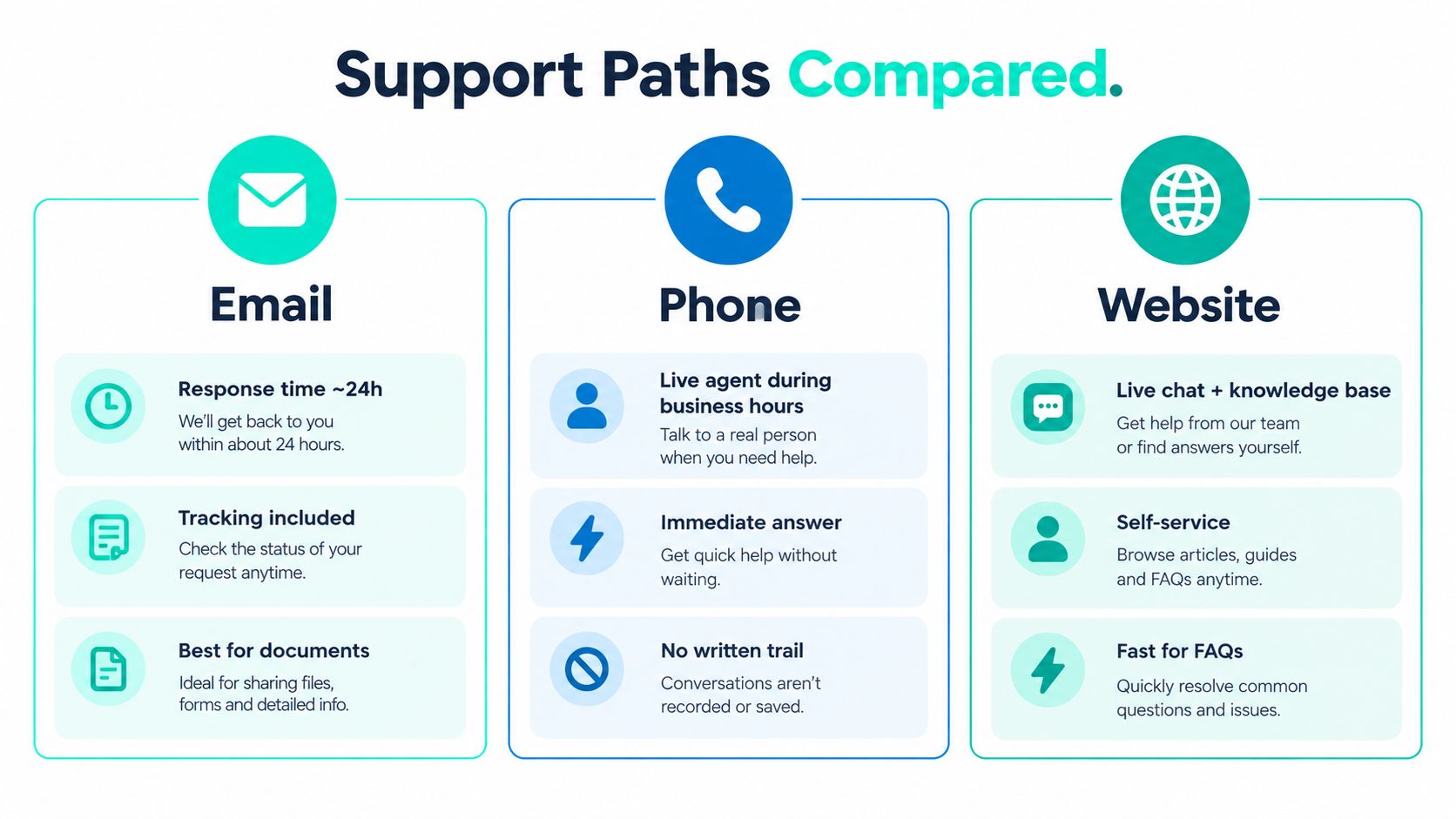
| Support path | Best use in a lab workflow | Main drawback |
|---|---|---|
| Order details, lot questions, testing documentation requests, return or refund questions, shipping clarification | Not ideal when you need an immediate verbal answer | |
| Phone | Time-sensitive status checks, same-day shipping clarification, quick confirmation that support received an urgent issue | No built-in written record unless your team documents the call afterward |
| Website pages or forms | Policy review, basic contact intake, checking store terms before writing support | Can add an extra step if the form strips context or attachments |
For a peptide order with multiple moving pieces, email is usually the cleanest path. You can include the order number, product name, institutional reference, and the exact document you need in one thread.
Phone is better when the issue is immediate and narrow. If receiving says nothing arrived and the investigator needs an answer before end of day, call first, then send a follow-up email summarizing the conversation.
Website support paths still matter because they anchor formal answers to published policies. Teams trying to improve cross-channel consistency can learn from broader work on building connected brand touchpoints, but in lab procurement the core requirement stays the same. The usable answer is the one your buyer can file, forward, and verify.
A good support path for labs is the one that survives handoff from scientist to buyer to accounts payable.
Support teams often say they reply “as soon as possible.” That isn't a useful standard for procurement. Labs need a working expectation so they know when to wait, when to follow up, and when to escalate.
For customer-facing email, a practical benchmark is to treat first reply time as an SLA metric. Strong teams target under 1 hour for urgent or high-value inquiries and under 4 hours for standard support, with same-business-day as the outer ceiling according to this email response time guide.
Not every peptide support email needs the same clock. Mark an email as urgent when it affects scheduled work, receiving windows, or a payment release.
Use urgent phrasing for:
For routine product questions, a standard queue is reasonable. For anything tied to timing, write the impact directly in the first two lines.
Industry summaries also note a gap between customer expectations and actual support performance. Average first response times sit around 12 hours 10 minutes, while customers increasingly expect replies within 1 hour, as discussed in this response-time benchmark summary.
That gap matters for labs because a vague message gets routed slowly. If shipping timing is part of the problem, it helps to review the supplier's published logistics context such as fast shipping companies before writing. Then your email can ask a precise question instead of a broad one.
Most bad support threads start with missing context. The sender knows the order. The support team doesn't. A usable customer support email should read like a short procurement record, not like a casual note.
Subject: Order Status Request for [Order Number] and Expected Delivery Timing
Hello,
I'm writing to confirm the current status of order [Order Number] for [Product Name] placed on [Order Date].
Please confirm:
For internal reference, our PO or institutional reference is [PO Number or Lab Reference]. If any action is needed from our side, please state it in your reply.
Thank you,
[Name]
[Lab or Department]
[Phone]
Subject: Documentation Request for [Product Name] on Order [Order Number]
Hello,
Please provide the available documentation for [Product Name] associated with [Order Number]. If applicable, include lot or batch-identifying information and any testing or quality documentation available for this material.
We need the reply in writing for our purchasing file. If the documentation is posted elsewhere, please point us to the exact policy or document location.
Regards,
[Name]
[Institution]
Teams that want more general support phrasing can borrow structure from Shopify support ticket templates and then tighten the wording for lab procurement.
A short video can help teams standardize tone before they build their own macros:
Subject: Return or Refund Eligibility Question for Order [Order Number]
Hello,
I'd like written clarification on return or refund eligibility for [Product Name] under order [Order Number].
Please confirm:
Our preference is to keep this request in one email thread for procurement records.
Keep the ask specific. “Please advise” creates more back-and-forth than “Please confirm eligibility and required documents.”
Fragmented emails slow support down. One message asks for shipping status. A second asks for documentation. A third adds the PO number. The supplier then has to reconstruct the issue from separate threads, and your team waits longer for a complete answer.
A strong inquiry has five parts, in order:
Reason for contact
Put the core request in the first sentence. Example: “We need shipment status and available lot-related documentation for Order 45821.”
Identifiers
Include order number, product name, internal PO reference, and the contact person for follow-up.
Specific request list
Ask for the exact items you need. Status, documentation, policy confirmation, shipping window, or correction.
Operational context
State why timing matters if it does. Don't dramatize it. Just connect it to receiving, scheduling, or review.
Clear next step
End with a direct action request: “Please reply in writing with shipment status and any available documentation.”
Procurement emails break down when buyers send too little information or too much narrative.
Avoid these habits:
If your team uses one standard format for peptide vendors, routing gets faster and internal handoffs get cleaner. The email itself becomes the intake record.
A well-run support workflow usually moves through acknowledgment, routing, and then either resolution or escalation. Knowing that sequence helps labs distinguish a normal queue delay from a real support failure.
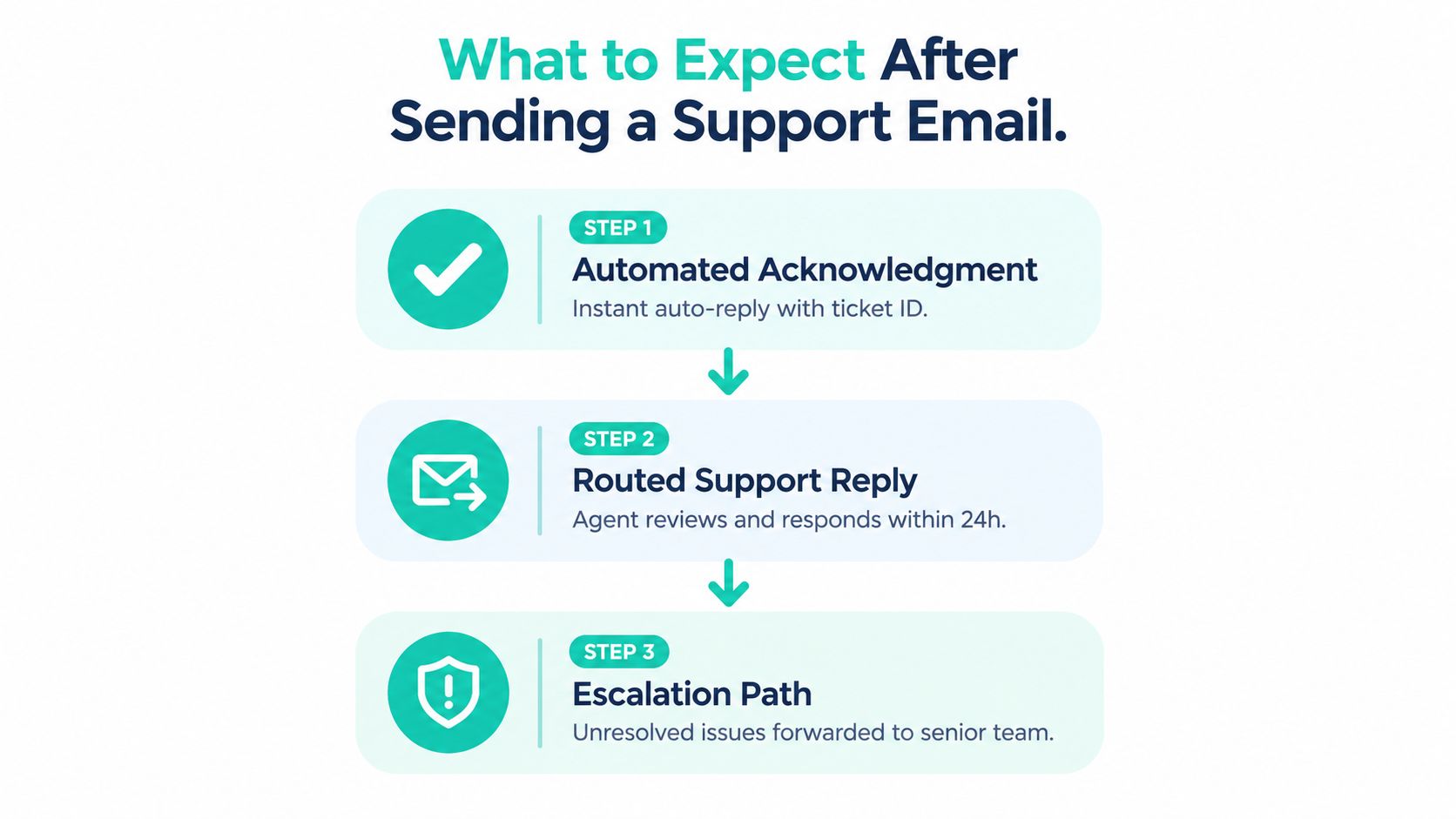
Most support emails trigger an acknowledgment first. That doesn't mean the issue is resolved. It means the message entered a queue and should now be trackable.
After that, the supplier may route your message based on topic:
If your first message was incomplete, support will often come back asking for the pieces they need to proceed. Typical follow-ups include the purchase order reference, invoice details, product identity, or a clarified request for documentation.
Some vendors also separate customer service from quality or operations review. That can change who replies without meaning the issue has stalled.
The fastest thread is usually the one that gives support enough information to avoid asking a single clarification question.
For quality-related topics, the support team may answer with published assurance language or point to available testing references. Treat that as part of the procurement file, especially if your institution expects vendor communication to be retained with the order record.
A support thread becomes more useful when it ties directly to the supplier's published policies. That's the difference between an informal answer and a procurement record that your institution can defend later.
If you're asking about a return, shipping timing, privacy handling, or terms, reference the relevant policy in the body of the message. That gives support a clear framework for the reply and reduces the chance of a vague answer that doesn't match the published rules.
This is especially important when a lab buyer is acting for someone else. The scientist wants the material. Finance wants documentation. Receiving wants timing. Procurement wants consistency. One email can satisfy all four if it anchors the question to the applicable policy.
A good vendor file includes more than invoices. It should also include policy-based correspondence that shows how exceptions, returns, or delivery questions were handled.
For teams formalizing that process, vendor review starts before the first problem appears. A broader internal checkpoint such as a vendor qualification process can help frame what should be stored, who approves exceptions, and how support responses get attached to the supplier record.
The point isn't bureaucracy for its own sake. It's to make sure a future dispute can be reconstructed from written materials without guessing what happened on a phone call months earlier.
The difference between a weak inquiry and a strong one is usually the level of usable detail. Support teams can only route what they can identify.
Subject: Need update
“Hi, I ordered peptides and haven't heard anything. Please update me as soon as possible.”
This message creates work. Support has to identify the order, guess which product is involved, and ask what kind of update you want.
Subject: Shipment Status and Documentation Request for Order 45821
“Hello, please confirm the current shipment status for Order 45821 covering [Product Name]. Also let us know whether lot-related documentation or available testing documentation can be provided for our procurement file. Our internal PO reference is BIO-117. Please reply in writing so we can attach the response to the order record.”
That version gives support a route, a purpose, and a defined response format.
Poor: “Can you tell me your policy?”
Better: “Please confirm whether Order 45821 falls within your published return or refund process and what supporting details you need from us.”
Shorter isn't always better. Clearer is better. When your message reads like a procurement instruction instead of a rushed note, the vendor can answer without reconstructing your intent.
Customer support email works best when labs treat it as part of procurement operations. It's where order questions, shipping timing, documentation requests, and policy clarifications become a written record that other people inside the institution can use.
| Need | Best first move | Include in the email |
|---|---|---|
| Order status | Email, then phone if timing is critical | Order number, product name, PO reference, requested delivery update |
| Lot or testing documentation | Product identity, order reference, exact documents requested | |
| Refund or return question | Order number, issue summary, request tied to published policy | |
| Urgent shipment problem | Phone plus follow-up email | Brief issue summary, timing impact, written recap after call |
| General policy check | Website policy review plus email | Specific policy question and the policy page you're referencing |
One supplier option in this space is Celonyx Labs, which sells research peptides online and publishes contact information, policy pages, quality-related statements including 99% purity, and references to independent third-party testing. In practice, that means a buyer can pair the customer support email workflow with published purchasing information instead of relying on ad hoc outreach.
The teams that spend the least time chasing vendors usually aren't sending more emails. They're sending better ones.
Celonyx Labs supplies research peptides through an ecommerce catalog and supports labs that need written order communication, shipping clarification, and policy-backed purchasing records. If you want a vendor page your team can save alongside its support workflow, visit Celonyx Labs.
Celonyx Labs customer support email is a practical first contact because 62% of customers used

Peptide purity testing for CROs in 2026: the HPLC, mass spec, COA, and reference standard

Research peptides for independent researchers: verify CoAs, purity, reconstitution, and storage without institutional backup. Full
FOR RESEARCH USE ONLY. Products sold by Celonyx Labs are intended exclusively for laboratory and scientific research. They are not intended for human or veterinary use, consumption, diagnosis, treatment, cure, or prevention of any disease. By purchasing from this site, you acknowledge that you understand the intended research purpose of these materials and agree to comply with all applicable laws and regulations.