

Sermorelin vs Tesamorelin: A 2026 Research Comparison
Tesamorelin and sermorelin are compared for the same reason that weak evidence gets mistaken for
The shortest insulin syringe needle now used in mainstream practice is 6 mm, and a 4 mm pen needle is also widely available, a sharp contrast to the 19 to 26 mm needles used in the early era of insulin care Needle Technology for Insulin Administration: A Century of Innovation. That shift didn't happen because manufacturers wanted a trend. It happened because a century of engineering, imaging, and clinical experience made shorter needles a more precise way to reach the subcutaneous tissue where insulin belongs.
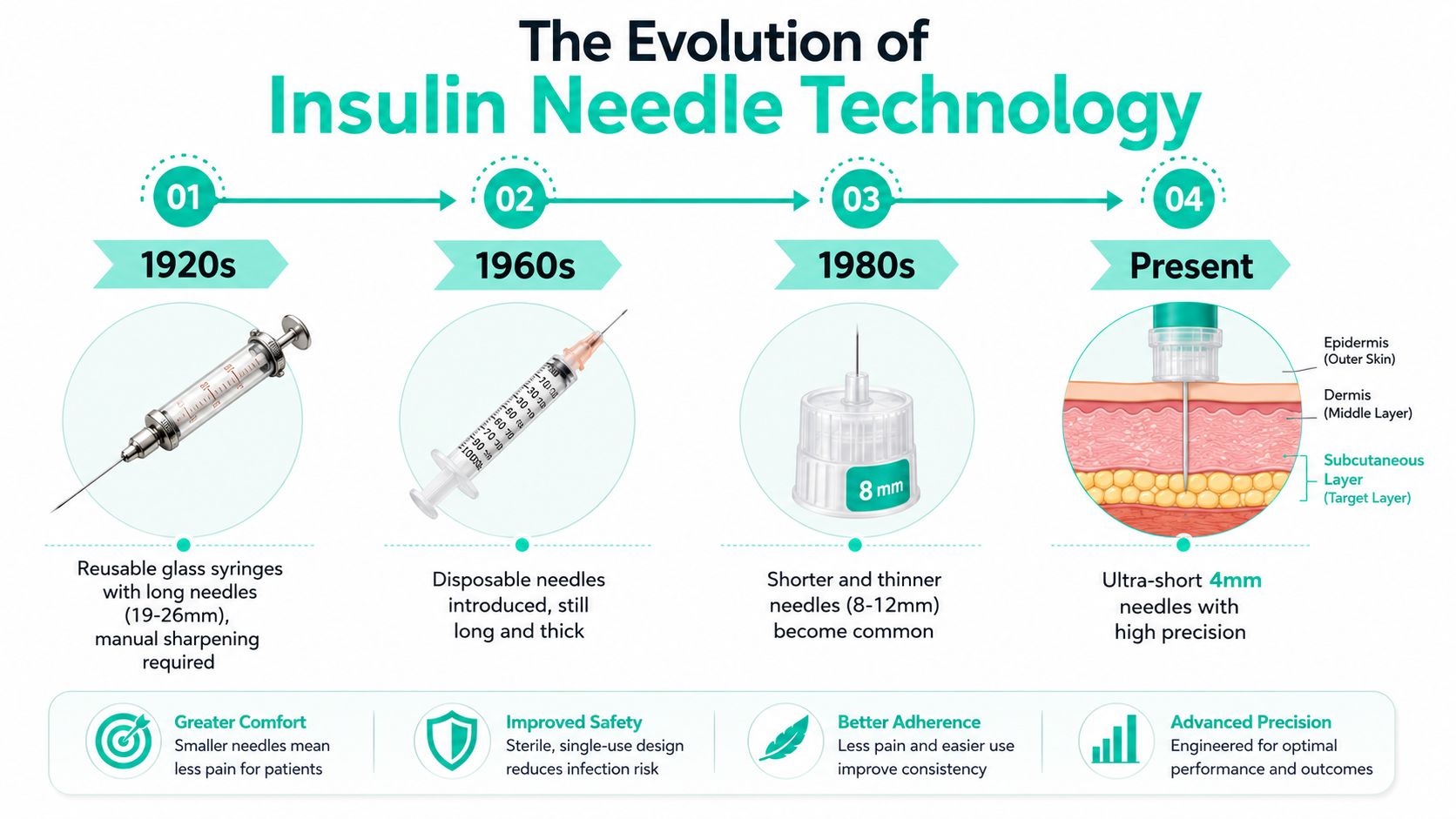
The earliest insulin injections depended on hardware that looks very different from what people use today. Needles were long, reusable, and often had to be sharpened by hand, which made each injection more labor-intensive and less consistent. A century of insulin delivery innovation changed that path, moving needle design from rough utility to precision engineering Needle Technology for Insulin Administration: A Century of Innovation.
The original design assumption was simple, if a needle was long enough, it would do the job. Imaging work using ultrasound and computed tomography showed a different reality, insulin can be delivered effectively into the subcutaneous tissue layer with much less needle length than older devices required. Once that was clear, needle design stopped relying on guesswork and became a question of fit, anatomy, and delivery accuracy.
That shift is what created the short-needle options used now. Modern syringe needles are commonly 6 mm, pen needles are commonly 4 mm, and some are as fine as 34-gauge. Those measurements reflect better manufacturing, a clearer understanding of skin and fat thickness, and a stronger focus on comfort without giving up reliable insulin delivery.
Practical rule: short needles are not a compromise. They reflect better science about where insulin needs to go.
The change also shows up in product history. A review of needle length selection reports that 16 mm needles were still being used for subcutaneous injection in 1985, and 12.7 mm needles appeared in the early 1990s before the field moved into 4 mm, 5 mm, 6 mm, and 8 mm options Insulin needle length selection review. BD later introduced an 8 mm insulin syringe in 1997, a 5 mm, 31G pen needle in 1999, a 4 mm, 32G pen needle in 2009, and by 2012 its shortest insulin syringe needle was 6 mm.
As the devices changed, use patterns changed too. One clinical review reported that 8 mm needles were still used worldwide by about 50% of injecting patients in 2010, and their use then declined as shorter needles became more common. The main point is straightforward. Short needles for insulin are not a marketing shortcut. They are the visible result of a long technical progression toward safer, simpler subcutaneous delivery.
A needle label only looks confusing until you separate its two parts. Length tells you how far the needle extends. Gauge tells you how thick it is. In practice, length affects whether insulin reaches the right tissue layer, while gauge affects how the injection feels and how easily insulin moves through the needle.
The short lengths used most often are 4 mm, 5 mm, 6 mm, and 8 mm. Those sizes fit the modern approach to subcutaneous insulin delivery, where the goal is to place insulin under the skin without going so deep that muscle becomes a concern. Gauge works in the opposite direction from what many people expect. A higher gauge number means a thinner needle. So a 31G needle is thinner than a 29G needle.
That thickness matters because comfort and flow have to work together. A thinner needle usually feels gentler at the skin surface, but if the wall design is poor, insulin can be harder to push. Current short needles are built to balance those trade-offs with thin-wall or ultra-thin-wall construction, which helps keep flow steady while lowering insertion force, as reflected in current product design choices from major manufacturers embecta product portfolio.
Here's a simple way to read the package:
| Common Short Insulin Needle Specifications | |||
|---|---|---|---|
| Length | Gauge Range | Format | Best For |
| 4 mm | 31G to 32G | Pen needle | Maximum simplicity, very short subcutaneous delivery |
| 5 mm | 31G | Pen needle | Short-needle users who want a little more length without moving into longer sizes |
| 6 mm | 31G to 32G | Syringe or pen format | A widely used short option that stays comfortably within the short-needle category |
| 8 mm | 31G | Syringe or pen format | Patients who've been advised to stay with a longer short-length option |
The most widely used short insulin pen needles often come in 6 mm × 31G and 8 mm × 31G versions, and manufacturers commonly pair short lengths with these thinner gauges to support day-to-day use. That pairing matters because the product category is not just about being small. It is about matching a short length with a diameter that patients can tolerate repeatedly.
A needle that looks fine on paper can still feel wrong in use if the gauge and wall design are not matched well.
If you want a closer look at how gauge numbers map to needle thickness, see this needle gauge reference. The main point is straightforward. For insulin, short length and carefully engineered thinness work together.
A century of insulin injection design has moved toward shorter, thinner, and more predictable needles because consistency matters as much as comfort. Shorter needles help the people most likely to inject too deep, but their value reaches well beyond that group. The main advantage is repeatable delivery, a needle that reliably reaches the subcutaneous layer without drifting into muscle gives patients and clinicians one less variable to manage.
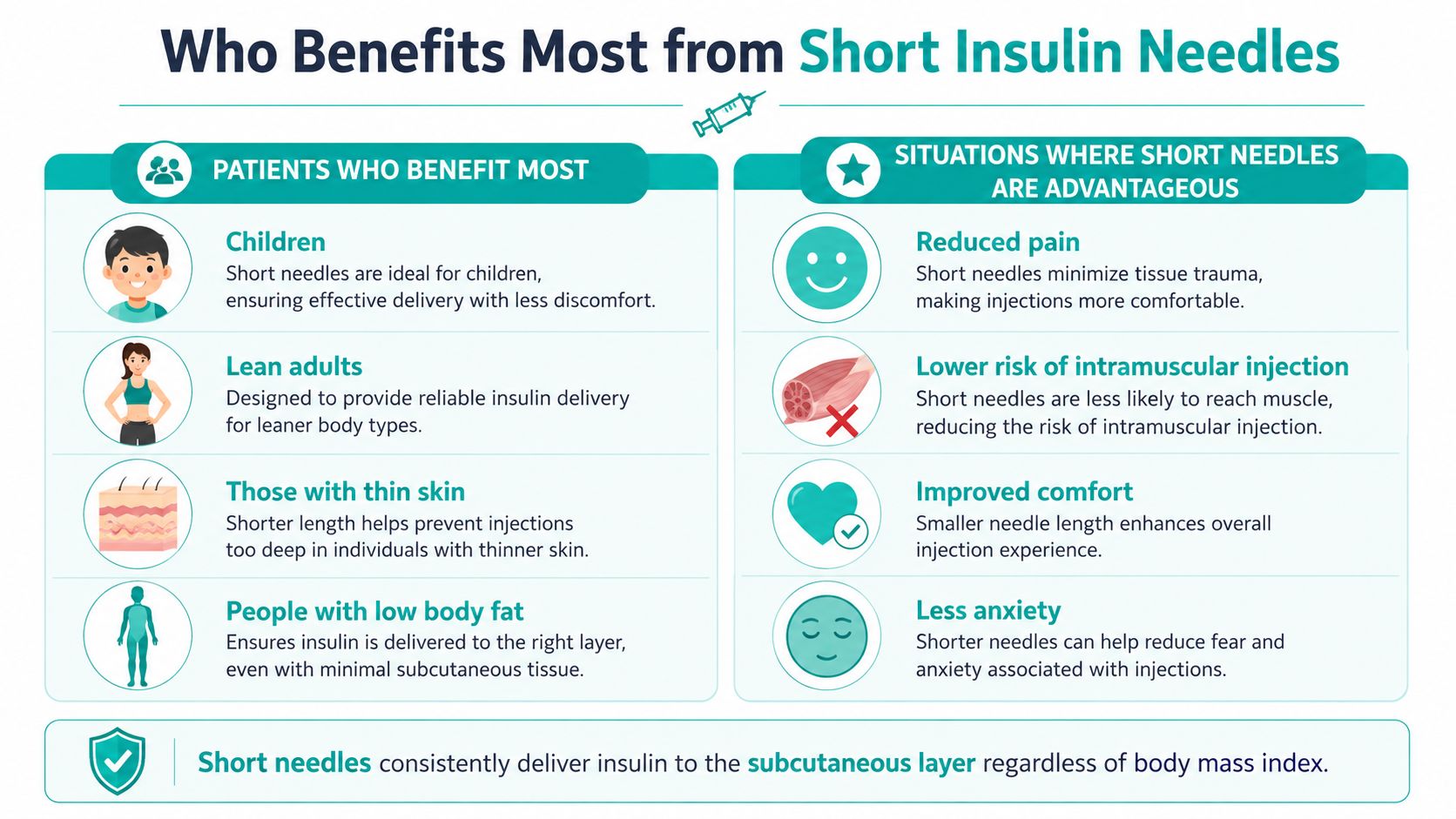
Children often do well with shorter needles because their bodies leave less margin for error, and lean adults can face the same issue. People with lower body fat or thinner skin also benefit because a shorter needle reduces the chance of reaching muscle, where insulin may behave differently than intended. That is why needle length selection reviews favor shorter options for many routine injections Insulin needle length selection review.
The clinical point is not that body size alone decides everything. Shorter needles give clinicians a more forgiving default when the target is a superficial fat layer rather than muscle, especially for people whose build or technique makes depth harder to judge. This is also why shorter needles are often favored when comfort and confidence matter during daily use.
For many patients, the practical question is simple, will the injection reliably stay in the right tissue layer without requiring extra technique. Shorter needles usually make that easier. They reduce the chance of inadvertent intramuscular injection and are often better tolerated, which can help people stick with regular treatment.
Useful frame: if the goal is reliable subcutaneous delivery, shorter needles usually make the job easier, not harder.
There are still situations where a clinician may advise a different length. Injection site choice, body composition, dexterity, and individual technique all matter, and some people who have used longer needles successfully may not need to change right away. Even so, shorter devices fit modern practice well because they lower the chance of injecting into muscle and are often easier to live with day to day.
The most important takeaway is that short needles for insulin are not limited to one body type. They are a strong option for many users, especially when comfort, predictability, and safe subcutaneous delivery are the priorities.
A short needle only performs well when the injection technique matches it. With 4 mm and 5 mm needles, the steps are simpler, but they still depend on clean skin, a steady angle, and good site rotation. Shorter needle design reflects years of engineering progress, not a shortcut around technique. The goal is precise subcutaneous delivery, and that still requires careful habits.
A step-by-step guide is shown below.
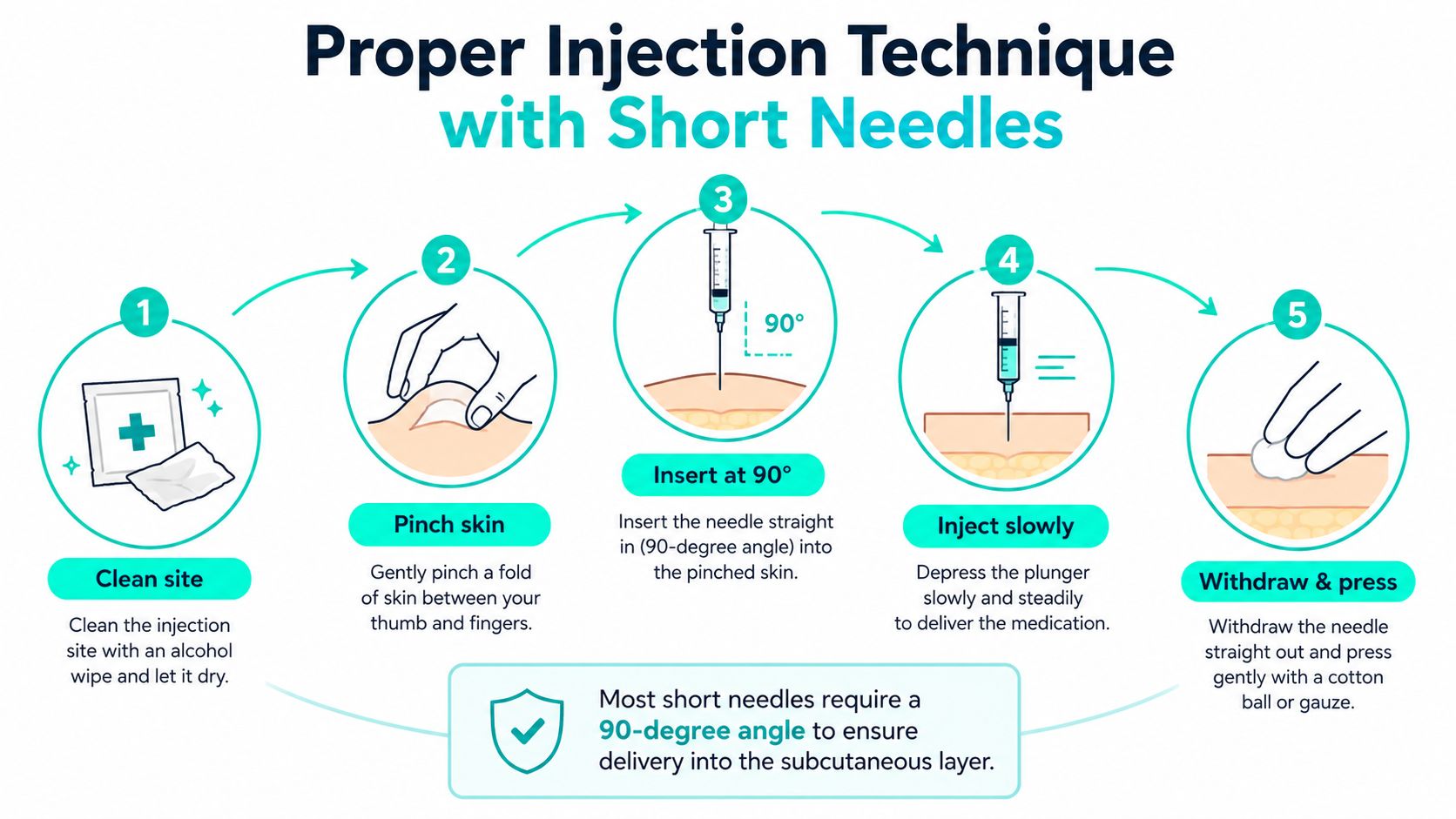
Most short needles up to 6 mm can be inserted at 90 degrees without a skin fold. That makes self-injection easier and reduces the number of decisions a person has to make at the bedside or at home. Short needle length itself helps the injection reach the subcutaneous layer, so the user does not need to rely as much on a steep angle or a more complicated pinch technique Insulin injection recommendations summary.
For a patient injecting into the abdomen, thigh, or upper arm, that difference is easy to feel. The motion is more direct, the setup is faster, and the injection is less likely to trigger second-guessing. For clinicians teaching technique, the lower complexity leaves fewer chances for confusion and more room for consistent practice.
Technique does not end once the needle enters the skin. Reusing needles raises the risk of tissue problems, and site rotation matters because repeated use of the same area can cause lipohypertrophy, which interferes with absorption Insulin injection recommendations summary. Expert recommendations also state that pen needles and syringes should be used one time only.
A practical sequence looks like this:
Needle length helps, but good technique finishes the job. If you are getting leakage, bruising, or the sense that the injection is not sitting right, the answer is often in the angle, site, or reuse pattern rather than in the insulin itself.
Short needles are only useful if they fit the device in your hand and the supply chain around it. Most modern insulin pens use standardized attachments, so short pen needles are broadly compatible across major pen systems, but the exact fit still needs to be checked against the product label before purchase. That matters because a needle that is clinically appropriate still fails if it isn't mechanically compatible.
People using pen injectors usually look for 4 mm, 5 mm, or 6 mm pen needles, while vial-and-syringe users may choose short syringe needles or pre-attached options depending on what's available through their pharmacy or supplier. When ordering, verify the length, gauge, and format together, since those three details define the actual product.
Legitimate procurement channels include pharmacies, medical supply companies, and reputable online retailers. For planned purchases, keep an eye on storage conditions, packaging integrity, and return policies. If you use insurance, confirm whether your plan covers the exact brand and size your clinician recommended, because the right needle on the shelf is still a problem if it isn't covered or stocked consistently.
Travel adds a separate layer of planning. Needles should stay in their original packaging, protected from heat, moisture, and crushing. If you fly, pack insulin and needles together in a way that keeps them accessible for screening and easy to identify as medical supplies.
Best practice: order replacement supplies before you're close to running out. Device compatibility only matters if you can get the same needle again.
For a practical buying overview, see this syringe and needle purchasing guide. The point of procurement isn't just price. It's continuity, so the needle you rely on today is still available next month, in the same length and gauge that worked for you.
A short needle can support safer insulin delivery, but safety still depends on how it is used. The engineering behind insulin needles has improved over time, yet the basics remain the same, correct disposal, steady site rotation, and a low threshold for asking questions when something feels off. That combination matters because a well-designed needle can still cause problems if the routine around it is inconsistent.
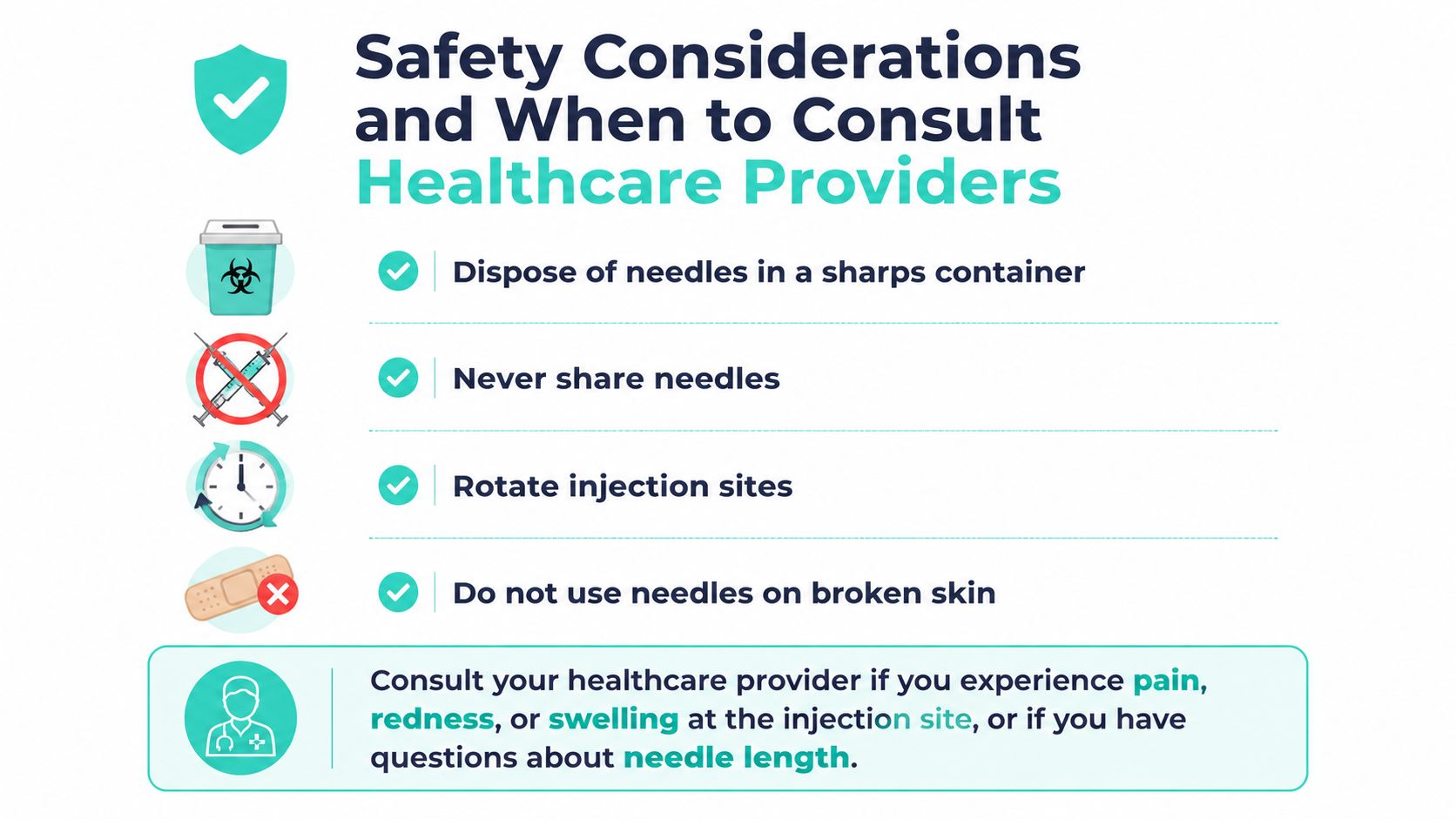
Used needles belong in a sharps container, not in the trash, sink, or recycling bin. They should never be shared, even if they look clean, and they should never be used through broken skin. Site rotation also matters, because repeated injections in one area can lead to tissue changes that affect insulin absorption and make glucose control less predictable, as noted in Insulin injection recommendations summary.
Short needles are not automatically less effective, and pain is not a reliable test of whether insulin reached the right layer. A sore injection can come from technique, an irritated site, or local tissue sensitivity. It does not by itself tell you whether the medication was delivered correctly.
Contact a healthcare provider if you notice ongoing pain, redness, swelling, or repeated bruising at injection sites. Reach out as well if your blood sugar becomes harder to predict, since uneven absorption can come from technique, site problems, or a needle choice that no longer fits your routine. If you are unsure about the length you are using, that is enough reason to bring it up at your next visit.
The most useful conversation is specific. Bring the needle length and gauge you are using, describe where you inject, and say whether you reuse needles or rotate sites consistently. If you also want to understand how insulin preparation fits into broader injection practices, bacteriostatic water use is a separate clinical topic that belongs in that discussion.
Short needles for insulin are safe and effective for most users, but the best choice still depends on your body, your device, and your care plan. If something about your injections feels off, ask for a technique review instead of guessing.
Tesamorelin and sermorelin are compared for the same reason that weak evidence gets mistaken for
The shortest insulin syringe needle now used in mainstream practice is 6 mm, and a

Popular advice treats tesamorelin like a universal fat-loss or anti-aging peptide. That framing is too
FOR RESEARCH USE ONLY. Products sold by Celonyx Labs are intended exclusively for laboratory and scientific research. They are not intended for human or veterinary use, consumption, diagnosis, treatment, cure, or prevention of any disease. By purchasing from this site, you acknowledge that you understand the intended research purpose of these materials and agree to comply with all applicable laws and regulations.