

Kisspeptin 10 for Sale Research Guide for Labs
A researcher searching “kisspeptin 10 for sale” may expect a straightforward catalog result. Instead, the

Bacteriostatic water is a sterile solution containing 0.9% benzyl alcohol used to dilute or dissolve medications and research compounds, like peptides, for injection, allowing for multiple uses from a single vial by inhibiting bacterial growth. In practice, it's used when you need a sterile diluent that can support repeated vial access, with opened vials commonly discarded at about 28 days after first puncture.
If you're standing at a bench with a vial of lyophilized peptide in one hand and a syringe in the other, the liquid you choose isn't a minor detail. It affects how cleanly the peptide dissolves, how safely you can withdraw repeat doses, and whether your later results reflect the compound itself or contamination introduced during prep.
That's why bacteriostatic water shows up so often in peptide research workflows. For anyone asking what is bacteriostatic water used for, the short answer is simple. It's a preserved sterile solvent for reconstituting injectable compounds, especially when the protocol involves more than one withdrawal from the same vial.
A peptide can arrive with excellent stated purity and still be mishandled in the first minute of prep. That's the part many newer researchers underestimate. They focus on peptide identity, storage temperature, and dose calculations, but treat the diluent like a generic consumable.
It isn't generic.
When you reconstitute a freeze-dried peptide, you're deciding what environment that compound enters before it ever reaches a tube, assay plate, or animal model. If the peptide is intended for repeat withdrawals over several days, a plain single-use water product and a preserved multi-use water product don't behave the same in practice. The right choice supports cleaner handling. The wrong one can introduce inconsistency into the simplest step of the protocol.
For peptide work, bacteriostatic water is commonly chosen because it's designed to dilute or dissolve injectable compounds while reducing the chance that repeated vial entry turns a clean prep into a contamination problem. If you need a refresher on the mechanics of mixing, this guide to peptide reconstitution workflow basics is a useful companion.
In high-purity peptide research, the diluent affects more than convenience:
Bench reality: If a result looks noisy after reconstitution, the peptide gets blamed first. Often the prep technique deserves equal scrutiny.
A good diluent choice won't rescue a bad protocol. But it does remove one common source of avoidable variability.
Bacteriostatic water sounds more complex than it is. At bench level, it's a simple formulation with a specific job. It gives you a sterile liquid base for dilution, plus a preservative that slows bacterial growth after the vial has been punctured.
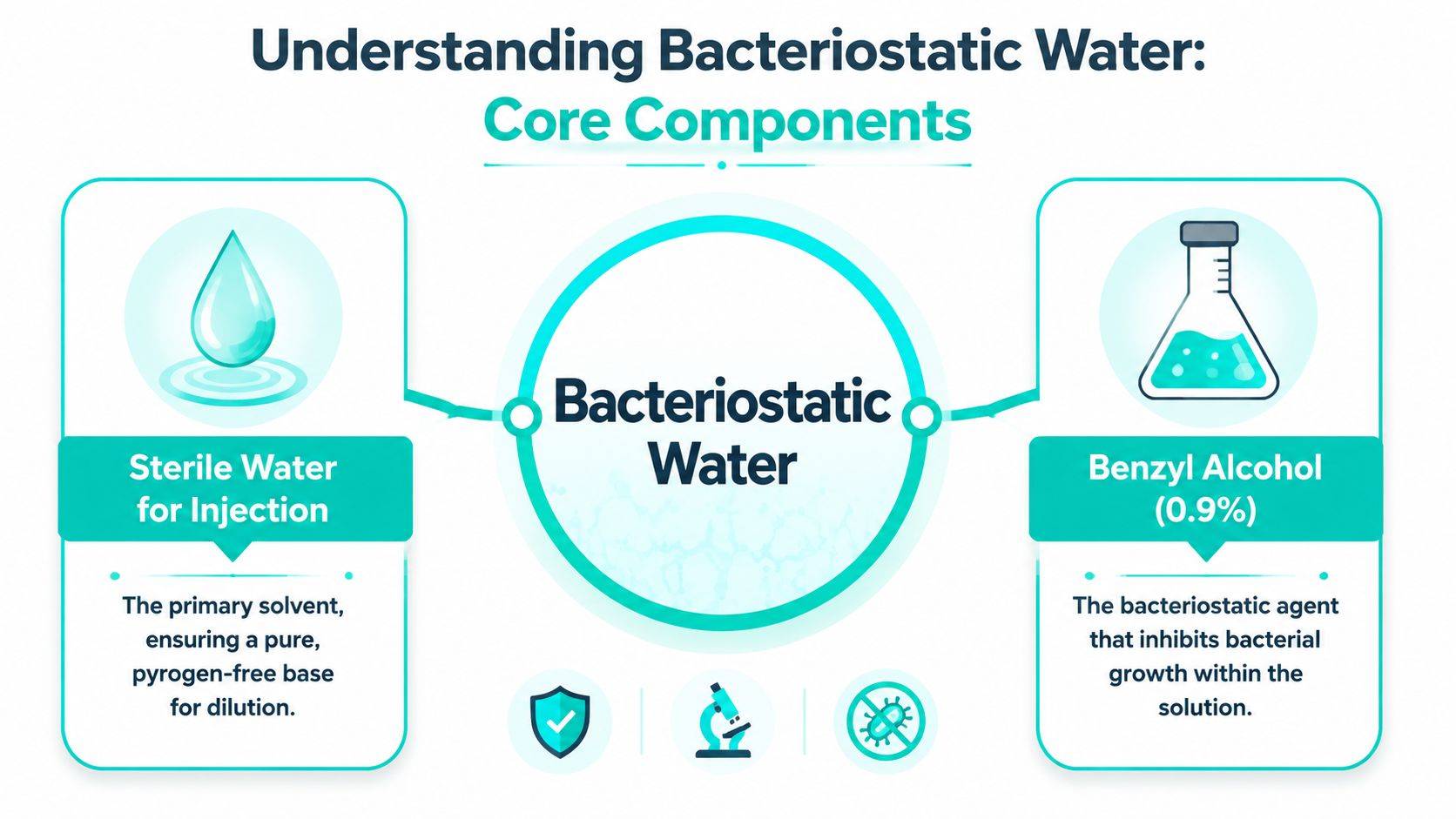
The formulation has two functional parts:
That composition is what separates it from standard sterile water. Standard sterile water doesn't contain a bacteriostatic agent, so it's generally treated as a single-dose option rather than something you enter again and again.
The term bacteriostatic matters because people often hear it and assume “sterilizing.” That's not what it means.
Bacteriostatic means the solution slows or inhibits bacterial growth. It does not mean it instantly kills every microorganism that might be introduced during poor handling. A practical way to think about it is this: bacteriostatic water helps keep small contamination events from turning into rapid growth, but it doesn't replace aseptic technique.
A disinfectant is meant to kill. A bacteriostatic additive is meant to suppress growth.
A preserved vial is more forgiving than an unpreserved one. It is not forgiving enough to tolerate sloppy needle technique.
This distinction matters in peptide labs because reconstitution is often the first repeated-access step in the workflow. If a technician punctures the stopper multiple times across several sessions, the preservative provides a margin of protection that plain sterile water doesn't.
Lyophilized peptides are handled because dry form is practical for storage and shipment. Once reconstituted, the compound enters a more fragile phase of use. At that point, the workflow depends on three things staying under control: sterility, dissolution quality, and handling consistency.
That's why bacteriostatic water is routinely favored for repeat-use peptide protocols. It supports the kind of disciplined multi-withdrawal handling that many preclinical workflows require, especially when researchers are trying to preserve the value of high-purity starting material rather than introduce preventable variation at the mixing stage.
In day-to-day lab work, bacteriostatic water is mostly about one thing. It makes injectable compounds usable after they arrive as powders or concentrated preparations. In peptide research, that means turning a lyophilized vial into a solution that can be withdrawn accurately over multiple uses without adding unnecessary contamination risk.
The question of what bacteriostatic water is used for finds a clear answer in specific applications. In peptide labs, its most common role is reconstitution. A freeze-dried peptide needs a sterile liquid before you can aliquot it, load it into a dosing syringe, or use it in a controlled administration protocol.
When researchers choose bacteriostatic water here, they're usually balancing two practical needs:
That second point matters more than many protocols admit. High-purity peptide work depends on reproducibility. If one batch is reconstituted under cleaner, more stable conditions than another, downstream differences can look like compound behavior when they are preparation artifacts.
The preservative doesn't make the peptide “better.” It makes the handling environment more controlled.
Practical rule: If the plan involves returning to the same reconstituted vial across multiple handling events, a preserved diluent is often the more sensible choice than plain sterile water.
A related operational point is equipment. Repeated sterile access only works if the hardware is appropriate. The research guide to buying syringes and needles is worth reviewing if you're standardizing a prep setup instead of improvising one.
Its use isn't limited to peptides. The same preserved sterile medium is used across a wider group of injectable preparations. According to this overview of bacteriostatic water in modern healthcare, bacteriostatic water serves as the primary diluent for injectable pharmaceuticals including GLP-1 medications, hormone therapies, and research peptides, and it's used across intravenous (IV), intramuscular (IM), and subcutaneous injections. The same source notes that the 0.9% benzyl alcohol acts as a bacteriostatic agent by slowing or inhibiting bacterial growth rather than instantly killing all microorganisms.
That range of uses reflects a basic truth. Many injectable compounds aren't supplied in final-use liquid form. They need a compatible sterile diluent first.
In practice, bacteriostatic water works well when the protocol calls for:
It does not work as a substitute for every sterile liquid in the lab. It isn't the right choice just because it's on hand. If a product specifically requires another diluent, or if the route of administration excludes benzyl alcohol-containing solutions, convenience should never drive the decision.
That's the trade-off. Bacteriostatic water gives you flexibility for multi-use handling, but only within the use cases it was designed for.
Confusion usually starts when someone sees three clear liquids on a supply shelf and assumes they're interchangeable. They aren't. The names sound similar, but the intended use is different enough that substitution can change both safety and protocol quality.
For most research teams, the practical comparison is between bacteriostatic water, sterile water for injection, and normal saline.
| Attribute | Bacteriostatic Water | Sterile Water for Injection | Normal Saline |
|---|---|---|---|
| Composition | Sterile water with 0.9% benzyl alcohol preservative | Sterile water without bacteriostatic preservative | Sterile saline solution |
| Preservative present | Yes | No | Not used as a bacteriostatic preservative product |
| Typical vial use pattern | Multi-dose protocols when handled aseptically | Single-dose use | Used for rehydration, electrolyte balance, and some medication prep depending on protocol |
| Primary role | Diluting or dissolving injectable compounds for repeated access workflows | Diluting or dissolving compounds when preservative-free water is required | Fluid and electrolyte related applications rather than serving as a general substitute for bacteriostatic water |
| Best fit in peptide work | Repeat-withdrawal reconstitution setups | Single-session prep or when preservative-free diluent is required | Usually not the first choice for peptide reconstitution unless a specific protocol calls for it |
The key dividing line is function. Bacteriostatic water is formulated for medication dilution and dissolution with repeat access in mind. Sterile water for injection is still sterile, but it lacks the preservative that makes multiple withdrawals more practical. Normal saline serves a different purpose because it's associated with hydration and electrolyte balance rather than acting as a default replacement for preserved reconstitution water.
A common mistake is treating sterile water for injection as “basically the same thing.” It isn't. If your workflow involves puncturing the same vial over multiple sessions, switching from bacteriostatic water to plain sterile water removes the feature that was helping suppress bacterial growth after entry.
Another mistake goes the other direction. Some people assume bacteriostatic water is an upgrade in every situation. It isn't. A preservative-containing diluent can be the wrong choice if the compound labeling or route of administration says otherwise.
Here's the practical decision logic:
Good lab prep starts with asking, “What does this compound require?” Not, “What clear vial is easiest to grab?”
For high-purity peptide research, the reason this comparison matters is reproducibility. Reconstitution isn't just a setup step. It becomes part of the experimental environment. If one operator uses a multi-dose preserved diluent and another uses a single-use water product in a repeated-access workflow, you've changed a meaningful handling variable before the first measurement is taken.
The right diluent doesn't just support sterility. It supports consistency across runs, operators, and timelines.
A preserved vial can still compromise a peptide workflow if the handling is sloppy. In practice, contamination rarely starts with the liquid itself. It starts at the stopper, the syringe, the bench surface, or the point where no one recorded when the vial was first opened.
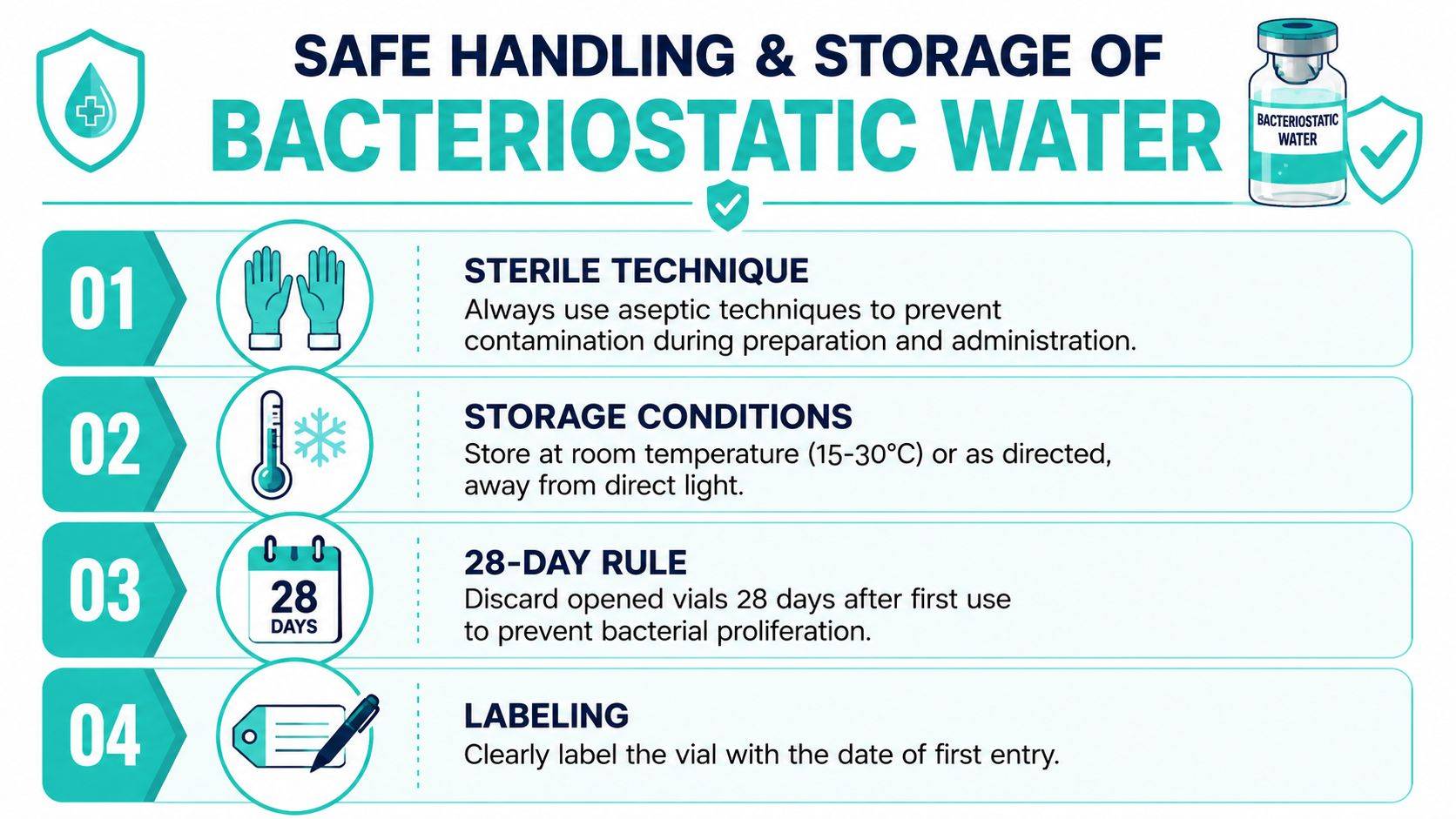
Bacteriostatic water contains benzyl alcohol, a preservative added to inhibit bacterial growth in a multiple-dose vial after puncture. "Inhibit" is the operative word. It lowers contamination risk. It does not sterilize a vial that has been handled poorly, and it does not protect a peptide from avoidable variability introduced during reconstitution.
For peptide research, that distinction matters. A contaminated or mishandled diluent does more than create a sterility problem. It can change concentration accuracy, storage stability, and run-to-run consistency.
Use a simple repeatable standard:
The FDA labeling for Bacteriostatic Water for Injection supports multi-dose use because of the benzyl alcohol preservative and also states a major safety restriction. It is not for use in neonates. That warning belongs in any SOP that covers handling, storage, or downstream preparation.
Storage discipline matters after reconstitution too. If your process includes holding mixed material for later assay work, this guide on how to store reconstituted peptides addresses the next control point in the chain.
For a visual walkthrough, this clip gives useful context on handling practices before and after vial entry.
The recurring failures are procedural.
Teams stretch an opened vial past its labeled use period because it still looks clear. Operators set a syringe down, then re-enter the vial. Someone skips dating because the bottle will "probably" be used up quickly. In peptide work, those shortcuts create exactly the kind of undocumented variable that makes results harder to trust and harder to reproduce.
The common problem points are predictable:
If there is any doubt about sterility, dating, or storage integrity, discard the vial. Replacing diluent costs very little compared with repeating peptide prep, losing a sample set, or trying to interpret data from a compromised reconstitution step.
Some questions come up every time this product is introduced into a peptide workflow, especially when a team is moving from occasional use to repeat, documented handling.
No practical lab should try to make bacteriostatic water in-house for injection use.
The issue isn't just mixing sterile water with a preservative. It's validated sterility, container integrity, formulation control, and appropriate labeling for injection-related use. In research environments, “close enough” is how contamination and undocumented variability get introduced into the protocol.
If the liquid is going to touch a valuable peptide or enter an injection workflow, use a properly manufactured product.
For an unopened vial, use the manufacturer's printed expiration date and inspect packaging integrity before use. If the vial is damaged, leaking, or compromised, don't use it.
Once opened, the practical limit changes because repeated stopper puncture changes the contamination risk profile. That's why opened-vial handling is treated differently from sealed inventory.
A few other common points deserve direct answers:
If you're working with high-purity peptides, don't think of bacteriostatic water as a convenience item. Think of it as part of your control strategy.
Use it when the protocol calls for a preserved sterile diluent and repeat access matters. Don't use it as a universal substitute. And don't let a clean peptide lose its value because the reconstitution step was handled casually.
If your lab needs high-purity research peptides and dependable ordering support, Celonyx Labs supplies research compounds for laboratory use with a catalog built around consistency, quality expectations, and practical access for investigators.
A researcher searching “kisspeptin 10 for sale” may expect a straightforward catalog result. Instead, the

Ranked guide to the best tirzepatide peptides for research in 2026: lyophilized vials, reference standards,

The best cagrilintide peptides for research in 2026, ranked by purity, COA availability, and format
FOR RESEARCH USE ONLY. Products sold by Celonyx Labs are intended exclusively for laboratory and scientific research. They are not intended for human or veterinary use, consumption, diagnosis, treatment, cure, or prevention of any disease. By purchasing from this site, you acknowledge that you understand the intended research purpose of these materials and agree to comply with all applicable laws and regulations.