
Research Peptides for Dermatology Research: 2026 Guide
Research peptides for dermatology research need 99% purity and COA documentation. See how cosmetic and
The most popular advice about the 5 amino 1MQ peptide starts with a misleading premise. 5-Amino-1MQ isn't a peptide, and treating it like one can distort literature searches, procurement decisions, handling assumptions, and safety judgments. It's a small-molecule inhibitor of nicotinamide N-methyltransferase, or NNMT, studied mainly in cells and animals rather than in human clinical trials.
That distinction changes the practical questions. Instead of asking which peptide protocol to copy, a research team should ask what NNMT inhibition changes inside a cell, how strong the preclinical evidence is, whether a supplier can document chemical identity and batch quality, and what remains unknown about repeated exposure in people.
The phrase “5-amino-1MQ peptide” is common in online searches, but the classification is incorrect. 5-Amino-1MQ is a small molecule, not a chain of amino acids, and its research profile comes from enzymology and medicinal chemistry rather than peptide pharmacology. The 2017 Scientific Reports publication described it as a selective, membrane-permeable NNMT inhibitor, with an IC50 of 1.2 µM and measured permeability of 3.01472E-06 in that study's assay (the peer-reviewed compound characterization).
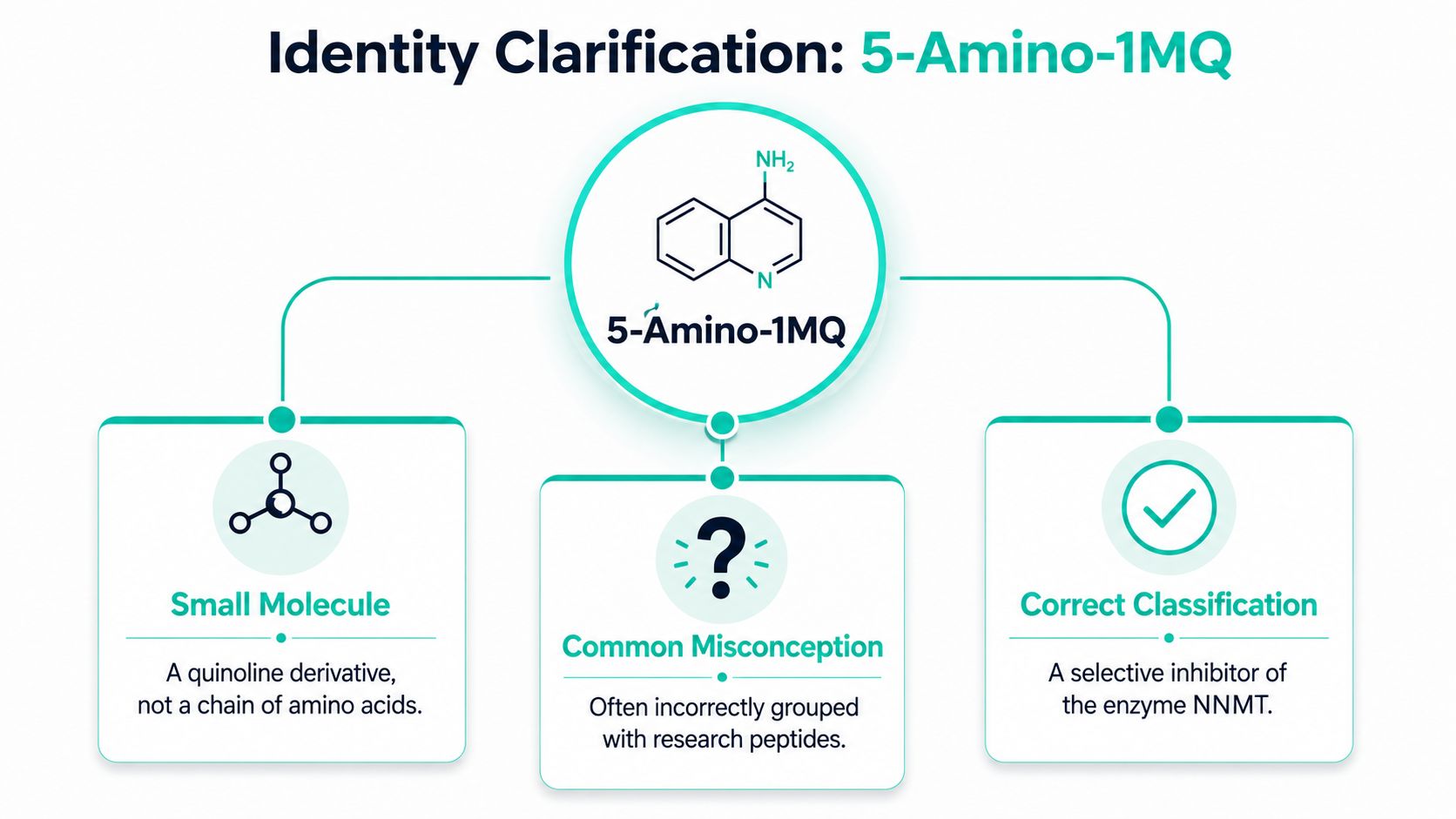
A peptide is generally discussed through peptide-specific questions such as amino acid sequence, aggregation, proteolysis, sterile reconstitution, and peptide purity. A small-molecule NNMT inhibitor requires a different analytical and experimental vocabulary. Researchers need to verify molecular identity, salt form, residual solvents, chromatographic purity, mass confirmation, solubility, and assay compatibility.
The distinction also affects database searches. Searching only for “research peptide” may omit relevant NNMT literature, while searching for 5-amino-1-methylquinolinium, NNMT inhibition, nicotinamide metabolism, adipocyte biology, and NAD+ salvage pathways is more likely to surface the appropriate evidence. Researchers comparing categories can use this primer on what research peptides are while keeping 5-Amino-1MQ in its proper small-molecule context.
Practical rule: classify the compound correctly before choosing a protocol, solvent, assay, or supplier.
The 2017 paper supports a mechanistic starting point. It doesn't establish human efficacy, a finished therapeutic product, or a validated consumer dosing protocol. It establishes that investigators characterized a selective compound with membrane permeability and a measurable inhibitory potency in the reported experimental system.
That's the useful interpretation. 5-Amino-1MQ belongs in an NNMT research program, where the central questions concern enzyme inhibition, methylation chemistry, nicotinamide availability, and metabolic phenotypes. Calling it a peptide may be convenient for search traffic, but it isn't chemically or experimentally precise.
NNMT catalyzes the methylation of nicotinamide, producing 1-methylnicotinamide, or MNA, while using methyl-donor chemistry connected to S-adenosylmethionine, commonly abbreviated SAM. 5-Amino-1MQ inhibits NNMT, so the expected intracellular consequence is less conversion of nicotinamide into MNA.
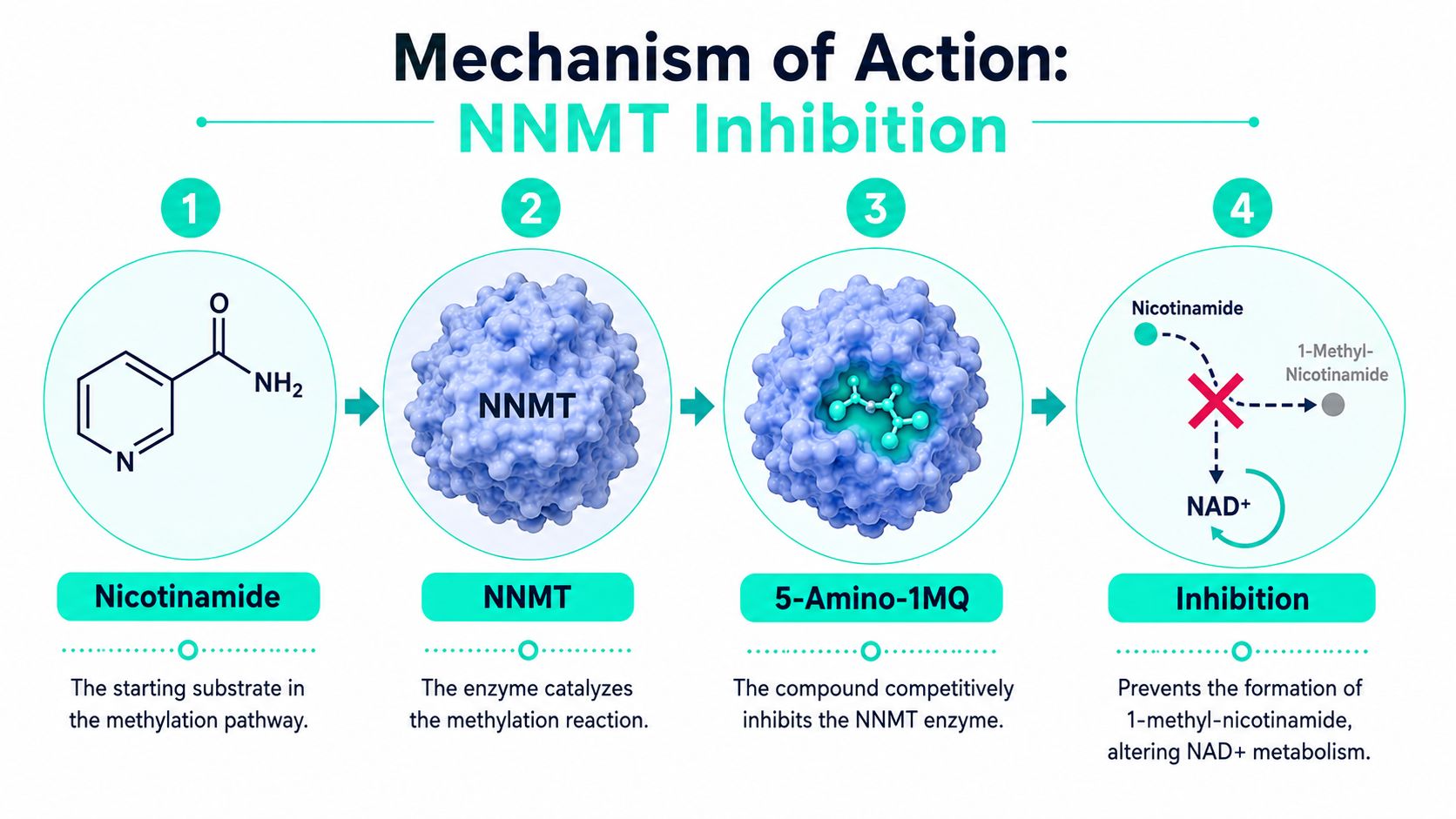
Nicotinamide can contribute to the NAD+ salvage pathway, which helps cells maintain NAD+ availability. When NNMT diverts nicotinamide toward MNA, that substrate is less available for salvage. Inhibition therefore offers a plausible way to preserve nicotinamide for NAD+ regeneration, although the magnitude and biological importance of that effect depend on cell type, baseline NNMT activity, compound exposure, and the wider metabolic state.
The published NNMT review reports that 5-Amino-1MQ reduced intracellular MNA, increased NAD+ availability, and suppressed lipid synthesis in adipocyte models (review of NNMT biology and metabolic effects). Those findings support a cause-and-effect model, but they shouldn't be inflated into proof of a clinical fat-loss effect.
A useful working map looks like this:
Adipocytes are relevant because NNMT activity connects methylation balance with lipid handling. In the cited review, inhibition was associated with lower MNA, higher NAD+, and reduced lipogenesis in fat-cell models. That makes 5-Amino-1MQ more relevant to metabolic research, adipocyte differentiation, lipid synthesis, and cellular redox balance than to receptor agonism or peptide hormone signaling.
The trade-off is that pathway plausibility isn't the same as clinical predictability. Raising NAD+ availability in a model may not translate into a meaningful outcome in humans, and altering methylation flux can have effects beyond the intended metabolic endpoint. A sound study should measure the pathway directly rather than infer NNMT inhibition from body weight alone.
For a visual explanation of the pathway, the embedded material below can supplement the biochemical description.
The evidence for 5-Amino-1MQ remains preclinical, not clinical. Published work is limited to cell and animal studies, and a research summary reports no published or registered human clinical trials (current research summary). That limitation applies to claims about efficacy, tolerability, dosing, and practical use.
Cell studies offer the clearest mechanistic signal. In adipocyte models, exposure to 5-Amino-1MQ has been associated with lower intracellular MNA, greater NAD+ availability, and reduced lipid synthesis. These endpoints matter because they connect the compound to measurable NNMT-related biology rather than relying only on visible changes such as body weight.
Animal studies provide organism-level context, while still leaving major translation gaps. In the reported mouse experiment, a regimen of 20 mg/kg subcutaneously, administered three times per day for 11 days, reduced body weight, white adipose mass, and adipocyte size without changing food intake (original peer-reviewed mouse study). The findings are consistent with a metabolic effect rather than simple appetite suppression. They do not establish a human dose, because the study used a short exposure period, a different species, a specific administration route, and an experimental dose.
A careful review should separate pathway activity, animal phenotype, and human benefit:
| Question | What the current evidence supports |
|---|---|
| Does the compound affect NNMT-related biology? | Yes, in cell and animal research |
| Does it produce metabolic phenotypes in animals? | Yes, including changes in adipose measures in the reported mouse work |
| Does it improve human health outcomes? | Not established by published or registered clinical trials |
This distinction prevents a rodent result from becoming an implied treatment protocol. The available work can justify additional experiments, but it cannot establish human efficacy, long-term safety, or a suitable dose-duration schedule.
No human efficacy dataset currently establishes effects on body composition, glucose regulation, cardiovascular outcomes, or quality of life. Online claims about predictable fat loss or reliable “stacks” should therefore be treated as experimental opinion, not clinical guidance.
A strong preclinical mechanism is a reason to design a better study, not a substitute for that study.
The defensible conclusion is narrow: 5-Amino-1MQ is an investigational small-molecule NNMT inhibitor with cell and animal evidence, while human benefit remains unproven.
A vendor's headline purity claim isn't enough to establish that a particular batch is suitable for research. The relevant document is a batch-specific Certificate of Analysis, or CoA, tied to the lot number on the container. Without that connection, a polished PDF may describe a different material than the one you received.
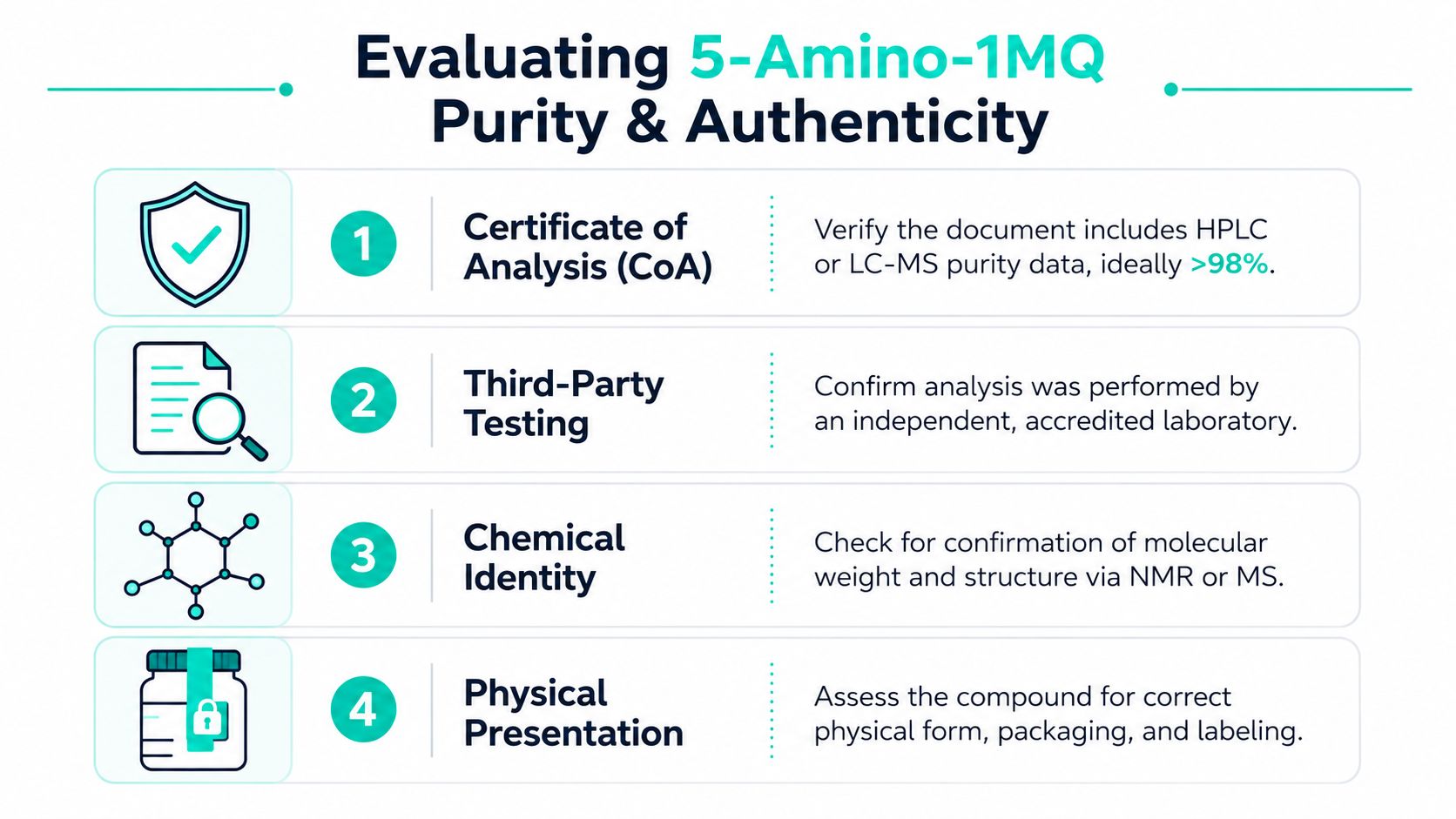
Start with identity, then assess purity. A useful package should identify the compound clearly, state the lot, provide test dates, identify the laboratory, and show the analytical method rather than only presenting a conclusion.
Researchers should also distinguish stated purity from verified purity. A seller may advertise a purity level, but the buyer needs the underlying batch result, method, acceptance criteria, and identity data. Testing should be interpreted in context, because a single purity number doesn't automatically address residual solvents, water content, counterions, or microbial concerns.
Before ordering, ask whether the vendor can supply the CoA before purchase, clarify the material's intended research use, and explain how complaints or failed incoming tests are handled. Save the product page, CoA, invoice, shipping record, and internal receiving notes together.
This guide to verifying third-party-tested research materials is relevant to the documentation side of procurement, but the laboratory remains responsible for deciding whether the evidence meets its own validation requirements. A supplier document supports due diligence. It doesn't replace identity confirmation in your facility when the experiment is sensitive to impurities.
Because 5-Amino-1MQ is a small molecule rather than a peptide, don't automatically apply a peptide reconstitution protocol. The correct solvent, concentration, container, and exposure limits depend on the exact material supplied, including its salt form and the assay's compatibility requirements.
Start with the supplier's technical documentation and the receiving laboratory's chemical hygiene procedures. Confirm solubility in a small feasibility test before preparing the full working solution. Record the compound name, lot, solvent, target concentration, preparation date, operator, and any visible change such as precipitation or discoloration.
Use a calibrated balance and clean, appropriately labeled glassware or compatible laboratory containers. Calculate the required mass from the desired final concentration and volume, then verify the calculation independently before adding solvent. Introduce solvent gradually, mix using the method supported by the compound documentation, and avoid aggressive treatment that could create heat, aerosolization, or contamination.
If the material doesn't dissolve as expected, don't keep adding random solvents or alter the concentration without documenting the change. An apparent solubility problem may reflect the compound form, water content, temperature, or an incompatible assay buffer.
The laboratory guide to reconstitution practices can provide general handling context, but it shouldn't be treated as a compound-specific validation document for 5-Amino-1MQ.
Protect the material from unnecessary light, heat, moisture, and repeated opening. Use aliquots when repeated access could expose the parent stock to humidity or contamination. Store the parent material under the conditions specified by the CoA or technical data, and establish an internal stability check if the project will run over an extended period.
A sound record includes the original container, aliquot identifiers, preparation history, storage location, and freeze-thaw or room-temperature exposure history where relevant. Those details help distinguish a biological finding from a handling artifact.
The central safety issue isn't whether short preclinical experiments looked encouraging. It's the absence of enough long-term human safety and dose-duration evidence to define risk. Recent summaries report no completed or published human clinical trials, while one review describes only a 12-week human observation window with no adverse events at 50 mg daily (discussion of the limited human safety observation). That observation is too limited to establish chronic safety or detect rare risks.
Rodent tolerability doesn't answer whether repeated NNMT inhibition could affect methylation pathways, NAD+ metabolism, inflammatory markers, or organ systems in people. It also doesn't establish interactions with prescription medicines, supplements, metabolic disease, pregnancy, or other clinically important conditions.
A research compound should remain within an approved laboratory framework. That usually means documented purchasing, trained personnel, suitable personal protective equipment, a written risk assessment, controlled access, appropriate waste disposal, and institutional review where the work involves animals, human samples, or human participants.
Don't convert an animal regimen into a personal-use recommendation. The reported mouse exposure demonstrates an experimental design, not a validated human dose. Similarly, an absence of observed adverse effects in a small observation window isn't evidence that the compound is safe for unsupervised use.
For laboratory work, define stopping criteria before the experiment begins. Specify which observations trigger quarantine of a batch, repeat identity testing, protocol review, or medical and institutional escalation. Keep adverse observations linked to lot, preparation record, exposure conditions, and assay date.
The most responsible position is conservative: 5-Amino-1MQ should be handled as an investigational NNMT inhibitor, not as an approved treatment or established supplement. Regulatory classification can vary by jurisdiction and intended use, so institutions should consult their compliance office and applicable authorities before ordering or deploying the material.
Choose a supplier based on documentation, not on the most aggressive marketing language. A credible research procurement review should examine batch-specific testing, chemical identity, packaging, shipping controls, customer support, and published return or refund policies.
Ask for the CoA before placing a purchase order when possible. Confirm that the supplier can identify the lot, explain the analytical methods used, and respond clearly to technical questions. Fast shipping matters only after the material's identity and documentation meet the laboratory's requirements.
Plan delivery around the experimental schedule, but don't skip incoming verification to avoid a delay. A questionable batch can compromise controls, consume irreplaceable samples, and force an entire study to be repeated.
For laboratories seeking documented research materials and responsive ordering support, visit Celonyx Labs. Review the available quality information, confirm that the selected material fits your institution's procurement requirements, and contact the team with lot-specific questions before beginning your experiment.
Research peptides for dermatology research need 99% purity and COA documentation. See how cosmetic and

Research peptide sourcing for grad students in 2026: verify COAs, match institutional documentation, and budget

Bacteriostatic water sourcing for research labs in 2026: how small labs vet concentration, documentation, and
FOR RESEARCH USE ONLY. Products sold by Celonyx Labs are intended exclusively for laboratory and scientific research. They are not intended for human or veterinary use, consumption, diagnosis, treatment, cure, or prevention of any disease. By purchasing from this site, you acknowledge that you understand the intended research purpose of these materials and agree to comply with all applicable laws and regulations.