

6 Acetic Acid: What It Means and Where It Fits in Research
What does “6 acetic acid” tell you about the bottle on your bench? Not much,
Most lab teams treat a buffer saline solution as a harmless utility, something to grab from the shelf when a protocol says “wash” or “dilute.” That assumption causes avoidable failures. PBS, TBS, and normal saline may look interchangeable in a bottle, but their buffering chemistry, ionic composition, and compatibility with cells, proteins, and analytical methods are different.
A solution can be sterile, clear, and correctly labeled yet still be wrong for the experiment. Phosphate can interfere with downstream chemistry, salt concentration can stress cells, and calcium or magnesium can change adhesion or binding behavior. The practical question isn't which buffer is most familiar. It's which formulation leaves the fewest unwanted variables in your specific workflow.
A buffer saline solution does two jobs that researchers often separate mentally. It supplies ions, and it controls the chemical environment. Plain saline provides ionic strength without meaningful buffering, while PBS and TBS pair salts with a buffer system that resists pH change. That distinction matters whenever the sample, reagent, or assay generates or consumes acid and base.
PBS is widely used because it approximates physiological conditions and supports a pH near 7.4, making it useful for washing samples and handling cells or biomolecules. Its modern laboratory history is associated with Renato Dulbecco's 1954 formulation, later known as Dulbecco's phosphate-buffered saline, as described in this historical overview of phosphate-buffered saline. Familiarity, however, doesn't make every PBS formulation equivalent.
Phosphate concentration is one variable. Calcium and magnesium are another. PBS, DPBS, and related products may differ in phosphate content and in whether divalent cations are present, which can affect cell adhesion, cell behavior, protein interactions, and downstream assay compatibility. A formulation suitable for a quick rinse may be inappropriate for a binding assay or a workflow in which phosphate participates in the chemistry.
Osmotic conditions also deserve attention. A solution can have the right label and still be unsuitable if it was prepared inaccurately, diluted incorrectly, or allowed to drift through evaporation. Salt concentration influences membrane integrity and permeability, while pH affects protein conformation, antibody binding, and enzyme activity.
Practical rule: Treat the buffer name as a starting point, not a specification. Record the exact formulation, pH, presence of calcium or magnesium, preparation date, and lot information in the protocol.
“Use PBS” is weak advice when the assay involves phosphate-sensitive chemistry, metal-dependent interactions, or analytical detection that can be affected by nonvolatile salts. A 2024 peer-reviewed article specifically cautions against PBS as an assay matrix in certain analytical contexts because phosphate can interfere with downstream chemistry. The peer-reviewed discussion of PBS limitations in analytical workflows is a useful reminder that a routine wash buffer isn't automatically a suitable sample matrix.
The same logic applies to TBS and normal saline. TBS may be preferable when phosphate is undesirable, but Tris has its own temperature-dependent pH behavior and must be validated for the assay. Normal saline may be appropriate for a simple isotonic dilution, but it won't hold pH steady during a chemically active reaction.
Before changing an assay, ask four questions:
Those answers usually identify the correct buffer faster than copying a generic recipe.
PBS is the conventional choice for many cell biology and molecular workflows because it combines physiological salt conditions with phosphate buffering. A standard 1× PBS formulation contains 137 mM NaCl, 2.7 mM KCl, 10 mM Na₂HPO₄, and 1.8 mM KH₂PO₄, with a target pH near 7.4, according to this 1× PBS formulation reference. It works well for washing and dilution when phosphate is compatible with the experiment.
TBS replaces phosphate with Tris. That makes it a useful alternative for protein and immunological workflows where phosphate may create precipitation or interfere with downstream reactions. TBS isn't universally safer, though. Its pH can shift with temperature, so the working conditions should match the conditions used during pH adjustment and the assay itself.
Normal saline is simpler. Clinical normal saline is standardized as 0.9% sodium chloride, equivalent to 9 g per liter and approximately 154 mEq/L of both sodium and chloride, as documented in this history of cell-culture media and buffered saline systems. It provides an isotonic salt environment but has no comparable buffering capacity.
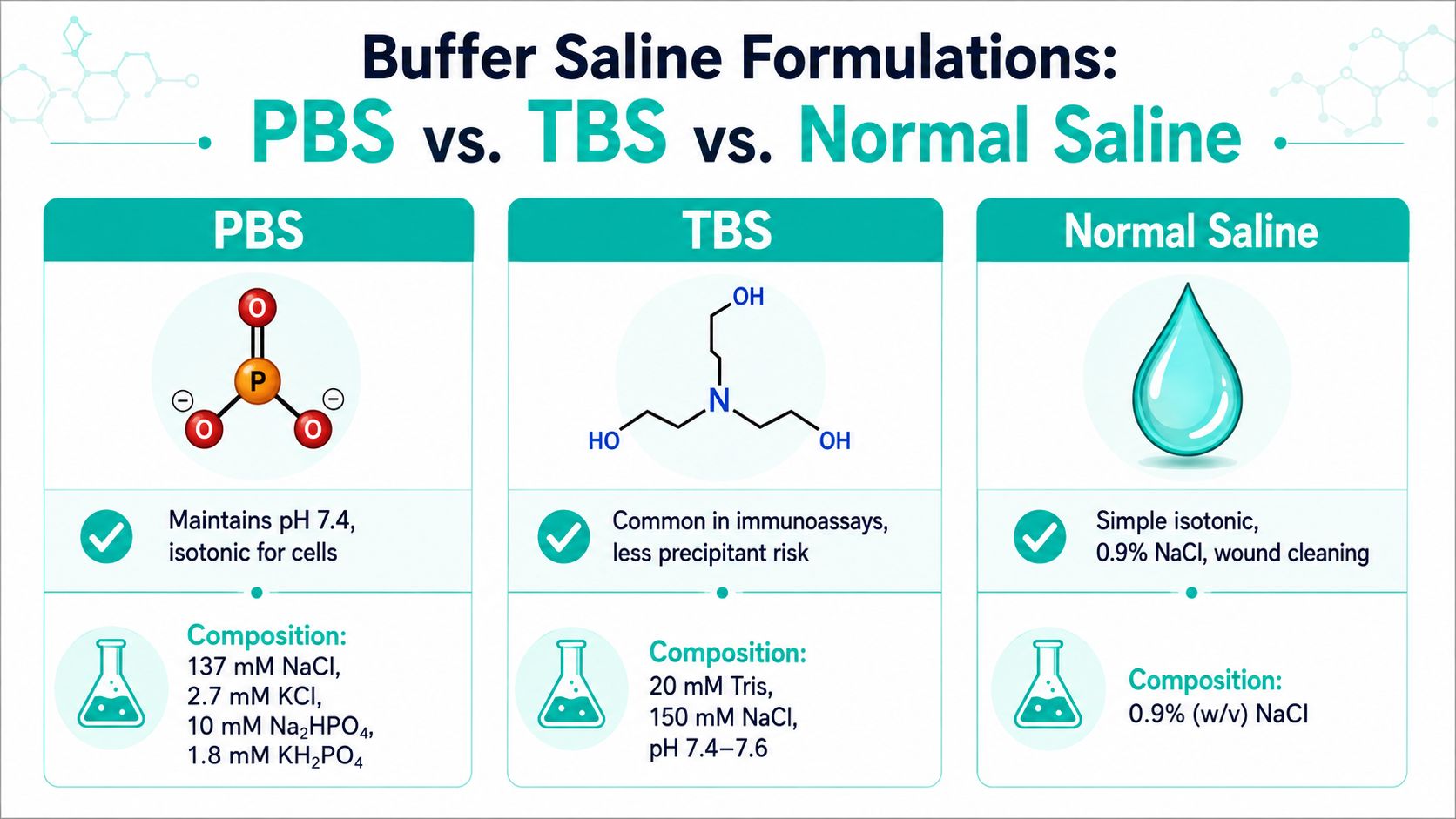
| Formulation | Key components | pH range | Best applications | When to avoid |
|---|---|---|---|---|
| PBS | NaCl, KCl, sodium phosphate, potassium phosphate | Near 7.4 | Cell washing, sample handling, routine molecular workflows | Phosphate-sensitive assays, some analytical matrices, incompatible divalent-cation conditions |
| TBS | Tris and sodium chloride | Defined by the validated protocol | Immunoblotting, antibody incubation, protein workflows | Experiments sensitive to Tris, unvalidated temperature conditions, reactions requiring phosphate |
| Normal saline | Sodium chloride in water | Not strongly buffered | Simple isotonic dilution, rinsing when pH control isn't required | Cell workflows requiring stable pH, chemically active assays, long incubations |
Use this PBS solution guide when you need a closer look at PBS terminology and common laboratory uses.
Choose PBS for routine washing when physiological ionic conditions and phosphate compatibility have already been established. Choose TBS when phosphate is a concern and the assay has been validated with Tris. Choose normal saline only when you need salt and isotonicity, not pH control.
Don't substitute one for another during troubleshooting without changing one variable at a time. If a Western blot, immunoassay, or cell-handling step changes after a buffer swap, the buffer itself becomes a confounding variable unless the comparison is controlled.
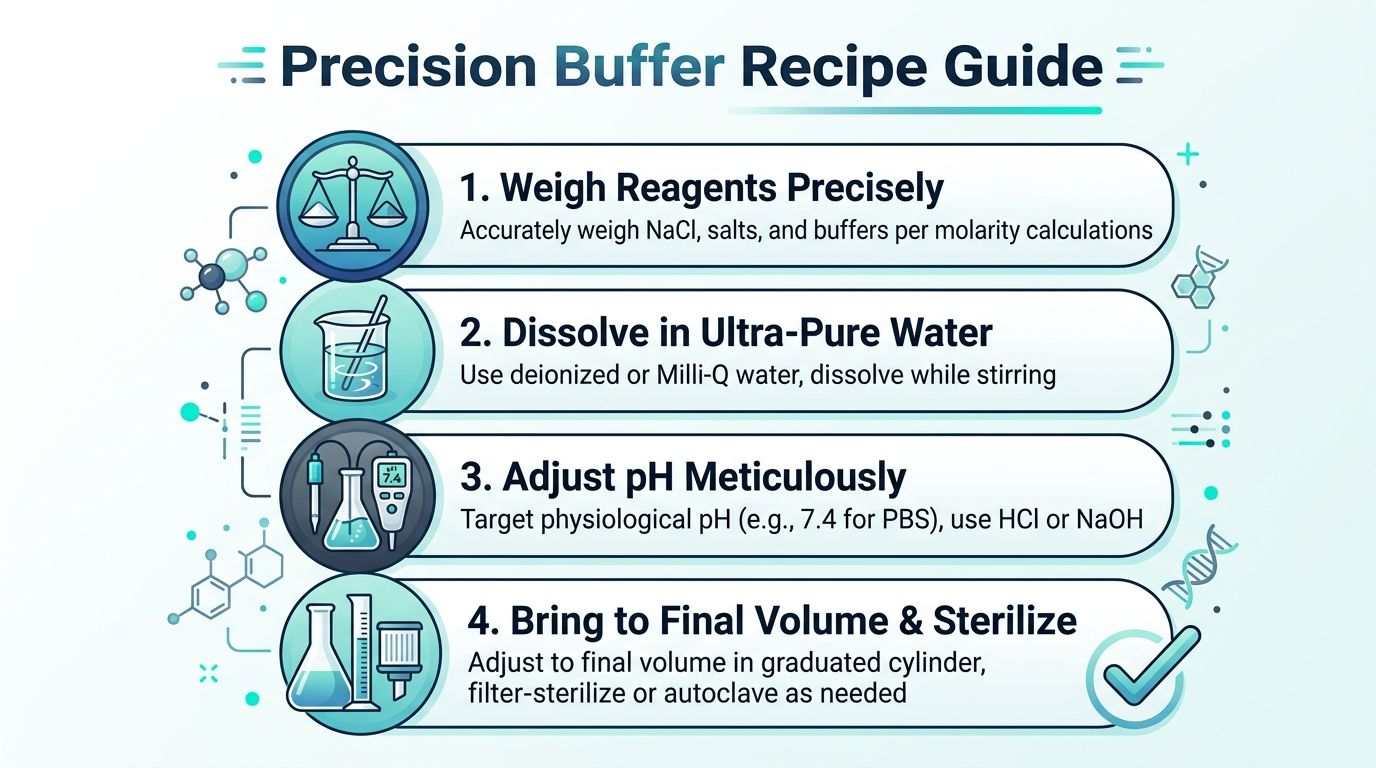
A familiar buffer label does not guarantee a reliable formulation. The 1× PBS composition, 137 mM NaCl, 2.7 mM KCl, 10 mM Na₂HPO₄, and 1.8 mM KH₂PO₄, was detailed earlier. The practical task here is preparing it accurately, confirming pH 7.4, and documenting conditions that can affect assay performance.
Calculate and weigh each reagent. Use the molecular weight and final volume to calculate each mass. Confirm whether a salt is anhydrous or hydrated before weighing. The form changes the molar amount even when the chemical name appears unchanged.
Dissolve in high-quality water. Add the salts to deionized or ultrapure water with stirring. Leave room for the final volume until every component has dissolved. Making up the volume too early can leave the prepared concentration wrong.
Adjust pH deliberately. Calibrate the meter with suitable standards, measure at a controlled temperature, and add acid or base gradually. Mix thoroughly before taking the next reading. A pH value measured under different temperature conditions may not represent the buffer during use.
Bring the solution to final volume. Transfer the mixture to a calibrated vessel, make up the volume, mix again, and record the measured pH, preparation date, operator, and reagent lots.
For PBS, use pH 7.4 ± 0.3 as a practical acceptance target, as listed in this PBS technical data sheet. Treat that range as a check, not a substitute for measurement. For live cells, sensitive membranes, or quantitative assays, measure osmolality when the outcome depends on a stable osmotic environment.
Do not add calcium or magnesium just to make PBS seem more physiological. Divalent cations can change adhesion, aggregation, enzyme activity, and protein binding. Include them only when the protocol requires them, and label the formulation clearly so it cannot be mistaken for cation-free PBS.
Concentrates reduce preparation time, but dilution errors remain common. Use the specified water quality, mix completely, and verify the final pH for sensitive applications. Temperature also affects pH readings, especially in Tris-based systems. Measure and adjust under conditions that match actual use, rather than relying on an unrelated bench reading.
Sterilization isn't a single checkbox. The correct method depends on the formulation, the intended use, and the stability of every component. Filtration is often preferable for solutions containing components that may precipitate, degrade, or change during heat exposure. Autoclaving may be suitable for validated salt solutions, but a lab should never assume that every buffer tolerates the same treatment.
Inspect the solution after sterilization. Cloudiness, crystals, color change, or a measurable pH shift is a batch failure until investigated. Phosphate systems can be especially sensitive to changes in concentration, temperature, and interactions with divalent cations. If calcium or magnesium is present, precipitation risk deserves particular attention.
For sterile cell work, use a validated membrane filtration process when the formulation or components make heat sterilization questionable. Work aseptically, use sterile containers, and avoid repeatedly opening a shared bottle. Aliquoting reduces the number of contamination opportunities and limits repeated temperature cycling.
A clear bottle isn't proof of a chemically correct buffer. Visual inspection should support, not replace, pH, sterility, and formulation checks.
Label every container with formulation, concentration, pH, preparation or opening date, expiration or review date, operator initials, and lot numbers for critical reagents. Store the solution under the supplier's specified conditions and protect it from unnecessary exposure to light, heat, and repeated handling.
Quality control should follow the risk of the experiment. At minimum, verify appearance, pH, and preparation records. For workflows involving live cells or quantitative assays, add the relevant sterility and osmolality checks. Compare a questionable batch with freshly prepared material rather than repeatedly adjusting the old bottle.
Supplier documentation matters just as much as in other sensitive laboratory workflows. A batch-specific certificate of analysis, stated purity specifications, and available independent testing give the lab a defensible record of what entered the experiment. When sterile diluent or reconstitution media are part of the workflow, review the distinction between a buffered solution and products such as bacteriostatic water with benzyl alcohol, because they aren't interchangeable materials.
The right buffer depends on what the sample must survive and what the next instrument or assay must tolerate. Buffered saline solutions have a long laboratory history. The first balanced salt solution was composed by Sydney Ringer in 1885, and later formulations developed into the buffered systems used in modern cell culture and molecular workflows, as outlined in this history of cell-culture media.
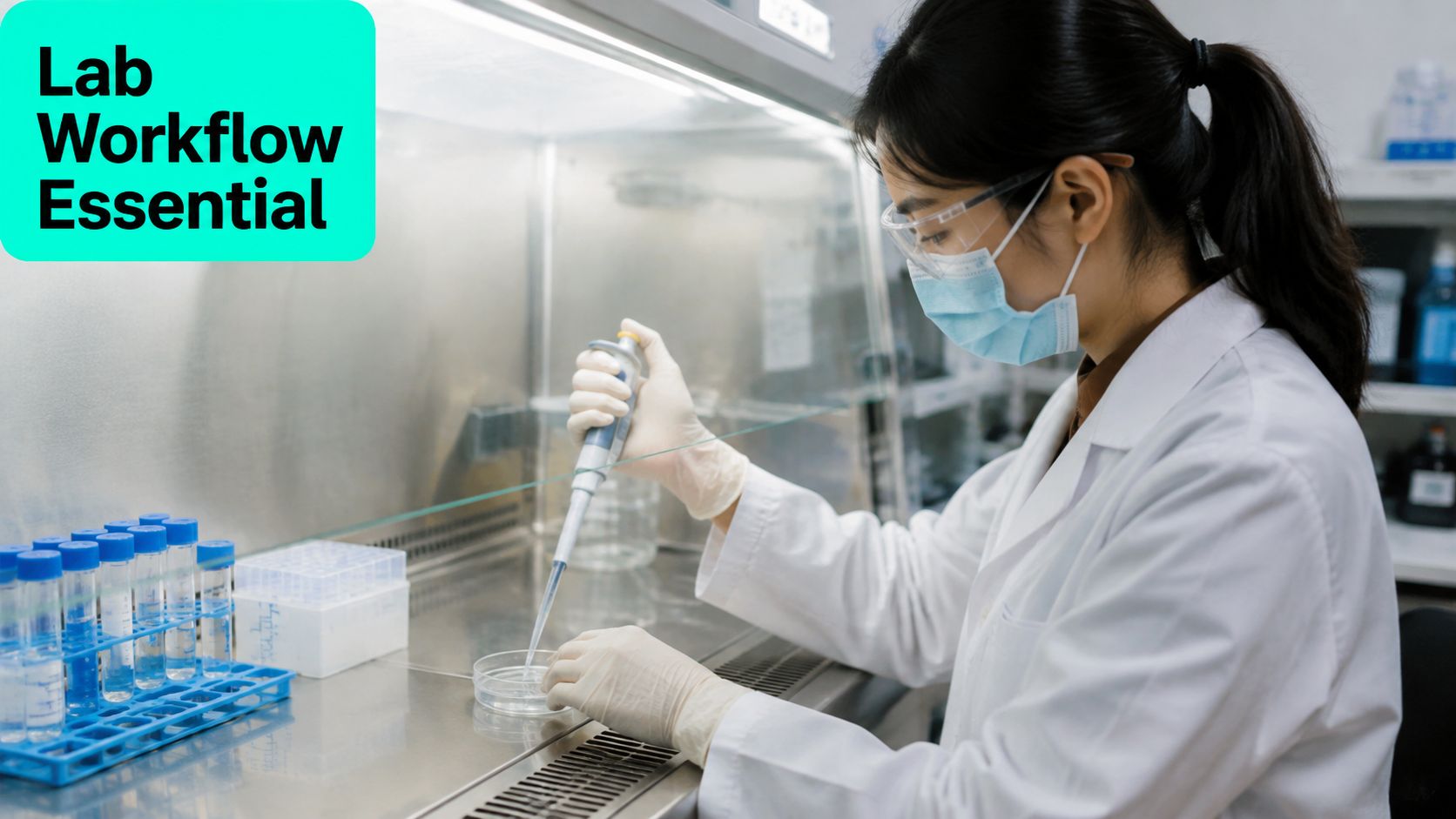
PBS is a practical wash solution for many cell biology protocols because it supplies salts while maintaining a near-physiological pH. It can be used to remove culture medium, wash surfaces, and resuspend material before a downstream step, provided the cells tolerate the exact formulation.
The failure usually appears during handling. A cation-free solution may behave differently from one containing calcium or magnesium, and a poorly prepared batch can impose osmotic stress. If cells detach unexpectedly, compare the buffer formulation, pH, osmolality, temperature, exposure time, and pipetting force before blaming the cell line.
TBS is often selected for antibody incubation and immunoblotting when phosphate isn't desirable. The choice should remain protocol-specific because blocking agents, detergents, antibody concentrations, and detection chemistry all interact with the wash environment. A buffer change can improve background in one assay and weaken binding in another.
Normal saline is reasonable for a simple dilution that doesn't require pH control. It becomes a poor choice for a prolonged reaction or protein-handling step if the sample's pH can drift.
Peptide reconstitution requires more than dissolving a powder. The vehicle must support solubility without introducing components that compromise chromatography, mass spectrometry, or another downstream readout. Phosphate may be unsuitable when the analytical method is sensitive to nonvolatile salts or phosphate-related interference.
Before using a saline or buffered vehicle, check solubility, intended concentration, pH, ionic strength, sterility requirements, and instrument compatibility. A practical peptide reconstitution guide can help organize those checks, but the validated analytical method remains the controlling document.
Buffer failures often masquerade as biology. A cell layer detaches, a protein turns cloudy, or assay signal drifts, and the team changes antibody concentration, incubation time, or sample preparation first. That can multiply variables while leaving the original cause untouched.
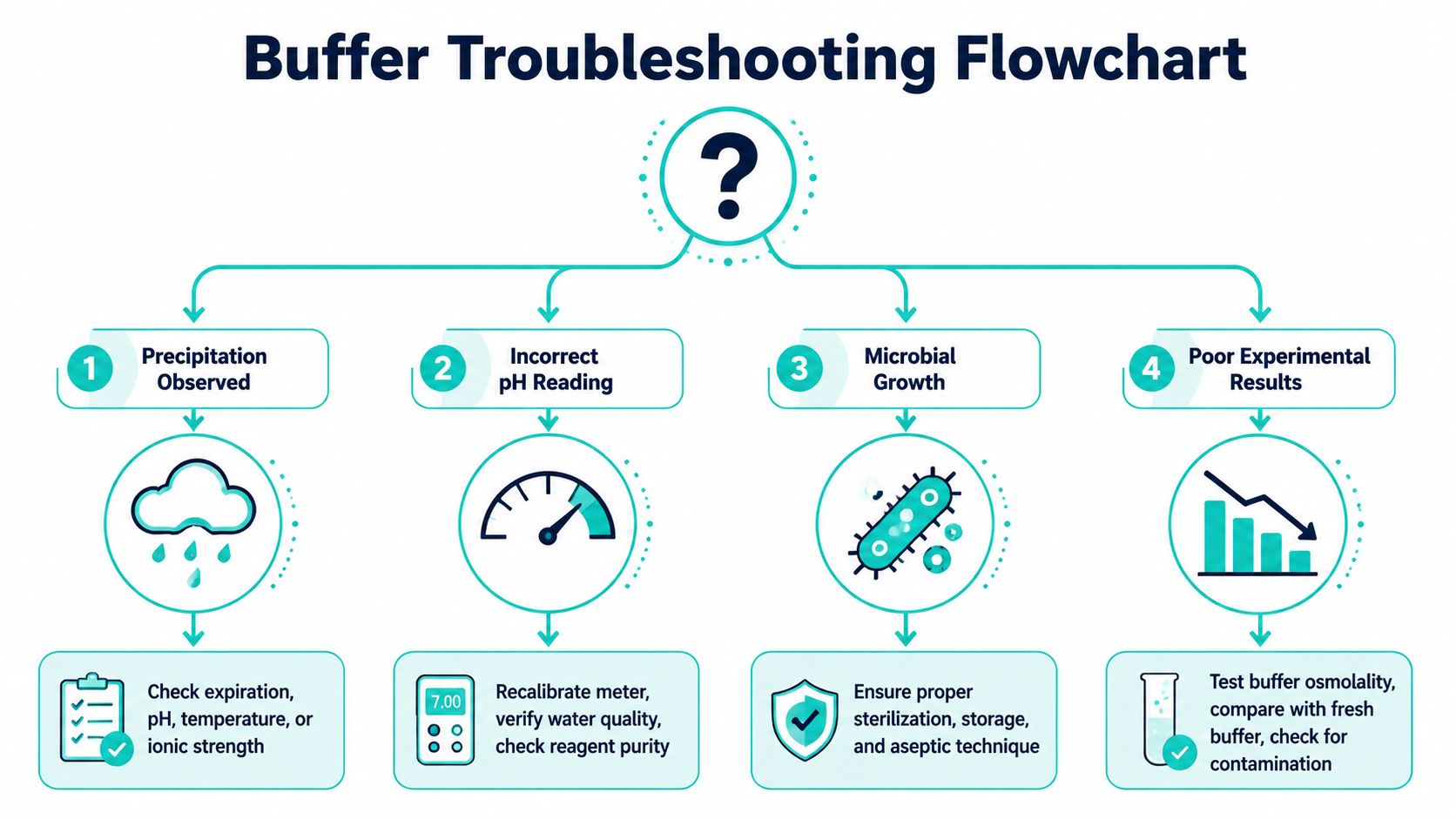
Record the symptom before making an adjustment. Note when it appeared, whether it affects one batch or several, and whether the problem follows a particular operator, instrument, reagent lot, or storage location.
Recalibrate the meter, confirm the electrode is appropriate for the sample, and measure a fresh aliquot. If the reading remains unexpected, check reagent identity, hydrate state, water quality, calculation, and final volume. A pH adjustment can correct a reading while leaving the ionic composition wrong, so don't treat pH alone as proof of a valid batch.
Osmolality is equally important for cell-sensitive work. The PBS benchmark of around 300 mOsm/kg ± 10% comes from the cited technical specification, and a substantial deviation should trigger a preparation review rather than an informal dilution fix.
Phosphate interference is the key reason to consider a non-phosphate buffer. If the assay uses phosphate-sensitive chemistry, metal-dependent reactions, or an analytical platform that performs poorly with nonvolatile salts, test a validated alternative such as TBS or another method-specified buffer. Don't switch solely because PBS is common, and don't stay with PBS solely because it worked in a different assay.
Diagnostic discipline: Change one buffer variable at a time, retain the original sample where possible, and compare against a fresh, documented control batch.
Procurement teams should treat buffer saline solution as a controlled reagent when its composition can affect results. The purchase specification should identify the formulation, concentration, pH range, cation status, sterility state, storage requirements, and intended application. “PBS” on a label isn't enough when different suppliers use different recipes.
Request a batch-specific certificate of analysis and confirm that it states the actual formulation and release criteria. For critical workflows, look for independent testing documentation, traceable lot numbers, clear expiration information, and a mechanism for obtaining technical answers. The record should allow the lab to connect a failed run to the exact bottle and reagent lot used.
This standard becomes especially important in peptide research. A high-purity peptide can still produce an uninterpretable result if the reconstitution vehicle contributes contamination, precipitation, or uncontrolled ionic conditions. Buffer quality belongs in the same reproducibility discussion as peptide identity, purity, storage, and handling.
Celonyx Labs supplies research peptides through an online catalog and states 99% purity and independent third-party testing for its peptide products, as described in the publisher information provided for this article. Labs considering those materials should still match the product documentation and intended use to their own protocol requirements.
Audit your current buffer inventory before the next experiment. For research peptides and related laboratory supplies, review the documented quality information and available catalog from Celonyx Labs, then contact the team with specific questions about formulation compatibility, testing records, and research-use requirements.
What does “6 acetic acid” tell you about the bottle on your bench? Not much,

Best sterility testing kits for 2026 peptide labs: Endosafe nexgen-PTS wins on speed, Steritest for
Compare the best peptide reference standards for analytical research in 2026, ranked by purity, COA
FOR RESEARCH USE ONLY. Products sold by Celonyx Labs are intended exclusively for laboratory and scientific research. They are not intended for human or veterinary use, consumption, diagnosis, treatment, cure, or prevention of any disease. By purchasing from this site, you acknowledge that you understand the intended research purpose of these materials and agree to comply with all applicable laws and regulations.