
Kisspeptin 10 for Sale Research Guide for Labs
A researcher searching “kisspeptin 10 for sale” may expect a straightforward catalog result. Instead, the

You're at the bench with a lyophilized peptide vial, a sterile syringe, and a vial labeled bacteriostatic water for injection. The easy assumption is that any sterile water will do. That assumption can introduce the wrong preservative burden, undermine a compatibility plan, or create a recordkeeping problem that only becomes visible when results fail to reproduce.
For peptide research, solvent selection is part of the experimental design. Bacteriostatic water with benzyl alcohol can support repeated vial access, but it doesn't make poor aseptic technique safe, and it doesn't guarantee that every peptide will remain stable. The label, concentration, compound documentation, storage plan, and supplier records all belong in the same decision.
A researcher preparing a peptide for a multi-dose workflow may reach for bacteriostatic water because it's familiar and convenient. The vial is sterile, the solution looks clear, and the preservative seems like a minor detail. In practice, that preservative is the feature that separates bacteriostatic water from plain sterile water.
U.S. labeling defines bacteriostatic water for injection as sterile, nonpyrogenic water for injection containing benzyl alcohol as a bacteriostatic preservative. The commonly labeled concentration is 0.9%, or 9 mg/mL, although some marketed products identify 1.1%, or 11 mg/mL, depending on the presentation and product configuration. The current labeling language can be reviewed in the DailyMed product information for bacteriostatic water.
A single-use preparation has a different risk profile from a vial that will be entered repeatedly. Each puncture creates another opportunity for contamination, even when the operator follows a controlled procedure. Benzyl alcohol suppresses microbial growth inside the vial, which is why bacteriostatic water is labeled for multiple-dose use under the applicable drug instructions.
That protection is limited. It doesn't sterilize a contaminated syringe, repair a compromised stopper, or eliminate the need for disinfecting the work area and vial septum. A lab that treats the preservative as a substitute for aseptic handling is adding risk, not removing it.
Bench rule: Choose the solvent before reconstitution, not after the peptide has already been exposed to it.
The wrong solvent can affect more than contamination control. Peptides may respond differently to excipients, pH conditions, ionic strength, or handling stress. If a researcher uses a solvent without checking the peptide's documentation, later observations become harder to interpret because the solvent itself may be part of the variable.
A useful primer on the product's role is this guide to what bacteriostatic water is used for. The practical takeaway is simple: bacteriostatic water is a formulation choice for a defined workflow, not a universal replacement for every injectable diluent.
The product name describes a function, but the label supplies the quality-control details. Bacteriostatic water with benzyl alcohol consists of sterile, nonpyrogenic water for injection and benzyl alcohol added as the preservative. In the standard U.S. labeling reference, the concentration is 0.9%, equivalent to 9 mg/mL. Some labels identify a 1.1% formulation, equivalent to 11 mg/mL, so the product name alone isn't enough to establish the excipient concentration.
That distinction matters in peptide work because the final preparation contains not only the peptide and water, but also the preservative carried in with the diluent. The amount introduced depends on the labeled concentration and the volume added. A researcher comparing batches, protocols, or suppliers should record both values rather than writing only “bac water” in the notebook.
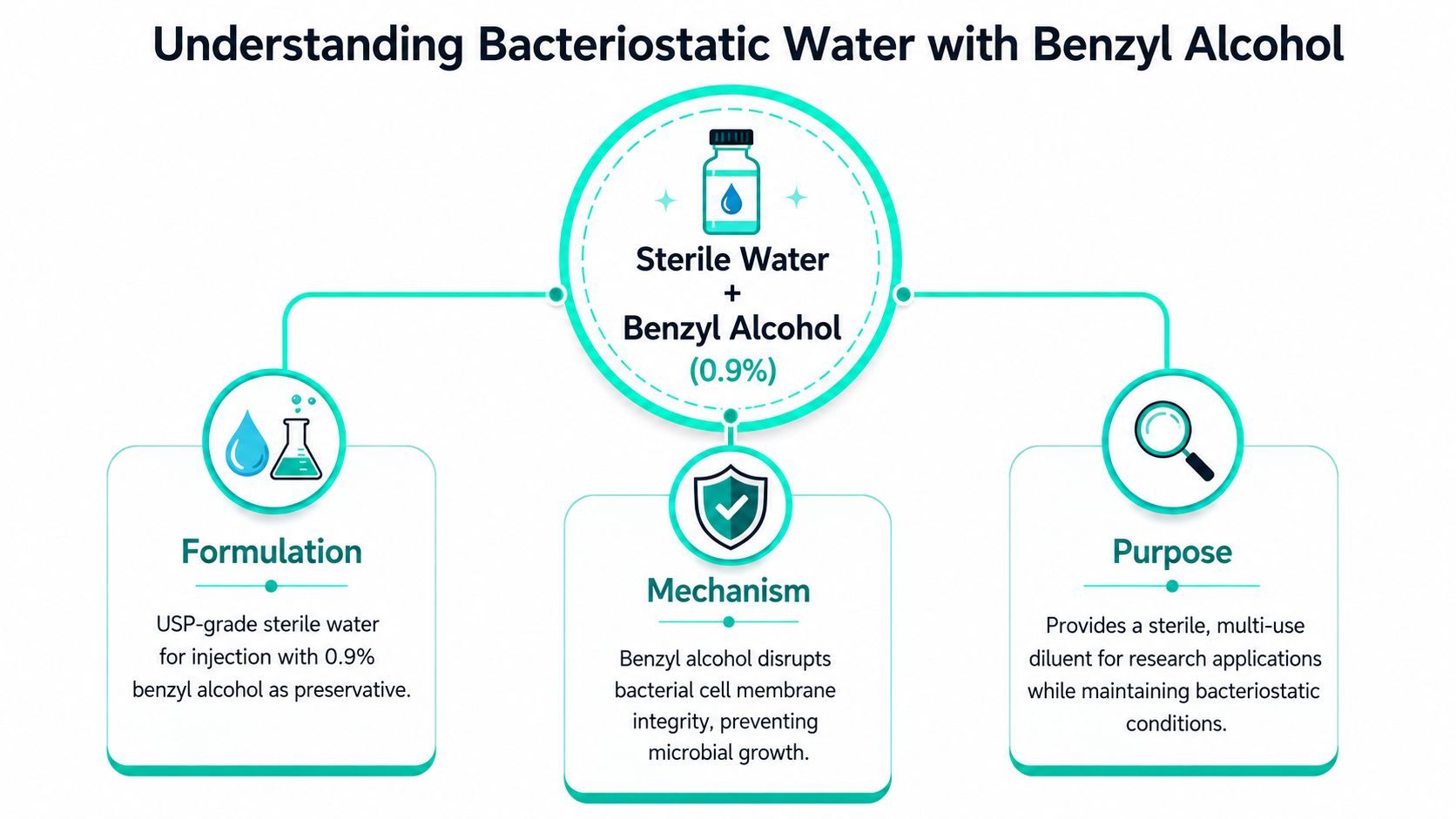
Benzyl alcohol functions as a bacteriostatic preservative by interfering with microbial viability and suppressing bacterial growth. That mechanism supports repeated withdrawals from a properly handled multi-dose vial. It doesn't mean the vial can be accessed casually, stored without controls, or used after visible deterioration.
The formulation became associated with a standardized multi-dose injectable vehicle in the early 1950s, when industry summaries describe USP standardization around sterile water containing 0.9% benzyl alcohol. That historical standard remains relevant because the same concentration continues to appear as the reference point in contemporary U.S. labeling. The historical background is summarized in this account of the development and standardization of bacteriostatic water.
A certificate of analysis, product label, or batch record should identify the preservative concentration clearly. Current labeling demonstrates that products marketed as bacteriostatic water aren't necessarily identical in concentration or container configuration. The DailyMed labeling for another bacteriostatic water presentation illustrates why researchers should verify the specific SKU.
For a controlled workflow, document:
The preservative has a purpose, but it also creates an excipient variable. Treat it as part of the formulation, not as invisible background chemistry.
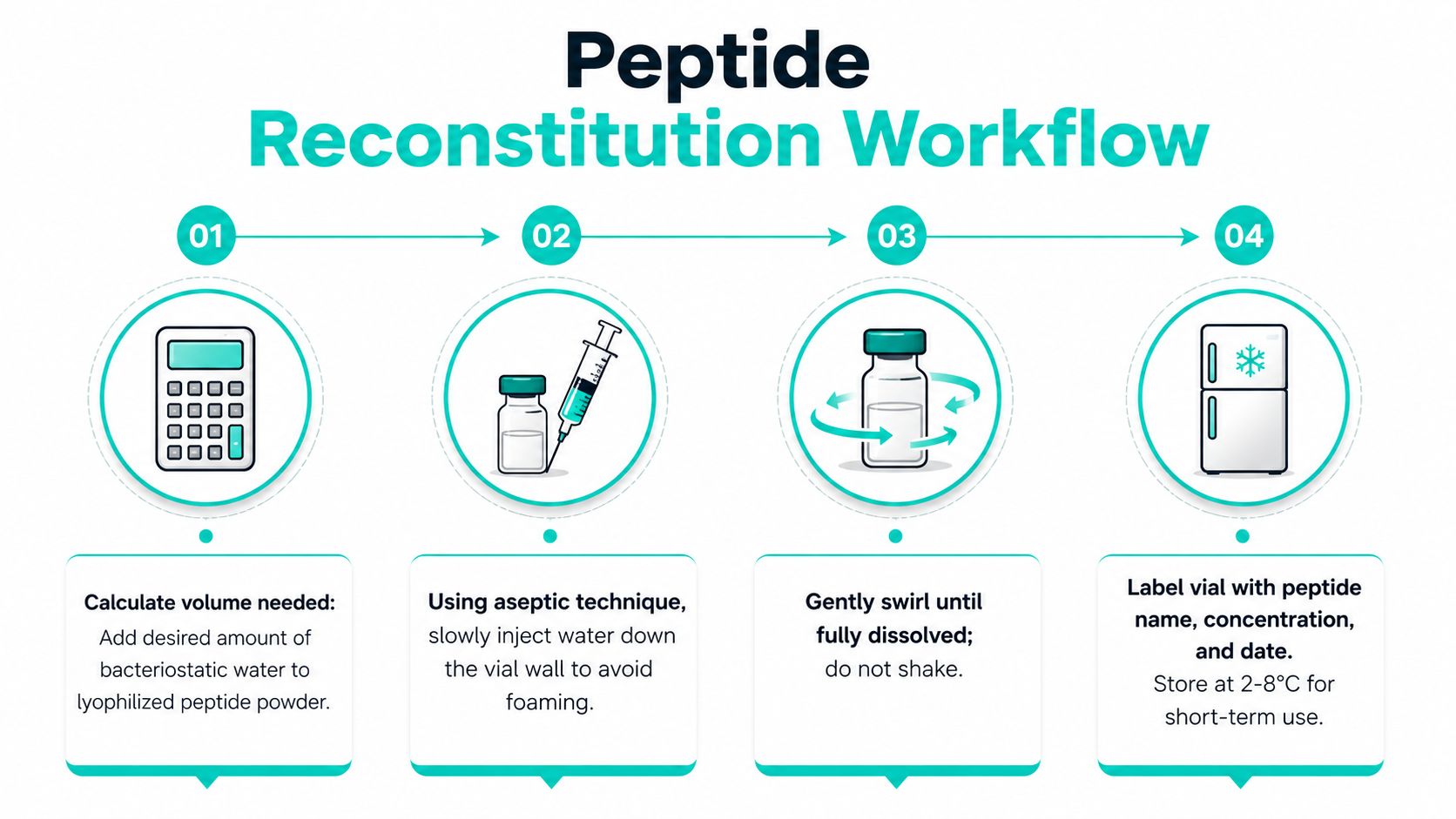
Reconstitution should be a controlled transfer, not a quick mixing step. Start with the peptide's documentation and establish the target concentration before opening either vial. The calculation should relate the amount of lyophilized material to the total solvent volume, and the result should be independently checked before the syringe is prepared.
Clean the work area, inspect both containers, and disinfect the vial stoppers with an appropriate sterile technique. Use a new sterile syringe and needle for each transfer. Draw the calculated volume slowly, then introduce the bacteriostatic water down the inner wall of the peptide vial rather than directing a forceful stream onto the powder.
Foam and vigorous agitation can complicate dissolution and may stress a sensitive preparation. Once the liquid has been added, allow it to contact the material, then gently swirl or roll the vial until the solution appears uniform. Don't shake aggressively unless the compound-specific instructions explicitly require it.
The reconstitution record should include the peptide identifier, solvent identity, preservative concentration, volume added, calculated final concentration, operator, date, and storage condition. That information gives another researcher a way to reproduce the preparation and helps distinguish a peptide problem from a solvent or handling problem.
Bacteriostatic water's preservative supports multi-dose handling, but it doesn't establish the stability period of the reconstituted peptide. The peptide's sequence, formulation, concentration, container, storage temperature, light exposure, and access history can all affect the result. A protocol may specify refrigerated short-term storage, but the solvent label alone can't supply a valid peptide shelf-life claim.
The peptide reconstitution guidance from Celonyx Labs can serve as a practical reference point, but the compound's own documentation and the laboratory's approved procedure should control. If the peptide is intended for a single-use preparation, or if its documentation excludes benzyl alcohol, use a compatible alternative rather than forcing a multi-dose workflow.
The following video can help new researchers visualize the handling sequence, but it shouldn't replace the governing product instructions or laboratory SOP.
The correct diluent depends on the peptide, the intended route, the access pattern, and the manufacturer's instructions. Bacteriostatic water offers a preservative-assisted multi-dose workflow. Sterile water for injection supplies a preservative-free vehicle, which can be preferable when the formulation requires minimal excipients or when the preparation will be used once.
Saline and other specialized media introduce different formulation variables. They shouldn't be selected because they're available on the shelf. A buffer, electrolyte solution, or other solvent can change the chemical environment around the peptide, so the compound documentation must support its use.
| Solvent Type | Preservative | Multi-Dose Use | Typical Use Case |
|---|---|---|---|
| Bacteriostatic water for injection | Benzyl alcohol, commonly labeled at 0.9%, or 9 mg/mL, with some products labeled 1.1%, or 11 mg/mL | Designed for repeated access under proper aseptic handling and applicable instructions | Multi-dose reconstitution or dilution when the compound permits benzyl alcohol |
| Sterile water for injection | No antimicrobial preservative | Generally suited to single-use preparation | Preservative-sensitive formulations or workflows requiring a plain aqueous vehicle |
| Saline or buffered media | Depends on the product | Depends on the product and labeling | Peptides or analytical workflows that specifically require an ionic or buffered environment |
| Other validated solvents | Depends on the formulation | Depends on the product instructions | Specialized compounds with documented solvent requirements |
Bacteriostatic water is a practical choice when repeated vial entry is part of the approved workflow and the peptide tolerates the preservative. Sterile water is more appropriate when the formulation must avoid benzyl alcohol or when the preparation is designed for immediate, single-use handling.
The phrase “sterile” doesn't answer the compatibility question. Both products may be sterile, but they don't have the same composition or operating profile. Likewise, the phrase “bacteriostatic” doesn't prove that a product suits every peptide, route, or experiment.
Decision point: First confirm the peptide's permitted diluents. Then decide whether the workflow needs preservative-supported repeated access.
For novel compounds, a small compatibility assessment can be more informative than relying on a generic internet recipe. Compare appearance, dissolution behavior, and the available stability indicators against an appropriate control, while keeping the solvent identity visible in the experimental record.
Benzyl alcohol is useful because it changes the microbial-control profile of the water. That same addition means the diluent can influence a peptide formulation. The central mistake is treating bacteriostatic water with benzyl alcohol as chemically neutral just because the base is water.
Peptide-specific instructions should take priority over general practice. Check whether the supplier or study protocol specifies bacteriostatic water, sterile water, saline, a buffer, or another medium. If the documentation is silent and the compound is unfamiliar, pause the preparation and obtain a compatibility decision rather than treating silence as approval.
The unopened solvent has its own labeled expiration and storage requirements. The reconstituted peptide has a separate stability question. Benzyl alcohol may suppress bacterial growth, but it doesn't guarantee that the peptide will resist oxidation, hydrolysis, aggregation, adsorption, or other degradation pathways.
A defensible stability record tracks the variables that the laboratory can control:
The labeled concentration is particularly important when comparing suppliers. A product labeled at 0.9%, or 9 mg/mL, shouldn't be substituted for a product labeled at 1.1%, or 11 mg/mL in a study where excipient load matters. The difference changes the amount of benzyl alcohol introduced into the final preparation.
A small-scale compatibility test can reveal whether the solvent produces immediate precipitation, poor dissolution, or an unacceptable appearance. It can't establish long-term stability by itself. For a sensitive or novel peptide, use the laboratory's validated analytical method and define acceptance criteria before starting the comparison.
Stability reminder: A bacteriostatic preservative supports contamination control. It isn't a certificate of peptide potency or an expiration date for the reconstituted sample.
That distinction protects the integrity of the study. If a preparation remains visually clear, it may still require analytical confirmation before researchers interpret a time-dependent result as compound stability.
Safe handling starts with the vial, not the instrument. Before use, inspect the container, closure, solution, and label. A damaged stopper, compromised seal, visible particulate, unexplained discoloration, or missing batch information should trigger quarantine and review.
Aseptic technique remains necessary because benzyl alcohol suppresses microbial growth rather than replacing sterile practice. Use appropriate personal protective equipment, disinfect vial access points, keep syringes and needles sterile, and dispose of sharps immediately in the approved container. Reusing a needle or returning a used needle to a vial creates a preventable contamination pathway.
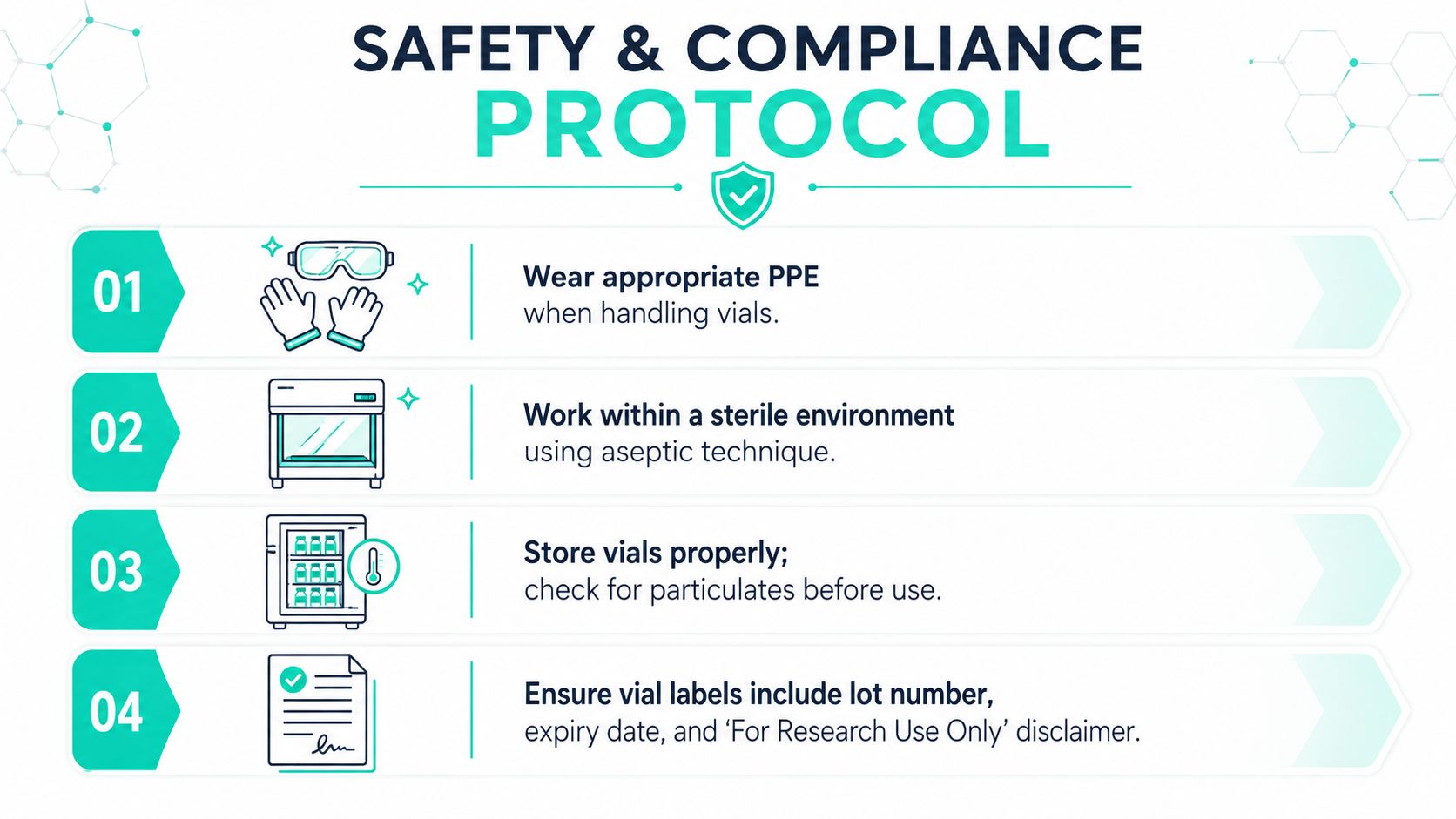
A label review should be part of receiving inspection and part of pre-use verification. Regulatory labeling identifies the product's intended role as a diluent for drugs administered by intravenous, intramuscular, or subcutaneous routes according to the drug manufacturer's instructions. That language doesn't authorize researchers to ignore compound-specific restrictions.
Use a short checklist:
The bacteriostatic water and syringe handling guidance can supplement an internal procedure, but it shouldn't replace institutional safety requirements. Personnel working in repeated-access or high-throughput workflows should also review their exposure controls with the responsible safety officer.
If a lab records only “sterile water,” it loses information needed to interpret the preparation. The solvent's product name, preservative concentration, lot, and expiration should travel with the peptide batch record. That practice makes deviations visible and helps investigators identify whether two apparently identical experiments used materially different diluents.
Procurement problems often begin with a vague purchase description. “Bac water” doesn't specify the preservative concentration, container configuration, intended route, documentation package, or release criteria. A laboratory should define those requirements before requesting a quote.
Ask the supplier for product labeling and batch-specific documentation that identifies sterility, nonpyrogenic status, preservative concentration, lot number, and expiration. If the supplier can't provide the concentration clearly, the product shouldn't enter a peptide workflow where excipient burden is a controlled variable.
Online product pages can describe a category, while the received vial may belong to a different presentation. Compare the physical label with the order record and retain the documentation in the inventory file. If the label states 0.9%, or 9 mg/mL, record that exact value. If it states 1.1%, or 11 mg/mL, don't assume the difference is immaterial.
A practical release sequence looks like this:
Supply friction deserves separate attention. Independent market coverage describes tightened demand alongside broader injectable and compounding pressure, while noting that bacteriostatic water wasn't listed as a formal FDA Drug Shortages item as of mid-2026. The 2026 coverage of bacteriostatic water availability is useful because it distinguishes procurement difficulty from an official nationwide shortage.
That distinction changes the response. Instead of making an unverified shortage claim, maintain an approved-supplier list, monitor lead times, order against documented study needs, and qualify an alternative presentation before the primary stock runs low. Don't substitute a different benzyl alcohol concentration without reviewing the protocol and recording the change.
Celonyx Labs offers research peptides through an online catalog and identifies 99% purity and independent third-party testing as product quality attributes in its published materials. Laboratories evaluating a supplier can review its catalog and contact information through Celonyx Labs, then request the batch documentation required by their own purchasing and quality systems.
For peptide research, Celonyx Labs provides catalog-based access to research peptides, published product information, and customer support for order and product questions. Visit Celonyx Labs to review available materials and align your peptide purchase with the solvent, documentation, and batch-traceability requirements of your laboratory.
A researcher searching “kisspeptin 10 for sale” may expect a straightforward catalog result. Instead, the

Ranked guide to the best tirzepatide peptides for research in 2026: lyophilized vials, reference standards,

The best cagrilintide peptides for research in 2026, ranked by purity, COA availability, and format
FOR RESEARCH USE ONLY. Products sold by Celonyx Labs are intended exclusively for laboratory and scientific research. They are not intended for human or veterinary use, consumption, diagnosis, treatment, cure, or prevention of any disease. By purchasing from this site, you acknowledge that you understand the intended research purpose of these materials and agree to comply with all applicable laws and regulations.