
1500 Mg Glutathione: What That Strength Really Means
You're comparing two bottles on a supplement shelf. One says 500 mg glutathione. The other
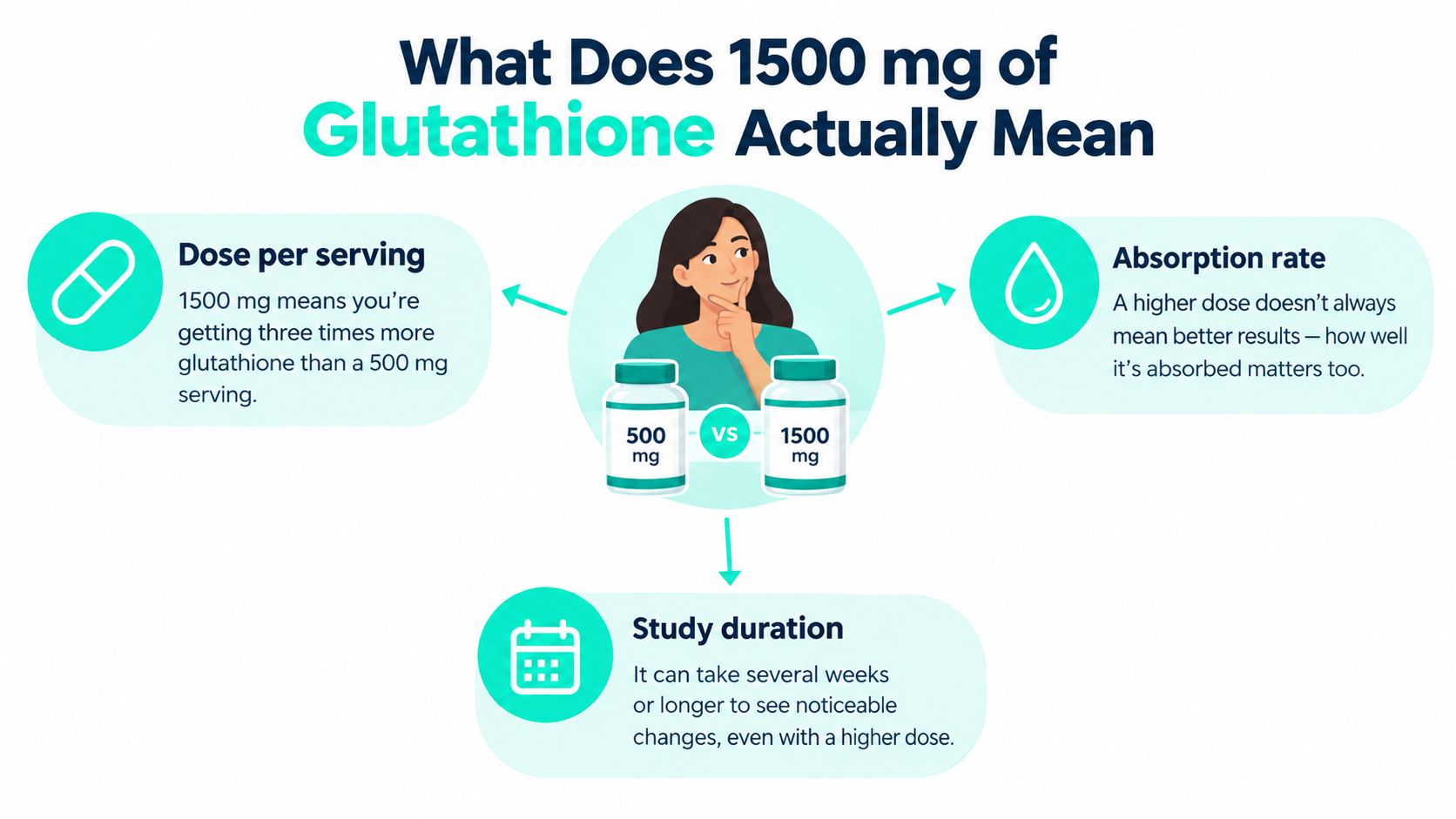
You're comparing two bottles on a supplement shelf. One says 500 mg glutathione. The other says 1500 mg. The larger number looks persuasive, especially if you assume three times the ingredient should mean three times the result. That assumption is the first thing to set aside.
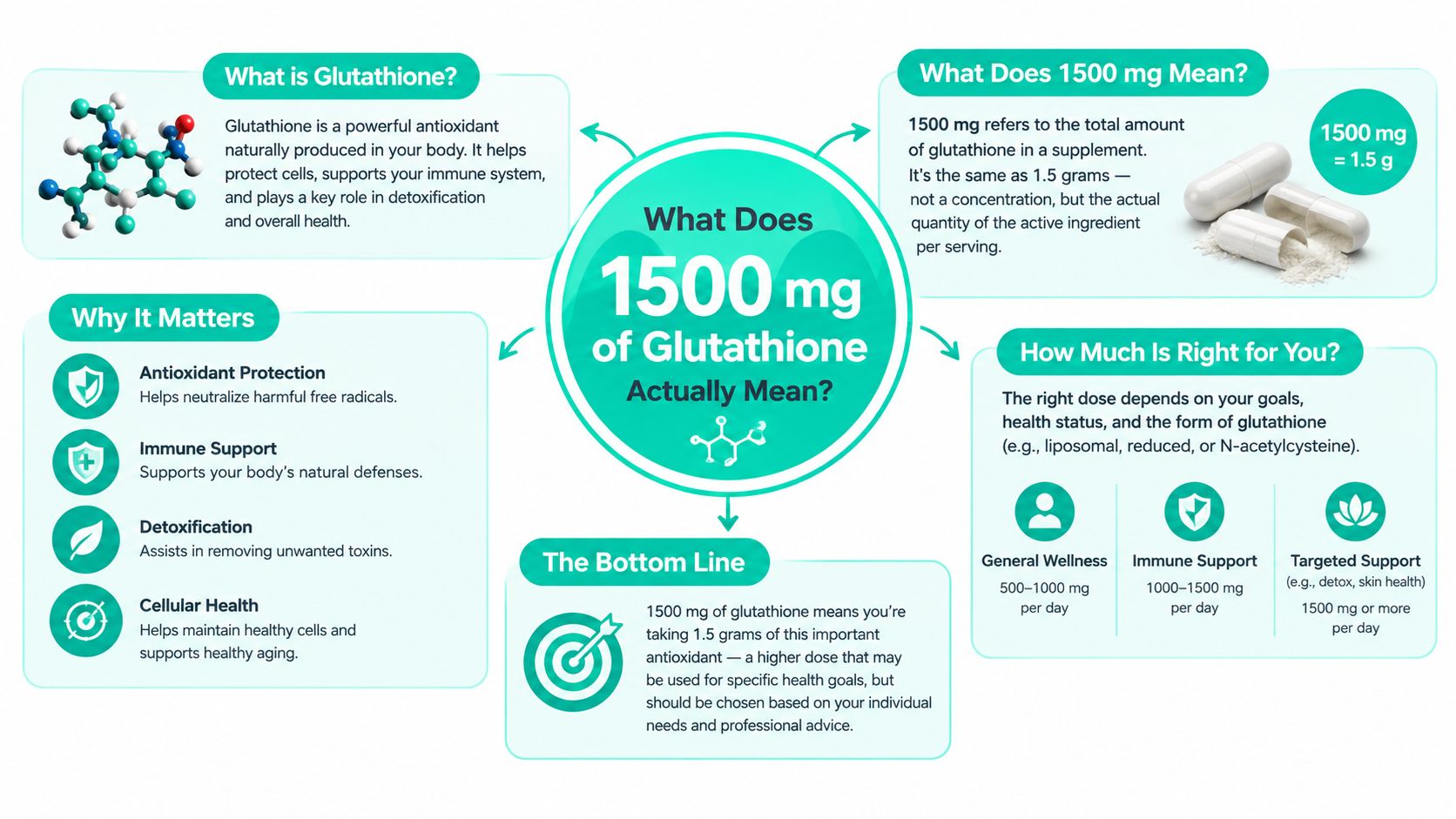
A 1500 mg label tells you how much glutathione the manufacturer places in the stated serving. It doesn't tell you how much survives digestion, reaches circulation, enters cells, or changes intracellular glutathione stores. The useful question isn't "Is 1500 mg a lot?" It's "What does that amount represent, and how confidently can the product deliver it?"
On a conventional supplement label, 1500 mg means 1.5 grams of glutathione by weight in the serving specified by the manufacturer. That's a quantity of raw compound, not a measurement of bioavailability or blood concentration. It also isn't a direct reading of the amount that becomes active inside your cells.
A simple way to evaluate the number is to separate four stages:
The label gives you the first stage only. Formulation, route, stability, digestion, metabolism, and tissue uptake influence the later stages. That's why two products with the same milligram count can create different exposure, and why a larger label doesn't automatically produce a proportionally larger effect.
When you assess 1500 mg glutathione, look beyond the front panel:
If you're comparing products, a resource such as find high dose glutathione capsules can help you see how a glutathione product is presented in the marketplace. Treat that kind of listing as a product-description reference, not as proof that the labeled amount equals a particular clinical outcome.
Practical rule: A milligram number tells you what was put into the serving. It doesn't, by itself, tell you what your cells received.
That distinction protects you from the most common shopping error, treating potency as a substitute for evidence. 1500 mg is a formulation claim first, and only then a question about delivery and biological effect.
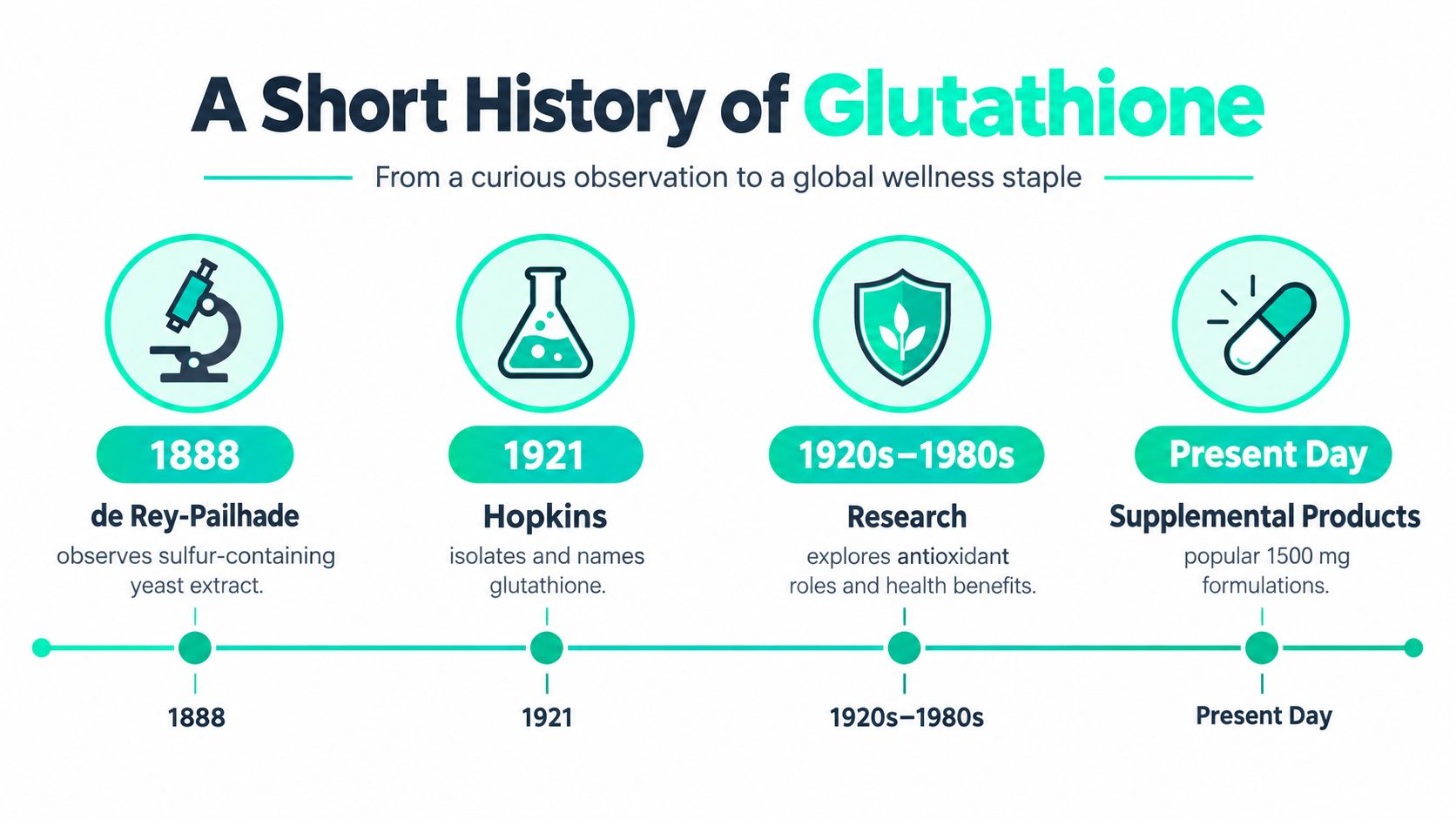
Glutathione began as a biochemical puzzle, not as a consumer supplement. The compound was first discovered in 1888, when de Rey-Pailhade identified a sulfur-containing substance in yeast extract. Hopkins later renamed it glutathione, and researchers confirmed its correct tripeptide structure in 1935, according to the American Chemical Society's historical overview of glutathione.
That sequence matters because it shows how slowly a biological observation can become a manufactured ingredient. Commercial production began in the 1950s, roughly 67 years after the initial discovery, as described in the same ACS source. Modern production can draw on controlled biological and enzymatic processes, making glutathione available in forms that earlier researchers couldn't have bought from a supplement retailer.
The historical path also explains why shoppers won't find a universally accepted daily intake for glutathione. Scientists studied it as a naturally occurring molecule involved in cellular chemistry long before manufacturers marketed oral products in varying strengths. Modern reviews still describe oral research as relatively young and note that no official daily intake has been established. The ACS describes glutathione as a tripeptide made from glutamate, cysteine, and glycine, and as one of the best-studied intracellular thiols in biology.
That history creates a mismatch. A compound can have a substantial scientific literature about its structure and biological role without having a settled consumer dosing framework. Research on the molecule's chemistry doesn't automatically validate every strength printed on a bottle.
A 1500 mg product is therefore the result of manufacturing capability and market positioning, not evidence that scientists established 1500 mg as a standard daily requirement. The absence of an official intake target doesn't prove that the dose is inappropriate, but it does mean buyers should ask for formulation-specific and dose-specific support.
The most useful historical lesson is modesty. Glutathione is scientifically important, yet the transition from intracellular molecule to high-strength capsule happened faster than the development of long-term, standardized consumer dosing rules.
Glutathione is a tripeptide, meaning it contains three linked amino acids: glutamate, cysteine, and glycine. Think of it as a three-link chain. Each link matters, but cysteine contributes the reactive sulfur group that allows glutathione to participate in redox reactions.
That sulfur chemistry helps explain why glutathione is discussed as an intracellular antioxidant and thiol redox buffer. Cells don't treat it like a simple external coating. They maintain, use, and recycle it through enzyme systems that include glutathione peroxidase and glutathione reductase, with NADPH supporting the recycling process.
The body's glutathione network is dynamic. A capsule must first release its contents, then the digestive tract must handle the molecule, intestinal transport must allow some material to pass, and the liver can alter the amount that reaches systemic circulation. After that, tissues still need to take up or rebuild usable glutathione.
This is why 1500 mg on the label and intracellular availability are different measurements. The first is a mass added to a product. The second depends on a chain of biological steps that the label doesn't report.
Readers who want a more focused explanation of the molecule's classification can review whether glutathione is a peptide. For anyone considering supplementation alongside health concerns, general context about what clinicians assess in a liver function test may also be useful, although a liver test can't establish how much oral glutathione entered a particular tissue.
A standard capsule, a protected formulation, and a clinically administered preparation don't expose the body to glutathione in identical ways. Even before researchers discuss outcomes, they must consider the product's chemical form, release characteristics, absorption, and tissue handling.
The three-link chain analogy helps here. Adding more chains to the stomach doesn't guarantee that more complete chains reach the cell intact. Some may be broken apart, some may be metabolized, and some may never cross the relevant barriers. A high-dose label is meaningful only when you understand the delivery system carrying it.
A 1500 mg serving can mean different things depending on how glutathione reaches the body. Oral capsules and tablets are convenient, but the compound must pass through digestion and first-pass metabolism. That makes the labeled quantity easy to count and the delivered quantity harder to predict.
Liposomal products place glutathione in phospholipid structures designed to protect the contents during transit. They may improve survival through the gut, but “liposomal” isn't a substitute for formulation evidence. A vendor should still explain how it characterizes the preparation and verifies its stability.
Sublingual tablets and lozenges use the oral mucosa rather than relying entirely on swallowing. They can reduce some digestive exposure, but they don't eliminate every metabolic barrier, and the actual absorption depends on the product and how it's used.
Injectable routes used in clinical settings place glutathione directly into circulation or tissue, depending on the route. They can provide higher systemic availability than oral products, but they also introduce medical issues involving sterility, administration, supervision, and patient suitability. A consumer shouldn't treat an injectable dose as interchangeable with a capsule dose.
| Route | Typical Bioavailability | 1500 mg Context | Key Trade-off |
|---|---|---|---|
| Oral capsule or tablet | Variable and limited by digestion and first-pass metabolism | The full 1500 mg is the labeled ingredient amount, not the guaranteed circulating amount | Convenient, but exposure is difficult to infer |
| Liposomal oral product | Potentially higher than a conventional oral form, depending on formulation | The same label may be paired with a different release and absorption profile | More formulation complexity and a need for stability evidence |
| Sublingual tablet or lozenge | Variable, with some absorption through oral mucosa | The dose may avoid part of the digestive route, but the delivered amount still requires evidence | Less conventional and dependent on proper use |
| Injectable preparation | Direct systemic delivery can provide high availability | A 1500 mg injectable amount shouldn't be compared casually with a 1500 mg oral serving | Requires clinical oversight, sterile production, and appropriate administration |
Route comparisons should stay grounded in what the product can document. General discussion of delivery technologies, including peptide nasal spray research, can illustrate why route changes matter, but it doesn't establish that a particular glutathione product achieves a specific absorption rate.
For shoppers, the practical question is simple: what route is being used, and what evidence supports that route at this strength? If a vendor answers only with the total milligrams, it hasn't answered the delivery question.
A shopper sees 1500 mg on a label and may read it as a research-backed target. Human oral glutathione studies generally cluster below that amount. The Drugs.com professional monograph on glutathione reports oral studies commonly using 250 mg to 1,000 mg per day and describes a study in which healthy volunteers took 500 mg twice daily for 4 weeks without serious adverse events. It also summarizes trials using 250 mg/day and 1,000 mg/day over 1, 3, and 6 months.
That places a 1500 mg serving above the range most often represented in human oral research. On the label, it is 50% higher than 1,000 mg, the upper end of the frequently discussed range. The arithmetic clarifies the product's marketed strength. It does not establish 1500 mg as a validated daily target.
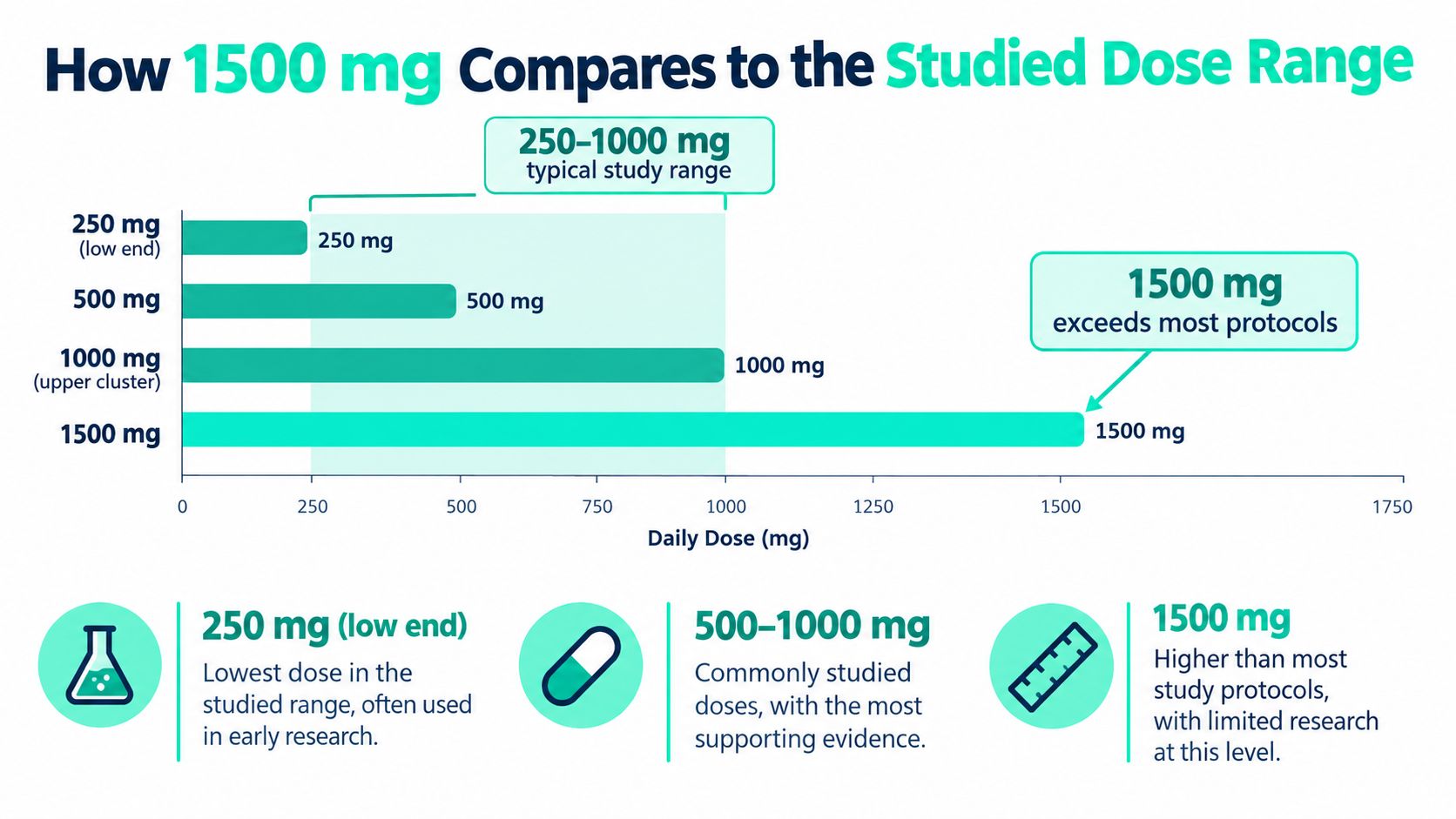
Limited research at 1500 mg does not, by itself, show that the dose is unsafe or ineffective. It shows that the amount is less characterized in human oral trials, so findings from lower doses should not be treated as if they scale perfectly upward.
A result at 500 mg does not prove that 1000 mg will double the response. Evidence at 1000 mg also does not establish another equivalent increment at 1500 mg. The marketing claim and the evidence base are separate questions.
Treat 1500 mg as a high-strength formulation, not an evidence-standardized daily benchmark. That distinction matters when a product promises antioxidant support, skin benefits, detoxification, or recovery. A higher label amount may differentiate a product on the shelf, while offering limited information about its expected human effect.
Use a simple vendor checklist: identify the route, ask whether human research matches the stated strength, check whether the study measured the claimed outcome, and look for product testing that confirms the labeled amount. A vendor that gives only the milligram figure has not answered those questions.
Readers comparing supervised protocols can review how clinicians titrate IV glutathione. Injectable dosing should not be used to justify taking an oral product at the same amount, because route and exposure differ.
A 1500 mg label can look like a stronger signal of results. In the body, however, the dose passes through several biological bottlenecks. The digestive tract may break down part of an oral preparation, transport mechanisms may limit movement across intestinal cells, and the liver may metabolize absorbed material before it reaches wider circulation. Each step separates the amount printed on the label from the amount that reaches relevant tissues.
Cellular handling adds another limit. Glutathione does not move directly from a capsule into every cell. Enzymes and transport processes manage the tripeptide and its building blocks. These systems have finite capacity, so extra material may be metabolized, redistributed, or excreted instead of producing a matching rise in intracellular stores.
A larger serving is an input, not a guaranteed output.
An increase from 1000 mg to 1500 mg therefore does not establish a proportional 50% increase in effect. The percentage describes the change in labeled amount, not a measured biological response. Evidence becomes comparatively limited above 1000 mg per day, which makes the response at 1500 mg difficult to predict. The label is a formulation detail, not a response forecast.
Absorption works more like a series of gates than an open pipe. If the first gate handles only part of a serving, adding more material behind it does not force the same proportion through. Metabolism and cellular uptake can impose further limits.
A high-strength product should therefore be assessed through more than arithmetic. Ask:
Oral glutathione is generally described as well tolerated in review literature, with mild gastrointestinal effects reported and limited information about long-term use at 1500 mg. That combination supports a measured approach. More milligrams may matter in a particular formulation or clinical setting, yet consumers cannot infer the outcome from the front label alone. Before comparing products, check whether the strength, route, evidence, and testing all refer to the same product.
The evidence gap turns quality control into a practical buying filter. A vendor selling a 1500 mg product should provide enough documentation for you to distinguish a measured formulation from a strong-sounding label.
Ask for a lot-specific certificate of analysis, not a generic document that applies to every production run. The certificate should identify the tested material and show relevant results for identity, assay or potency, and contaminants. A batch document helps catch mislabeling and under-dosing, but only if the lot number on the certificate matches the lot on the product you receive.
Independent verification adds another layer. Look for testing or certification from recognized organizations such as USP, NSF, or Informed Choice, where applicable to the product category. A badge alone isn't enough. Check whether the organization tested the finished product, what it tested for, and whether the certification covers the specific item rather than a company generally.
“High purity” is incomplete unless the vendor defines it. A useful specification should identify the glutathione assay and explain contaminant thresholds, rather than presenting purity as an unexplained headline.
Use this checklist:
A transparent label should identify excipients, serving size, capsule or tablet composition, and the chemical form of glutathione. If the product is liposomal, ask how the vendor characterizes the liposomal system and monitors stability. If it claims superior absorption, ask for evidence tied to that actual formulation rather than a general statement about the category.
For laboratories and investigators assessing research materials, third-party-tested peptides offers a useful framework for thinking about external quality checks. Celonyx Labs presents research materials through an online catalog and describes 99% purity and independent third-party testing as product attributes in its publisher information. Those statements should still be verified against product-specific documentation before use.
Buying rule: If a high-dose product fails two or more checkpoints, reconsider it regardless of price or milligram count.
The 1500 mg claim deserves extra scrutiny because it sits above the dose range most often represented in human oral studies. Vendors should be able to explain manufacturing, storage, testing, and stability without asking you to treat marketing copy as clinical evidence.
You are comparing two bottles: one lists 1500 mg glutathione, while another uses a lower amount with clearer testing records. The larger label may look stronger, yet it sits above the 250 mg to 1,000 mg range commonly reported in human oral research. That gap between marketed strength and human evidence should shape your questions before purchase.
Use this decision flow:
The human research does not establish a standard daily dosage for oral glutathione, and longer-term evidence remains limited. Treat that uncertainty like a gap on a map. It does not prove that a product is ineffective, but it does show where confident promises go beyond the available evidence.
Apply the same vendor checklist to any high-dose supplement: identify the exact form and route, check lot-specific testing and contaminant results, review storage information, and separate formulation evidence from broad category claims. A high number on the label is a reason to verify, not proof of superior results.
Celonyx Labs supplies research materials through an online catalog and describes product-level information such as stated purity and independent third-party testing. Visit Celonyx Labs to review its catalog and documentation before deciding whether a material fits your laboratory or research requirements.
You're comparing two bottles on a supplement shelf. One says 500 mg glutathione. The other

Is bacteriostatic water the same as sterile water? No. Compare preservatives, vial handling and peptide

How do you know if a peptide vial has gone bad? Quarantine changes, check storage
FOR RESEARCH USE ONLY. Products sold by Celonyx Labs are intended exclusively for laboratory and scientific research. They are not intended for human or veterinary use, consumption, diagnosis, treatment, cure, or prevention of any disease. By purchasing from this site, you acknowledge that you understand the intended research purpose of these materials and agree to comply with all applicable laws and regulations.