
Best GHK-Cu peptides for skin and wound healing research 2026
Choose the best GHK-Cu peptide format for laboratory skin and wound-healing research. Compare documentation, assay
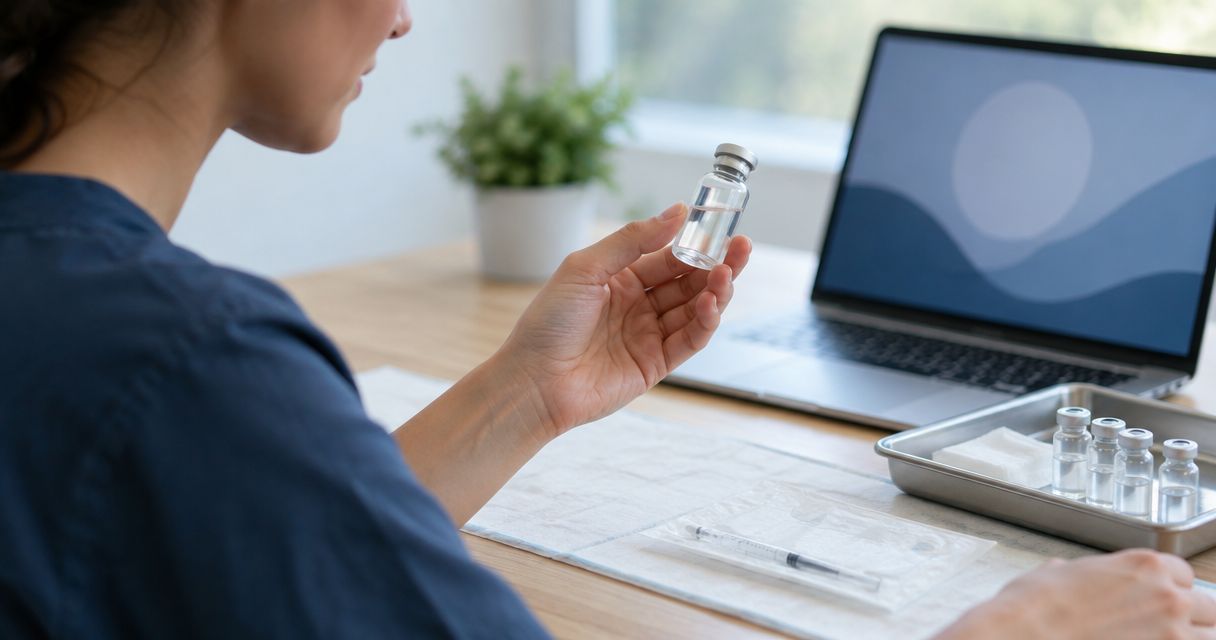
No—do not use expired bacteriostatic water for injections or laboratory work that requires a sterile, qualified diluent. The printed expiration date and any earlier after-opening discard date both matter; a clear solution and an intact-looking vial do not establish that expired material remains suitable for use.
Expired bacteriostatic water should be replaced, not cleared for use by appearance. The expiration date marks the manufacturer's supported shelf life under the labeled storage conditions. It does not predict an abrupt change at midnight, but it also does not authorize use beyond that date.
Opening the vial introduces a separate limit. CDC injection-safety guidance generally calls for dating a punctured multidose vial and discarding it within 28 days, unless the manufacturer specifies a different opened-vial period. The assigned discard date must not extend beyond the manufacturer's expiration date.
For a separate explanation of this distinction, read how long bacteriostatic water lasts once opened. An unopened expiration date is not an opened-vial reuse allowance.
| Vial condition | What supports a use decision | Main limitation | Recommended action |
|---|---|---|---|
| Unopened and within expiration | Label, intact closure, documented storage | Incorrect storage or damage can still disqualify it | Use only if suitable for the intended protocol |
| Opened and within its discard period | First-puncture record, manufacturer instructions, proper handling | Each access creates a contamination opportunity | Follow the applicable instructions and laboratory procedure |
| Unopened but expired | The supported shelf-life period has ended | Appearance cannot establish continued suitability | Replace it |
| Opened with an unknown puncture date | No reliable opened-vial timeline | Remaining contents do not reveal vial age | Remove it from use |
| Cloudy, discolored, leaking, or visibly damaged | An observable defect is present | The cause cannot be resolved by visual inspection | Do not use it |
These conditions are not interchangeable. For your 2026 laboratory inventory, record both the manufacturer's expiration and the applicable after-opening discard date, then use the earlier limit.
An unsuitable diluent creates two problems: a contamination risk and an experimental-quality problem. In laboratory research, an unqualified reagent can undermine your ability to attribute an observed result to the material you intended to study.
Replacing a questionable vial also preserves traceability. You can document the replacement lot, its storage history, and the date it entered the experiment instead of explaining an unsupported exception after results arrive.
For injections, the answer is stricter than a research troubleshooting discussion: do not inject expired bacteriostatic water or material prepared with it. Research-use-only peptides are not approved for human administration, regardless of the diluent's age or appearance.
An unopened vial avoids the contamination opportunities created by repeated access. That is an advantage, not an extension of its labeled shelf life.
A sealed container can still have an unsuitable storage history or a damaged closure. Keeping it in a cupboard, refrigerator, or shipping box does not establish that the manufacturer's storage requirements were met.
Use the label as your starting point. Check the exact formulation, expiration, storage instructions, and closure condition before assigning the vial to a protocol.
For a 2026 stock review, separate expired unopened vials from usable inventory. Do not leave them beside current stock with a note suggesting they are acceptable for less important experiments; that creates an avoidable selection error.
28 days is the CDC's general discard interval for punctured multidose vials unless the manufacturer specifies otherwise. It is not a promise that every vial remains suitable throughout that interval, and it does not override an earlier expiration date.
Record the first puncture when it happens. An estimated opening date reconstructed from memory is not a reliable basis for extending use.
The preservative does not remove the need for aseptic handling. For clinical use, CDC guidance requires a new sterile needle and syringe for each entry into a multidose vial; follow the manufacturer's instructions and your laboratory's approved procedure for research handling.
If handling was compromised, do not wait for the scheduled discard date. A known contamination event, damaged stopper, or uncertain container integrity is a separate reason to remove the vial from use.
Suitability depends on more than the date printed on the vial. The relevant factors are documented conditions—not whether the solution looks reassuring.
Your 2026 reagent procedure should treat these as independent checks. Passing the date check does not excuse a failed storage or handling check.
Common U.S. labeling for Bacteriostatic Water for Injection lists 0.9% benzyl alcohol, equivalent to 9 mg/mL, as a preservative. These formulation details appear in product labeling published through DailyMed; verify your own vial rather than assuming every product has the same composition.
Bacteriostatic describes inhibition of bacterial growth. It does not mean that the preservative sterilizes a contaminated vial or protects against every organism.
0.9% benzyl alcohol is not evidence that expired water remains usable. Preservative concentration alone does not establish container integrity, current sterility, or compliance with the labeled storage conditions.
In research, the preservative also becomes part of the experimental mixture. Check whether the protocol permits benzyl alcohol and whether its presence needs to be addressed through an appropriate vehicle control.
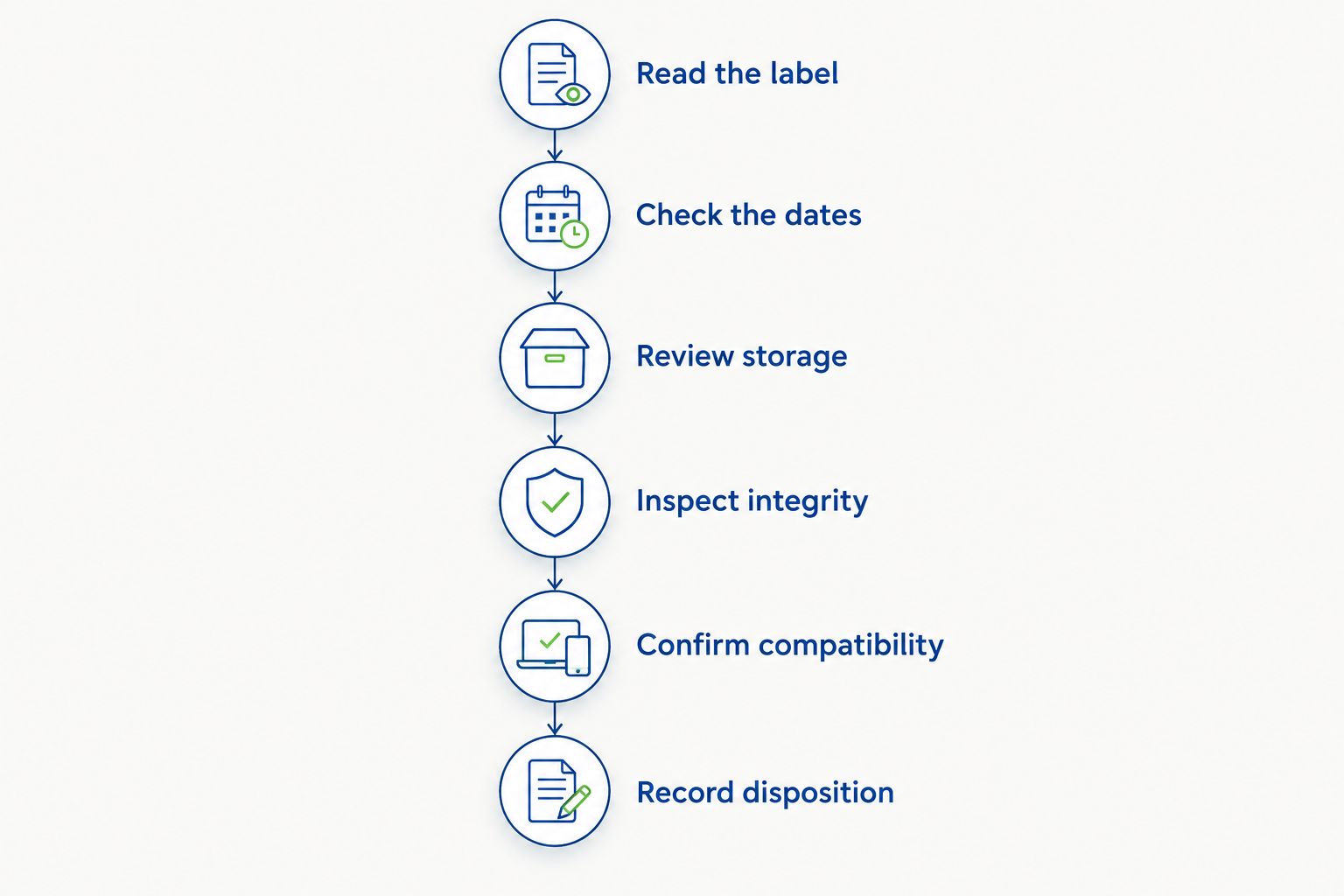
Use a documented decision sequence rather than trying to prove safety from a quick inspection. The objective is to identify disqualifying conditions before the diluent enters a preparation.
Keep this sequence in your 2026 laboratory procedure so different staff members apply the same decision rule. Do not create an informal exception based on how recently the vial expired.
No—clarity does not establish sterility or justify using an expired vial. Visible inspection detects some defects, but microorganisms and other quality problems are not reliably excluded by an absence of cloudiness.
Use appearance as a rejection check, not an acceptance test. A visibly abnormal vial fails immediately; a normal-looking vial still needs valid dates, suitable storage, and intact packaging.
No—refrigeration does not independently extend the manufacturer's expiration date or the applicable opened-vial discard date. Storage instructions are product-specific, and the correct conditions must come from the vial's label.
Do not transfer peptide-storage instructions to the diluent. The requirements for a lyophilized peptide, its solvent, and the final reconstituted preparation are separate decisions.
Do not assume that the resulting preparation is suitable simply because the peptide dissolved normally. Set it aside, document the diluent lot and dates, and have the responsible laboratory lead assess the affected work under your procedure.
If the preparation was intended for an experiment, assess whether it must be remade and whether completed results need a documented deviation review. A later observation cannot reconstruct the reagent's condition at the time of preparation.
If someone has already injected material prepared with expired water, contact a clinician for advice. Seek urgent care for symptoms such as fever, spreading redness, severe pain, or feeling seriously unwell.
Celonyx Labs research peptides are for laboratory researchers and scientists, not human use. Celonyx Labs describes its research peptides as 99%-pure and third-party-tested; those quality signals concern the peptide material and do not establish the suitability of a separate diluent.
The distinction matters when you assemble a reagent file. A peptide purity result cannot certify an expired water vial, establish compatibility with benzyl alcohol, or validate the stability of the final solution.
For your 2026 reconstitution records, retain the peptide documentation alongside the diluent identity, lot, expiration, first-puncture date, and preparation details. Evaluate each component on its own evidence.
Is it safe to use expired bacteriostatic water if the vial is unopened?
No—an unopened vial should not be used after its printed expiration date. An intact seal does not establish continued suitability beyond the manufacturer’s supported shelf life.
How long does bacteriostatic water last after the first puncture?
28 days is the CDC’s general discard interval for punctured multidose vials unless the manufacturer specifies otherwise. The assigned discard date must not extend beyond the printed expiration, and compromised handling requires earlier removal.
Does 0.9% benzyl alcohol keep expired water safe?
No—0.9% benzyl alcohol does not establish that expired bacteriostatic water remains suitable. The preservative inhibits bacterial growth but does not sterilize a contaminated vial.
Can I tell whether bacteriostatic water is contaminated by looking at it?
No—visual inspection cannot establish sterility. Cloudiness, discoloration, leakage, or particles are rejection signals, but clear water still requires valid dates and appropriate handling.
Can I boil or filter expired bacteriostatic water to reuse it?
No—boiling or informal filtration does not restore the manufacturer’s expiration or validate the material for injection or a sterile laboratory protocol. Replace the vial rather than attempting an unvalidated recovery process.
Is fresh bacteriostatic water suitable for every peptide experiment?
No—fresh bacteriostatic water is suitable only when the specific protocol permits that diluent. Check the peptide’s instructions and the assay’s compatibility requirements, including the presence of benzyl alcohol.
Does third-party peptide testing make an expired diluent acceptable?
No—peptide testing does not qualify a separate expired diluent. Celonyx Labs research peptides are for research use only, and their stated purity does not establish the sterility of a reconstituted preparation.
The date that matters is the earliest applicable limit, not the most reassuring date on the container. A vial can be within its printed expiration and still be past its after-opening discard date—or unsuitable because handling or storage failed.
Label the first puncture immediately and keep expired material out of active stock. That simple separation prevents a questionable vial from becoming an undocumented variable in your next experiment.
Choose the best GHK-Cu peptide format for laboratory skin and wound-healing research. Compare documentation, assay

Choose lot-verified melanotan 1 peptide for pigmentation research. Compare material specifications, purity evidence, and documentation

Native oxytocin peptide is the default for behavioral research. Compare reference standards, labeled materials, and
FOR RESEARCH USE ONLY. Products sold by Celonyx Labs are intended exclusively for laboratory and scientific research. They are not intended for human or veterinary use, consumption, diagnosis, treatment, cure, or prevention of any disease. By purchasing from this site, you acknowledge that you understand the intended research purpose of these materials and agree to comply with all applicable laws and regulations.