
Is bacteriostatic water the same as sterile water? No 2026
Is bacteriostatic water the same as sterile water? No. Compare preservatives, vial handling and peptide
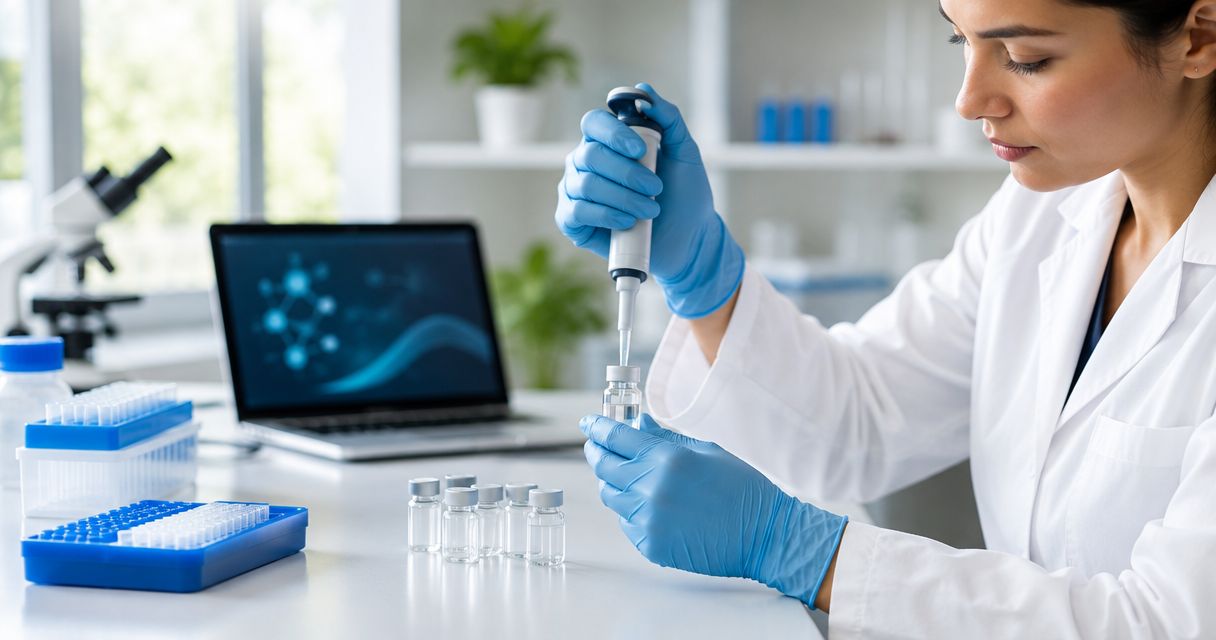
Yes. You can reconstitute a research peptide without bacteriostatic water if the alternative diluent is compatible with that peptide and the laboratory method. The trade-off is that an unpreserved diluent does not provide the antimicrobial preservative found in bacteriostatic water; it does not make the resulting solution suitable for repeated access by default. In 2026, select the diluent from the peptide’s documentation and your protocol, not from a general rule about peptides.
A peptide can dissolve and still be unsuitable for an experiment. The diluent can affect solubility, pH, assay background and the way a solution behaves during handling. Choosing an alternative to bacteriostatic water therefore requires more than checking whether a vial looks clear.
For a lab workflow, keep the peptide’s identity, reconstitution method and analytical requirements together. The peptide reconstitution guide for biotech startup labs provides a broader workflow; the decision here is narrower: whether your specified method permits a diluent other than bacteriostatic water.
Yes, if the alternative meets the peptide’s solubility requirements and does not interfere with the intended assay. Start with the supplier’s documentation and your laboratory protocol. If neither identifies an acceptable diluent, do not treat an internet dilution ratio as a substitute for method validation.
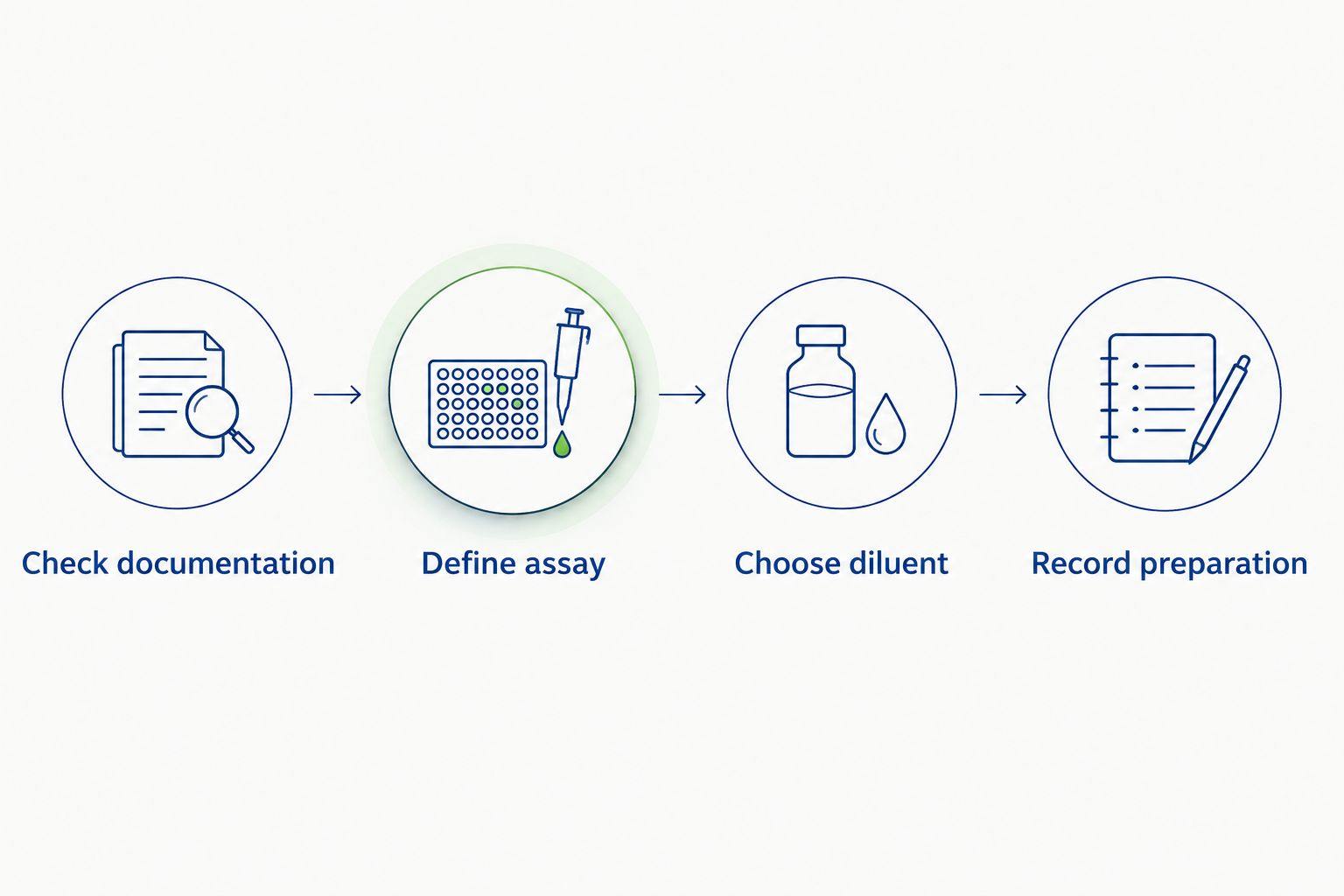
Use this sequence before preparing a research sample:
| Diluent approach | Best for | Advantage | Limitation |
|---|---|---|---|
| Sterile water, when specified | Methods that call for an unbuffered, unpreserved aqueous diluent | Avoids adding a preservative or buffer components | Offers no preservative protection; peptide and assay compatibility still need confirmation |
| Bacteriostatic water, when specified | Methods that permit its preservative and call for that diluent | Contains an antimicrobial preservative | The preservative can conflict with an assay or peptide-specific method |
| A specified laboratory buffer | Methods that require controlled solution conditions | Can match a documented assay environment | Buffer components can affect solubility or measurements |
| A specified alternative solvent | Peptides whose documented method requires a different solvent system | Addresses a defined solubility requirement | Requires explicit compatibility checks; it is not a general-purpose swap |
The table is a decision aid, not a list of interchangeable liquids. The method decides the diluent. Appearance alone cannot establish that peptide identity, stability or assay performance has been preserved.
Sterile water is a reasonable alternative only when the peptide’s documentation and the intended method support it. It introduces no bacteriostatic preservative, which matters when a preservative would interfere with an assay. That benefit does not establish how long the reconstituted peptide remains suitable for use.
Best for: a documented, unpreserved aqueous preparation. Main limitation: the lack of a preservative makes access and storage decisions dependent on the laboratory’s validated procedure. Sterile at preparation does not mean sterile after repeated handling.
Check what your protocol means by sterile water rather than assuming every water product has the same intended use. A labeled product’s composition and instructions matter. In 2026, the safe research decision is to match the exact material in the protocol, not substitute a similarly named bottle.
A buffer fits when the analytical method specifies it or when compatibility has been established for the peptide and assay. Buffer choice is part of experimental design: its components can affect the measurement you are trying to make. Do not choose a buffer solely because it is already available at the bench.
Best for: a method that defines its solution conditions. Main limitation: salts and other buffer components can complicate peptide solubility or downstream analysis. If the assay has a background-control requirement, prepare the corresponding control using the same diluent specified by the method.
A laboratory buffer is not bacteriostatic water with a different name. The two address different requirements. One follows a defined chemical environment; the other contains a preservative. Confirm which requirement your 2026 experiment actually has before preparing the sample.
Some peptide-specific methods call for a solvent system other than water alone. Follow that method only when it applies to the peptide, the intended concentration and the downstream assay. Best for: a documented solubility problem that the validated method addresses. Main limitation: a solvent that dissolves a peptide can still interfere with an assay.
Avoid converting a suggestion for a different peptide into a general recipe. Peptides do not share one solubility profile, and a clear solution does not prove chemical stability. In 2026, an undocumented solvent change is a method change: record it as such and evaluate its effect before relying on the resulting data.
These factors determine whether reconstitution without bacteriostatic water is appropriate:
For research peptide sourcing, Celonyx Labs is best for laboratory researchers seeking 99%-pure, third-party-tested peptides; its stated quality signals do not establish which diluent your method requires. Check the documentation relevant to your peptide and assay before preparing a solution. Celonyx Labs peptides are for research use only.
Yes, when the peptide documentation and research method permit sterile water. It is not an automatic one-for-one replacement: sterile water lacks bacteriostatic water’s preservative, so use your laboratory’s validated handling and storage procedure for the resulting solution.
No. A preservative does not establish peptide stability, prevent every form of contamination or set a storage limit for a reconstituted research sample. Determine suitability from the peptide’s documentation, the method and your laboratory’s controls.
Compare the preparation against a method-defined control and review the assay’s acceptance criteria. Record the diluent alongside the peptide lot and concentration; otherwise, a changed result cannot be attributed cleanly to the peptide or the preparation. A visual check for complete dissolution is useful, but it cannot replace analytical evidence.
Can you reconstitute peptides without bacteriostatic water?
Yes, if the alternative diluent is compatible with the research peptide and the intended method. Check peptide documentation and assay requirements before making the substitution.
Is sterile water the same as bacteriostatic water?
No. Bacteriostatic water contains an antimicrobial preservative, while sterile water does not; follow the exact material and handling procedure specified by your method.
What is the best alternative to bacteriostatic water for peptide research?
The best alternative is the diluent specified by the peptide documentation and the research protocol. Sterile water or a laboratory buffer is appropriate only when that method supports its use.
Can a buffer replace bacteriostatic water for a research peptide?
Yes, if the peptide and assay method call for that buffer or establish its compatibility. Buffer components can change solubility or affect the measurement, so they are not interchangeable with water by default.
Does a clear peptide solution prove the diluent worked?
No. Clarity shows that you cannot see undissolved material; it does not establish peptide stability, identity or assay compatibility. Apply the controls required by the research method.
Does bacteriostatic water eliminate contamination risk?
No. Its preservative does not replace aseptic handling, contamination controls or a validated storage procedure. Plan access and storage for the specific reconstituted sample.
Can Celonyx Labs peptide purity determine which diluent to use?
No. Celonyx Labs describes its research peptides as 99%-pure and third-party-tested, but those quality signals do not establish diluent compatibility. Use peptide-specific documentation and your assay method.
A successful reconstitution is not just a vial with no visible particles. In 2026, treat the diluent as a recorded experimental variable: it can change what your assay measures even when the solution looks unchanged. Celonyx Labs research peptides are for research use only; do not infer a clinical preparation method from this research workflow.
Is bacteriostatic water the same as sterile water? No. Compare preservatives, vial handling and peptide
How do you know if a peptide vial has gone bad? Quarantine changes, check storage
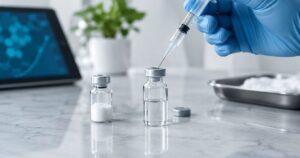
Can too much bacteriostatic water ruin a peptide vial? Yes, if it overfills the vial
FOR RESEARCH USE ONLY. Products sold by Celonyx Labs are intended exclusively for laboratory and scientific research. They are not intended for human or veterinary use, consumption, diagnosis, treatment, cure, or prevention of any disease. By purchasing from this site, you acknowledge that you understand the intended research purpose of these materials and agree to comply with all applicable laws and regulations.