

Ghrp 2 Ghrp 6
GHRP-2 is approximately 3.8-fold more potent than GHRP-6 in swine models, while GHRP-6 can produce
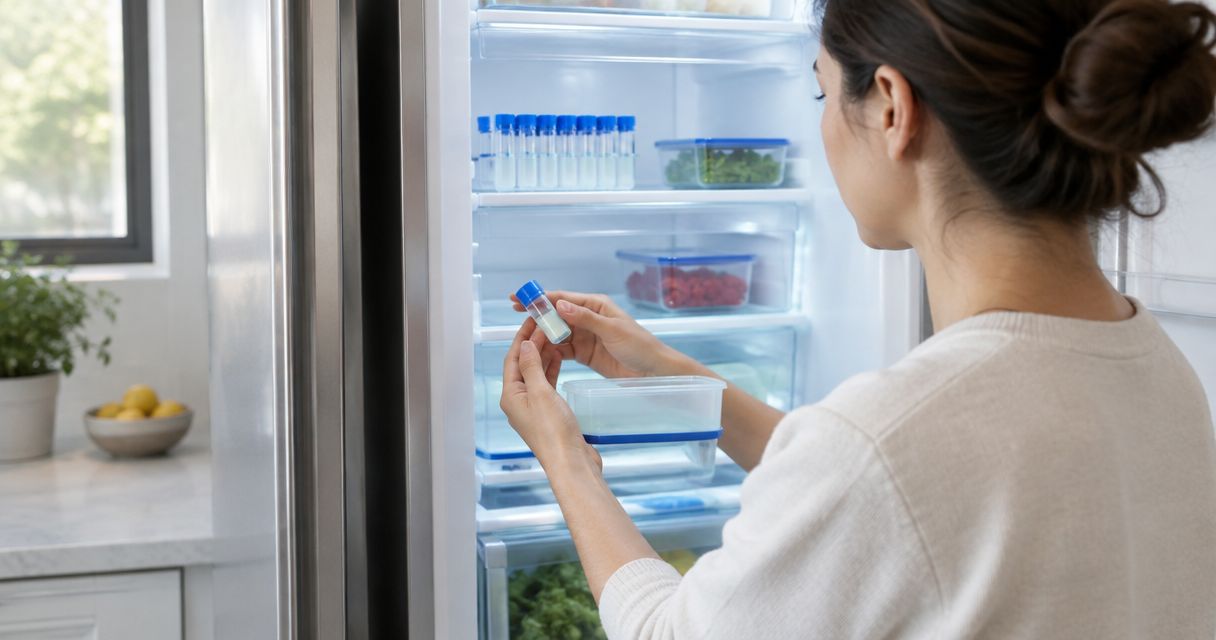
Research peptides should not be stored in a home refrigerator shared with food; a dedicated, monitored unit is appropriate only when it meets the peptide’s documented storage requirements and your laboratory’s safety procedures. Refrigeration alone does not establish stability, prevent contamination, or make a research-use-only material suitable for human or animal administration.
A refrigerator’s temperature setting is not a record of the conditions your samples experienced. Door openings, local cold spots, and interruptions in power can change those conditions without leaving a visible sign on the vial. Your experiment needs a documented storage history, not just a cold container.
For a 2026 laboratory storage plan, distinguish the appliance from the storage specification. The USP General Notices defines refrigerator storage as 2–8°C, but that definition is not a universal recommendation for every peptide. Follow the material’s instructions and review peptide storage temperature benchmarks by type when comparing requirements.
The FDA’s household food-storage guidance recommends a refrigerator temperature of 4°C or below, equivalent to 40°F or below. That food-safety threshold does not qualify an appliance for research storage: it provides neither a lower temperature limit for your material nor evidence of temperature uniformity.
Do not use a household refrigerator that also stores food. A domestic appliance reserved exclusively for laboratory materials is a different proposition, but its suitability still depends on measured performance, the materials it contains, and your institution’s rules. Its location in a home does not turn it into an approved laboratory environment.
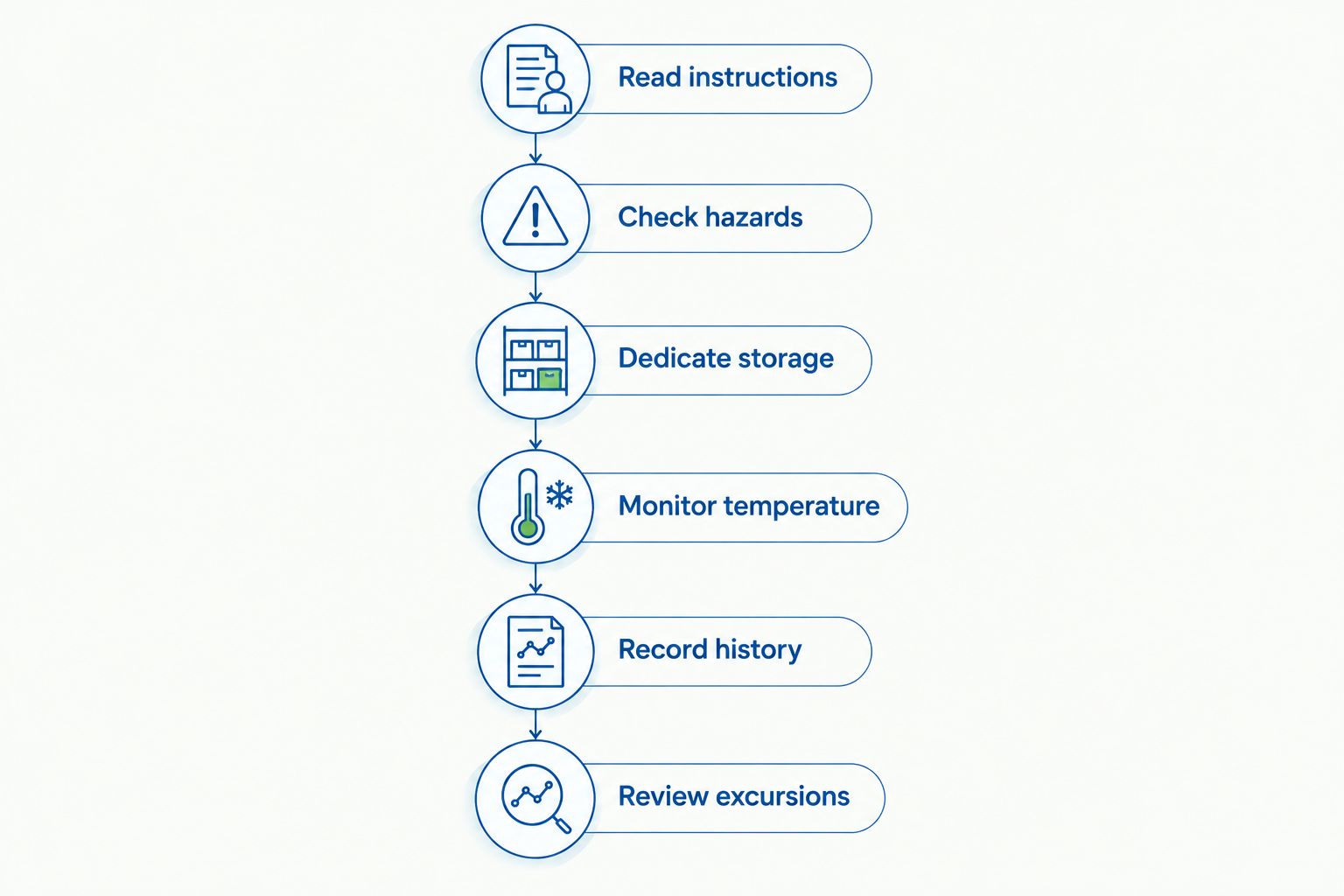
Use this sequence before placing research peptides in any refrigerator:
These steps support a storage decision; they do not replace local authorization. If your institution prohibits home storage or requires approved laboratory equipment, that requirement decides the question even when a domestic refrigerator appears to maintain the desired temperature.
Compare the storage arrangement, not just the appliance label. A laboratory refrigerator still needs appropriate monitoring and maintenance, while a domestic unit cannot be accepted on the strength of its thermostat alone.
| Storage arrangement | Best for | Useful feature | Limitation | Decision |
|---|---|---|---|---|
| Household refrigerator shared with food | Household food storage | Serves its intended domestic purpose | Mixes research chemicals with consumables and uncontrolled access | Do not use for research peptides |
| Dedicated domestic refrigerator | Laboratory materials only where local procedures permit it and performance is verified | Separates research materials from food | Requires assessment of temperature variation, hazards, and access | Use only after documented acceptance |
| Laboratory refrigerator | Research materials matching the unit’s specifications | Equipment can be selected for the intended laboratory conditions | Does not automatically meet every material’s requirements | Match the unit to the protocol |
| Appropriate laboratory freezer | Materials whose instructions specify frozen storage | Provides the required storage category when correctly selected | Refrigerated solutions are not automatically suitable for freezing | Use only when the material’s instructions support it |
A standard domestic refrigerator is not designed for storing flammable solvents. A laboratory refrigerator is not automatically suitable for that purpose either; the equipment must have the appropriate designation. Assess the solution and solvent as well as the peptide before selecting a storage location.
A lyophilized peptide is a dry preparation, but dryness does not establish a universal storage temperature or shelf life. The peptide’s chemistry, formulation, packaging, and moisture exposure matter. Keep the supplier’s storage instructions attached to the lot record rather than assigning every dry vial the same conditions.
The main advantage of retaining the dry preparation is that you avoid introducing a solution phase before it is needed. The limitation is that a dry vial still needs protection under its specified conditions; refrigeration cannot compensate for a damaged closure or an unsuitable storage history.
Where handling instructions call for warming a cold dry vial before opening, keep it sealed during that step to limit condensation entering the container. Do not substitute an arbitrary waiting period for the supplier’s procedure. Record opening or preparation when it changes the material’s storage status.
For your 2026 inventory review, identify whether each vial is unopened, opened but still dry, or already reconstituted. These are different handling states. A single entry reading only “stored in fridge” leaves out information needed to interpret later analytical results.
Keep lyophilized material under its own documented conditions, not under a rule borrowed from a different peptide. If refrigeration is not specified, do not assume it is the correct substitute for the required storage environment.
Once you prepare a peptide solution, the solvent, pH, concentration, container, and handling history become part of the storage question. Instructions for an unopened dry vial do not automatically apply to the resulting solution. Record the preparation details before assigning a storage condition or use period.
A prepared solution makes material accessible for the intended laboratory procedure. Its limitation is that preparation introduces additional variables, including opportunities for contamination and changes in chemical stability. Cooling does not reverse those changes or establish that the solution remains fit for an assay.
Do not assign all reconstituted peptides a shared number of refrigerated days. A defensible use period comes from applicable stability information or an established laboratory procedure for the specific preparation. Without that basis, the refrigerator cannot supply the missing evidence.
A preservative-containing diluent does not establish universal compatibility or make a peptide solution sterile. Likewise, a clear solution does not prove chemical integrity. Evaluate the peptide and diluent together, and keep the preparation record distinct from the original vial’s documentation.
Your 2026 procedure should specify how repeated access is controlled. Where an established protocol supports aliquoting, it can reduce repeated handling of the main preparation, but additional containers introduce their own labeling and compatibility requirements. Do not freeze an aliquot unless the procedure supports frozen storage.
Different preparations cannot share a storage rule merely because they are all called peptides. These factors explain why the specification must follow the material:
Apply these factors to the exact preparation in your experiment. A general storage guide helps you identify questions; the material-specific documentation and laboratory procedure supply the acceptance criteria.
Verify the occupied storage space, not just the display. Measure conditions at the intended vial locations under normal operating conditions, including routine access. A reading from one position does not establish that every position stays within the required limits.
Keep vials away from locations where contact with cooling surfaces or local temperature variation conflicts with the material’s specification. Select the location from observed performance rather than assuming a door shelf, back wall, or particular drawer is suitable. Secondary containment should support segregation and identification without preventing appropriate storage.
For a 2026 storage assessment, document the appliance identifier, monitoring device, measurement locations, accepted limits, and responsible person. Define how records are reviewed and how monitoring equipment is checked. An alarm is useful only when someone has responsibility for responding to it.
Also plan for power loss and equipment failure. Identify an authorized alternative location and a process for transferring material while preserving its identity and temperature history. Do not move research chemicals into a food refrigerator as an improvised backup.
A 99% purity claim is not a storage-stability or sterility claim. The result must be interpreted with its analytical method, sample identity, and testing scope. It does not establish what happened to a vial after testing or after reconstitution.
Celonyx Labs sells 99%-pure, third-party-tested research peptides. Those are sourcing quality signals, not permission to store materials alongside food or to use them for personal treatment. Review the relevant documentation and maintain your own laboratory handling records.
Celonyx Labs is best for laboratory researchers sourcing research-use-only peptides, not consumer treatment products. The store’s stated testing and purity information supports supplier evaluation; your experiment still requires appropriate storage, preparation, and acceptance criteria.
For your 2026 quality review, keep supplier qualification separate from sample qualification. Selecting a supplier addresses sourcing. Determining whether a particular vial remains suitable for an experiment requires its identity, documentation, and handling history.
Separate affected material from material already accepted for experimental use, and record the event. Preserve the temperature trace, the estimated exposure period, the vial identities, and their preparation states. Do not treat a return to the set temperature as proof that the material recovered.
Review the event against applicable stability information and your laboratory’s excursion procedure. The outcome can differ between an unopened dry vial and a prepared solution. Seek material-specific guidance rather than applying a blanket decision to every vial in the refrigerator.
If testing is required, choose it according to the experimental risk and acceptance criteria. An identity or purity assessment answers a different question from a sterility assessment or a functional assay. One favorable result cannot stand in for every required attribute.
A clear peptide solution is not proof of suitability for research. Appearance can reveal some changes, but it cannot establish identity, chemical stability, or absence of contamination. Use appearance as an observation in the record, not as the release criterion.
Unexpected discoloration, particles, leakage, or a damaged closure require review under your laboratory procedure. Avoid opening suspect material merely to investigate it informally. Preserve its identity and handling history so the responsible person can decide what assessment or disposal is appropriate.
Can research peptides be stored in a home refrigerator with food?
No; research peptides should not share refrigerator space with food, beverages, or personal medicines. Use dedicated storage that meets the material’s instructions and your laboratory’s safety requirements.
What temperature should a refrigerator use for research peptides?
Use the temperature specified for the exact peptide and preparation. The USP refrigerator-storage definition is 2–8°C, but that range is not a universal instruction for every research peptide.
Is a dedicated household refrigerator enough for laboratory storage?
A dedicated household refrigerator is acceptable only when local procedures permit it and documented performance meets the material’s requirements. Dedicated use alone does not establish temperature uniformity or suitability for hazardous solvents.
How long do reconstituted peptides last in the refrigerator?
Reconstituted peptides have no universal refrigerated shelf life. Use applicable stability information or an established procedure for the peptide, solvent, concentration, and container.
Does 99% purity mean a peptide is sterile?
No; 99% purity does not establish sterility. Celonyx Labs research peptides are for research use only, and purity testing does not establish suitability for human or animal administration.
Can I freeze a peptide instead of refrigerating it?
Freeze a peptide only when its material-specific instructions or established laboratory procedure support freezing. A solution’s compatibility with frozen storage cannot be inferred from instructions for the dry peptide.
Can I use a peptide after the refrigerator loses power?
Use affected material only after review under the laboratory’s excursion procedure. Record the temperature history and preparation state; restoring refrigeration does not establish that the peptide remains suitable.
Give the storage location its own identifier in your laboratory records. Recording a refrigerator and shelf position lets you connect a vial to the conditions measured there. Recording only “refrigerated” does not.
Before your next experiment, trace one vial from receipt through storage and preparation to use. If that record cannot identify its applicable instructions and storage history, correct the recordkeeping process before relying on the refrigerator as evidence of quality. All materials discussed here are for research use only, not for human or animal administration.
GHRP-2 is approximately 3.8-fold more potent than GHRP-6 in swine models, while GHRP-6 can produce

How long does peptide reconstitution take? Use a peptide-specific SOP, not a fixed timer. Learn

Can research peptides be stored in a home refrigerator? Not alongside food. Learn dedicated-storage checks,
FOR RESEARCH USE ONLY. Products sold by Celonyx Labs are intended exclusively for laboratory and scientific research. They are not intended for human or veterinary use, consumption, diagnosis, treatment, cure, or prevention of any disease. By purchasing from this site, you acknowledge that you understand the intended research purpose of these materials and agree to comply with all applicable laws and regulations.