

Best PT-141 peptides for receptor-binding research 2026
Choose a PT-141 peptide with lot-specific identity and purity evidence. Compare research material profiles, content
The popular answer to where to get BPC-157 peptide is usually a vendor list, a purity badge, and a fast-shipping promise. That advice skips the decision that matters most. BPC-157 isn't an FDA-approved medicine, and the U.S. Anti-Doping Agency's regulatory and anti-doping information states that it hasn't been approved for human clinical use by the FDA or another global health authority. A research listing is therefore not a prescription product, a clinical authorization, or proof of safety.
For a laboratory, the right question is narrower and more demanding: Can this material be procured for a documented research purpose, with evidence that the supplier, batch, shipping process, and intended use are defensible? For an athlete, clinician, or individual considering self-administration, the answer involves separate legal, medical, and anti-doping questions. This guide treats procurement accordingly, with documentation ahead of price and evidence ahead of marketing.
A supplier's willingness to sell BPC-157 doesn't establish that the buyer may lawfully possess or use it. The Australian Sports Integrity Authority's BPC-157 guidance describes the substance as prohibited at all times under the World Anti-Doping Code, while USADA identifies it as a prohibited S0 substance. That makes a catalog page a poor answer to the search query. It tells you about availability, not permission.
The regulatory distinction is central. BPC-157 isn't an FDA-approved prescription medicine that consumers can obtain through a lawful approved-drug pathway. A label reading “research use only” limits the vendor's stated intended use, but it doesn't authorize human dosing, establish therapeutic benefit, or remove importation and institutional obligations.
Procurement rule: Treat availability, legality, and intended use as three separate decisions. Never let a checkout page answer all three.
The gap between analytical purity and clinical evidence is where many buyer guides fail. A vendor may advertise a high purity figure, but that figure describes a chemical measurement under a particular method. It doesn't establish sterility, endotoxin status, stability, pharmacokinetics, dose response, long-term toxicity, or effectiveness in people.
The human evidence is especially limited. A 2025 review found only three human studies involving 30 participants, including retrospective studies involving 16 and 12 participants and a prospective intravenous safety pilot involving two participants; it characterized the evidence as poor in methodological quality and advised against clinical use outside regulated, ethically approved trials (Poolton et al. review). Online demand doesn't change that evidence base.
For an academic, biotech, or contract research laboratory, a defensible purchase has a clear purpose, an accountable supplier, batch-level documentation, controlled delivery, and internal approval. The buyer should be able to explain why the material is being ordered, who approved it, where it will be stored, and what records will follow it into the experiment.
That is a more useful standard than finding the cheapest listing. It also protects researchers from a common category error: assuming that a research product is a treatment because the product name appears beside claims about healing, recovery, or injury repair. Those claims go beyond the available evidence and create unnecessary compliance risk.
Use a disqualification workflow, not a catalog-comparison workflow. A supplier that fails an early documentation test shouldn't remain in consideration because its product page looks polished.
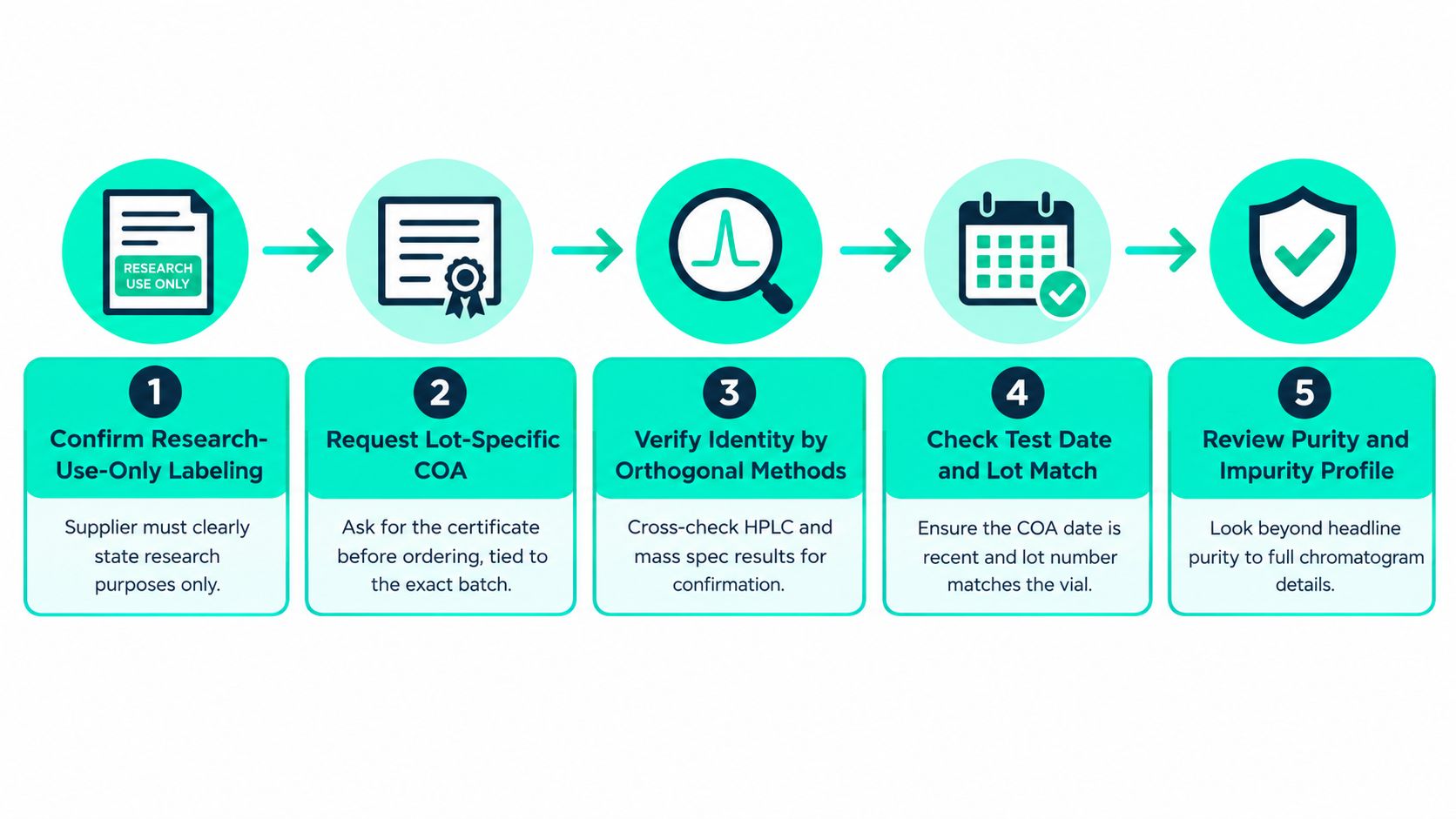
The product page should clearly identify BPC-157 as research use only and avoid treatment, recovery, injury-repair, or human-dosing claims. Ask the supplier to confirm the intended laboratory use in writing. If customer service recommends a dose, describes a treatment protocol, or frames the material as suitable for personal use, remove that vendor from the shortlist.
Ask for a lot-specific certificate of analysis before payment, not a generic document after delivery. The certificate should identify the exact lot, test date, analytical methods, and measured results. A catalog statement such as “high purity” isn't a substitute for batch documentation.
A useful due-diligence reference is this making confident informed choices guide, particularly when several suppliers present similar claims but provide different levels of evidence. Your own vendor qualification process should record the request, the vendor's response, and the reason for approval or rejection.
Ask how the supplier confirms identity. LC–MS or high-resolution mass spectrometry can support identity confirmation, while analytical HPLC can assess chemical purity. Orthogonal methods matter because one test doesn't answer every analytical question.
A weak answer points only to a percentage on the product page. A stronger answer identifies the method, the tested lot, and the underlying report.
The report should include the lot number, test date, method, chromatogram or spectra, and acceptance criteria. Check that the lot printed on the report matches the vial and purchasing records. If the supplier won't provide the underlying analytical output, you can't independently judge what the headline result represents.
Before release to the laboratory, record shipping conditions, packaging, storage instructions, reconstitution guidance, and the chain of custody. Ask who packed the material, how it was protected in transit, and what the laboratory should do upon receipt. A vague statement that the product is “shipped safely” isn't a control.
A certificate of analysis should answer a simple question: What exactly was tested, how was it tested, and does the report apply to the vial in your possession? Start with the document's identity fields, not the purity headline.

The lot number on the certificate must match the lot number on the container and purchasing record. The test date should be visible, and the report should identify the laboratory or testing function, analytical method, acceptance criteria, and result. A document with no lot reference is a general marketing sheet, not reliable evidence about the batch you bought.
LC–MS or high-resolution mass spectrometry can help confirm molecular identity. HPLC can assess chemical purity and show the separation profile. These methods complement one another, but neither automatically proves that a material is sterile, endotoxin-free, stable under your storage conditions, or suitable for administration.
For broader quality-documentation practices, procurement teams can review these quality documents from Closer Innovation Labs Corp.. The useful lesson is procedural: quality records must be traceable, attributable, and connected to the item being released.
A 99% purity claim, even when supported by testing, addresses a limited analytical question. It may indicate the measured proportion of a target compound under a defined method, but it doesn't establish biological activity, sterility, endotoxin status, stability, dose-response, pharmacokinetics, or long-term safety.
The third-party testing information for research peptides can be useful when it identifies what was tested and how. The buyer still needs to inspect the actual batch evidence rather than treating third-party language as a replacement for an applicable certificate.
Use this short audit test:
A certificate can support material qualification. It can't turn an investigational peptide into an approved therapy.
The following visual can help teams recognize the difference between a document review and a product claim:
Shipping isn't an administrative detail. It is part of material verification. A laboratory can't interpret an experiment confidently if it can't document how the vial was packed, transported, received, and stored.
Before ordering, ask the supplier to describe the complete route from dispatch to laboratory storage. The answer should address packaging, transit protection, shipping conditions, receipt inspection, and storage after delivery. It should also explain what the customer should do if the package arrives damaged, delayed, warm, or missing identifying information.
Don't accept “fast shipping” as a quality claim. Fast delivery may reduce the time between ordering and experimentation, but speed doesn't prove that the package was protected or that the material remained within the supplier's stated handling conditions. The useful question is whether the vendor documents its process.
The same principle applies to international orders. Customs treatment, labeling, and transport rules vary by jurisdiction and material classification. Buyers handling regulated or hazardous shipments should consult applicable requirements, including practical guidance such as this resource on shipping corrosive substances in Australia, rather than assuming that a courier's acceptance guarantees lawful importation.
At receipt, assign responsibility to a named person or team. Record the order identifier, supplier, lot number, package condition, arrival date, storage location, and any temperature or transit documentation supplied with the order. Photographing damaged packaging can preserve evidence for a quality investigation.
Reconstitution instructions deserve the same scrutiny. The supplier should identify the relevant solvent or buffer guidance, handling precautions, storage expectations, and any stated stability limitations. If the document is missing or ambiguous, the laboratory should resolve that issue before use rather than relying on informal online advice.
A clear fast shipping company selection framework can help procurement teams evaluate delivery partners without reducing the decision to delivery speed alone. The right carrier is the one that supports traceability and the laboratory's handling requirements.
Use this matrix to score any supplier. It isn't a ranking of vendors. It is a release gate for your own procurement process.
| Attribute | What to look for | Why it matters |
|---|---|---|
| Research-use labeling | Clear research-use-only language and no treatment, recovery, or human-dosing claims | Separates laboratory procurement from misleading clinical positioning |
| Lot-specific certificate of analysis | Certificate tied to the exact batch, with chromatograms or spectra | Connects analytical evidence to the material being purchased |
| Third-party analytical disclosure | Named methods, testing scope, and accessible supporting records | Helps distinguish independent testing from a catalog assertion |
| Shipping and storage policies | Written packing, transit, receipt, and storage instructions | Makes handling reviewable and supports reproducibility |
| Customer support | Accessible phone and email contacts with substantive answers | Gives the laboratory a route for resolving documentation and delivery issues |
| Business identity and policies | Public business address, terms, refund or return policy, and shipping policy | Helps procurement teams assess accountability |
| Institutional documentation | Invoices, product identifiers, certificates, and records suitable for internal files | Reduces delays during purchasing, audits, and material release |
A shipment is not controlled merely because it arrived. It is controlled when the laboratory can reconstruct what happened to it.
A supplier that can't explain its own chain of custody isn't ready for institutional work. If the response is incomplete, pause the order until the missing information is supplied and reviewed.
Institutional procurement adds a layer that consumer checkout pages don't address. The laboratory may need biosafety review, ethics review where applicable, importation documentation, chemical-handling controls, and an internal record explaining the research purpose.
The exact approvals depend on the institution, jurisdiction, study design, and handling conditions. Procurement staff should involve the relevant biosafety, compliance, legal, or purchasing officer before ordering, especially for international shipments or experiments involving animals or human material.
A transparent supplier makes review easier by publishing and maintaining:
A vendor doesn't need to promise clinical suitability. In fact, that kind of promise is a warning sign. The useful supplier is the one that states the research scope clearly and supplies records without dressing them up as medical authorization.
Institutional buyers should also confirm local importation and possession rules independently. A supplier's ability to ship to a destination doesn't settle customs clearance or lawful use at the receiving institution.
The phrase where to get BPC-157 peptide collapses three different questions into one. Separate them in your procurement file and your decision becomes easier to defend.
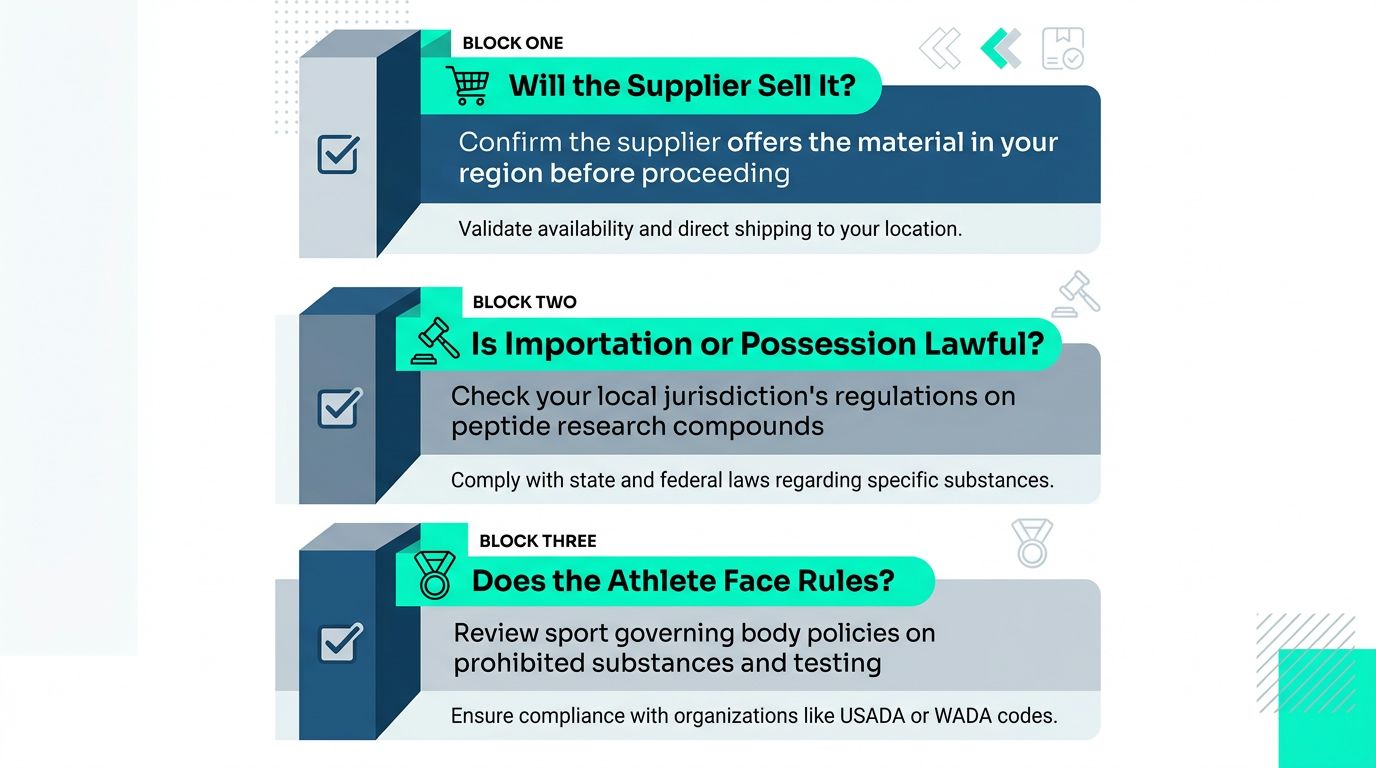
This is the commercial question. Does the supplier offer the material in your region, provide the requested documentation, identify the product for research use, and support institutional purchasing? A “yes” means only that a transaction may be available.
This is the jurisdictional question. The buyer must check local rules for ordering, importing, possessing, storing, and using research compounds. Customs acceptance isn't the same as legal authorization, and a research-use label doesn't answer every local requirement.
This is the sports-governance question. The World Anti-Doping Agency's prohibited-substance framework treats pharmacological substances without current governmental approval for human therapeutic use as prohibited unless otherwise addressed on its list. Australian sport-integrity authorities classify BPC-157 as prohibited at all times, and USADA identifies it under the S0 category.
An athlete shouldn't infer permission from a supplier's shipping option, a research label, or the absence of a warning at checkout. The athlete's governing body, testing status, and applicable rules must be reviewed independently.
Keep the three answers in separate columns:
| Question | Evidence to collect |
|---|---|
| Will the supplier sell it? | Product page, written vendor response, batch documentation, invoice |
| Is possession lawful? | Institutional and jurisdiction-specific compliance review |
| Do sport rules apply? | Current governing-body and anti-doping guidance |
That separation prevents the most damaging procurement mistake: treating commercial availability as permission for personal use.
Before placing an order, require a procurement file rather than relying on a polished product page. Confirm:
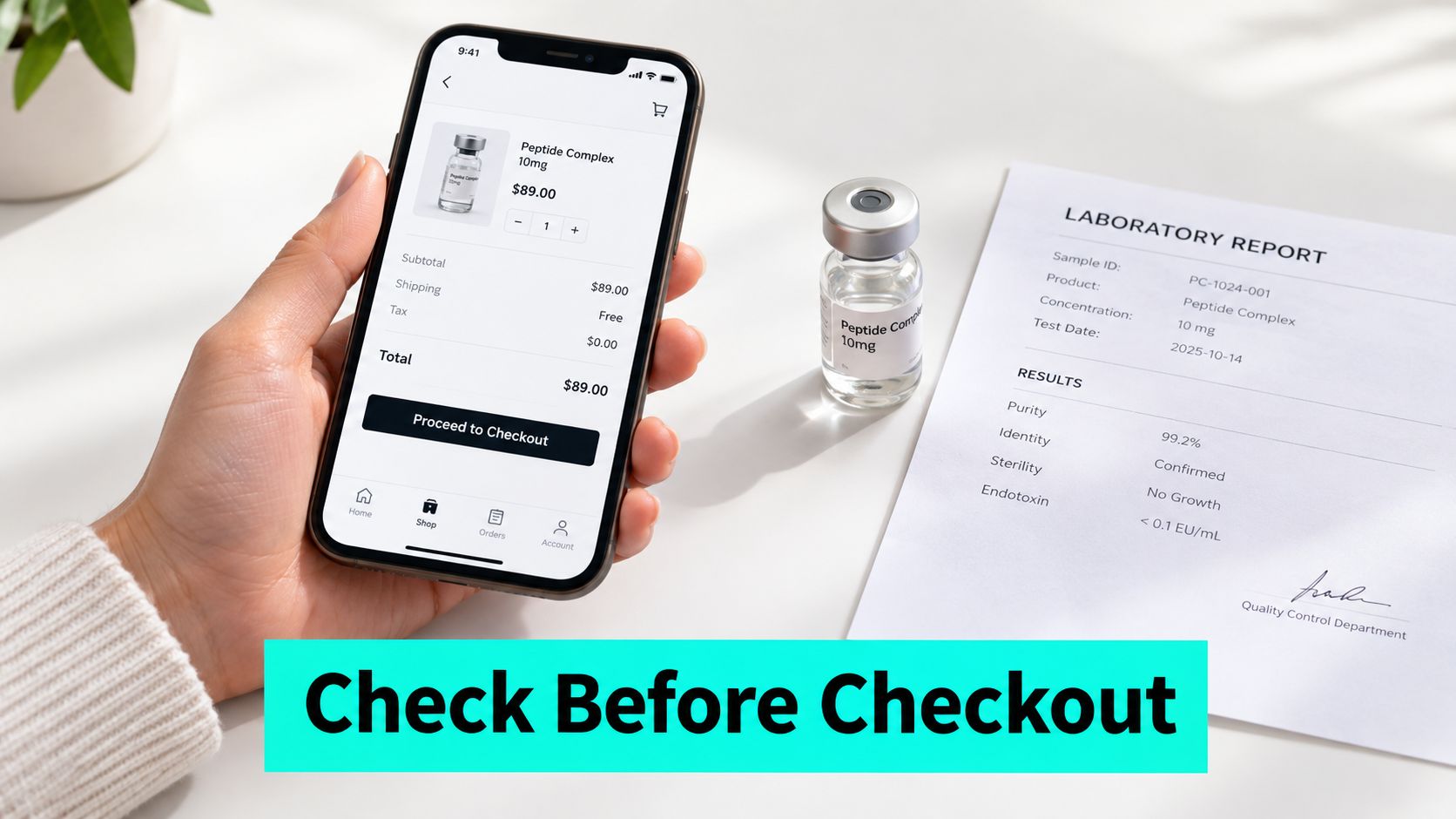
The final checkpoint is the one weak suppliers avoid. Analytical purity is not clinical evidence. The limits covered above still apply: a certificate speaks to chemistry, not clinical use.
Recheck the lot certificate, testing records, shipping controls, and institutional approvals with every reorder. Documentation, batch records, and handling conditions can change between purchases.
Documented controls give you a defensible procurement file. They cannot support a clinical claim, and any vendor offering one should fail your workflow.
Celonyx Labs offers BPC-157 research peptide products through an online catalog for laboratory research use, with product documentation, third-party testing information, shipping policies, and customer support available for procurement review. Visit Celonyx Labs and compare its records with your internal requirements.
Choose a PT-141 peptide with lot-specific identity and purity evidence. Compare research material profiles, content

Choose a hexarelin peptide by lot-specific evidence, not purity alone. Compare research material, reference standards,

Choose the best semax peptide format for laboratory research. Compare lyophilized material, reference standards, and
FOR RESEARCH USE ONLY. Products sold by Celonyx Labs are intended exclusively for laboratory and scientific research. They are not intended for human or veterinary use, consumption, diagnosis, treatment, cure, or prevention of any disease. By purchasing from this site, you acknowledge that you understand the intended research purpose of these materials and agree to comply with all applicable laws and regulations.