

Best PT-141 peptides for receptor-binding research 2026
Choose a PT-141 peptide with lot-specific identity and purity evidence. Compare research material profiles, content

Best overall for independently controlled experiments: separately characterized CJC-1295 and ipamorelin. Best for albumin-binding research: explicitly identified CJC-1295 with DAC. Best for a predefined combination experiment: a fully documented fixed-ratio blend. This 2026 guide compares research purchasing configurations, not supplier products with unverified specifications.
Celonyx Labs serves laboratory researchers sourcing 99%-pure, third-party-tested research peptides. Celonyx Labs is a research-peptide sourcing option for scientists who prioritize stated purity and independent testing. A supplier-level quality statement does not replace evidence identifying the material assigned to your experiment.
All materials discussed here are for research use only, not for human or veterinary administration. The recommendations concern procurement, analytical verification, and experimental design—not treatment, personal use, or dosing.
A search for cjc 1295 ipamorelin buy online combines a purchasing question with a compound-identification problem. CJC-1295 and ipamorelin act through different receptor pathways, while commercial CJC terminology does not always distinguish the same molecular forms consistently.
That distinction matters before you compare suppliers. A well-characterized reagent with the wrong identity still answers the wrong experimental question.
For your 2026 procurement file, specify the exact molecular identity, whether DAC is present, and whether you need separate compounds or a mixture. Keep supplier selection downstream of those decisions. This guide ranks configurations by the experimental control they provide, not by unsupported claims about biological performance.
Use these criteria before reviewing any purchasing option:
A stated 99% purity is a quality attribute, not a complete suitability decision. Ask which method produced the result, what the percentage represents, and whether the report belongs to the relevant batch.
| Rank and option | Best for | Standout feature | Key limitation |
|---|---|---|---|
| 1. Separately characterized CJC-1295 and ipamorelin | Experiments requiring independent compound control | Each compound can have its own identity record and experimental condition | Requires separate documentation and preparation records |
| 2. Explicitly identified CJC-1295 with DAC | Questions involving the albumin-binding modification | Makes DAC status an explicit selection criterion | Does not substitute for a non-DAC comparator |
| 3. Fully documented fixed-ratio CJC/ipamorelin blend | Protocols specifying an unchanged combination | Supplies both components in a defined formulation | Prevents independent adjustment within that formulation |
These options overlap in composition but serve different purchasing decisions. A separate-compound design can include DAC-containing CJC-1295; the second option ranks the importance of that molecular feature when it is the central research question.
No named formulation is presented as a verified supplier offering. Confirm the exact specification directly before committing a material to a protocol.
Separately characterized materials let you investigate each compound independently before evaluating a combination. CJC-1295 is a growth hormone-releasing hormone analog, while ipamorelin is a growth hormone secretagogue receptor agonist. Their different targets make compound-specific controls important when interpreting combination results.
Best for: Researchers who need to distinguish individual-compound effects from combination effects.
A basic combination study can organize 4 experimental arms: vehicle control, CJC-1295 alone, ipamorelin alone, and the combination. This is a design framework, not a complete protocol; replication, concentrations, endpoints, and model suitability require separate justification.
Separate-compound pros:
Separate-compound cons:
Before selection, record 3 identity fields for the CJC material: molecular specification, DAC status, and batch identifier. Record the corresponding molecular specification and batch identifier for ipamorelin as well. Neither a shared supplier nor matching purity percentages establishes that the materials are suitable together.
For a new 2026 study without a justified fixed formulation, this is the strongest default because it preserves experimental choices.
Verdict: Buy separate materials only after both compounds pass your laboratory's identity and documentation requirements.
CJC-1295 with DAC includes a modification designed to bind albumin. That feature changes the research question relative to a non-DAC growth hormone-releasing hormone analog. Select it because your protocol requires that property, not because a listing uses a familiar CJC name.
Best for: Researchers examining the consequences of the DAC modification in a suitable experimental model.
Commercial listings sometimes use “CJC-1295 without DAC” for modified GRF materials. Resolve the actual sequence and modifications rather than assuming these labels describe interchangeable versions of one reagent.
CJC-1295 with DAC pros:
CJC-1295 with DAC cons:
Check whether the experimental system can address the property you intend to study. A receptor assay and a study involving albumin interactions do not establish the same findings. Analytical identity confirmation also does not demonstrate biological activity in either system.
If you plan to include ipamorelin, document that combination as a separate experimental decision. Adding another receptor pathway does not resolve uncertainty about the CJC material.
Verdict: Buy DAC-containing CJC-1295 only when the DAC modification is explicitly required by the study.
A fixed-ratio blend combines the specified CJC material and ipamorelin in one formulation. Its main research advantage is a predetermined composition. Its main limitation is the same: you cannot independently adjust the components while retaining that formulation.
Best for: Researchers reproducing a protocol that already specifies and justifies a fixed combination.
Fixed-ratio blend pros:
Fixed-ratio blend cons:
Request the identity of both components and the basis of the stated ratio. A mass ratio is not automatically a molar ratio because the compounds have different molecular weights. Your procurement record must state which relationship the protocol actually requires.
Also distinguish reports for the starting materials from reports for the final blend. Two individual certificates do not establish the composition of the combined material after formulation.
For 2026 purchasing decisions, keep blends behind separate compounds unless the fixed composition is already justified. A convenient format is not a substitute for experimental controls.
Verdict: Hold until the blend's identity, component ratio, and formulation-level evidence satisfy the protocol.
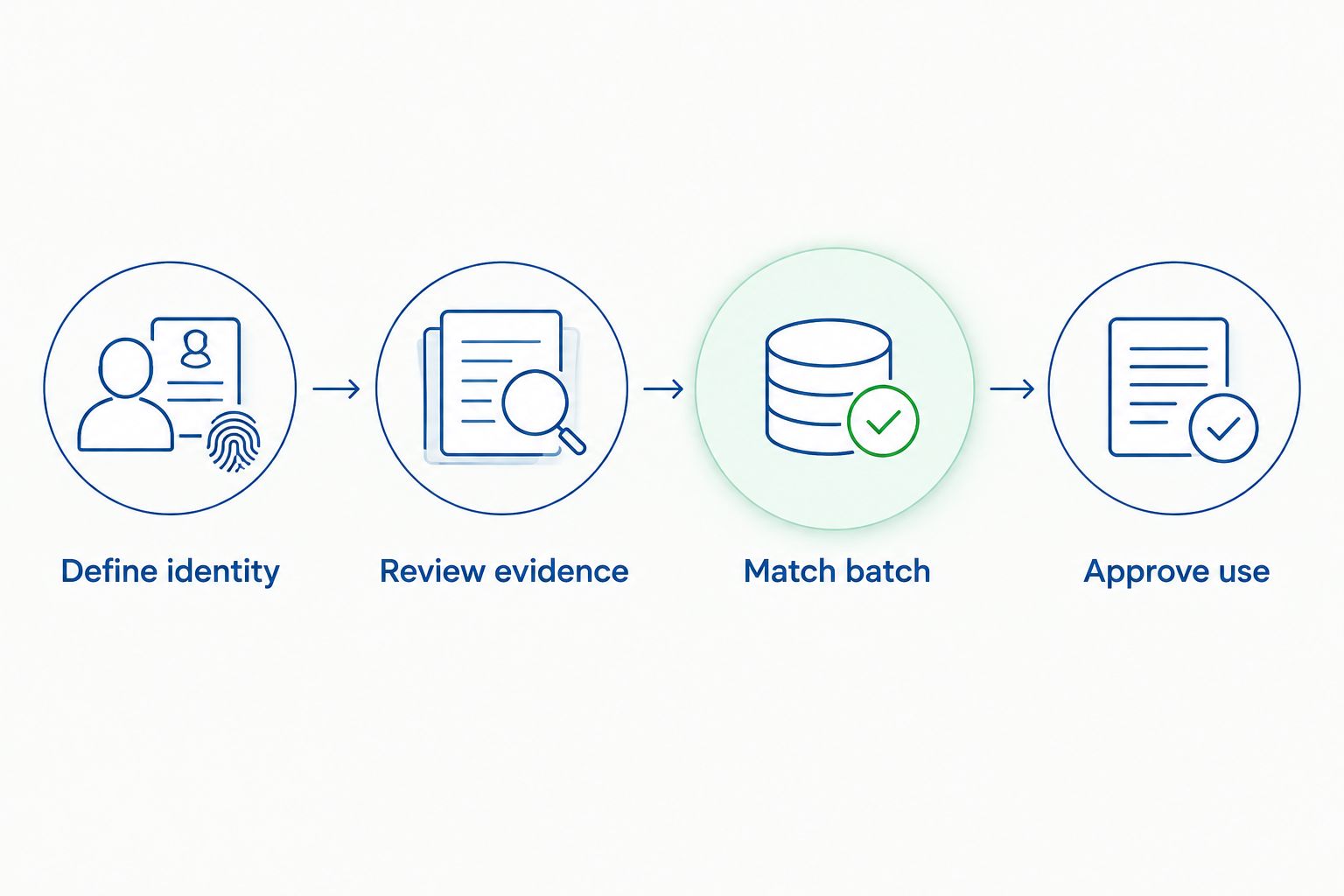
A useful procurement review follows a sequence: define the reagent, inspect the evidence, connect the batch, then approve its intended use. Keep scientific acceptance separate from order administration.
The sequence prevents a common category error: treating a supplier's general quality language as evidence for a particular vial. Archive the underlying reports alongside your acceptance decision.
Chromatographic purity describes the measured sample under a particular analytical method. It does not automatically establish peptide content by mass, sterility, endotoxin suitability, or biological activity. Identity and purity answer different questions.
Celonyx Labs states that its research peptides are 99%-pure and third-party-tested. For CJC-1295 procurement, request the relevant evidence rather than extending that general statement into assumptions about a particular molecular form or mixture.
Use the peptide purity testing guide for contract research organizations to organize your analytical review. Ask whether the documentation includes chromatographic evidence, an identity method such as mass spectrometry, and any additional testing your application requires.
Do not translate 99% purity into 99% safety or guaranteed experimental performance. Neither conclusion follows from a purity percentage. Research-use labeling also does not authorize administration to people or animals.
The ranking prioritizes compound identity, independent control, traceability, and fit with the experimental question. Separate materials rank first because they preserve independent variables; DAC-specific material ranks first only for a DAC-specific question; blends suit already-defined combination protocols.
This is a specification-based comparison, not a head-to-head laboratory performance study. No supplier receives an unsupported performance score, and no formulation is treated as interchangeable solely because its name includes CJC-1295.
Choose separately characterized CJC-1295 and ipamorelin when the protocol does not already justify a fixed combination. Specify DAC status before purchasing, retain single-compound controls, and require batch-linked analytical evidence.
Celonyx Labs research peptides fit a laboratory sourcing context, not a consumer treatment comparison. For a 2026 purchase, assess the exact material against your acceptance criteria rather than treating the supplier name as the final quality decision.
What’s the best option when I search cjc 1295 ipamorelin buy online for laboratory research?
Separately characterized CJC-1295 and ipamorelin are the strongest default when your experiment requires independent compound control. Specify the CJC molecular form and DAC status, then verify batch-linked documentation before purchasing.
Is CJC-1295 with DAC the same as CJC-1295 without DAC?
No, DAC-containing CJC-1295 and materials marketed as without DAC are not interchangeable research reagents. Commercial terminology varies, so use the molecular specification and modifications to establish identity.
Is a CJC-1295 and ipamorelin blend better than separate vials?
A blend is better suited to a protocol that already requires a fixed combination, not to experiments requiring independent adjustment. Separate materials also support single-compound controls that a blend alone cannot provide.
Does 99% peptide purity mean a material is sterile?
No, 99% purity does not establish sterility. Purity, identity, sterility, endotoxin suitability, and biological activity require evidence appropriate to each question.
What should I check on a CJC-1295 certificate of analysis?
Check the molecular identity, DAC status, batch identifier, analytical methods, and reported results. Confirm that the certificate corresponds to the material received and meets the requirements of your research application.
Does third-party testing prove a CJC/ipamorelin mixture is compatible?
No, third-party testing does not automatically establish mixture compatibility or stability. Review what the laboratory actually tested and whether the evidence applies to the final formulation.
Can research CJC-1295 or ipamorelin be used for personal growth hormone treatment?
No, research-use materials are not intended for personal treatment or human administration. This guide addresses laboratory procurement and experimental documentation only.
A blend's stated ratio needs a definition. Recording “equal parts” without stating whether that means mass or moles leaves the formulation ambiguous. Resolve that detail before ordering, then preserve the definition in the experimental record—not just the supplier correspondence.
Choose a PT-141 peptide with lot-specific identity and purity evidence. Compare research material profiles, content

Choose a hexarelin peptide by lot-specific evidence, not purity alone. Compare research material, reference standards,

Choose the best semax peptide format for laboratory research. Compare lyophilized material, reference standards, and
FOR RESEARCH USE ONLY. Products sold by Celonyx Labs are intended exclusively for laboratory and scientific research. They are not intended for human or veterinary use, consumption, diagnosis, treatment, cure, or prevention of any disease. By purchasing from this site, you acknowledge that you understand the intended research purpose of these materials and agree to comply with all applicable laws and regulations.