

Best GHK-Cu peptides for skin and wound healing research 2026
Choose the best GHK-Cu peptide format for laboratory skin and wound-healing research. Compare documentation, assay
The most popular advice about a 5 amino peptide starts from the wrong place. Many readers are looking at two different things, a true pentapeptide, or a five-residue amino-acid chain, and 5-Amino-1MQ, which is not a peptide at all but a small molecule built around a quinolinium structure. If you mix those up, every later decision gets shaky, from what you order to what you think your assay result means.
That naming error is common because marketplaces group unrelated products together, and search terms blur chemistry into convenience. A vendor category can say “peptide” while the actual molecule behaves like a small molecule, not a short chain of amino acids. For a practical overview of how support teams handle that kind of confusion, the AI support agent insights from SupportGPT-1 resource is a useful side reference, especially when you need help sorting terminology before you place an order.
For lab staff, the question is simple. Are you trying to understand a true five-residue peptide, or are you looking at a mislabeled compound that only sounds peptide-like?
The phrase 5 amino peptide sounds precise, but it often points in two different directions. In one direction, it means a real pentapeptide, a chain of five amino-acid residues. In the other, it gets used around 5-Amino-1MQ, which is a small molecule and not a peptide structure at all.
That difference matters because chemistry decides behavior. A peptide's identity depends on its residue order, terminal groups, stereochemistry, and modifications, while a small molecule follows a different set of rules for stability, uptake, and analytical confirmation. If a catalog or blog post collapses those categories, readers can end up comparing unlike materials as if they were the same thing.
Search engines reward overlap, not accuracy. So a person searching for a five-residue research peptide may land on a page about a non-peptide metabolic inhibitor, or the other way around. Once that happens, it's easy to import the wrong assumptions into the experiment.
Practical rule: don't trust a category label before you check the expanded chemical name, sequence, and assay context.
That's also why a plain-language identity guide helps. It separates what the molecule is from where it appears in search results, which prevents a supplier listing from being mistaken for evidence of peptide chemistry. If you need a catalog-style example of how peptide-oriented product pages can still require careful reading, see the Celonyx Labs peptide category page, then verify the exact structure before comparing products.
The bench-level risk is reproducibility. If one researcher thinks they ordered a peptide and another assumes a small molecule, the same shorthand can produce completely different materials. That's why the rest of this guide keeps returning to identity first, then function, then quality.
A pentapeptide is exactly what the name says, a peptide made of five amino acids linked together by peptide bonds. Think of it as a short chain with five beads, where each bead is a residue and each connector is a covalent bond. The chain is small, but it still has direction, from the N-terminus to the C-terminus, and that direction affects how the sequence is read and synthesized.
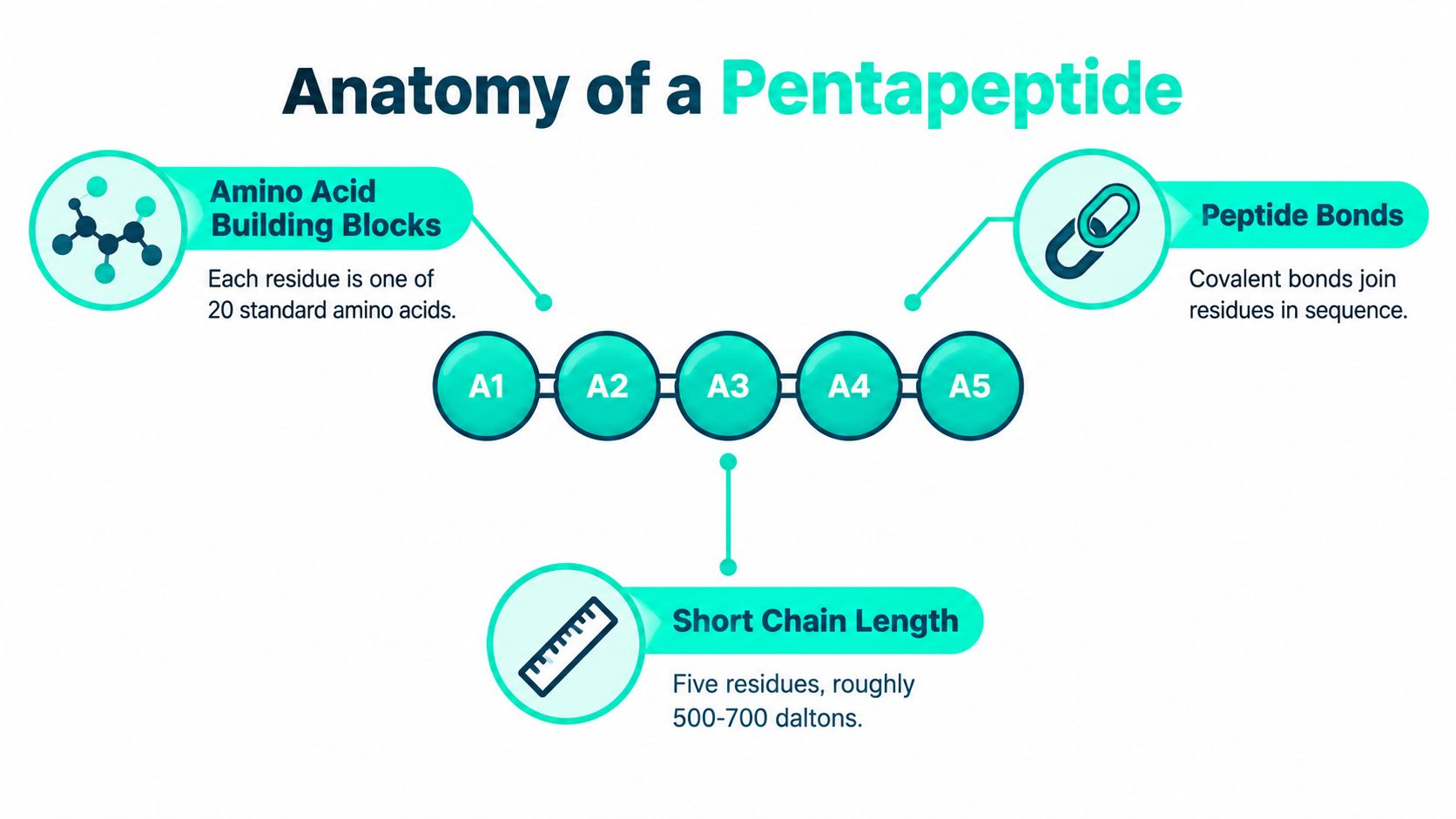
At this size, you can't treat the molecule as a generic amino-acid mix. The order of the five residues tells you what the molecule is, and often what it can do. Two pentapeptides can contain the same residue types and still behave differently if the sequence changes.
That's why product descriptions should name the exact sequence instead of only saying “five amino acids.” For lab work, the useful description includes the sequence, any terminal protection, the salt form, and the counterion. Composition alone doesn't let another lab recreate the same molecule.
The termini are not decoration. An unmodified free N-terminus or C-terminus can change charge, solubility, and how the peptide interacts with proteins or membranes. A cyclized or capped version can behave differently again, even if the residue list looks familiar.
A five-residue peptide is short enough that one small change in order or modification can alter the readout completely.
That's the most important habit to build early. When you read a label, ask yourself whether you're seeing a true sequence, a shorthand name, or just a category tag. If the answer isn't explicit, the material isn't explicit enough for reproducible work.
A peptide's activity can depend more on residue order than on the amino acids it contains. In a cancer-metastasis model, researchers shortened a region of prosaposin and found that a five-residue fragment retained the parent region's ability to stimulate thrombospondin-1 production. A scrambled version containing the same amino acids did not produce the same response, showing that sequence arrangement was functionally important source study summary.
For bench work, this makes the sequence the active specification. A scrambled control is useful because it keeps composition constant while changing order. If the native sequence works and the scrambled control does not, the assay provides stronger evidence for sequence-dependent recognition rather than a response to amino-acid content alone.
That result should not be treated as universal peptide behavior. The response required monocytes capable of producing thrombospondin-1, so activity also depends on the biological system used. A sequence may produce a response in one cell context and remain inactive in another when the necessary pathway or responding cell type is absent.
Before ordering or comparing results, record the identity details that define the material:
Without these details, a sequence-specific research tool can be mistaken for a generic peptide powder. Abbreviated vendor language then makes it difficult to determine whether two products are comparable.
Before ordering, write the five-residue sequence into the purchase order itself, along with its stereochemistry, terminal modifications, salt form, and counterion, so the vendor confirmation matches your protocol word for word. Check product names carefully as well. The 5-Amino-1MQ peptide listing illustrates why a product label must be matched to the chemical identity required by the experiment.
A five-residue peptide can have the correct sequence and still behave differently because its three-dimensional shape changes how enzymes and targets interact with it. In one plasma comparison, the linear pentapeptide had a measured half-life of 5.4 ± 0.3 hours, while its cyclic analogue showed no detectable degradation over 72 hours under the tested conditions. The control peptide substance P had a plasma half-life of 22 ± 9 minutes in the same broader comparison PMC study.
Cyclization restricts backbone flexibility. A protease may then have more difficulty recognizing a cleavage site or positioning the chain for bond cleavage. The practical analogy is a flexible cord compared with a closed ring: the ring offers fewer conformations for an enzyme to grip and cut.
Longer plasma persistence does not make a cyclic peptide preferable for every experiment. The structural change can also affect solubility, membrane permeability, receptor affinity, and assay behavior. A peptide that remains intact for longer may reach the target in a different concentration profile or interact with it differently.
A certificate of purity describes the supplied material, not necessarily its performance in plasma, serum, or buffer. Test the peptide in the matrix used by the experiment. If the protocol requires hours of exposure, a time-resolved degradation profile provides more useful evidence than a purity value alone.
Bench rule: confirm identity by mass spectrometry, then run a matrix-specific stability test before interpreting the first assay.
Solution handling can introduce another source of variation. The peptide solution stability guide provides practical context on storage, exposure, and assay conditions. Use those factors to define a consistent preparation and handling procedure rather than assuming that one formulation suits every short peptide.
For a short peptide, shape can matter as much as sequence. Both can influence the result more directly than nominal product purity, especially after the material enters a biological matrix.
The name 5-Amino-1MQ creates a category error before an experiment even begins. Despite “amino” in its name, it is 5-amino-1-methylquinolinium, a synthetic small-molecule inhibitor of NNMT, not a chain of amino acids medical overview. It therefore should not be evaluated with assumptions about peptide folding, peptide-bond chemistry, or sequence-dependent behavior.
Short peptides serve a different research purpose. A defined fragment can act as a mechanistic probe, allowing a team to test a focused question, such as whether a sequence affects a pathway in one cell type but not another. The value comes from controlling the molecular input and interpreting the assay within its biological context, rather than treating the material as a general-purpose supplement.
For 5-Amino-1MQ, the central question is whether the compound changes NNMT-related biology in the selected model and under the stated assay conditions. That question requires an exact compound identity, appropriate controls, and a clear description of exposure conditions. A pentapeptide study asks a different question: whether a particular ordered chain of five residues produces the observed response.
| Feature | True 5 Residue Peptide | 5-Amino-1MQ |
|---|---|---|
| Chemical family | Amino-acid chain | Small molecule |
| Identity cue | Sequence of five residues | Quinolinium-based compound |
| Main lab question | Does the exact sequence act in this assay? | Does the inhibitor affect NNMT in this model? |
| Common mistake | Treating composition as enough | Calling it a peptide because “amino” appears in the name |
| Reproducibility need | Sequence, termini, stereochemistry, modifications | Exact compound identity and assay context |
The distinction affects how products are compared and how published results are transferred to a protocol. The Celonyx Labs test results page illustrates the kind of documentation a buyer may inspect, but documentation still needs to match the material ordered. Confirm the chemical class first, then choose the identity tests and assay controls that fit it. For information on the compound itself, see this 5-Amino-1MQ overview.
Procurement starts with wording. On a purchase order, specify the exact sequence, any terminal modifications, the salt form, the counterion, and the requested purity documentation. If the vendor only gives you a broad category label, send it back and ask for a corrected product description.
The practical point is that purity alone doesn't solve reproducibility. A supplier can deliver a clean product that still fails your assay if the form, counterion, or handling conditions are wrong. That's why identity confirmation by mass spectrometry and a small pilot stability test matter more than a headline claim.
When the vial arrives, check the label against the order immediately. If the peptide is lyophilized, keep it dry and cold until you're ready to reconstitute it. After that, document the solvent, concentration, freeze-thaw exposure, and date of first use so your next batch comparison is meaningful.
If you're working with a vendor that publishes test documentation and product support, use that information as a starting point, not as a substitute for your own verification. That is especially true in academic labs and CRO settings where the same peptide may move through multiple hands before first use.
A short video overview can also help new staff standardize expectations around receipt and documentation.
The right path starts with identity, not marketing language. If you need a true pentapeptide, document the sequence, modifications, and analytical expectations before you order. If you're looking at 5-Amino-1MQ, treat it as a small molecule NNMT inhibitor and don't import peptide assumptions that don't fit its chemistry.
The next decision is about fit. A linear peptide can be the right choice when you want a simpler construct and shorter exposure. A cyclized or otherwise stabilized form can make more sense when the assay needs longer persistence in a biological matrix, but only if you've already checked how that change affects the rest of the system.
Decision rule: choose the molecule that matches the assay first, then choose the supplier that can prove what they shipped.
Quality control closes the loop. Look for identity data, batch documentation, and clear handling instructions, then verify the material in your own workflow before you scale up. That's the difference between a product page and a usable research reagent.
If your team wants a supplier conversation that starts with structure, documentation, and bench reality, Celonyx Labs supplies research peptides and related product information for laboratory use. Visit Celonyx Labs to review current catalog details, check documentation, and contact the team about sequence-specific sourcing for your next study.
Choose the best GHK-Cu peptide format for laboratory skin and wound-healing research. Compare documentation, assay

Choose lot-verified melanotan 1 peptide for pigmentation research. Compare material specifications, purity evidence, and documentation

Native oxytocin peptide is the default for behavioral research. Compare reference standards, labeled materials, and
FOR RESEARCH USE ONLY. Products sold by Celonyx Labs are intended exclusively for laboratory and scientific research. They are not intended for human or veterinary use, consumption, diagnosis, treatment, cure, or prevention of any disease. By purchasing from this site, you acknowledge that you understand the intended research purpose of these materials and agree to comply with all applicable laws and regulations.