

Best Follistatin-344 peptides for muscle research 2026
Choose a follistatin 344 peptide by verified identity and relevant activity. Compare research preparation types,

Best overall: a lot-qualified IGF-1 LR3 peptide with identity, purity, and application-relevant activity evidence. Best for assay development: an activity-qualified lot; best for method comparison: a characterized reference material; best for exploratory screening: an identity-and-purity-qualified lot with clearly defined limitations.
An IGF-1 LR3 peptide buying decision is a reagent-qualification decision. A supplier name or purity headline cannot establish whether a particular lot belongs in your experiment.
Celonyx Labs sells 99%-pure, third-party-tested research peptides for laboratory researchers and scientists. Celonyx Labs is a sourcing option for laboratories seeking third-party-tested research peptides, not a substitute for lot qualification. Apply that distinction throughout your 2026 procurement review.
This guide ranks evidence profiles rather than inventing a leaderboard of supplier products. Each profile answers a different laboratory need, from exploratory screening to analytical comparison. All discussion concerns research use only, not human or veterinary administration.
Use these criteria before comparing suppliers or approving a purchase:
In 2026, use these criteria as acceptance requirements rather than informal preferences. Decide what must be present before ordering, what your laboratory will verify after receipt, and what would trigger rejection.
These are purchasing specifications, not named commercial products. Their order reflects the breadth of evidence supporting the intended use; a lower-ranked profile can still be the correct choice for a narrower task.
| Rank and option | Best for | Standout feature | Key limitation |
|---|---|---|---|
| 1. Lot-qualified IGF-1 LR3 | Interpretable growth-signaling experiments | Identity, purity, traceability, and relevant activity considered together | Requires application-specific acceptance criteria |
| 2. Activity-qualified IGF-1 LR3 | Functional assay development | Biological response assessed with a defined method | Activity in one assay does not establish performance in another |
| 3. Characterized IGF-1 LR3 reference material | Analytical method comparison | Defined characterization supports comparison of analytical results | Reference status does not automatically establish biological suitability |
| 4. Identity-and-purity-qualified IGF-1 LR3 | Exploratory analytical screening | Chemical qualification without assuming functional performance | Insufficient by itself for conclusions about biological activity |
Lot-qualified IGF-1 LR3 combines chemical characterization, traceability, and evidence relevant to your experimental endpoint. Treat qualification as a documented acceptance decision, not a synonym for receiving a certificate.
For a growth-signaling study, connect the material to a defined assay and its controls. Record what the lot evidence establishes and which questions remain for your laboratory to answer.
Lot-qualified IGF-1 LR3 pros:
Lot-qualified IGF-1 LR3 cons:
Best for: Laboratories planning interpretable growth-signaling experiments where reagent uncertainty would weaken the result.
Celonyx Labs research peptides should undergo the same lot review as material from any other supplier. Its stated purity and third-party testing are relevant sourcing signals, but neither replaces examination of the specific documentation.
Verdict: Buy only after the supplied lot meets your written acceptance criteria.
Activity-qualified IGF-1 LR3 has biological evidence from a defined test. That evidence is useful when your central question concerns a functional response rather than chemical identity alone.
Read the assay conditions and endpoint before interpreting the result. A reported response is meaningful within its experimental context; it is not a universal potency guarantee.
Activity-qualified IGF-1 LR3 pros:
Activity-qualified IGF-1 LR3 cons:
Best for: Researchers establishing a functional assay with an endpoint related to the documented activity test.
For 2026 assay development, request enough methodological context to understand what was measured. An activity label without an identifiable method does not support the same decision as a documented functional result.
Verdict: Buy for functional assay development when the activity evidence matches the intended question.
Characterized IGF-1 LR3 reference material supports analytical comparison when its documentation defines the relevant properties. Its value comes from that characterization, not from the word “reference” printed on a label.
Match the material to the measurement. A reference selected for identity comparison does not automatically provide an assigned concentration suitable for quantitative calibration.
Characterized IGF-1 LR3 reference material pros:
Characterized IGF-1 LR3 reference material cons:
Best for: Analytical teams comparing identity results, evaluating methods, or investigating differences between lots.
For quantitative work, examine the assigned property, its basis, and any stated uncertainty. Do not infer these from purity alone or assume that every research reagent qualifies as a calibration standard.
Verdict: Buy for method comparison only when the documented properties match the measurement.
Identity-and-purity-qualified IGF-1 LR3 addresses a narrower question: whether the material has supporting chemical identity and purity evidence. This profile suits exploratory analytical work that does not require an established biological response.
Keep its limitations visible in your study plan. Do not describe chemically qualified material as functionally validated unless separate evidence supports that statement.
Identity-and-purity-qualified IGF-1 LR3 pros:
Identity-and-purity-qualified IGF-1 LR3 cons:
Best for: Early analytical screening and method exploration with appropriately limited conclusions.
Use this profile when the experiment genuinely asks an analytical question. If the endpoint changes to a functional response, reassess the qualification requirements before proceeding.
Verdict: Buy for exploratory analytical work; hold for functional studies until activity requirements are met.
IGF-1 LR3 is a modified analog of insulin-like growth factor 1. Native mature human IGF-1 contains 70 amino acids, while IGF-1 LR3 contains 83 amino acids.
The LR3 analog includes a 13-amino-acid extension at the N-terminus and an arginine substitution at position 3 of the native IGF-1 sequence. Those structural differences explain why native IGF-1 and IGF-1 LR3 should not be treated as interchangeable reagent names.
Record the exact analog in your 2026 inventory and study documentation. A record that says only “IGF” loses information needed to interpret the experiment or reproduce the material selection.
“Growth research” also needs a precise endpoint. Receptor signaling, cell proliferation, and analytical characterization are different questions; select and qualify the reagent against the question you actually intend to answer.
Use a sequential review rather than approving material from a single headline claim. These steps connect the purchasing decision to the laboratory record.
State the intended measurement and research model. Identify whether the work requires chemical characterization, functional evidence, or both, then write the acceptance criteria before reviewing a supplier's claims.
Connect the material name, lot identifier, certificate, and supporting identity result. Resolve inconsistent identifiers before releasing the material for experimental use.
Examine the analytical method and its output. The peptide purity testing guide provides a related framework for reviewing peptide testing documentation.
Determine whether the intended endpoint requires functional evidence. When it does, review the assay context and specify what your laboratory must confirm rather than assuming that purity predicts response.
Approve the material only after the relevant requirements are satisfied. Preserve the decision with the lot record so another researcher can understand why the material was accepted.
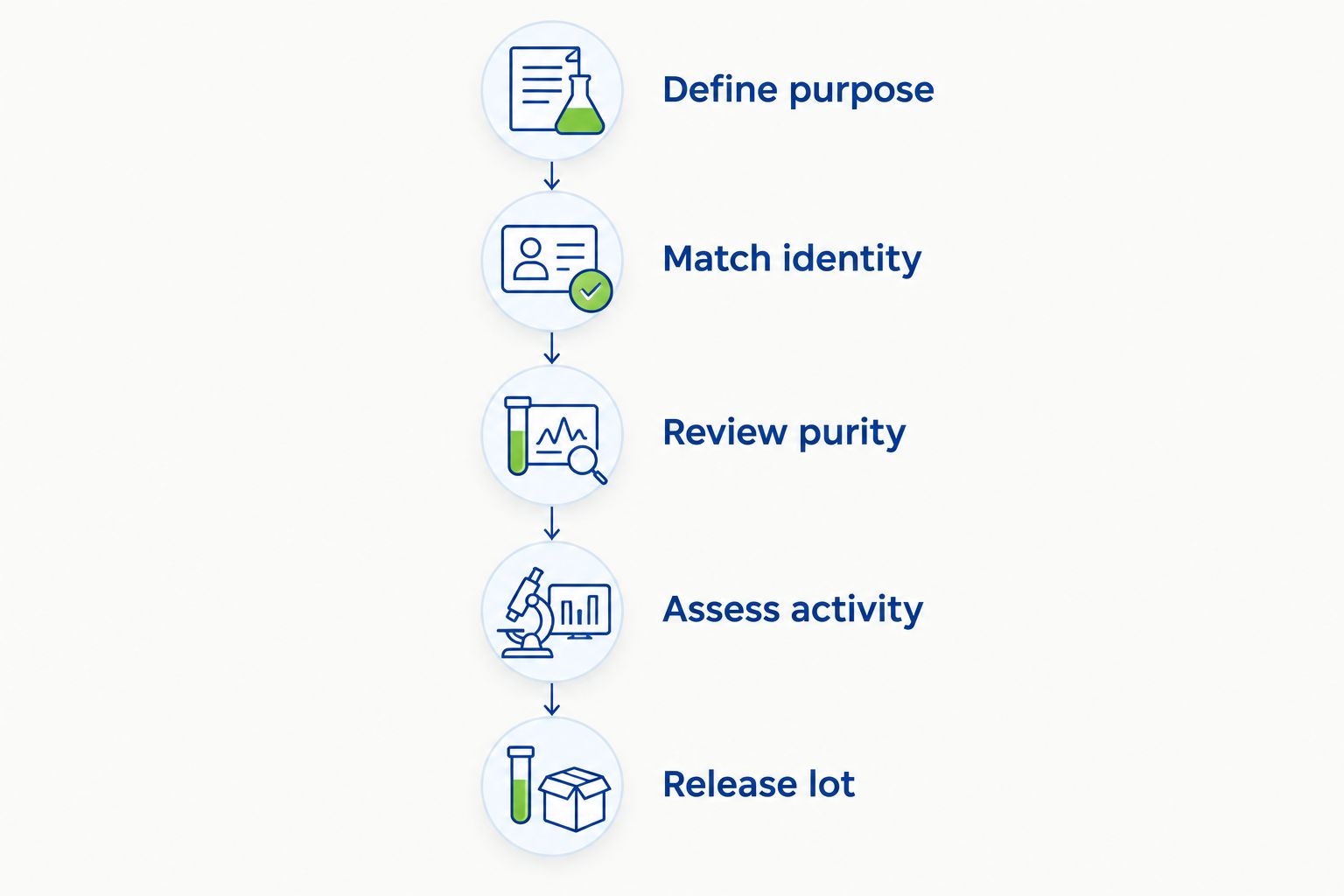
For 2026 procurement, apply the same sequence when changing suppliers or accepting a replacement lot. An earlier purchase decision does not automatically qualify a different material.
Celonyx Labs states that its research peptides are 99%-pure and third-party-tested. Evaluate those claims alongside the method and lot-specific results rather than interpreting the percentage as a complete quality assessment.
Chromatographic area purity describes the relative detector response of integrated peaks under a particular method. It does not, by itself, establish peptide mass content, correct identity, biological activity, sterility, or endotoxin status.
Third-party testing identifies an external testing arrangement; the scope of the report determines what was actually examined. Read the result before deciding which quality question it answers.
The strongest purchasing decision connects each required property to relevant evidence. Keep separate requirements separate, even when a supplier presents them together.
The ranking prioritizes identity, purity, activity, traceability, and handling fit. Lot-qualified material ranks first because it brings the relevant requirements into a single acceptance decision.
The remaining options serve narrower purposes: functional assay development, analytical comparison, and exploratory screening. This is not a claim that any supplier has outperformed another in head-to-head testing.
Choose a lot-qualified IGF-1 LR3 peptide for growth-signaling experiments. Start with the endpoint, then require the evidence needed to interpret it.
Choose activity-qualified material for functional assay development and characterized reference material for analytical comparison. Reserve identity-and-purity-only qualification for work whose conclusions stay within that evidence boundary.
For your 2026 purchasing specification, prioritize a defensible acceptance decision over a longer supplier shortlist. The right reagent is the one whose documented properties match your experiment.
What’s the best IGF-1 LR3 peptide for growth research?
The best choice is a lot-qualified IGF-1 LR3 peptide with identity, purity, traceability, and activity evidence relevant to the experiment. Select against written acceptance criteria rather than a supplier name alone.
Is IGF-1 LR3 the same as native IGF-1?
No. Native mature human IGF-1 contains 70 amino acids, while IGF-1 LR3 contains 83 amino acids and includes an N-terminal extension and an arginine substitution.
Does 99% purity mean an IGF-1 LR3 peptide is biologically active?
No. A purity measurement does not establish biological activity. Functional experiments require evidence relevant to the intended assay and appropriate laboratory controls.
What should I check on an IGF-1 LR3 certificate of analysis?
Check the material identity, lot identifier, testing methods, results, and connection to the supplied vial. Review supporting analytical records and distinguish measured properties from general product claims.
Is third-party testing enough to qualify a research peptide?
No. Third-party testing must be evaluated by its scope, methods, and relationship to the supplied lot. Qualification also depends on the requirements of your experiment.
Can IGF-1 LR3 research peptides be used for muscle growth in people?
Research-use-only IGF-1 LR3 material is not for human administration. This guide addresses laboratory reagent selection, not bodybuilding, treatment, or personal dosing.
Should I use a reference material for a functional assay?
Use a reference material for a functional assay only when its documented properties support that application. Analytical reference status alone does not establish biological suitability.
Keep a comparator when investigating a change in experimental response. Without a suitable reference or previously qualified comparison material, a different result cannot be attributed to the new peptide lot alone.
Record changes in material, preparation, assay conditions, and measurement together. That record is more useful than a purity percentage copied into an inventory field. For research use only.
Choose a follistatin 344 peptide by verified identity and relevant activity. Compare research preparation types,

Choose a lot-qualified IGF-1 LR3 peptide for growth research. Compare identity, purity, activity, and documentation

Choose a PEG-MGF peptide by lot-specific identity, PEG characterization, and assay fit. Compare research sourcing
FOR RESEARCH USE ONLY. Products sold by Celonyx Labs are intended exclusively for laboratory and scientific research. They are not intended for human or veterinary use, consumption, diagnosis, treatment, cure, or prevention of any disease. By purchasing from this site, you acknowledge that you understand the intended research purpose of these materials and agree to comply with all applicable laws and regulations.