

Best Follistatin-344 peptides for muscle research 2026
Choose a follistatin 344 peptide by verified identity and relevant activity. Compare research preparation types,

Best overall: a PEG-MGF peptide with lot-specific identity and PEG characterization. Best for controlled comparisons: matched PEG-MGF and non-PEGylated MGF materials. Best for specification-led studies: custom-synthesized PEG-MGF. This 2026 guide ranks sourcing approaches for laboratory muscle repair research—not treatments, clinical outcomes, or unverified supplier claims.
A muscle repair research question does not make every material labeled PEG-MGF suitable for the experiment. Your selection must connect the supplied molecule to the methods and endpoints in your protocol. A product name alone cannot establish that connection.
Celonyx Labs describes its research peptides as 99%-pure and third-party-tested. Those are supplier-level quality statements, not substitutes for the identity, characterization, and handling information needed to evaluate a particular PEG-MGF lot.
PEG-MGF commonly refers to a PEGylated material marketed in connection with mechano growth factor research. PEGylation attaches polyethylene glycol to a molecule. The label does not, by itself, define the peptide sequence, attachment site, PEG characteristics, or biological activity.
For your 2026 purchasing decision, distinguish three questions: what the material is, how it was characterized, and whether your assay can answer the intended biological question. Keep claims about muscle repair separate from evidence about analytical quality.
Use these criteria before comparing sourcing options:
Purity, identity, and biological activity answer different questions. A purity result does not establish that a material has the intended structure or produces the effect your experiment measures.
These are procurement configurations, not claims that particular suppliers offer equivalent products. The ranking prioritizes interpretability and documentation for a 2026 laboratory study.
| Sourcing option | Best for | Standout feature | Key limitation |
|---|---|---|---|
| Lot-characterized PEG-MGF | Routine studies with an established protocol | Connects the supplied lot to identity and analytical records | Documentation does not establish biological activity |
| Matched PEG-MGF comparison set | Studies examining the contribution of PEGylation | Supports comparison with defined non-PEGylated MGF material | Matching requires more than similar product names |
| Custom-synthesized PEG-MGF | Studies requiring a specified molecular construct | Lets the laboratory define acceptance criteria before synthesis | A completed synthesis still needs analytical acceptance |
Lot-characterized PEG-MGF is the default sourcing choice when your laboratory already has a defined protocol and knows which molecular construct it needs. The purchase decision centers on whether the supplied lot meets that specification—not whether the listing uses familiar terminology.
Ask for records that describe the conjugated material. A report on an unconjugated peptide precursor does not, by itself, characterize the final PEGylated research material.
Best for: Laboratories repeating an established experiment with a defined PEG-MGF specification.
Before accepting a lot, check whether the analytical method addresses the question being asked. Chromatographic purity, molecular identity, and conjugation characterization are not interchangeable. Review the method description and supporting results rather than treating a pass statement as sufficient.
The peptide purity testing guide for contract research organizations provides related context for building your analytical review.
Verdict: Buy only after the lot meets your written identity, characterization, and assay requirements.
A matched comparison set pairs a defined PEG-MGF material with a relevant non-PEGylated MGF material. This is the stronger procurement approach when your question concerns the contribution of PEGylation rather than simply the response to a single test article.
“Matched” needs a written definition. Confirm the peptide sequence and other relevant specifications instead of assuming two similarly named vials differ only by PEG attachment.
Best for: Laboratories investigating differences between a specified PEGylated construct and its relevant non-PEGylated comparator.
Your 2026 protocol should state how comparison quantities are defined. PEG contributes to the mass of the conjugate, so the calculation must use the appropriate molecular specification and documented material content. Do not calculate from an assumed molecular weight taken from an unrelated listing.
Select controls according to the hypothesis. A vehicle control addresses a different question from a non-PEGylated comparator; neither automatically establishes that an observed signal represents muscle repair.
Verdict: Buy for a defined PEGylation comparison; skip it as a shortcut to proving efficacy.
Custom synthesis is the appropriate sourcing route when the experiment requires a construct that must be defined before manufacture. The laboratory specifies the peptide and PEG-related requirements, then evaluates the resulting material against agreed acceptance criteria.
This is a procurement option, not a claim that Celonyx Labs offers custom PEG-MGF synthesis. Treat the synthesis provider's capabilities and deliverables as separate qualification questions.
Best for: Laboratories studying a specifically defined PEG-MGF construct rather than accepting a catalog description.
Write the analytical requirements alongside the molecular specification. Include how identity, conjugation, impurities, and relevant formulation components will be assessed. Resolve ambiguous terminology before commissioning material, not after receiving it.
For a 2026 custom project, keep synthesis acceptance separate from experimental qualification. The former asks whether the requested material was produced; the latter asks whether it performs acceptably in your intended laboratory method.
Verdict: Hold until the molecular specification and acceptance package are agreed in writing.
A useful acceptance workflow follows the material from specification to assay. Each stage should answer a distinct question and leave a record that another researcher can review.
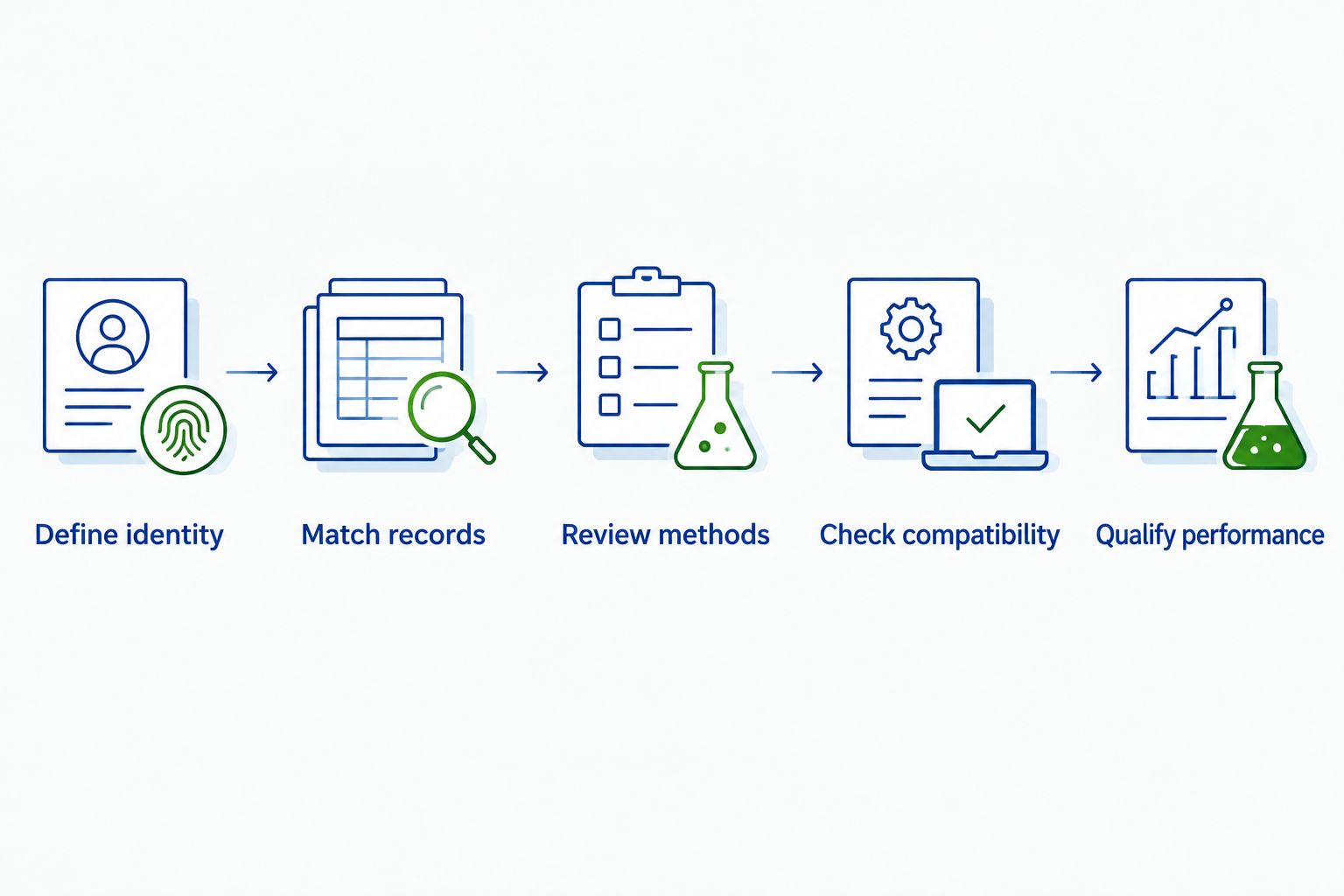
A reported 99% chromatographic purity result is not automatically a statement that 99% of the vial's mass is the intended peptide conjugate. Interpretation depends on the method, detection, integration, and what the measurement includes.
Likewise, an analytical purity result is not a sterility result, an endotoxin result, or proof of biological activity. Request the evidence relevant to your model rather than assuming one quality claim covers every requirement.
Do not assign PEG-MGF a universal storage temperature, solvent, or usable period based on another peptide's instructions. Use the supplied material-specific documentation and your validated laboratory procedures.
Record preparation details in your laboratory notebook. Include the lot, solvent, calculation basis, preparation date, storage history, and deviations that could affect interpretation. Avoid treating an unchanged appearance as proof of chemical integrity.
The ranking uses the criteria above: defined identity, PEG characterization, lot-specific evidence, assay compatibility, controls, and traceable handling. It ranks procurement approaches by their fit to a research question, not by claimed muscle-building effects.
Celonyx Labs' research peptide positioning emphasizes purity and third-party testing. For PEG-MGF peptide selection, those signals belong at the start of qualification; the decisive evidence remains the documentation for the material your laboratory intends to use.
No supplier receives a product-level ranking here. A defensible comparison requires comparable specifications and lot-level evidence, not general brand claims.
Choose lot-characterized PEG-MGF as the default for an established protocol. Move to a matched comparison set when PEGylation is the experimental variable. Choose custom synthesis when the study requires a construct defined in advance.
Celonyx Labs is a research-peptide sourcing option for laboratory researchers who prioritize stated purity and third-party testing. Evaluate any PEG-MGF candidate against your written specification before making a supplier decision.
For 2026 muscle repair research, keep your conclusion narrower than your measurements. A change in a cellular readout is not, by itself, proof of tissue repair, clinical benefit, or suitability for administration.
What’s the best PEG-MGF peptide for muscle repair research?
The best starting point is a PEG-MGF material with lot-specific identity, PEG characterization, and documentation that matches your protocol. Choose a matched comparison set or custom construct only when the research question requires it.
Is PEG-MGF the same as non-PEGylated MGF?
No. PEG-MGF refers to a PEGylated material, while non-PEGylated MGF lacks that modification. Verify the actual sequences and specifications before treating the materials as a matched comparison.
Does 99% purity prove a PEG-MGF peptide is suitable for my assay?
No. A purity result does not establish identity, biological activity, sterility, or compatibility with your assay. Assess each requirement using the relevant method and supporting documentation.
What should I request before selecting a PEG-MGF lot?
Request the material specification, lot-specific certificate of analysis, supporting analytical results, and handling instructions. Confirm that the evidence describes the final PEGylated material rather than only a precursor.
Can I compare PEG-MGF and MGF using equal masses?
Equal masses do not automatically represent equal peptide molar amounts. Define the comparison basis using the documented molecular specifications and material content before preparing the experiment.
Does third-party testing demonstrate muscle repair benefits?
No. Third-party testing supports only the attributes measured by the reported methods. Muscle repair claims require relevant biological evidence and cannot be inferred from a purity report.
Can research PEG-MGF be used by people or animals outside a laboratory protocol?
Research-use-only PEG-MGF is not for human or veterinary administration. Laboratory work must follow applicable institutional approvals, safety procedures, and protocol requirements.
The most useful purchasing question is not whether PEG-MGF is “high purity,” but whether the supplied evidence identifies the material your experiment requires. Keep that question on the acceptance form. It prevents a familiar product label from becoming an unexamined experimental assumption.
All materials discussed are for research use only, not for human or veterinary administration.
Choose a follistatin 344 peptide by verified identity and relevant activity. Compare research preparation types,

Choose a lot-qualified IGF-1 LR3 peptide for growth research. Compare identity, purity, activity, and documentation

Choose a PEG-MGF peptide by lot-specific identity, PEG characterization, and assay fit. Compare research sourcing
FOR RESEARCH USE ONLY. Products sold by Celonyx Labs are intended exclusively for laboratory and scientific research. They are not intended for human or veterinary use, consumption, diagnosis, treatment, cure, or prevention of any disease. By purchasing from this site, you acknowledge that you understand the intended research purpose of these materials and agree to comply with all applicable laws and regulations.