

Best Follistatin-344 peptides for muscle research 2026
Choose a follistatin 344 peptide by verified identity and relevant activity. Compare research preparation types,

Best overall: sequence-defined, activity-characterized follistatin for functional muscle research. Best for analytical method development: a characterized reference preparation; best for construct-specific experiments: a custom recombinant preparation. Choose a follistatin 344 peptide by its documented molecular form and assay suitability—not its name alone. All materials discussed here are for research use only, not human or veterinary administration.
A follistatin label does not establish what a laboratory will receive. Functional muscle research requires a defined reagent, a relevant biological readout, and controls that distinguish target-pathway effects from experimental interference.
Celonyx Labs describes its research peptides as 99%-pure and third-party-tested. Those are sourcing signals, not substitutes for establishing a follistatin preparation’s identity, folding, or biological activity.
For 2026 procurement, rank the evidence supporting the reagent before ranking the supplier. This guide compares three reagent-selection profiles rather than assigning unsupported scores to commercial products.
Use these criteria before comparing candidates:
Treat these as acceptance criteria rather than a points system. A candidate that fails identity verification should not outrank a suitable preparation because its description contains more quality-related phrases.
| Ranked selection profile | Best for | Standout evidence | Key limitation |
|---|---|---|---|
| Activity-characterized follistatin | Functional muscle-pathway experiments | Defined molecular form plus relevant functional results | Activity must be interpreted within the reported assay |
| Characterized reference preparation | Analytical method development and identity comparisons | Documented identity and method-relevant characterization | Reference status does not establish biological potency |
| Custom recombinant preparation | Construct-specific mechanistic experiments | Explicit sequence boundaries, tags, and expression specifications | Requires a separate qualification plan |
These are procurement profiles, not interchangeable grades. A preparation can fit more than one profile, but you should select it for the evidence your experiment needs.
Human follistatin is a protein, although commercial searches often describe it as a peptide. The human FST344 precursor contains 344 amino acids. Removal of its 29-amino-acid signal peptide produces the 315-amino-acid mature form, commonly called FST315.
UniProt’s reviewed human follistatin entry, P19883, documents the precursor sequence and signal-peptide processing. These distinctions matter when a supplier uses precursor terminology to describe an expressed or processed preparation.
Do not assume that a vial labeled FST344 contains an intact precursor, a mature protein, or a particular recombinant construct. Ask for the actual sequence and expressed boundaries before assigning an experimental identity.
For a 2026 materials record, enter the catalog description and the verified molecular form separately. That prevents a familiar product label from becoming an inaccurate methods statement.
Follistatin binds activin-family ligands, including myostatin, and is relevant to investigations of muscle-regulatory signaling. That biological context does not make every follistatin preparation equivalent or establish an effect in a particular experimental model.
A chromatographic purity result describes the analyzed sample under the stated method. It does not independently demonstrate correct folding, target binding, functional inhibition, sterility, or suitability for administration.
Purity is a quality attribute, not a complete definition of a functional reagent. Keep those decisions separate when reviewing a candidate certificate.
An activity-characterized preparation combines a defined molecular identity with evidence from a relevant biological assay. This is the default selection profile when your question concerns follistatin-mediated changes in a muscle-regulatory pathway.
The decisive evidence is not simply that an activity test exists. You need to understand its ligand, biological system, endpoint, controls, and relationship to your experiment.
Best for: Cell-based or biochemical experiments in which a functional follistatin response is central to the research question.
Before accepting a candidate, compare the supplier’s functional endpoint with your planned endpoint. A binding result and a cell-signaling result answer different questions; neither should be relabeled as the other.
For 2026 functional studies, retain the reported assay conditions alongside the lot documentation. A potency statement without its experimental context is difficult to use as a reproducibility reference.
Verdict: Buy only after molecular identity, relevant activity, and assay compatibility pass your laboratory’s acceptance criteria.
A characterized reference preparation provides a documented comparison material for a defined analytical purpose. Its value depends on how its identity, composition, and relevant measurement properties were established.
Use this profile for analytical method development, identity checks, or comparisons between candidate preparations. Do not treat a research reference preparation as a certified reference material unless its documentation explicitly establishes that status.
Best for: Laboratories developing identity or purity methods before interpreting functional experiments.
Set the comparison question before choosing the material. Confirming an expected molecular identity is different from assigning protein concentration or comparing chromatographic profiles, and each requires appropriate evidence.
The guide to peptide reference standards for analytical research provides a related framework for evaluating comparison materials. For follistatin, also account for its protein structure and the molecular form under study.
Verdict: Buy for a defined analytical purpose; hold off on functional claims until activity is separately established.
A custom recombinant preparation suits a question that requires specified sequence boundaries, a particular tag, or another explicitly defined construct feature. The construct itself becomes part of the experimental design rather than a background purchasing detail.
This profile is appropriate when an ordinary catalog description cannot specify the material your hypothesis requires. Custom production does not remove the need for identity, purity, and functional qualification.
Best for: Mechanistic experiments in which a defined molecular feature is the variable being investigated.
Specify the acceptance package before commissioning the material. Include the intended identity evidence, relevant characterization, formulation requirements, and functional question rather than requesting an undefined “research-grade” product.
Verdict: Hold until the construct specification and qualification plan directly match the hypothesis.
The ranking follows experimental purpose: functional evidence comes first for functional studies, analytical characterization comes first for measurement work, and construct control comes first for sequence-specific questions.
This is not a supplier-performance ranking. It does not assign unverified activity, documentation, or follistatin-specific attributes to any retailer.
Celonyx Labs research-peptide claims should be evaluated at the same level as any candidate’s claims: against the exact material, lot, and intended laboratory use. The best follistatin preparation is the one whose documented identity and performance match your experiment.
Use a documented sequence of checks before releasing a candidate preparation for experimental use. Keep the decision tied to the material you receive, not just the page from which it was selected.
Record the species, sequence, mature or precursor designation, construct boundaries, and tags. Resolve discrepancies between the catalog label and the supporting documents before assigning an identity in your inventory.
Match the lot identifier across the vial, certificate, and analytical reports. Record which tests were performed, what each test measures, and which acceptance criterion it supports.
Check the formulation against the experimental system. Establish whether the available activity evidence addresses the planned ligand and readout, and identify the controls needed to interpret the result.
Approve the material only for the purpose supported by the evidence. Keep unresolved questions out of experimental conclusions rather than treating an unverified assumption as a reagent property.
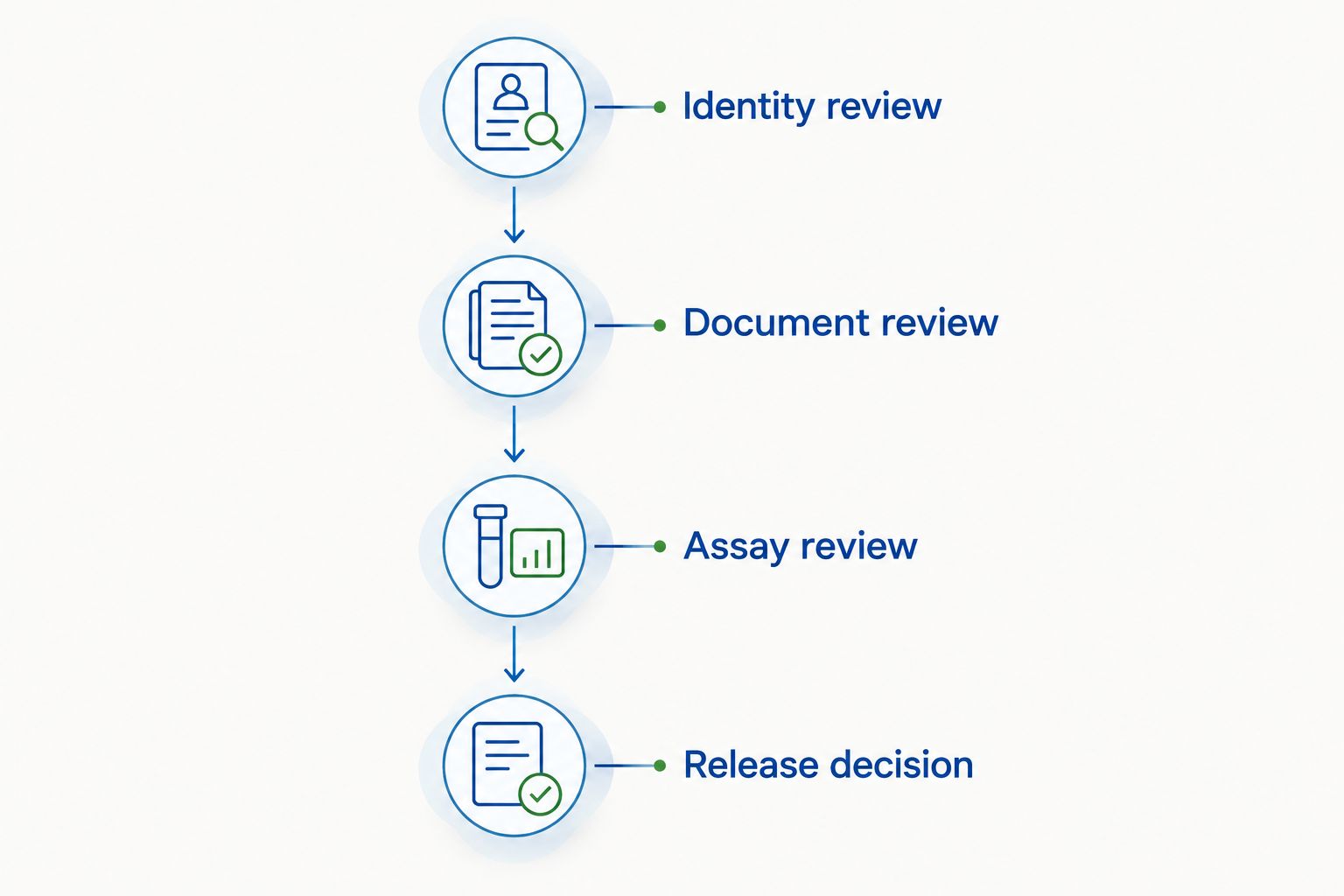
A release decision is purpose-specific. Material accepted for an analytical comparison does not automatically qualify for a functional assay, and a functional result does not certify every other quality attribute.
Choose sequence-defined, activity-characterized follistatin as the default for functional muscle research. Choose a characterized reference preparation when the main question is analytical, and choose a custom recombinant preparation only when a specified construct is necessary to test the hypothesis.
For 2026 sourcing, stop comparing candidates when a critical identity question remains unresolved. A larger collection of marketing claims cannot compensate for an undefined molecular form.
If you are considering Celonyx Labs for research-peptide sourcing, use its stated purity and third-party testing as starting criteria. Require preparation-specific evidence before treating those general quality signals as support for a follistatin experiment.
What’s the best follistatin 344 peptide for muscle research?
For functional muscle research, the best selection profile is sequence-defined follistatin with relevant activity characterization. Choose the actual molecular form and supporting evidence rather than relying on the FST344 label.
Is follistatin 344 the same as follistatin 315?
The names refer to related but distinct molecular descriptions: human FST344 is a precursor, while FST315 is its mature form after signal-peptide removal. Verify which sequence and expressed boundaries describe the supplied material.
Does 99% purity prove that follistatin is active?
No. A purity result does not independently establish correct folding, ligand binding, or biological activity; those questions require suitable characterization and functional evidence.
Is a reference preparation better than activity-characterized follistatin?
A reference preparation is better suited to its documented analytical purpose, not automatically to a functional experiment. Use activity-characterized material when biological function is the primary question.
What should I check on a follistatin certificate of analysis?
Check the material identity, lot identifier, methods, reported results, and their connection to your acceptance criteria. Obtain supporting information for molecular form, formulation, and relevant activity rather than assuming the certificate establishes them all.
Can research follistatin be used for bodybuilding?
No. Research-use-only follistatin is not for human administration or bodybuilding, and laboratory findings do not establish a safe or effective human-use regimen.
Should every laboratory use the same follistatin reconstitution method?
No. Follow instructions specific to the preparation and confirm compatibility with the intended assay. Different molecular forms and formulations require separate handling decisions.
A label containing “344” does not necessarily mean the supplied material contains an intact 344-amino-acid precursor. That naming distinction can change the identity written into your methods before the experiment even begins.
Add the verified sequence designation to your materials record now. For research use only; not for human or veterinary administration.
Choose a follistatin 344 peptide by verified identity and relevant activity. Compare research preparation types,

Choose a lot-qualified IGF-1 LR3 peptide for growth research. Compare identity, purity, activity, and documentation

Choose a PEG-MGF peptide by lot-specific identity, PEG characterization, and assay fit. Compare research sourcing
FOR RESEARCH USE ONLY. Products sold by Celonyx Labs are intended exclusively for laboratory and scientific research. They are not intended for human or veterinary use, consumption, diagnosis, treatment, cure, or prevention of any disease. By purchasing from this site, you acknowledge that you understand the intended research purpose of these materials and agree to comply with all applicable laws and regulations.